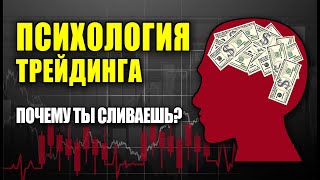

Two Traders, Same Trade: Discipline vs Panic
54sThe vivid contrast between a calm disciplined trader and a panicking one is instantly relatable and shows why emotional control makes or breaks your account.
▶ Play Clip"Delivers a clear, practical guide to trading psychology; only a short Telegram plug keeps it from a higher score."
This video explains why trading psychology and discipline are the true foundation of trading success. It contrasts disciplined and undisciplined traders, outlines emotional traps such as fear, greed, and tilt, and offers practical solutions including a trader's diary, stable risk management, and a three-step assignment.
Trading is not only market analysis but constant self-work. Without emotional control and a clear system, a trader becomes a gambler rather than a professional.
Two traders open the same trades. The disciplined one follows the algorithm and takes profit or loss; the undisciplined one moves stop-losses and exits early, ending with losses and panic.
After a series of losses, a trader increases risk two or three times to win back money. This is extremely incorrect thinking and leads to the deposit disappearing faster.
Fear causes missed opportunities and panic selling; greed makes traders wait for more points until price reverses; hope keeps losing positions open; tilt is anger and aggression toward the market.
The market is indifferent to the trader, so no emotions should accompany a trade from beginning to end. Revenge and euphoria are pointless.
Traders rush into moves without checking conditions or higher timeframes. Even experienced traders can deviate from their written plan, which is an impulsive trade.
Risk per trade must always be stable; changing it per transaction is forbidden. Trading without a stop-loss is absolutely forbidden unless you are an investor averaging spot positions.
Losses are the price of the profession. Trying to compensate them right away leads to bigger losses; over the long term, accepting them leads to profitability.
Write down what you felt before each deal. Honest self-analysis reveals patterns and is one of the most powerful tools for discipline, psychology, and growth.
Filter information noise, use a strict entry/exit algorithm, limit the number of trades, analyze errors regularly, and keep balance between life and trading to avoid burnout.
Psychology and discipline are your stability; without them you are just statistics in a broker's report. Follow a clear plan, accept losses, control emotions, and the market starts working for you — because trading is chess, not a casino.
What is the basis for a trader's success according to the video?
Psychology and discipline.
00:01
What does a trader become without emotional control and a clear system?
A gambler or a political forecaster, not a professional.
00:29
Which emotions commonly prevent traders from achieving stable profit?
Fear, greed, hope, tilt, euphoria, and the desire to win back.
02:45
What is 'tilt' in trading?
Anger, aggression, and a desire to take revenge on the market.
03:30
What is the rule about risk per trade?
It must always be stable; you cannot change risk per transaction.
06:02
According to the video, when is trading without a stop-loss acceptable?
When you are an investor on spot building positions and averaging; this is investing, not trading.
06:19
Why should losses be accepted?
Losses are the price of the profession; trying to compensate for them immediately leads to larger losses.
06:47
What is a trader's diary used for?
It is your psychologist: write down what you felt before each trade and find behavioral patterns.
07:54
What are the three points of the practical assignment?
Write an entry/exit checklist, start a trader's diary with emotion and discipline analysis, and create a daily routine including trading, analysis, and rest.
10:35
Psychology and discipline are the foundation
Reframes trading as continuous self-work rather than market analysis alone, making it the central thesis of the video.
00:01The disciplined vs. undisciplined trader contrast
A concrete example showing that the same trades yield opposite results depending on whether the trader follows rules.
00:43The market doesn't know you exist
A memorable reminder that revenge trading and emotional reactions are pointless because the market is indifferent.
03:30Losses are the price of the profession
Stops traders from trying to recover losses immediately, a core principle for long-term profitability.
06:47The three-step practical assignment
Gives viewers an actionable starting point: checklist, trader's diary, and daily routine.
10:35[00:01] trading. How to overcome these emotions and become a disciplined trader. So, why is psychology and discipline in general the basis for any trader’s success? Yes, a trader, of course, and in general, trading is not only about
[00:15] market analysis, it’s about constantly working on yourself, right? You can't do this without nerves of steel and your composure. Psychology in general will determine how we react to the market, and discipline will determine how much we follow our rules. And
[00:29] every wrong puck, and you are not a trader, but already a gambler. So, without emotional control and a clear system, a trader becomes a political forecaster, not a professional. A few examples, yes,
[00:43] to make this situation a little worse, so you understand what the harbingers of problems are, right? Imagine there are two traders. They opened the same trades, yes, and the first one will strictly follow his algorithm. He will
[00:56] either get his take profit or accept the loss. And the second one starts to rush around, moving his stop loss. So the movement went against him a little bit, he already moved the stop-loss to breakeven, yes, then, where there will be
[01:11] some kind of imbalance, he closes it to breakeven, and the price moves calmly without him. God forbid it increases the risk even more. Now, if the price is moving in the opposite direction, yes, and he thinks that now everything will reverse and
[01:23] loses even more. Bottom line: one sleeps peacefully, while the other is googling how to sell his soil. So be on the right side. Another example. The trader suffered a series of losses and decided to get his money back. This is all around here. Ah, and
[01:38] he increases his risk by two, three times. I'll add to this story, even his thoughts, yes, here he is like this , well, this is exactly 100% of 1,500 , well, this is exactly 100% of 1,500 options that this situation will work out,
[01:52] because I'm confident in it or some mentor sent it to me. Here. And here I will now increase the risk, earn more, and immediately beat off my previous
[02:04] stop losses. Extremely incorrect thinking. Ah, and I open trades without clear confirmation. or a signal according to your trading strategy, right? And what is the result? Of course, the deposit disappears even faster than you can
[02:18] say: “I didn’t know it would happen like this.” Yes. And instead of stopping and analyzing his mistakes, the trader rushes into a new battle. Yes, but the market will always be merciless to these emotions. What's more, he doesn't even know
[02:31] emotions. What's more, he doesn't even know you exist. Here. And it will act as needed. Here. Therefore, no emotions should accompany the transaction no emotions should accompany the transaction within the transaction, but from the beginning to the end.
[02:45] We'll cover two typical challenges so you understand what a trader typically encounters on their path to becoming a professional. So, what emotions generally prevent a trader from achieving a stable profit? Yes, fear. This is what is meant by the
[02:59] fear of opening a position, right? My hands are shaking, my finger is hovering over the buy button. The result: constantly missed opportunities, yes, or panic selling at the minimum, or where you don’t receive your profit, there, let’s say,
[03:14] one in three. Greed, yes, when just a little bit more , just five more points, and instead of going into the plus, the price reverses. Here. And will Nadezhda really turn around now? Of course not. Holding on to losing positions, yes,
[03:30] turns trading into a prayer. Tilt is a very common moment, yes, when you have anger, aggression, a desire to take revenge on the market. Spoiler alert: the market doesn't know you
[03:42] exist. Yes, that's a fact. The euphoria of being a market god after a couple of successful deals. And the next deal usually puts everything in place. This is a fact. The desire to win back is, of course, a road to the abyss, leading to the constant draining of
[03:57] deposits. Friends, an important point. We have a free Telegram channel where we publish educational content on SmartMoney trading every day. These materials are available only in our Telegram channel.
[04:11] Here are some tips and life hacks that you won't find on YouTube. Here we regularly publish content on trading psychology and show how to correctly open profitable trades. We periodically publish lists of promising coins for
[04:24] trading and provide tips on where to enter a trade and where to lock in profits. If you want to make trading a source of steady income, then subscribe to our Telegram channel. The link to the channel is now on the screen, as well as in the description below
[04:38] this video. Subscribe and let's trade together. So, let's move on. Disciplinary errors. What errors are there in general? Yes, lack of a clear plan. If there is no strategy, you are simply reacting to chaos.
[04:53] Impulsive trades, yes, you see a move and rush into the market without checking the conditions. I had a similar moment once, but I identified it in time , which happens, that is, I have enough experience, I have a trading strategy
[05:06] , uh, but you sit down to analyze and see: "Damn, right now there is some saw it at this moment, there are excellent targets, so don't go in." And this falls under the category of impulsive trades, but you, ah, didn’t look at the higher
[05:22] time frame, you didn’t look at your other instruments, if you use anything else, you understand? That is, it turns out that you are deliberately deviating from your analysis plan , because you do not see the big picture. Yes, sometimes such
[05:35] positions, quick response, because flexibility in trading is also necessary , this is not a template topic, in fact, then impulsive transactions also, it turns out, are related to the nature of the system, do you understand? You are moving away from your
[05:47] system, which you had written down in advance. This is such a moment. Deviation from risk management. I don’t know, maybe someone has, uh, but I have n’t heard this for a long time, but you know, this, of course, can’t be done and it’s not allowed, uh,
[06:02] to change the risk per transaction, yes, more in this one , less in that one. That is, it must always be stable. Here. Well, this is an extraordinary case. In general, trading without a stop is absolutely forbidden, of course. Unless you're an investor,
[06:19] trading on spot, building your positions there, averaging, and so on. This, but this has nothing to do with trading, this is investing. This is called sitting out losses or early exit, yes, when instead of the planned
[06:31] take profit, you close with a minimal plus or, God forbid, sit out losses. So, here are the solutions. Accepting losses is the price of this game, the price of this profession. And without them, well, you can’t go anywhere.
[06:47] Here. The main thing is not to try to compensate for them right away. You will still end up in the black over the long term . I also know from my own experience that the next day you will be truly more productive. You will look at the market with a different perspective, from a
[07:01] different angle, and make a better decision. But in general, and as a you were caught somewhere by manipulation or simply had an incorrect analysis, then tomorrow everything will be better. Even if not tomorrow, then the
[07:15] better. Even if not tomorrow, then the day after tomorrow. This is emotional control. You can use some breathing techniques, yes, sports, good sleep, some kind of sauna, yoga, anything . At least meditation in front of the monitor,
[07:28] if that helps. That is, find some key of your own, something that will make your emotions calmer, more measured, right? That is, you should not have a thirst to make money, but a thirst to win back. No, you should have
[07:41] only one thirst. Find a good setup and trade it correctly. All. The only thirst you should pursue throughout the day. Nothing more. Here is constant self-analysis, yes, according to psychology. A trader's diary is your
[07:54] psychologist. Write down what you felt before the deal, and you will find patterns afterwards. So, even if you're leading him there for two weeks, you obviously just need to be honest with yourself. You will have standard errors. I was hasty, this was not my
[08:07] analysis. there was not sufficient grounds for entry and so on. And from here you trading strategy lie. So it improving here and systematizing yourself. That's why a
[08:21] trader's diary is one of the most powerful tools in terms of discipline and psychology. And as a consequence of your growth as a trader. Do you understand? Because if work. Not so that you could look at the statistics, they
[08:37] dumped it somewhere and that's it. No, this is your internal tool, you must work with it constantly. Information noise filtration. Here. Read less analytics on Telegram and trust your system more. This is in psychology, yes, in discipline. Strict
[08:50] entry and exit algorithm. So I saw the setup, went in, didn’t see it, went to drink tea. Limited number of transactions. Trading is not a click marathon, yes, work on
[09:02] quality, not quantity. From here, by the way, such a moment will be built, which I also noticed is different for everyone. That is, look, our . For some people one amount is enough, for others another. Here. Eh,
[09:17] very convenient. That is, in this right there is freedom, so to speak, of regulation, because you can build your day, and, as a consequence, your life, yes, from the quantity that will intersect with the greatest quantity in
[09:33] quality. Regular analysis of errors. Failures are your lessons. There's no need to perceive them as, well, just the loss of a deposit, yes, and not a reason to go on a drinking binge. The balance between life and trading is everything to us. Well, uh, if the market has become
[09:50] the center of the universe, you're in danger. Rest, distract yourself, otherwise you will burn out. So, the conclusion is that yes, psychology and discipline are your stability, yes, without this you are not a trader, but statistics in a broker's report. Just
[10:05] think about it too. And having your emotions under control means fewer losses for you. Logic always wins over feelings . Oh, and trading is a way of life. You're not just pressing buttons, you're building a system of thinking, and yes, I would
[10:20] add the added bonus of actions. So how should you think, what should you do, right? Just follow a clear plan, and then the market will start working for you, not you for it. This is also actually a pretty useful idea. So,
[10:35] I want to give you a little practical assignment. Ah, write a checklist of entry and exit, don’t trade without it , in principle. Enter a trader's diary with an analysis of emotions and discipline. stop-loss, I just have a comments column, I immediately write there why
[10:51] they happened at that moment. Create a daily routine that includes trading, analysis, and rest. Just three points, guys, just do it. Well then, guys, just do it. Well then, live with this for a month and if there is no
[11:06] result, I don’t know what, well, there definitely should be, something will definitely change for the better in you . And remember, trading is chess, not a casino. Manage your emotions, act systematically, and may
[11:19] your emotions, act systematically, and may you always have a profit.

⚡ Saved you 0h 11m reading this? Transcribe any YouTube video for free — no signup needed.