Full Transcript
[00:00] This is a dish you could hear coming from a mile away. The whole restaurant would stop, heads turning, following this delicious sound and this intoxicating aroma as it floated through the dining room.
[00:13] In a world filled with Instagrammable dishes, things made for the photo, this dish announced it's arrival like a train screaming into the station. But in the 90s, short of a Habachi restaurant,
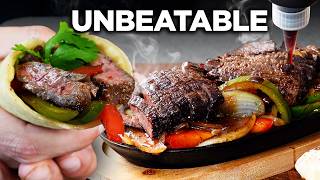
[00:25] this was as much of a spectacle as you were going to get. And I'm going to share with you the secret to that iconic sizzle at home. This is sizzling steak fajitas. Yeah, I'd like 6,000 chicken fajitas, please.
[00:38] Now, to me, the number one way to improve any steak at home is preparing it in advance. It gives you better flavor, better texture, and a better crust. And since these are super thin, we need them super dry
[00:50] so we can get a super nice crust fast. So you can start this earlier in the day or like me, do it one to two days in advance. We start with a whole skirt steak, which is one of the longer cuts of meat you can buy.
[01:02] And we need to take this lengthy piece of meat and process it into smaller pieces. I want them in about three to four-inch pieces. Cut with the grain so that once they're cooked, we can cut them across the grain
[01:15] and we'll end up with perfect little slices of beef fajitas. It means stripped. So the idea is everything is kind of cooked in a strip. The amount of pieces you yield will depend entirely on the size of the skirt steak you buy.
[01:27] So now we have our portions. Some skirt steaks can be a bit thick. If you encounter that, you could slice them in half and yield a thinner piece of meat so that it cuts into a nice fajita slice once it's cooked.
[01:41] Or you can just keep them thick if you prefer, it's up to you. Set those off to the side while we make our seasoning rub. In a bowl, we're going to add about two tablespoons of chili powder followed by one tablespoon of cumin,
[01:54] one tablespoon of coriander. Those two are a pair I always add. Another pair is one tablespoon of garlic powder and one tablespoon of onion powder. To add some tang, I add about a teaspoon of citric acid.
[02:06] It's kind of like powdered vinegar so it gives a nice tang almost like a marinade wood without the liquid. And then we finish with a bouillon cue. We're going to get that mixed in together with a little bit of black pepper and that's going to be our seasoning rub.
[02:19] Back to the meat. I'm going to spray each piece of meat with a little bit of olive oil spray to act as a binding agent for our spices. Then I'm going to season each piece with salt. I prefer salting separately from the rubs
[02:31] to make sure each piece is properly seasoned. Next, we're just going to coat each piece with the rub using our hand to spread and rub it into the meat on each side. Then we're going to place that in a fridge uncovered and that takes us to today.
[02:44] So I just pulled these out of the fridge, allow them to come to room temp while we prep everything else. Red bell pepper, green bell pepper, one onion, few cloves of garlic. Now, remember what I said. Fajita means slices. So everything gets cut into slices.
[03:04] Onion pretty easy. Pick the root in the top off. Got in half. Put a little layer or two of that paper off. Then we're going to take the onion like this and we're going to cut around in slices. Following the curvature of the onion.
[03:17] As I come around top, I start straightening the blade out and I get to about here, I push it over, do the same thing. We're just going to slice the garlic out. Next up, we need to make a little quick guacamole.
[03:31] So I've got an avocado here. Come down to the bottom and test. If that's soft, that's the last place to sort of get soft. So that's when you know it's ripe. I also look for this nub right in here to be intact. Otherwise, if it's open, then that's what allows air in there
[03:46] to get it oxidized. So let's see how we did about this two days ago. There's a little firm when I got it, pretty good. A couple dark spots, but it's a pretty good looking avocado. Gonna microplane a little bit of garlic in there.
[03:59] Just one clove should be enough. Then to that, some lime juice. It shouldn't mellow out that garlic and prevent the avocado from oxidizing further. And we're just going to mash a little more salt.
[04:13] I'm just going to chop roughly fresh cilantro. I like them kind of rough. I'm just going to fold that in. And now you could add some more stuff to that. jalapenos, a little onion, a little tomato. But at your basis, that's incredible guac really quick.
[04:28] I'm just going to keep that covered and cold until we're ready to use it. I'm going to press the plastic down. So no oxygen gets in. Last but not least, we have our sizzle sauce. This could be anything from water to just a little bit of oil,
[04:43] but I like this sort of blend of soy sauce, lime juice, and a little bit of oil. So in a little squirt bottle, I'm just going to go in with some soy. This adds a little bit of that umami to it, you know? Lime.
[04:56] A little bit of oil. Tossed on at the very end for that sizzle. Now we've just got about everything set. Usually I would make our flour tortillas. I have plenty of videos on those. But one of my favorite spots, stew linards,
[05:08] started making them fresh every day along with apple cider doughnuts. So why would I make them? I figured I'd give my arm a break, but we still got problems. So these are real beautiful tortillas.
[05:21] Nice and fresh. These are going to work just fine. The other piece is a sizzle platter, of course. Now one thing you got to understand about this recipe is everything's going to be like as hot as possible. This is a hot, fast, violent, reactive dish.
[05:34] So I'm going to get this onto the stove. I'm going to get that preheated. Starting on low and when we get towards the end, we'll start to jack it up and get that nice and hot. I've got a big pan here. This is getting preheated on the stove as well.
[05:47] So first thing we're going to do is cook our steak. It's different than we would do chicken fajitas where we might do it all together. We're going to cook the steak perfect and then present it on top of everything. Now before we go any further, I just did a little bit of international travel myself.
[06:01] And for me, one of the pain points of international travel is access to quality and reliable internet. But thanks to our sponsor today, Sally, I can just quickly download the Sally app, purchase an ESIM in over 200 places around the world
[06:15] I can stay connected without any hassle. ESIMs are digital SIM cards that work without needing to put anything into your phone. No more swapping physical SIM cards, no more scammers selling you fake SIM cards at the airport.
[06:27] With Sally, just choose a data plan, install it on your phone and you're all set. You'll have the internet wherever you go without expensive roaming fees. With Sally, you only need to install an ESIM once, eliminating the need to install a new ESIM
[06:41] each time you travel and for each country. Sally has different size, the affordable data plans, including unlimited data in over 200 destinations. They also have global and regional plans in case you're planning on visiting several countries
[06:55] in one trip. Sally will notify you when you've used 80% of your data so you can re-up in a few clicks easily if you need. And they've got chat support 24-7, so if there's any issues, you contact them, they'll sort it out.
[07:07] They've also got built-in ad blockers so you don't have to deal with nonsense while you're just trying to enjoy a vacation. And with travel season coming up and to make sure you stay connected, Sally's giving you guys an exclusive 15% discount
[07:20] on Sally, ESIM data plans. Download the Sally app, use the code and ACS at checkout and enjoy your vacations. Let's get back to the recipe. Now to cook these steaks, I've got my largest widest frying pan.
[07:33] It's been heating up for a few minutes now. Pan's hot, we're gonna add some oil and then check the temp. It should be around 400, 4.5. These are super, super thin steaks. So we need to cook them super hot and super fast.
[07:47] We're gonna add in about four steaks at a time in this pan this size and we're gonna get some weights on them and we're going to cook them on that first side for roughly around two minutes.
[07:59] No more. Any more, you're gonna rebootally overcook the steaks. There'll be like a tiny gray band and then a thin layer of medium in the center due to how thin the steaks are.
[08:12] After two minutes of cooking, we're gonna remove the weights and we're going to flip them and we're gonna cook them on the other side for maybe a minute, maybe two minutes. Total cook time, four minutes, anything beyond that,
[08:24] you're gonna really overcook these steaks. But we've got a nice crust and get them off the heat and I'm gonna let them rest. Then to the hot oil, we're gonna add in our sliced onions. Fill up the pan, season them with some salt
[08:37] and get them coated in that oil and starting to soften and pick up all the flavors in the pan. Once they've browned and softened a little bit, then we can go ahead and add in our peppers, season those peppers up.
[08:50] And then we're looking for some char on these vegetables. We're gonna cook them hot again. To me, fajitas are all about high heat, blistering and charring in the vegetables. And that's sort of what we're looking for. While the peppers and onions are cooking down,
[09:03] I'm gonna start throwing some tortillas on an open flame, flipping them every few minutes to get them nice and toasted and prepared for plating. Now once those peppers have started to soften up a little bit,
[09:15] then we can go ahead and we can add in our sliced garlic and we can begin to marry all those flavors together. We're less looking to caramelize the onions and we're more looking to fry all the vegetables up. After about five minutes or so of cooking,
[09:28] those onions and peppers are nice and soft, we're going to deglaze the pan with a little bit of the sizzle sauce we made to get those flavors into the pan. It's gonna coat the vegetables, pick up some of those good bits off the pan
[09:40] and then we're gonna push that off to the back burner and let those just sort of stay warm while we move our sizzle platter over to the heat and get that super heated while finishing up toasting the rest of our tortillas.
[09:53] And once your tortillas have warmed up and puffed up, then we can take a towel and we can just sort of steam them in the towel while we make our way through warming up all of the tortillas.
[10:05] Before we fill up the sizzle platter, we just need to slice our steaks. So now you're gonna see what I mean, right? The grains are running this way. We're going to simply cut strips. Super thin, right?
[10:17] So you have a little gradient, nice medium in the middle, a little gradient on the inside, perfect for fajitas. Back to our sizzle platter now should be smoke and hot, maybe around like 500 degrees.
[10:29] And you can start to add in a fried up onions and peppers. Then just drop a few of those steaks on top to cover the onions and we're gonna transfer it over to the wood that it sits on and hit it with that sizzle sauce.
[10:44] Finish on top with some fresh cilantro. So now it's a build. We go down with some glauque and sour cream. A little bit of the cheese.
[10:56] A little bit in there, a little cilantro, some jalapenos, then all you do is fold one side in. And then just roll it up.
[11:12] See no pulling of steak after a bite. It's just super tender. Now the problem with the restaurant is the fajitas smelled and appeared really delicious, but they were always underwhelming. This is something else.
[11:24] We added no acidity to the dish whatsoever. All we added with that little acidity of the lime juice in the sauce and that citric acid on the meat. And I get a really nice balanced acidity throughout the dish. The vegetables have that char and a tender
[11:37] and not like raw, like sometimes you get them when they cook them too fast. Overall, incredible flavor. So the recipe is gonna be down in the description. It's all that I have today. I will see you next time. Until then, take care yourself.
[11:51] Go feed yourself. Go feed yourself.