AI Summary
This video explains the mechanics behind self-siphoning devices used in urinals to flush periodically. It highlights a common flaw in automatic siphons when water fills slowly and presents a clever design that overcomes it using an inner chamber and small air inlet.
Chapters
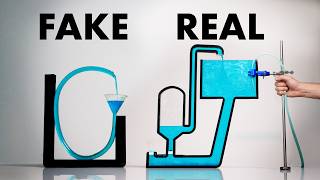
A simple automatic siphon empties a container when water rises above its top, but fails when filled slowly due to lack of a seal.
When filling slowly, the siphon doesn't prime because air can escape before a seal forms, causing the container to empty slowly.
In public restrooms, urinals use siphons to flush periodically, and they are all connected to a common system to synchronize flushes.
The mechanism solves the slow-fill problem by using a thinner inner chamber and a small hole that traps air, ensuring a seal even at low flow rates.
Using slow motion footage, the video shows how the inner chamber fills, air escapes through a hole, and water levels equalize, leading to siphon initiation.
Initial test had a flaw where water level didn't change; adjustments were made to the heights of the channels to achieve proper operation.
A narrow channel allows water to slowly fill, and when it tips over, a small hole prevents backflow, causing the main siphon to prime via trapped air.
The 3D version includes a box, copper pipe, and U-bend. The primer siphon feeds into the main siphon, ensuring reliable periodic flushing.
The video successfully demystifies a clever mechanical timer that uses water pressure to flush urinals periodically, showcasing an elegant solution to a common engineering problem.
Mentioned in this Video
Study Flashcards (3)
What is the main flaw of a simple automatic siphon?
easy
Click to reveal answer
What is the main flaw of a simple automatic siphon?
It fails to prime when the container is filled slowly.
00:17
How does the inner chamber design overcome the slow fill problem?
medium
Click to reveal answer
How does the inner chamber design overcome the slow fill problem?
A narrow channel and small hole trap air, creating a seal even when filling slowly.
02:11
What happens if the hole for air escape is too large?
hard
Click to reveal answer
What happens if the hole for air escape is too large?
Air would bubble through, and water would trickle without forming a proper seal.
05:24
💡 Key Takeaways
Slow Filling Reveals Flaw
Demonstrates a real-world limitation of a simple siphon that many might not consider.
00:59Clever Engineering Solution
Shows how a simple addition of an inner chamber and small hole solves a significant problem.
02:11From 2D to 3D
The transition from theoretical model to actual working device illustrates practical engineering.
07:08Full Transcript
[00:01] It's an example of an automatic siphon but I am already a huge fan of automatic siphons. so when the water level rises above the top of the siphon,
[00:17] and the container empties itself. to add binary numbers together, for example. that automatic siphons have a huge flaw.
[00:31] Instead of the siphon priming, no seal is created, narrower so that even if you're filling
[00:46] will ensure that there is a seal out of the container very slowly. that you fill very slowly,
[00:59] You might think that's a very niche requirement, Look, I'm very slowly filling this container, suddenly the whole thing starts to empty very quickly
[01:13] and what you're looking at here is a urinal siphon. you'll be familiar with that moment suddenly start flushing at the same time.
[01:26] such a poorly maintained amenity for this shot. whilst I was filming a urinal until it did the flush thing, This simultaneous flushing thing
[01:41] but the idea is instead of each urinal they're all connected to the same system And if you want a container to empty periodically,
[01:56] seems like the perfect mechanism to use. so we turn down the flow of water into the container. and we can't just make the siphon channel narrower
[02:11] So we need some way of getting a good seal even when the container is being filled slowly, and that's exactly what this mechanism achieves
[02:23] Just a quick note on the 2Dness of this. 2D versions of things, would sit in the middle of the container.
[02:37] into two regions that aren't connected. to one side of the container instead of in the middle. about three different siphons all working together
[02:52] because they'll block each other. You see that around the back, and then this kind of thinner inner chamber
[03:06] So strictly speaking, this isn't 2D. are 2D because of the universe we live in, this video would've been much harder to make
[03:20] if it wasn't for this video by Mr. Matt and Mr. Chay. Link in the card and the description to that video To explain how it works I've got this slow motion footage,
[03:33] and pause it in different places but I'll show it all the way through at normal speed As the container fills up,
[03:47] That's because air is able to escape but ultimately via this hole here. of that inner chamber,
[03:59] so the water level rises through there as well. the reason you are seeing water here and you can see that by looking around the back.
[04:15] The water continues to rise as before, reaches the bottom of this channel. in the main siphon chamber stops rising.
[04:28] for the air inside the main siphon chamber But this surface and this surface so we should expect them to match the level
[04:41] of the water in the main container. If there wasn't a plug of water here, would always be able to escape
[04:54] and that's happening in such a way matches the difference in height between here and here between the inside of the siphon chamber
[05:09] In Mr. Matt and Mr. Chay's animation, and the water level doesn't change that wasn't right after some initial test runs.
[05:24] otherwise you'd get air bubbling through with water trickling over the inlet. and the height of this two close together.
[05:39] the height inside the main part of the siphon chamber But actually because the water level is going down here, So in this failed version,
[05:55] as soon as the water starts tipping over the edge, where the water coming in matches the water going out But anyway, the really clever part is just coming up.
[06:08] and because this channel is so narrow, of water coming into the system This hole is small enough that water can't get back in
[06:23] and so the level of the water And because the water level has gone down, and the air that was trapped inside the siphon chamber
[06:38] And crucially by this point, is all the way up here. means that the level of water in the siphon chamber
[06:51] has a way to get out is enough to create a seal in this tube here, and so the main siphon is initiated.
[07:08] Look, this was one of my earlier designs. and air inlet tube could be vented but that just means that the main siphon chamber
[07:22] once that smaller inner siphon is activated. the water level inside drops down and the siphon breaks.
[07:36] those two channels merge with the main siphon here that route is blocked for the passage of air coming in. to be able to get out of the siphon chamber
[07:50] and over the main siphon channel. we need to stop air from being able to get back in and priming siphon join the main siphon channel here,
[08:07] to the real-world 3D device. So this siphon sits inside the system
[08:19] Around the base, there's this gap you can see here and I've loosened it already so we can take it off. this kind of box bit here, this open box.
[08:34] that I've created with the white background here. so you can see what's going on there. So look, that's where the air can get in,
[08:49] That sits at the bottom in there has to go up through there And then the copper pipe, this one here,
[09:07] You'll notice that the funny box bit That's equivalent to the little hole and this is the main siphon,
[09:21] This U-bend bit here is inside. and you can see those two holes there.
[09:35] and the exit for the primer siphon, they both feed into that final U-bend part there. As promised, here's the whole sequence at normal speed.
[09:49] (upbeat rock music)
[10:25] (light jazz music)
[10:43] because I needed light coming from the back, to get light coming through that blue liquid, and that needs to be lit from the front.
[10:56] and I'm playing around with frame rate between point-and-shoot photography and DSLR photography You could use a bread machine, it's dead easy,
[11:11] You don't have as much control over things and bake in the oven. because it's just such an unbelievably smooth transition
[11:24] another example is razor blades. And that's by design without worrying about the position of the blades
[11:36] or the point-and-click camera, there are trade-offs. and just try shaving if you've let your beard
[11:48] Before the bread machine, there was oven there was the safety razor The Henson a AR13 is friendly to your skin by default.
[12:03] extends just 30 microns from the shave plane by following the contours of your face. had that simple skill for his entire adult life
[12:15] since Henson started sponsoring my videos. that I've been trying to do recently. for a precision engineered handle from a company
[12:27] and then that's yours for life. If you're interested, go to hensonshaving.com/stevemould to get 100 free blades with the purchase of your AL13 razor.
[12:43] I hope you enjoyed this video. (light bright music)