
We Made a Video Game – It's Not About Tech
45sDestin's surprise twist that game design is psychology, not technology, hooks viewers interested in gaming and human behavior.
▶ Play Clip"Title accurately describes the video: Destin and team made a game called Fish Game, and the video is about that journey."
Destin from Smarter Every Day explores the psychology and craft behind creating a compelling video game, using his friend Gordon's indie game 'Fish Game' as a case study. He interviews legendary game designer Philip Bouchard (Oregon Trail) and other developers at PAX to uncover what makes games meaningful, ultimately revealing that good game design is about psychology, emotion, and creating worlds that stretch the player.
Destin learned that making a good video game is more about psychology than technology—how gameplay makes you feel and behave.
Gordon wanted to create a game that captures the magic of underwater life and fish interactions, which no game had done before.
Philip Bouchard explains that the game's design ensures players will fail multiple times, removing stigma and encouraging repeated attempts.
After reaching Oregon, a point system and high score list motivate players to replay and improve their strategy.
Allowing players to name party members after real people made deaths more impactful and increased empathy.
Philip Bouchard states that play is essential for humans, and video games provide an outlet for imagination and learning.
Developer Ryan Clark says losing is valuable because it forces you to refine your approach, unlike games where you just grind XP.
Developers emphasize that games can offer new perspectives and help players reflect on their own thoughts.
Gordon explains that game design should start with the desired feeling, then build mechanics to create that emotion.
The development began with brainstorming and scientific research, evolving into a detailed database of fish behaviors and parameters.
Destin felt a similar sense of responsibility and emotional attachment to his fish as he did managing a wagon on the Oregon Trail.
Destin concludes that a good game creates a new world that challenges and teaches you, leaving you with a changed perspective.
A great video game is not about technology but about psychology and emotion—it creates a world that stretches the player, teaches them something, and leaves them changed. Fish Game succeeds by capturing the nurturing emotion of fishkeeping and the responsibility of caring for digital creatures.
What did Destin learn is more important than technology in making a good video game?
Psychology—how the gameplay makes you feel and behave.
00:28
What is the 'certainty of failure' in Oregon Trail?
Players are guaranteed to fail multiple times, which removes stigma and encourages repeated attempts to get farther.
06:31
How did Oregon Trail motivate players after they reached Oregon?
It revealed a point system and high score list, encouraging players to replay and improve their score.
07:13
Why did adding personal names to Oregon Trail increase emotional impact?
Players named party members after real people, making deaths more personal and empathetic.
08:51
According to Philip Bouchard, why are video games valuable at the soul level?
Humans were meant to play, and video games provide an outlet for play, imagination, and learning.
11:30
What does developer Ryan Clark say about losing in games?
Losing feels good because it forces you to learn and refine your approach, unlike grinding for XP.
13:57
What is a 'Roguelike' game?
A genre where when you die, you lose all experience and items and must start over completely.
14:38
According to Gordon, what should game design start with?
The desired feeling or emotion, then build mechanics to create that emotion.
17:04
What did Destin feel while playing Fish Game that reminded him of Oregon Trail?
A sense of responsibility and emotional attachment to his fish, similar to managing a wagon party.
23:52
What is the URL to access Fish Game?
fish.game
20:04
Psychology Over Technology
Destin's key realization that game design is about psychology, not just tech.
00:28Certainty of Failure
Oregon Trail's design philosophy that removes failure stigma and encourages persistence.
06:31Humans Were Meant to Play
Philip Bouchard's profound statement on the value of play in human life.
11:30Design from Emotion
Gordon's reverse-engineering approach to game design starting with the desired feeling.
17:04Good Games Stretch You
Destin's conclusion that a good game transports and teaches you, leaving you changed.
24:52[00:00] We made a video game. I was supposed to make a video here about like, Hey, this is the game, and you can That was the original idea for this.
[00:14] I learned over the last few years through the process of working with this team to make the video game, I thought it was going to be about the technology and the I was wrong.
[00:28] What actually happens to make a good video game is more the psychology. It's like how you do what you do in the gameplay. I totally got off on a tangent.
[00:41] Now, I hope through the process of watching this video, I earn your trust and But even if you're not into that, ultimately what I hope is that you learn what I learned to appreciate how a well-crafted video game is created and so
[00:57] that you can see what's a good video game that you should be spending your time with So that's what we're going to do today, and I'm really excited about it. It's called Fish Game.
[01:11] You choose the size. You can put hardscape and plants and even things that the fish can hide in. discover how these fish interact, which all the interactions are based on science.
[01:28] it's really fun to play, and I think you'll find it really satisfying. I got off into trying to learn this stuff is how do people make good video games?
[01:41] It's one of the biggest video game conferences that there is. video game creators that make the best video games in the world.
[01:53] This is the person that led the team that created one of the most iconic video games of all time. And I'm so excited to give you a peek into how he thinks.
[02:06] Ultimately, I do want you to buy the game at the end of the video if I earn that. games with you, and this is going to be really fun. [Smarter Everyday Intro Rock Riff]
[02:22] He's the quiet behind the scenes guy Gordon is an expert in sound design. He has a company called A Shell in the Pit that's been doing music in slow motion
[02:36] sound effects for Smarter Every Day for over a decade. how he designs the super slow motion sounds.
[02:49] This is what a banana would sound like exploding next to Gordon's head. Gordon is one of my favorite people. We've been through a lot together, including the Amazon Rainforest.
[03:05] Blackflies. Too. They're going to start biting. To let you know his level involvement, I went to Gordon.
[03:19] change the name of the channel to smarter everyday, And I was like, Oh, yeah. Gordon and his team are well respected for their ability to create amazing audio and
[03:31] So instead of just making the music and sound for video games, a few years ago, Gordon reaches out and said, Hey, man, would you consider retweeting this tweet about a video game I'm making?
[03:44] I remember where I was standing when you told me, Will you please tweet it? [D] Because you have always wanted the game to exist, right? [G] Yeah, I've got spreadsheets of me trying to make a game in spreadsheets.
[03:59] It doesn't work at all. But there's this kernel of having been a fishkeeper and observing behavior, always being just like a huge... Every kid wanted to be a marine biologist, and I was another one of those.
[04:14] There's just something magical about things underwater. interact and seeing the relationships and all that
[04:29] stuff, I was like, Nobody's captured this in a game And that's what's so cool about a video game because the game itself is a And as I got to thinking about all this, I
[04:43] And I got really excited when I was on a Real talk. The best video game ever, what is it? I'm out here in Idaho and I'm at a rest
[05:00] stop and I got so excited because I love that game as a child. The Oregon Trail was a video game that took players from Independence, Missouri,
[05:12] And it was based on the perils of travel along the west. navigate difficult terrain and you got to hunt.
[05:25] we're going to talk to one of the people that helped create it. This is Philip Bouchard, correct? That's correct. Minnesota Educational Computing Consortium was tasked with updating the original
[05:42] Philip Bouchard led that team. And the beautiful thing about this is that And as a kid, if you ever worked hard in class just so you get 30 minutes of extra
[06:00] computer time, you know I was flying high on an absolute nostalgia blast. It was amazing. I want to key in on the hows and whys of
[06:15] What makes a video game important to a person that plays it? If you make it interesting enough, people will want to succeed and they'll want to come back and try again.
[06:31] it's probably still the case, is the certainty of failure. number of times, but each time you can get farther.
[06:45] You're always going to end up failing. So there is no stigma with the failure. Instead, the goal is how far can I get before I fail?
[07:00] That is the idea that you would have to play it three or four times before you would succeed in getting out to Oregon. they've gotten to Oregon instead of putting the thing on the shelf.
[07:13] So what are my other motivations? But in terms of motivation, once you get to Oregon for the first time, we suddenly reveal there is a point system
[07:29] And here you were on the list, but not near the top. [D] So you moved the goalpost a little bit. And then I had questions.
[07:43] How can I do it again and get higher on the high score list? There's also the way it's built, it's encouraging trying different methods.
[07:55] What if I did a lot of hunting instead, or vice versa? Or what if I rested a lot on the way? A crew, whatever.
[08:09] There's different lots of opportunities for tweaking your approach. and new things to discover along the way are these So there's more things to explore in the corners.
[08:25] To realize that my childhood was shaped by a guy named Philip and his team that was sitting there and being like, Now, there's a kid in Alabama that's going to play
[08:37] So you thought that through. Now, this was an innovation for the game is that not putting in the first name, but
[08:51] at this point, what are the names of other members of your party? better than we expected because people will put in names of family or friends or
[09:03] And your job is to keep them all alive to Oregon or as many as you can. And when people and members of your party die on the way and it's somebody's name Oh, no.
[09:18] Sarah, died. This is beautiful. [P] Okay, we're going to go in a Master General store.
[09:32] The concept of a store was present in the original, original one. I switched up a little bit in terms of what you buy. For instance, I added spare parts and several other things.
[09:44] Now, the kids, so often on the very first trip, will go out without spare parts. And then you get part way out there and you break a wagon tongue or you break an axel, you break a wheel.
[09:58] And all of a sudden like, oh, I'm stuck. [D] That's great. So you build in the failure to create those pain points cause education.
[10:11] As long as the kids still feel motivated They usually say, I want to do it again. I might even be able to have a good hypothesis as to what went wrong.
[10:27] If I buy some spare parts, it's probably going to help. One of the things that was essential for We took us like nine to ten months to get it done.
[10:42] prototype, only had parts of the game running yet. And I found to my surprise that they were more empathetic with people dying than I had thought.
[10:57] And it was mainly because of having put in the names of people they knew. And for those few that were seriously affected, they would then resolve not to But for most of them, it was more like.
[11:13] I am responsible for these people. [D] Being the guy that led the team, one of ever, what are your thoughts on the value of video games?
[11:30] Why are video games valuable to people at the soul level? [P] I think humans were meant to play. We need to have play as part of our lives.
[11:45] And video game is one way that we can have the outlet for this play. And play involves not just recreation, it often involves imagination. of that's presented on the screen, you're having to fill in other details.
[12:01] It can also, and I think, open up your mind to things you hadn't At least you can put your mind into a new direction. limited to just over half a megabyte on a floppy disk.
[12:17] Games today have millions of times that amount of space and processing power. So it's not necessarily the technology that makes it entertaining and engaging. Let's go meet with some of the Philip Bouchards of today and see what their
[12:31] philosophy is to making and creating good video games. All right, so we are in Seattle now with Gordon at PAX. [G] It's the Penny Arcade Expo, and it's a game developer trade show, basically.
[12:47] they've come out or after they've come out, they get to meet the developers. [G] An independent game, technically, is a That's the technical definition.
[13:03] [D] Okay. So Gordon was my trail guide, so to speak, I got a sense of people's excitement and passions when they announced that the
[13:15] And they hustled to get in line to play The respect given to Gordon in this room was incredible. the world from different projects they had worked on together.
[13:30] to major studios and everything in between. first time playing in The Combine Harvester.
[13:42] But what impressed me the most was the So Ryan, you produce a bunch of games and publish them. [R] For me, I actually like the act of learning.
[13:57] Actually, losing feels good to me because if you're winning all the time and playing learning much because you're just executing your plan. I actually like it when I lose and I try
[14:10] [D] The pain of losing actually refines you and, There are some games like World of Warcraft or a lot of traditional RPGs
[14:22] where you level up over time by gaining XP, by fighting monsters. I actually don't like games like that very much because you get stronger just I'm not sure if you know there's a genre of games called Rougelike.
[14:38] One of our games, Crypto the Necrodancer, is one of the early indie Rougelike games. You start over again. [D] Rouge-like? this type of thing where you die and completely start over again.
[14:53] [R] Now there's a genre of games called Rougelikes that are similar to that. When you die, you don't keep any of your experience, you don't keep any of your And so people always call it grinding, in games where you level up, you gain
[15:09] And in Rougelikes, you don't grind to get stronger, you grind your soul to get [T] I feel like games do a really good job of putting you in someone's shoes.
[15:22] [D] Really? It's just like, okay, this is straight from someone's brain. I feel like there's a lot. Of value in that.
[15:36] Just the feeling of continual accomplishment through a Thing that I think I crave in games the most. Like in times where I'm having a really
[15:51] bad day, you achieve a little thing, and that just helps you a lot. knowledge or new experience or even just thoughts about yourself. [S] I'm into games that make you reflect on your own thoughts on things, right?
[16:11] particularly, I Was a Teenage Exocolonist questions about the future of humanity and how we should approach expansionism, environmentalism, colonialism.
[16:24] those things, you will have by the end of my game. head necessarily, but make you consider how you feel about a subject and see it
[16:36] About it yourself and figure out how you, [S] Yes. [D] Really? [S] In a good way.
[16:49] Experience the controls, and then that I know you're an engineer guy, right? behavior is the emotion.
[17:04] of in our head when we're making games is what is the need? What is the feeling that I want you to feel? And then I try to figure out what is the emergent behavior.
[17:19] And then I actually build the axioms in reverse. [G] I think my favorite thing a game can do is introduce, like have a very, very weird idea build a bridge from the life you know to this weird other reality.
[17:36] That's really fun because it's like, yeah, you get people somewhere they're not Does that make sense? [D] Yeah. valuable because when you've played a game that can do that for you really
[17:48] successfully, I know it can be a life-changing experience. [D] I don't know why, but I was surprised by And I don't know what that says about me, but I didn't expect that.
[18:03] Every one of them wanted to create a new world, a world that would somehow stretch These new worlds would challenge you, and So it appears a good video game stretches us and pushes us somewhere new.
[18:22] Why are you making Fish Game? I wanted this game to exist.
[18:34] that just said, If somebody makes this game, I would throw some money at it. And then Ryan and Aaron actually messaged me and we're like, hey, we'd try.
[18:49] So we did. We took a little crack and then we took a bigger crack and then I told you about it. But yeah, it has been like...
[19:03] it's like, make the stuff that you want to see and make the game you want to play. Making something that you want and you will enjoy is a really good
[19:18] way to go because I'm not a unique snowflake. And if I like something, other people are probably going to like it too. [D] When Gordon first told me about it, I could tell that it was in your soul.
[19:33] I really wanted it to be called Fish Game [G] Yes [D] Did you have a name? [G] You said, I'm in... We couldn't think of anything better.
[19:48] Well, when we... with lists of dozens and dozens and dozens of names. It is.
[20:04] Fish dot game fish.game [D] I feel stupid. [G] I think we also bought, [D] I can remember the early days of talking to Gordon about Fish Game, and he would
[20:18] I thought that was beautiful. So to make an idea, an actual reality, a good, playful game, what do you do? Gordon made first contact with the development team, Ryan and Aaron on
[20:31] After that, Gordon built out the team and a lot of people got involved because it's a really big task. discussions early on, it looks like a mix of brainstorming, scientific research and
[20:45] It started as lists, just ideas, notes, different species, their behaviors, what they like to do, that slowly morphed into a detailed database of fish behavior, all the
[20:58] different parameters quantifying emotions and physical traits like what pH each species prefers or if they're loaners or do they prefer schooling? emergent behaviors based on actual science.
[21:12] Do we make the colors algorithmically or How do we handle hardscape? How do players move things, translation, rotation, and scale?
[21:24] little fish in with a tank full of pyranhas? The plants are almost just as important as the fish. it and then he would refine the code and then we would test it in a bigger way.
[21:39] And ultimately, we decided to release it here as an independent game to you. super excited that we finally got to meet Aaron and Ryan out at PAX in Seattle.
[21:54] [A] Yes. So a lot of research on fish, need in a tank, plants, hardscape, water temperature, pH, all of the chemicals.
[22:07] Against each other is an interesting puzzle, and we think that, that is really fun. Putting that with taking care of a pet that you love or
[22:21] interested in, have been followed and following its little life story. people discover what's already really cool about keeping fish. really enjoyable by seasoned veterans in the fishkeeping world.
[22:40] One of my favorite, again, is the color of the fish. ability to change various parts of the fish.
[22:52] It's really cool. Ryan built this from scratch. Yeah, so you can make things in very special software to make assets. But what's best is to make the game in the game so you can see it happening.
[23:07] You can make it completely transparent under its scales. You can go to the URL, which is fish.Game and it's right there.
[23:22] Click on the Steam link, load it up on Steam, and you can play it. tank, and I immediately felt immersed in a different world. It felt like a game within a game.
[23:36] The first thing I did was go to the shop to get some fish and stuff, and it struck Decades ago, I had bought supplies in the shop on the Oregon Trail to start an I picked out my fish and my plants.
[23:52] As I named my fish, I suddenly understood what Philip was trying to tell me. I was instantly emotionally attached to a digital representation of a fish. managing their food supply, their oxygen, their shelter.
[24:07] I was responsible for accommodating for their instinctual, emotional needs. felt just like the responsibility of being the team leader on the Oregon Trail. I found that my favorite thing to do was just click on my Blue Beta, William
[24:22] He would guard his territory and he would check things out. the fish, so you get to see the world from their perspective. As I watched my fish, I could feel myself being stretched, just like all those
[24:36] I could feel myself being transported to another world, a world that I was learning about and looking at in a whole new way. an appreciation of real fish that I didn't have before.
[24:52] the team could give me that through a game they made, a good game. He captured that nurturing emotion that he set out to capture.
[25:04] to play fish game for the first time, watch this. What?
[25:16] William Wallace is eating Princess Buttercup. No, he bit her. Really?
[25:32] [D] Should we protect her? Wanted to hide the cave, but couldn't find one. helmet for Princess Buttercup to hide in, I've got something really fun.
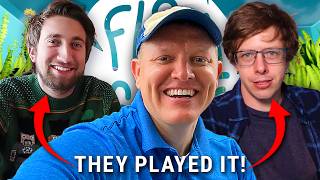
[25:47] from Stuff Made Here and Gavin from the Slomo Guys. Now, before we start this, if you were a Let's see how they did.
[26:02] I know what it's about. All right, let's fill her up. They're already dead?
[26:17] They were in here for two seconds. Hey. They're looking around. I have two tanks.
[26:33] Another one died? They're dying as fast as I can get them in here from the shop.
[26:45] eat up. Big boys. Change water.
[26:59] Oh! I thought I'd pulled the plug there for a second.
[27:13] Let's clean the glass. Let's vac up the fish excrement. Some fish that won't die.
[27:27] I'm going to name you, dinner plate. You guys try to kill each other faster than my kids. Oh, my goodness.
[27:42] Overall, this is. Barely even left them for a second. Dinner plate died of hunger.
[27:56] Well, all my fish are dead. Destin and your game. Please go check out Fish Game at fish. Game. that's the whole URL you see it in the logo there.
[28:11] add even more things like custom 3D models you can put in the tanks. So if you play it and like it, please tell your friends.
[28:23] This was a monumental effort by a lot of people. for a really long time, and he made it happen. And I'm thankful for all the years that
[28:38] and I'm thankful for you considering going Anyway, that's it. I'm Destin. Have a good one. Bye.



⚡ Saved you 0h 28m reading this? Transcribe any YouTube video for free — no signup needed.