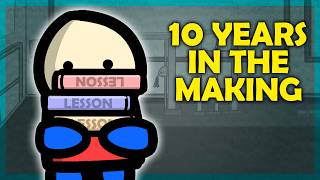

10 Years of Fitness: The #1 Lesson
45sThe creator's honest reflection on a decade of content creation hooks viewers with curiosity about hard-won insights.
▶ Play Clip"The title accurately reflects the content: the video shares three personal lessons learned over a decade, though it slightly exaggerates the depth of 'everything' taught."
The creator reflects on a decade of making fitness content on YouTube, sharing three key lessons that have shaped their approach to fitness and content creation, aiming to help viewers approach fitness more mindfully.
The creator's goal is to provide objective fitness information, leading to the 'it depends' answer, which allows presenting multiple perspectives rather than a single answer that may not work for everyone.
Simplifying fitness advice, like 'eat less, move more', can ignore real factors like hormones, genetics, and stress, causing confusion and frustration.
Science provides averages and direction (like a map), but individual variability, obstacles (genetics, stress, injuries), and personal experience ultimately determine what works for each person.
The creator values science as a guide but emphasizes personal experience as the final answer for fitness; they appreciate their audience's support over the years.
Why does the creator often answer fitness questions with 'it depends'?
To present multiple perspectives and avoid giving a single answer that may not work for everyone.
0:47
What is an example of oversimplified fitness advice that can be problematic?
'Eat less and move more' ignores real factors like hormones, genetics, and stress.
2:14
What does the creator say about science in relation to fitness?
Science is a great place to start (like a map), but not always the best place to end; personal experience is the final answer.
3:34
In the supplement example, what happened to four out of eight subjects?
They saw essentially no gains from the supplement.
3:55
What does the creator compare science to in terms of guiding fitness decisions?
A map that gives direction but does not account for real-world obstacles like genetics, stress, or injuries.
4:29
Value of Nuance in Advice
Challenges the common demand for straight answers, advocating for context-aware guidance that acknowledges individual differences.
0:47Oversimplification Pitfalls
Exposes why 'eat less, move more' is insufficient, highlighting complex factors like hormones and stress that affect adherence.
2:14Science as a Map, Not a Rulebook
Offers a realistic view of scientific findings by noting averages can mislead, and personal experimentation is essential.
3:34[00:00] Ten years
[00:01] of making fitness content on YouTube.
[00:04] No doubt
[00:05] I picked up many lessons
[00:06] along the way
[00:07] that shaped my views
[00:08] of the fitness world,
[00:09] which in turn shaped
[00:10] how I create content for you guys.
[00:12] So I want to share
[00:13] three of the biggest lessons
[00:15] I've learned the past
[00:16] ten years as a fitness creator.
[00:18] Lessons that I think
[00:19] can help you approach fitness
[00:21] a bit more mindfully as well.
[00:23] When I first decided to make videos,
[00:24] my goal was and still is,
[00:26] to provide
[00:27] as objective fitness information
[00:29] as I possibly can.
[00:30] And this essentially led to the birth of,
[00:33] I guess, kind of the biggest meme
[00:34] of picture fitness.
[00:35] And that's me repeatedly
[00:37] answering questions with.
[00:38] It depends,
[00:39] but the need to answer questions with it
[00:42] depends is undoubtedly
[00:44] one of the most important lessons
[00:45] I've learned over the years.
[00:47] Now, I know some of you.
[00:48] And yeah,
[00:49] even other fitness creators
[00:50] would say that
[00:51] giving straight answers
[00:53] is better and saying it
[00:54] depends is just a cop out.
[00:56] Well, to me
[00:57] it actually feels more like a cop out
[00:59] to just give straight answers
[01:01] all the time.
[01:02] The whole point of it
[01:03] depends is to allow me to present
[01:04] as many perspectives
[01:06] for a question as possible.
[01:08] If I just provide one straight answer,
[01:09] then I'm not doing my due diligence
[01:11] because that answer isn't guaranteed
[01:13] to work for everyone.
[01:14] For example,
[01:15] if you ask me
[01:16] how many reps of bicep curls to do.
[01:18] My answer will be it depends.
[01:20] It depends on your goals.
[01:22] For strength,
[01:22] go for 2 to 5
[01:23] reps with heavy weights for muscle,
[01:25] focus on volume and effort
[01:26] and use the rep range to help
[01:27] you do the most.
[01:28] This to me is how to approach
[01:30] fitness,
[01:31] especially as a fitness influencer
[01:33] with a large audience.
[01:35] Otherwise,
[01:35] if you were to just shoot it straight,
[01:37] then the only reasonable advice
[01:39] and you fitness creator
[01:40] can offer is to eat right.
[01:42] Stay active and sleep well.
[01:44] But even this seemingly simple
[01:46] recommendation can have people
[01:47] wondering what exactly
[01:49] does eating right mean?
[01:50] Well it depends.
[01:52] Now, just as much as I try
[01:54] to keep my content objective,
[01:55] I also try to keep things simple.
[01:57] Especially since fitness science
[01:59] can get pretty complicated.
[02:00] But another lesson I learned
[02:02] is that sometimes
[02:03] simplifying things
[02:04] actually makes things harder.
[02:06] This happens when simplicity leaves out
[02:09] way too much context
[02:10] that can lead to confusion,
[02:12] misinterpretations, and even frustration.
[02:14] Perhaps the clearest example of
[02:16] this is the classic
[02:18] simple weight loss
[02:19] advice to eat less and move more.
[02:22] And yeah, if we're talking
[02:23] simple science,
[02:24] using more energy than you
[02:25] consume leads to weight loss.
[02:27] But here's the catch
[02:28] if it was that simple, then
[02:30] me and every other fitness creator
[02:32] would have been out of a job
[02:33] a long time ago.
[02:34] The thing is,
[02:34] we can't just ignore all the real factors
[02:37] that can easily influence
[02:39] our ability to both eat
[02:40] less and lose more.
[02:41] Real factors like hormones,
[02:43] genetics environment
[02:44] stress everything.
[02:45] Now, of course,
[02:46] some people like to dismiss
[02:47] all this
[02:48] and simply say
[02:49] that people gotta stop being so lazy.
[02:52] Well, okay, let's just say that's true.
[02:55] How often do we stop being lazy?
[02:58] To sincerely answer that,
[03:00] we'll just end up
[03:01] right back at those factors
[03:03] we so quickly dismissed.
[03:04] So as I continue to simplify my content,
[03:07] I'm also listening to you guys
[03:09] to make sure
[03:09] the information is as complete
[03:11] and clear as possible.
[03:13] Speaking of information, it's
[03:14] no secret that my content is quite
[03:17] heavy on science,
[03:18] despite potential conflicts
[03:20] and sometimes messy data.
[03:22] I do believe that science,
[03:23] with its randomizing,
[03:24] controlling and blinding,
[03:26] is the most objective
[03:27] information out there.
[03:29] But if we're going to use science,
[03:30] we need to understand
[03:32] what it actually tells us.
[03:34] So the third biggest lesson
[03:35] I learned is
[03:36] that science is a great place to start,
[03:38] but not always the best place to end.
[03:41] You see, science mostly works
[03:43] by reporting results based on averages.
[03:46] For example,
[03:46] let's say you study
[03:47] claims a new supplement
[03:48] is great for strength
[03:50] because on average,
[03:51] eight subjects increase their one
[03:53] rep max by 15%.
[03:55] Sounds great on the surface,
[03:56] but let's take a closer
[03:57] look at the subjects.
[03:58] Two of them had way
[04:00] above average increases,
[04:02] two were right on the average,
[04:03] and four saw essentially no gains.
[04:06] Now apply this to the real world.
[04:08] Half the people buying
[04:09] this new supplements
[04:10] just wasted their money.
[04:11] We can basically apply this concept
[04:13] to everything else in science.
[04:15] The fact is,
[04:16] individual variability
[04:18] always exists and averages
[04:20] don't tell the full story.
[04:22] Sometimes you'll fall
[04:23] right on the average,
[04:24] but sometimes you'll fall far from it.
[04:26] So instead of completely
[04:27] sticking to science,
[04:29] I think a better way is to treat it
[04:31] more like a map
[04:32] that can give us some direction.
[04:34] But looking at the map is one thing.
[04:36] Actually moving to
[04:37] our destination is another,
[04:39] and when we do, we're going to run
[04:40] into unexpected obstacles
[04:42] like genetics,
[04:43] rough weather,
[04:44] like stress and detours like injuries.
[04:46] And maybe we'll find an even better,
[04:49] quicker path that's not on the map.
[04:51] So as great as science can be,
[04:52] and it will always guide
[04:54] much of my content.
[04:55] The final answer for
[04:56] you will be your own experience.
[05:00] And that's the three
[05:01] major lessons
[05:02] I learned over the last ten years.
[05:04] If you've been here
[05:05] since the beginning,
[05:06] I genuinely appreciate
[05:08] you supporting me all these years.
[05:09] And even if you've only been here
[05:11] for a little while,
[05:12] I appreciate you
[05:13] for giving a triangular cartoon
[05:15] character a chance to help you
[05:17] with your goals.
[05:18] Other than that,
[05:19] if you enjoyed this video, then please
[05:20] give it a dependable thumbs up
[05:22] and share it with your lesson
[05:23] loving friends.
[05:24] Subscribe for more
[05:25] and let me know what you think
[05:26] in the comments!
[05:27] As always,
[05:28] thank you for watching and don't
[05:29] forget to get your protein.

⚡ Saved you 0h 05m reading this? Transcribe any YouTube video for free — no signup needed.