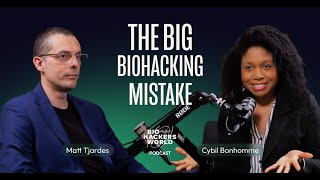

Why Fewer Biohacks Work Better
60sChallenges the common biohacking trend of using many tools, offering a counterintuitive and simple principle that resonates with minimalists.
▶ Play Clip"The title is generic and doesn't promise specific content, but the podcast delivers a solid, if meandering, discussion on biohacking principles."
In this podcast episode, biohacker and entrepreneur Matt shares his journey from wrestling in the 1990s to becoming a pioneer in the field of biohacking. He discusses his early experimentation with sauna suits, cold showers, and keto, and how his curiosity about the science behind these practices drove him to research and understand the body's responses. The conversation explores the importance of foundational health practices, the potential ethical limits of human enhancement, and the need for honesty and research in the biohacking space.
Matt's interest in biohacking began in the 1990s through wrestling, where he used sauna suits, cold showers, and keto, and started researching why these methods worked.
Matt highlights cold air therapy and breathwork as favorite natural methods, emphasizing the benefits of breathing and grounding for mental health and stress reduction.
Matt believes there are ethical limits to human enhancement, cautioning against pushing beyond natural human capacity without considering long-term consequences like health risks.
Matt advises that the real edge in biohacking comes from being honest with yourself and conducting thorough research to understand the true effects and validity of practices.
He stresses that a solid foundation of movement, exercise, and diet is essential for achieving results, and warns against getting lost in the noise of AI and social media.
Matt's insights underscore the importance of a research-driven, honest approach to biohacking, focusing on foundational health practices and long-term well-being over quick fixes or extreme enhancements.
Honesty and Research as the Real Edge
This is a core principle that differentiates effective biohacking from fads, emphasizing critical thinking and self-awareness.
17:50Foundation is Key
Highlights the importance of basic health practices as the bedrock for any biohacking, making it a practical and actionable takeaway.
18:40Ethical Limits of Enhancement
Raises a critical question about the long-term consequences of biohacking, encouraging a balanced and ethical approach.
15:42[00:00] You're listening to the Biohackers World Podcast.
[00:30] which is a pioneer in biohacking and innovator in mice and PMS technologies, dedicated to pushing the limits of human performance and longevity. Thank you so much for being here today. Thank you for having me. I'm excited.
[00:42] Absolutely. So how long have you been in the world of biohacking, and how did you get into it? Sure. So I've been into it since the 90s, and it all started pretty much when I got into sports, when I got into wrestling.
[00:56] We were doing certain things back then, like, you know, if you got sick, you used the sauna suit, and then you go for a long run. We might not have understood exactly what we were doing, but we knew that you wouldn't get sick after that.
[01:08] So we were doing cold showers. We were doing keto. And I'm a big reader. So I started researching a lot when we were doing all this stuff. Why is it happening? What's happening to my body? Exactly. Why does it work?
[01:20] So that was initially my beginnings. And then, of course, getting into supplements on top of that. to. And then, you know, after I was done wrestling, I still continue exercising and lifting weights.
[01:33] I got into powerlifting, just trying to look for various advantages, while keeping it as natural as possible. So that's really how I initially got into it. And then, of course, when I met my wife in the early 2000s, that's when she introduced me into
[01:48] light and frequency as well. So it made me a little bit more well-rounded. A little bar hockey fan. Yeah, exactly. And in terms of you and your family, were you the only one that was into it, or was your family into it as well?
[02:00] Well, so my mom's a longtime naturopath, and she's very big into Native American history, and as well as their practices and modalities, too. So there was a lot of natural methods growing up as well.
[02:14] And that always interested me, too, on how different herbs and plants affect the body, and they could be used for various different things. and then progressing to now me and my wife and our son,
[02:27] we're all doing all the different things. Amazing. Family.by, together, space together, right? Yeah. And you call yourself the math scientist in the best way,
[02:41] precise, mythological, and bold. What does your self-experimentation process actually look like on a day-to-day? How do you decide what's worth testing? Sure. Well, so I think you nailed it there about the mad scientist part of it.
[02:53] As far as my obsession and drive and being meticulous about it and everything, especially when learning about all the technologies and all different ways to biohack. So what my biohacking looks like now, it's drastically different from how it used to be.
[03:11] Before I was really kind of, you know, try out different things, keep adding more and more. now you know I will tend to take away something before I will add something but my experience now
[03:23] I know exactly what works for me and for many years of trials so if I do try to add something new in it's very research heavy in the beginning I've always been research heavy I have to completely understand how it works I have to make sure there's studies that correspond to that too
[03:40] and I advise everybody to do that but in addition to that I equally weigh personal experience too if I know three or four different people that tried something and they say that it works for them, I'm going to try it as well and start incorporating that and see if it's right for me at the same time.
[03:56] So I equally weigh scientific research and personal experience, and that's kind of how I attack my biohacking now. And I do have different goals now as opposed to younger. I mean, I'm not in sport and I'm not trying to reach powerlifting records anymore.
[04:11] It's more of good quality of life and longevity. which is fundamental and a holistic co-founder with your wife Rhonda, blending data
[04:23] science and intuition how has working as a couple shaped your approach to biohacking and human potential? Sure well so a bunch of things, I mean she's an amazing woman and we've been
[04:35] together 21 years shout out to Rhonda and we work together too for the entire time And so we been around each other 24 hours a day so we almost like the same person now It a very unique relationship You get a mesh together Yeah it a very unique relationship and dynamic so it is and it fantastic without her I wouldn be at the place I am now
[04:59] because like I said she largely introduced me into frequency and light therapy and I help round her out with supplements as well so we have very complete knowledge and experience of
[05:11] biohacking and health and wellness now and we just continually apply it but yeah It's been a great adventure, and we plan on continuing to do it this way for a long time to come. Love it. Can't wait to see it.
[05:25] And many people think biohacking is about adding more supplements, more gadgets, and more routines. You've also spoken about the removal and the minimalism of our performance principle.
[05:37] Can you explain that paradox? Sure, definitely. So it's kind of a tough one because everything works a little bit different for everybody, okay? And I'm a big believer in if something doesn't work right for you
[05:53] or if you're getting side effects from it, just immediately stopping and be done with it. Maybe come revisit it later or not do it at all. As far as removal too, I mean, so the way I look at it kind of is
[06:06] if you're taking 10, 15 different supplements at the same time or using 10 or 15 different devices at the same time, how do you really know what's working? Exactly. Yeah. So you have to do, you know, trial by fire, one by one.
[06:19] You find out the ones that work, and you just ruthlessly call out the ones that don't because you don't need all that stuff. And in adults, if you only need PEMF or you only need light therapy at the current time, that's fine.
[06:31] And then, you know, if you have a certain goal that you're trying to reach with that and you achieve it, maybe you go off for it a while and you try something different. But you don't need, you know, 10, 20, 30 different things at the same time. I think this is a very big misconception.
[06:45] And especially now with how advertising is and how people push things, it gets you very excited. It does like a real big psychological thing to you. Totally. Yeah, where, you know, you get so hyped up to try something and you think it's going to work for you and you spend this money and it doesn't.
[07:01] So, I mean, you just kind of have to ignore that and, you know, like this is a problem. Yeah, that really works for me. And why do I need more? And, again, back to the main principles of, you know, diet, exercise, sleep, sunlight, things like that.
[07:17] You know, if you have those nailed down, you really don't need a lot on top of that. For sure. And it goes beyond, like, gadgets and supplements. And this is something I talk about in my book, right? So even food, right?
[07:30] A lot of times when people are trying these diets and these fads and trends, if they admire someone on Instagram, they're like, oh, I'm going to try this. Thinking they're going to look and feel exactly as they do.
[07:44] But I always say it's like such a personal journey. You have to eat and consume what makes you feel good. So if it's not making you feel good, you should eliminate it. Just because the food itself is healthy, it may not be beneficial or healthy for you.
[07:58] So, like you say, you have to cut out the noise. Like, just because there's this big hype about it, everyone's doing it, should you be doing it? Exactly. You nailed it with that one, yeah.
[08:10] Okay. And do you believe energy-based tools can actually change the nervous system, or are they primarily enhancing physiological recovery? Sure. So, the way I see it with energy-based tools like frequency and light, again, they're natural things.
[08:27] So I think that they can be utilized as devices to help get your body back to what it's naturally supposed to do. Right, right. And you only want to do it for a certain period of time, too. I mean, the technologies, you can use them forever, but you still want to take time off, too, as far as tolerance.
[08:43] For sure. So as far as actually, like, physically changing something, you know, I think what they do more or less is just help get your body to do what it's supposed to do. So, like, for example, like, you know, PEMF, it pretty much just tells all your cells start firing at the same time and, you know, get to work.
[09:01] So it's not really adding something on top of that. Nice. Okay, yeah. Again, the things in your body. Yeah, definitely. And you've explored unconventional therapies and uncomfortable ideals for decades.
[09:16] How do you balance experimentation with safety, knowing that many of your methods push beyond conventional research? Sure, so that is kind of a touchy subject with a lot of people
[09:28] But the thing is that you really have to keep in mind if your public facing or not. So I think companies have a big responsibility As far as what they present to the public because you can cause a real danger Now if you get somebody that wants to be a little reckless and test stuff on themselves that entirely their option you know legal or not legal whatever it may be
[09:52] You know, but as far as telling other people to do it, and you do see this a lot with social media influencers sometimes, they might tell you to be doing something that you probably shouldn't and probably isn't for everybody.
[10:04] So, you know, that does exist out there, but that is a very big responsibility. But, like, as far as us with our company, we try to pick the stuff that is the safest and still works the best.
[10:18] I mean, we will never put something out there that's even remotely dangerous to the public. And you don't really need to go that route. I mean, there's stuff that's completely safe that you can do that works better than some of the dangerous stuff.
[10:31] So, yeah, that's kind of my idea about that. Okay, awesome. And as an industry that often chases trends, holistic skills grounded in data and integrity. How do you keep innovation sustainable and accessible and not just exciting for early adopters?
[10:50] Okay. So this is kind of a different one for us because we're a new company. We launched in January of this year. But a lot of thought went into it beforehand. So we developed our product line for about two and a half, maybe three years.
[11:05] But it's 30 years and more of experience behind it, too. So everything that we put forward now, it's our best of the best. This is all the stuff we wanted. so as far as trends
[11:17] we will probably be some of the last people to hop on trends because with us it has to make sense it has to make sense with the science it has to make sense in real life too and those don't always match up
[11:29] I mean kind of an odd example is science cannot tell you why ice is slippery really and it can't tell you why a bicycle stays upright so like I said both have to make sense
[11:41] at the same time But, yeah, it's, you know, the trends, that's all, to me, I see as just trying to get more money. Right. Yeah. I don't hop.
[11:53] Exactly. I don't hop on the hype. So we're here to stay the same products we have now, unless it's a revised model that's a little better or looks a little different for some reason. It's going to largely stay what it is. I'm with you on that one.
[12:05] If something just came up, I'm like, I'm a little bit of you. Yeah. Okay. And in your view, what's the biggest mental block that keeps people from achieving real transformation,
[12:17] even when they have access to cutting-edge tools? Sure. So that is kind of a tough one because it does vary person to person. But I think the biggest mental block can be honesty.
[12:33] And by that I mean that you really have to be really honest with yourself sometimes about, number one, how you feel about what you're really doing, about is this really working or not,
[12:45] and going hand-in-hand with that is being in tune with yourself too. That's something you have to practice. You have to practice understanding how you feel, why you feel that way. For example, pain, it's like, does it really hurt that bad?
[12:58] Where exactly is that pain coming from? You've got to kind of block out all the noise. and analyze that. But the honesty part, I think that is big because, you know, especially as people age, you know,
[13:10] you might not want to think that you can't do something anymore. Like admit to yourself, right? Yeah, exactly. But then on the other hand, another mental block that I think is big is maybe not believing in yourself enough.
[13:24] I mean, there's a saying out there that you're capable of 20 times what you actually think you can do. So limit yourself. Yeah. So, you know, don't be limited, but at the same time you have to be honest with yourself and you also have to be very realistic.
[13:38] So I think there is a certain mindset that will really make a difference. And, again, it's kind of personal. All this stuff is very personal, person to person. Yeah, it's, you know, yeah. And have you yourselves ever experienced any mental blocks?
[13:53] You know, I have. But the biggest one for me that I ever overcame happened when I was in wrestling. It's just as far as understanding that I am capable of doing something,
[14:05] and I can't push myself past my limits. There's just something about when you get in certain situations where you have to go past what you're capable of, you learn a lot about yourself. Same thing like I used to run a lot, too.
[14:17] If you go on a long run, you're just breaking through walls. You get tired and you think you can't, and you keep going. And that does a lot for you mentally as well. You surprise yourself. Yeah, exactly. I love that. If you stripped all tech away no devices no labs what the one natural biohack you still rely on every day Oh i love this so and it so hard it almost impossible for me to answer because like nature i mean like so i
[14:45] mean you know because obviously like there's sunlight you go out in the forest and get negative ions you just you stand on the ground and ground yeah but i will tell you uh my favorite and there used to actually be resorts that did this in the 1800s early 1900s is cold air therapy
[15:00] cold air bats you just breathe cold air outside or you just stand outside in cold air that has to be one of my favorite natural methodologies people don't understand just how breathing can help you
[15:13] right breathe and maybe your mental health goes away like breathing is like people are just so caught up in life and just so everything's so heavy just take a moment and breathe like it's like in miami miami traffic is so horrible if i don't do my breath work while i'm driving like
[15:29] all go insane. It does help for sure. It helps. Like people don't understand. Like breathing is, it's a hack. Yeah, definitely. And do you believe there's an ethical limit
[15:42] to human enhancements? A point where we've optimized too far or lost our natural balance? Yeah, I do think so. Because I think about it a lot too because I love what-if scenarios.
[15:56] I love sci-fi. And I also, you know, I'll call myself a mad scientist, too. So I think about and I understand, like, what the limits can be. And if you push past there, like, what consequences could be. And it can be catastrophic.
[16:09] But there's a point where you get to where you're either human or you're a cyborg. So really, and I largely believe that, you know, they have bionic limbs and legs now. And, I mean, you can augment tissues and various things where you can go beyond human capacity.
[16:23] But look at what cost. Right. So I truly believe that, you know, even with our products that we have, is that whatever you can do to help yourself be in your best natural state as possible,
[16:35] I really think that's the way to go. And, again, the responsibility on companies is like, you know, there's marketing behind it too. You know, if you have a company telling you that you can exceed your human limits in this capacity or that,
[16:48] it's like, okay, how are they making money on it and why? It's like, what's going to be the real consequences? What's the human nation? Yeah, are you going to, you know, maybe you could be, you know, Mr. Fantastic for five years, but what happens after those five years?
[17:01] Are you going to die early? Are you going to get cancer, some major disease? And it's like, you can't. So I definitely think there should be limits like that. And I think for a lot of people, they think of, like, the right hands right now. They don't really think long-term.
[17:14] Like, this is going to make me feel good and look good right now. The future's the future. We don't care about that. Right, yeah, that is a big mentality, but you have to think about the future. because, you know what, five years is going to come and go in a snap,
[17:26] and then when you get there, you're going to be sorry. Like yesterday was January. It's already October. Exactly, yeah. See, well, November, see, I'm already behind. Yeah.
[17:38] If you could leave our audience with one truth about pushing limits, what would it be? What's the real edge, the body, the mind, or the willingness to explore? Okay.
[17:50] So I think the real edge that people are going to get here ties in the back with what I said before. It's that you have to really be honest with yourself, and you have to be research-heavy and understand why things work.
[18:03] You have to understand exactly what you're doing to your body, what are the consequences going to be, good or bad. Are there any long-term effects? Is this research real? Are these doctors putting out this information real?
[18:16] are the social media influencers even real? There's a lot of fake stuff nowadays and bad information. I've heard thousands of people misspeak, so-called professionals.
[18:28] So I'm a big believer in research and, like I said, honesty, being honest about what you really need. And then you just kind of build upon it from there. And aside from that, any other advice I could give would just be foundation.
[18:40] Foundation is key. If you don't have some kind of movement, exercise, and diet, then you don't really have much to build on. You're not going to get great results. I think that's an amazing answer. And, of course, now there's even more noise with the AI technology and everything like that.
[18:56] So, like, if you know the foundation of the roots, I think you're good to go. Matt, this has been amazing. Thank you so much for joining me today. Well, thank you. Yeah. Thank you so much for having me. It has been amazing. Of course. And everyone out there, I know Matt has given you so much.
[19:11] I hope you take the time to listen to this and reflect and just live your best self. hacking life. Until next year. Come join us at Biohackers World in 2026.
[19:23] Coming to an area near you.
⚡ Saved you 0h 19m reading this? Transcribe any YouTube video for free — no signup needed.