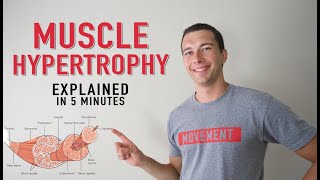

From Small Biceps to Big: The Fiber Layers
45sVisually explains muscle fiber structure, hooking viewers with a clear goal of bigger biceps.
▶ Play Clip"The title accurately describes the content: a concise 5-minute explanation of muscle hypertrophy physiology and mechanisms."
This video explains the physiology of muscle hypertrophy at the cellular level, from micro trauma caused by training to the role of satellite cells and muscle protein synthesis. It covers the three mechanisms of hypertrophy (mechanical tension, metabolic stress, muscle damage) and distinguishes between myofibrillar and sarcoplasmic hypertrophy.
Matt from Movement System introduces the topic of muscle hypertrophy and explains the goal of going from a smaller to a bigger bicep.
Muscle fibers are composed of myofibrils; satellite cells surround the fibers and are crucial for growth.
Dr. Schoenfeld's three mechanisms: mechanical tension, metabolic stress, and muscle damage. Training combines these to cause micro trauma.
After micro trauma, a hormonal cascade (testosterone, IGF-1, growth hormone) activates satellite cells to initiate muscle protein synthesis.
Satellite cells use DNA to encode amino acids into muscle proteins, filling damaged areas and adding sarcomeres to myofibrils.
Primary mechanism is hypertrophy (enlarging existing myofibrils), not hyperplasia (creating new ones).
Recap: training → micro trauma → hormones/satellite cells → new proteins → bigger myofibrils → bigger muscle.
Two types: myofibrillar (contractile proteins) and sarcoplasmic (non-contractile proteins). Offers to make follow-up videos.
What are the three mechanisms of muscle hypertrophy according to Dr. Schoenfeld?
Mechanical tension, metabolic stress, and muscle damage.
1:18
What are satellite cells and what role do they play in muscle hypertrophy?
Satellite cells are stem cells around muscle fibers that contain DNA and help repair and build new muscle proteins.
0:58
What signals activate satellite cells after micro trauma?
A hormonal cascade involving testosterone, IGF-1, and growth hormone.
2:09
What is the difference between hypertrophy and hyperplasia, and which is the primary driver of muscle growth?
Hypertrophy is the enlargement of existing myofibrils; hyperplasia is the creation of new myofibrils. Hypertrophy is the primary mechanism in humans.
3:18
What is the difference between myofibrillar and sarcoplasmic hypertrophy?
Myofibrillar hypertrophy increases contractile proteins (actin and myosin); sarcoplasmic hypertrophy increases non-contractile proteins and fluid.
4:54
How do satellite cells contribute to making a muscle fiber bigger at the myofibril level?
Adding sarcomeres to existing myofibrils, making them bigger.
2:51
Three Mechanisms of Hypertrophy
Provides a foundational framework for understanding how different training stimuli lead to muscle growth.
1:18Hormonal Cascade Activates Satellite Cells
Explains the biological signaling pathway that initiates muscle repair and growth.
2:09Hypertrophy vs Hyperplasia
Clarifies a common misconception about how muscles actually grow at the cellular level.
3:18Myofibrillar vs Sarcoplasmic Hypertrophy
Distinguishes between two types of hypertrophy, which has practical implications for training program design.
4:54[00:00] hey what's up guys it's matt with
[00:01] movement system today we're going to
[00:02] talk about what is muscle hypertrophy
[00:04] so we're going to explain at the muscle
[00:06] fiber level how we're actually
[00:08] going from damaging a muscle to muscle
[00:10] protein synthesis and rebuilding a
[00:12] muscle in the physiology of that cycle
[00:14] let's go ahead and dive into it
[00:23] [Music]
[00:25] okay so to lay the groundwork our goal
[00:27] is to go from smaller bicep
[00:29] to bigger bicep how are we going to do
[00:32] this well
[00:33] when we think about the layers of the
[00:34] muscle fiber we actually have when we
[00:36] think about the whole muscle when we
[00:38] look at a cross section of that many
[00:40] muscle fascicles
[00:42] and those fascicles with different types
[00:44] of fibers are made up of
[00:45] many individual muscle fibers and what
[00:48] we're looking at here is one muscle
[00:49] fiber so what you'll see here is that
[00:52] there are actually many myofibrils
[00:55] making up this one fiber and then what
[00:57] you'll see in orange are
[00:58] satellite cells around the fiber so you
[01:01] may have heard
[01:02] that muscle cells are multi-nucleated
[01:04] and this is actually going to be a
[01:05] really important
[01:07] thing to remember when we're thinking
[01:08] about the process of muscle hypertrophy
[01:10] okay so step one is to actually go from
[01:12] a fiber to a fiber
[01:14] that has had some micro trauma and how
[01:16] do we do that with training
[01:18] these are dr schoenfeld's three
[01:20] mechanisms of muscle hypertrophy
[01:22] mechanical tension metabolic stress and
[01:24] muscle damage
[01:25] so the training that you do and the
[01:27] training that you program as a strength
[01:28] coach or as a personal trainer
[01:30] is going to have some combination of
[01:31] mechanical tension metabolic stress and
[01:33] muscle damage
[01:34] so we can do high rep training that's
[01:36] going to have more metabolic stress we
[01:37] can do heavy loaded training it's going
[01:39] to have more mechanical tension
[01:41] but either way some combination of these
[01:43] three
[01:44] factors are going to actually lead us to
[01:46] causing micro trauma
[01:48] at the muscle fiber level so once we've
[01:51] done training
[01:52] and we've gone to a muscle fiber that
[01:54] has some micro trauma
[01:55] those myofibrils the actin and the
[01:57] myosin within those myofibrils
[01:59] have had some structural damage what
[02:02] we're going to need to do next
[02:03] is muscle protein synthesis so once
[02:06] micro trauma has occurred at the
[02:07] myofibrillar level
[02:09] we actually have a hormonal cascade of
[02:12] things like testosterone and igf-1 and
[02:14] growth hormone
[02:15] that are going to signal that there's
[02:17] been damage and
[02:18] as well activate satellite cells so
[02:21] these are the satellite cells that we're
[02:22] talking about here
[02:23] now this is really important those
[02:25] satellite cells
[02:26] are at the level of dna so that dna can
[02:30] actually encode
[02:31] transcribe amino acids which can then
[02:35] become muscle
[02:36] proteins so these satellite cells with
[02:39] the nuclei in there
[02:40] will actually kind of fill in the areas
[02:42] that have had micro trauma
[02:44] and they will become through a process
[02:47] of dna to amino acids to proteins they
[02:50] will become
[02:51] the myofibrils and that's really
[02:53] important because that's actually the
[02:54] whole principle
[02:56] of adding sarcomeres and making a muscle
[02:58] bigger
[02:59] if this has been helpful for you so far
[03:01] make sure you go ahead and hit that like
[03:02] button
[03:02] and subscribe and turn your
[03:04] notifications on so whenever i make
[03:06] follow-up videos about more things
[03:07] related to muscle hypertrophy and
[03:09] strength conditioning
[03:10] you won't miss them okay so just to be
[03:12] abundantly clear here
[03:13] if this is a muscle cell and there's
[03:16] myofibrils within it
[03:18] what we could do is two things we could
[03:20] either add
[03:21] new and more myofibrils in that would be
[03:24] called
[03:25] hyperplasia and that would occur if
[03:27] those satellite cells grouped together
[03:29] and formed a brand new myofibril that is
[03:32] probably not what occurs
[03:34] as the primary mechanism of muscle
[03:35] growth instead what happens
[03:37] is that those damaged myofibrils
[03:40] actually have satellite cells that come
[03:42] on
[03:42] and make them bigger so that way those
[03:44] current myofibrils
[03:46] actually get bigger and expand the cell
[03:48] and cause muscle hypertrophy that way
[03:50] and just to give you an idea of what
[03:52] this looks like at the cellular level
[03:54] here's a picture so what you can see
[03:56] with this picture is the process of
[03:57] muscle protein synthesis
[03:59] going all the way from an inactive
[04:00] satellite cell that was then
[04:02] activated with the hormonal cascade that
[04:05] came on after muscle damage
[04:06] to then move to a group of satellite
[04:09] cells to then
[04:10] turn those satellite cells into a
[04:13] myofiber
[04:14] so then that myofiber can become part of
[04:16] a myofibril
[04:17] which would make a muscle fiber bigger
[04:19] which would make the entire muscle
[04:21] bigger
[04:21] which we would call muscle hypertrophy
[04:23] so to recap we started with a muscle
[04:25] fiber
[04:26] we did training that involved mechanical
[04:28] tension metabolic stress and muscle
[04:30] damage
[04:31] to then cause micro traumas in that
[04:33] muscle
[04:35] and then what we did was we signaled
[04:37] some hormones
[04:38] and we activated satellite cells to then
[04:41] start to
[04:42] generate new muscle proteins and then
[04:45] that added
[04:46] myofibrils to our muscle fiber which
[04:48] then made our muscle fiber bigger
[04:50] which then made our muscle bigger which
[04:52] then made your biceps bigger
[04:54] importantly though this isn't the only
[04:55] type of hypertrophy what i'm explaining
[04:57] here is the process of myofibrillar
[05:00] hypertrophy which is increasing the
[05:02] myofibrils
[05:03] and increasing the active contractile
[05:06] muscle proteins
[05:07] we could also though have sarcoplasmic
[05:09] hypertrophy of non-contractile proteins
[05:12] if you want me to make a video about the
[05:13] difference between myofibrillar and
[05:15] sarcoplasmic hypertrophy
[05:16] or a video about the sliding filament
[05:18] theory or something like that just go
[05:19] ahead and leave a comment below
[05:21] and i will do follow-up videos to this
[05:22] hopefully this has been helpful for you
[05:24] if it was
[05:25] make sure you go ahead and like and
[05:26] subscribe and if you want to learn more
[05:28] go ahead and join the strength
[05:29] conditioning study group on facebook
[05:31] alright guys thanks for watching and
[05:32] i'll catch you on the next one
[05:41] you
⚡ Saved you 0h 05m reading this? Transcribe any YouTube video for free — no signup needed.