
Never Take Insurance (Unless You Count Cards)
44sDirectly challenges common blackjack advice with a contrarian twist, sparking curiosity and debate.
▶ Play Clip"The title is accurate and the video delivers exactly what it promises, though it's quite short and could have included more examples."
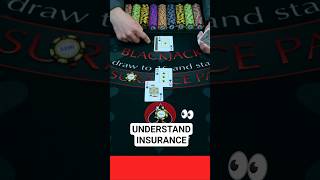
This video explains when to take insurance in blackjack, distinguishing between casual players and card counters. It emphasizes that insurance is a side bet and should generally be avoided unless the count is favorable.
Insurance is technically a side bet on whether the dealer has blackjack. For non-card counters, it's typically a bad bet and should never be taken.
Card counters should take insurance when the count is high enough, meaning there are enough 10-valued cards left in the shoe. The ratio of high to low cards makes the bet profitable.
When taking insurance, you bet half your original wager. If the dealer has blackjack, you lose your initial bet but win the insurance bet at 2:1, resulting in a wash.
In a shoe game (multiple decks), the threshold for taking insurance is a true count of +3 or higher.
In a single or double deck game, the threshold is a true count of +2.5 or higher.
Insurance is a profitable bet only for card counters when the true count reaches specific thresholds. For everyone else, it's a sucker bet that should be avoided.
What is insurance in blackjack?
A side bet on whether the dealer has blackjack.
00:01
Should non-card counters ever take insurance?
No, it's typically a bad bet and should be avoided.
00:01
What is the insurance bet amount relative to the original bet?
Half of the original bet.
00:28
What is the payout for insurance if the dealer has blackjack?
2:1.
00:28
What is the true count threshold for taking insurance in a shoe game?
+3 or higher.
00:43
What is the true count threshold for taking insurance in a single/double deck game?
+2.5 or higher.
00:57
Insurance is a side bet
Clarifies that insurance is not a protection but a separate wager, which is a common misconception.
00:01Card counters have a profitable threshold
Provides a specific, actionable rule for when insurance becomes a positive expectation bet.
00:14Insurance bet mechanics
Explains the exact bet size and payout, making the strategy concrete.
00:28Shoe game threshold
Gives a precise number for multi-deck games, which is essential for card counters.
00:43Single/double deck threshold
Shows that the threshold varies by game type, adding nuance to the strategy.
00:57[00:01] know when playing Blackjack is when to take insurance. Now, if you're not a card counter, don't ever take insurance as it's technically a side bet as to whether or not the dealer has Blackjack. We know that side bets are typically a
[00:14] scam. All right, so that said, um if you are a card counter, there's a point at which the count is high enough when there's enough 10 valued cards left in play, so the ratio of high to low cards is such that by betting the insurance
[00:28] bar, you play half your bet. In this case, we bet 200, so we put 100 on the insurance bar, and if the dealer has Blackjack, then what happens is we lose our initial bet, but we get paid two to one. [music] So, it's essentially a wash
[00:43] in that case. Now, what is that number? In [music] in a shoe game, so if it's a playing, it's at true count of plus three or higher. And if you're playing going to be at a true count of plus two
[00:57] and a half or higher is when you want to take insurance if you're a card counter.
⚡ Saved you 0h 01m reading this? Transcribe any YouTube video for free — no signup needed.