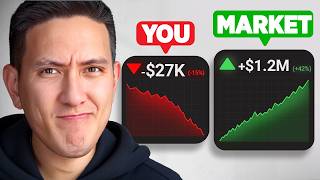

Why 91% of Fund Managers Fail
59sShocking statistic that challenges the value of professional investing, appealing to those who want to beat the market.
▶ Play Clip"Delivers on the promise with solid data and psychological insights, though some sections feel padded with repetition."
This video explores why beating the stock market is nearly impossible, using data from the SPIVA scorecard and Warren Buffett's famous bet to show that even professional fund managers fail to outperform the S&P 500 over the long term. It then delves into the psychological biases, such as the disposition effect and overconfidence, that lead investors to make poor decisions, and concludes by advocating for a simple, low-cost index fund strategy as the most reliable path to wealth.
The video opens by noting that the S&P 500 averages 8-10% annual returns, yet many people seek higher returns through stock picks, premium analysis services, and social media, all in an attempt to beat the market.
The SPIVA scorecard, published by S&P Global, shows that over 50% of actively managed funds underperform the S&P 500 in most periods. For example, in the first half of 2025, 54% underperformed. Over 10 years, 85.98% underperform, and over 20 years, 91% underperform.
Buffett bet $1 million that the S&P 500 would outperform a selection of hedge funds over 10 years (2008-2017). The S&P 500 compounded at 7.1% annually, while the hedge funds gained only 2.1%. The hedge fund manager conceded that high fees were a critical factor.
Hedge funds typically charge a 2% management fee and a 20% performance fee. Even small fee differences can significantly impact long-term returns, as illustrated by an Investopedia chart.
Investors tend to sell winning stocks too early and hold losing stocks too long, driven by regret avoidance and loss aversion. Studies show that winning stocks sold early outperformed the market by 2.4%, while losing stocks held underperformed by 1% or more. This effect is amplified during market crashes.
Researchers from Ireland and Australia found they could predict GameStop's price movements by analyzing emotions in Reddit posts. Three phases: joy (price rises), fear (price drops), and anger (brief price increase). This shows how social media can create a feedback loop where emotions drive stock prices, detached from fundamentals.
A study of 66,000 brokerage accounts found that the most active traders underperformed by 6.5% annually. The average household underperformed the market by 1.5% per year and turned over 75% of their portfolio annually, leading to high fees that erode returns.
Despite all the evidence, the market has historically delivered ~10% average annual returns over the long term, surviving major crises. By not trying to beat the market, investors can avoid emotional decisions and achieve better returns than 90% of active traders.
The video recommends buying low-cost index funds like VTI or VOO, or a three-fund portfolio (US stocks, international stocks, bonds). It also suggests focusing on increasing income, contributing to retirement accounts, and considering alternative assets like real estate or commodities.
The video concludes that trying to beat the market is futile due to professional underperformance and psychological biases. The best strategy is to invest in low-cost index funds, avoid frequent trading, and focus on growing your income, thereby profiting from others' mistakes.
What percentage of large-cap funds underperformed the S&P 500 over a 20-year period according to the SPIVA scorecard?
91%
02:18
What was the annual return of Buffett's S&P 500 index fund versus the hedge funds in his bet?
The S&P 500 index fund compounded at 7.1% annually, while the hedge funds gained 2.1%.
03:12
What is the '2 and 20' fee model in hedge funds?
A 2% management fee on assets under management and a 20% fee on profits.
04:02
Define the disposition effect.
The tendency to sell winning stocks too early and hold losing stocks too long, driven by regret avoidance and loss aversion.
04:55
What did the study of 66,000 brokerage accounts find about the most active traders?
They underperformed by 6.5% annually.
08:24
What are the three emotional phases identified in the GameStop Reddit analysis?
Joy, fear, and anger.
06:48
91% of funds underperform over 20 years
This statistic powerfully demonstrates the near impossibility of beating the market over the long term.
02:18Buffett's bet: 7.1% vs 2.1%
A real-world, high-stakes example that even elite hedge funds cannot beat a simple index fund.
03:12Disposition effect explained
Provides a clear psychological explanation for common investing mistakes.
04:55Emotions predict GameStop price
Shows how social media sentiment can drive stock prices, highlighting the dangers of retail trading.
06:48Market returns ~10% over long term
Reinforces the value of long-term investing despite market crashes.
09:15[00:01] market and in fact, there are entire industries dedicated to the pursuit of above market returns. The S&P 500 averages an 8 to 10% return per year, yet that's not enough of a return for some people. And if you want to get rich
[00:15] fast, people say you have to make more than 10% every single year. Think about CNBC, you might have the Jim Cramers of the world selling you stock picks. Then you turn on the computer and you might see a Motley Fool type of publication
[00:28] service for their premium stock analysis. Then there's a subreddit people are posting their gains and losses all in the attempt to try to beat the market and YOLO their way into higher net worth. And it seems like no
[00:42] matter where you look, you could find some confirmation for any stock idea just obsessed with this notion of beating the market. In this video, I'm biases that are hardwired into every investor's brain, which not only explain
[00:57] why we keep trying to beat the market, but why we're actually destined to fail case studies on how professionals can't why you don't need to try beating the market and that's actually the better
[01:10] way to live. To begin, let's look at the SPIVA scorecard. This is essentially a fund managers and is published by the S&P Global company, which is the same company behind the S&P 500 itself. In this scorecard, they take thousands of
[01:23] actively managed mutual funds and compare the funds returns to the market index like the S&P 500 and they also track this over different time periods. If we look at this column chart, even in a relatively good period like the first
[01:35] half of this year of 2025, 54% of active That's actually kind of on the lower end as well. As you can see, most of the time it is over 50% that funds will underperform the S&P 500. You have some
[01:49] outlier years here and there like in 2007 when 45% of large cap funds underperformed the S&P 500, but still 45% is quite a lot. But that's not the down in the report, which I will link down below in the description, you can
[02:03] of these funds across different time periods. As the time horizon gets longer, you'll notice that after 1 year, 3 years, 5 years, even up to 20 years, underperforming their benchmarks gets worse and worse every time. For all
[02:18] large cap funds compared to the S&P 500, you'll notice that by the time the 10-year time frame rolls around, 85.98% of large cap funds underperformed the benchmark. By the 20-year mark, that is now 91% of funds underperforming their
[02:33] professionals, too, with a lot of resources like, think if you're active Bloomberg terminal which costs, you know, $30,000 per year or has access to advanced insights and just industry
[02:46] knowledge of what's going on in the market 24/7. So, 9 out of 10 the index and Warren Buffett was so confident in this reality that he made a public $1 million bet against some of the world's most elite hedge funds. He
[02:59] bet that they couldn't beat a simple index fund over a 10-year period. This bet ran from 2008 to 2017 with Buffett wagering that the S&P 500 would outperform a selection of hedge funds over those same 10 years. And you
[03:12] guessed it, the results weren't even close at all. According to the article, as of the end of the bet, quote, Buffett's S&P 500 index fund had compounded a 7.1% annual gain over that period of 10
[03:24] years. The basket of funds selected by Protégé Partners, the managers with whom he had made the bet, had gained 2.1%. You can see that in this chart, the hedge funds underperformed the S&P 500 every single year with the exception of
[03:36] 2008 where the hedge fund was just down a lot less than the S&P 500 was for that while hedge funds can be down in performance, the hedge fund itself can be doing well financially because it charges annual fees to its investors.
[03:50] Quote, in conceding defeat, said the hedge fund manager who wagered the bet with Buffett, said the high investor fees charged by hedge funds was a critical factor. Hedge funds tend to be a good deal for the people who run the
[04:02] funds, who pass on the big bills to their investors. So, hedge funds tend to charge a two and 20 model, which means they charge a 2% management fee on your assets under management and a 20% fee on the profits every year. And just to
[04:14] illustrate how big of a fee a 2% fee is, we can look at this chart from Investopedia, which details the small differences of expense ratio fees. While these aren't exactly hedge fund fees per se, what you'll notice is that even
[04:26] seemingly small percentages will make a big difference at the when it comes to your returns over a long period of time. I hope that this drives home the point that yes, even professionals can't beat the market. So, if that's the case where
[04:39] elite hedge funds can't beat a simple index, why do people keep trying? The actually psychological. There are powerful cognitive biases that make us when the data proves otherwise. The first of these cognitive biases is
[04:55] what's known as the disposition effect. This is where investors will consistently sell winning stocks too early and they will hold losing stocks for way too long. Studies have shown that winning stocks sold too early went
[05:07] on to outperform the market by 2.4% while the losing stocks held by these same investors kept underperforming by 1% or more. This disposition effect is basically a combination of regret avoidance and loss aversion. Both are
[05:21] psychological biases that play into our behavior around investment decisions. With regret avoidance, you don't want to regret not taking profits, so you might profit that you have already. When it comes to loss aversion, you may be
[05:34] unwilling to realize a stock that is losing, so you don't want those realized gains. So, you hold on to that stock hoping that it'll come back from being down, let's say 20% or maybe even 50% and you hold on to it way longer than
[05:46] you should. Macro Synergy, a London-based macroeconomic research firm, also found that this effect is super amplified during market crashes. When markets are doing poorly, people become even more likely to panic and
[05:58] sell their winners while holding their losers for just way too long. So, this the disposition effect is when compared to the market's returns. You can see that when the market is in a bear market or a period where it crashes, the
[06:11] disposition effect is at its peak. Emotions then are just causing us to make exactly the wrong decisions at all the wrong times. The next case study shows how emotions can actually drive market behavior and lead to poor
[06:23] investment decisions, especially if you're a retail investor. Earlier this year, three researchers from Ireland and Australia studied the GameStop situation that unfolded back in 2021 and they actually made a discovery. They could
[06:36] actually predict the stock's price movements by analyzing the emotions and sentiment expressed in Reddit posts. This wasn't really about fundamentals, earnings, or business strategy. It was pure psychology driving a stock worth
[06:48] billions of dollars. According to them, there were three phases of emotions when it came to the GameStop saga. The first was the joy phase. When they analyzed when the users expressed joy and excitement, GameStop's price tended to
[07:02] This would then cause the eventual run-up of GameStop stock all the way up to around the 300s or even the low 400s during that time. But then when the stock hit its very peak, the emotion of fear started to set in and once fear
[07:16] became the dominant emotion in these Reddit posts, prices would drop within eventually crashed, investors would become more angry and in the angry phase, the researchers noticed that investors started to double down and buy
[07:29] more briefly causing the price of GameStop to increase by a little bit. this really only applied to GameStop started to trade away from company fundamentals. GameStop started to trade
[07:43] think it just shows you that modern retail investing amplified by social media can be very dangerous because it kind of creates this feedback loop where the emotions can actually drive the stock price. You might actually see this
[07:56] now, there's a lot of buzz about Palantir, quantum computing, nuclear energy, robotic stocks, certain meme stocks that trend on Twitter, etc. The problem is while some people make tens of thousands or maybe even hundreds of
[08:09] that makes a lot of money, there are probably 99 losers in that bunch. The have when it comes to buying and selling stocks on their own is that they are often too overconfident or this is known as overconfidence bias. A study of
[08:24] 66,000 brokerage accounts found that the most active traders, who were the most most active traders, who were the most confident, underperformed by 6.5% for its time because it examined the households' behavior over a 5-year
[08:37] period and it came to the conclusion that number one, the average household underperformed the market by 1.5% annually. And number two, that the average household turned over 75% of their portfolio each year, which was 25%
[08:50] more turnover than the overall market. And if you factor in fees and killing all of their returns. People trade too much because they're abilities and even if they can technically beat the market, they still
[09:03] have to beat the fees and the cost of actively trading and that might be that just might prove very difficult. So, everything I just told you about, the failing fund managers, the psychological biases, and the emotions in trading,
[09:15] this is actually good news. It means that we can stop playing that game altogether and just stick to a strategy that actually works to build wealth. the past century. Through the Great Depression, World War II, the dot-com
[09:28] crash, the 2008 financial crisis, and COVID-19, every single catastrophe that you can imagine, the market has delivered consistent wealth to patient investors. The average annual return still sits at
[09:40] around 10% over the long term and it's even more in the past 5 years. The truth is is that the more simple your life can be, the better. When you stop trying to time to yourself because you're probably not watching Jim Cramer screaming about
[09:54] not checking your portfolio every 5 minutes, and you know you're not being emotional with investing because you hopefully aren't even paying attention. mind that you're going to get back, and paradoxically, you'll also get better
[10:07] returns than 90% of people who are trying to outsmart or beat the market. practically? Of course, you can do what we have said on this channel, which is just to buy a low-cost index fund like VTI or VOO, and just set it and forget
[10:20] it. You could invest in something like a three-fund portfolio that's going to be a combination of a US stock market index fund, an international stock market index fund, and a bond market fund. Or, if you really feel like tweaking your
[10:32] financial optimizations and being in the weeds, perhaps instead I would suggest focusing on where your money is going and optimizing where you're allocating putting some money into your Roth IRA or 401k, you could buy some alternative
[10:45] assets that can help you diversify your portfolio, for example, commodities or real estate. And if you really want to own individual stocks, I would just say limit it to a very few great companies and possibly within a retirement account
[10:58] think about this is that essentially you're profiting off of other people's psychological mistakes. Every time somebody panic sells, and every time a emotional decision, or every time someone tries to time the market, their
[11:12] loss is technically becoming your gain because you don't even play that game. The best investors are usually the most boring ones, and it is my opinion that focusing how to grow your main source of income and increasing that. Because
[11:26] wealth rather than trying to buy options on certain stocks that are hot that week me know if you're susceptible to any of these biases. I personally think I'm susceptible to the first one, which is the disposition effect. If you enjoyed
[11:40] knowing whether or not you're doing well financially, you might want to check out my next video right here on the signs you're doing well financially, even if it doesn't feel like it. Again, this video was maybe a tough message or tough
[11:52] pill to swallow, but I think it would benefit majority of investors out there. a future one on the channel. Let me know what you think. All right. Bye.


⚡ Saved you 0h 12m reading this? Transcribe any YouTube video for free — no signup needed.