
72 Million Trades Reveal Trader Biases
40sReveals shocking data from 72 million trades showing how retail traders lose money due to well-known biases, appealing to curiosity and desire for insider knowledge.
▶ Play Clip"Title accurately reflects content: analysis of 72 million trades reveals why bettors lose."
This video analyzes 72 million Kalshi trades to uncover behavioral biases causing retail traders to lose money in prediction markets. The presenter discusses long shot bias, maker-taker dynamics, the Yogi Berra bias, optimism tax, and emotional category inefficiencies, then demonstrates how to exploit these biases using Python scripts and DuckDB queries on an open-source dataset.
Bettors overpay for low-probability events, e.g., paying 6 cents for a 5% chance. This bias is documented in horse racing (Thaler & Ziemba, 1988) and persists in prediction markets like Kalshi.
The presenter bought Houston Rockets to win NBA at 7% probability; later probability dropped to 4%, losing nearly half his money due to emotional bias.
Contracts priced at 5 cents actually win only 4.18% of the time. Buying the 'no' side (94% implied) yields a 95% win rate, providing an edge.
Limit order makers earn 2.5% excess returns per trade, while market order takers lose correspondingly. This effect is also observed on Polymarket.
Custom script analyzed NBA finals bets: nearly $7 million lost on long shot teams. Indiana Pacers alone accounted for $5 million in losses.
Traders refuse to update beliefs as events unfold, holding or buying more at 1-2 cents even with 98% chance of loss, hoping for a miracle.
Users default to buying 'yes' contracts, but data shows 'no' contracts have an advantage. The presenter's earlier video used LLMs to identify overpriced 'yes' bets.
Entertainment, crypto, and sports categories are less efficient due to emotional betting; finance categories (e.g., rate cuts) are more efficient.
Bet against lottery-ticket outcomes by buying 'no' on long shots in emotional categories, using limit orders, and diversifying across many markets.
Retail traders lose in prediction markets due to well-documented biases like long shot bias, default optimism, and emotional category betting. By acting as a maker and betting against overly optimistic long shots, traders can exploit these inefficiencies for a mathematical edge.
Jonathan Becker
person
Hacker News article
link
GitHub repository
link
Article on hackingthemarkets.com
link
Thaler and Ziemba (1988) on horse race bettors
paper
Reichenbach and Walther (2025) on Polymarket
paper
Makers and Takers: The Economics of the Kalshi Prediction Markets (2025)
paper
Yogi Berra bias paper (2012)
paper
Python
tool
DuckDB
tool
Kalshi API
tool
Perplexity Sonar API
tool
Grok
tool
What is long shot bias in prediction markets?
Bettors overpay for low-probability events, e.g., paying 6 cents for a 5% chance.
01:38
What did Thaler and Ziemba's 1988 study find?
Horse race bettors overpay for long shots, e.g., paying 6 cents per contract for a 5% chance.
01:38
What is the empirical win rate for contracts priced at 5 cents on Kalshi?
4.18%.
04:30
What excess return do makers earn per trade according to Becker's paper?
2.5%.
05:37
How much money was lost on long shot NBA finals bets in the example?
Nearly $7 million.
07:39
What is the Yogi Berra bias?
Traders refuse to update beliefs as events unfold, holding or buying more at low prices even with high probability of loss.
08:19
What is the optimism tax or default bias?
Users default to buying 'yes' contracts, but 'no' contracts have an advantage.
10:50
Which categories are less efficient according to Becker?
Entertainment, crypto, and sports.
12:21
What is the 'nothing ever happens' strategy?
Bet against lottery-ticket outcomes by buying 'no' on long shots in emotional categories, using limit orders, and diversifying.
14:25
What tool is used to query the parquet files in the tutorial?
DuckDB.
03:50
Long Shot Bias Proven in Prediction Markets
Demonstrates that a bias from 1988 horse racing still applies to modern prediction markets.
01:38Makers Outperform Takers by 2.5%
Quantifies the advantage of using limit orders over market orders.
05:37$7 Million Lost on NBA Long Shots
Concrete example of massive losses due to emotional betting.
07:39Yogi Berra Bias: Holding Hopeless Positions
Identifies a temporal bias where traders fail to cut losses.
08:19Nothing Ever Happens Strategy
Provides a practical, data-backed strategy to exploit biases.
14:25[00:02] through the site Hacker News and I came across this article called the microstructure of wealth transfer in prediction markets. Love the title there, so I decided to dive in. And what we have here is a
[00:16] where I used to work, some of you may know. His name is Jonathan Becker and what he did was create a huge data set of Kalshi trades, 72 million of them.
[00:28] And what he found is that there are a number of well-known biases that have been uh documented in research for decades now that apply to Kalshi markets and are causing retail traders to lose uh lots of money on these prediction
[00:43] markets. So, uh in this tutorial, what I want to do is discuss uh what some of these biases are and how you might write code to actually uh take advantage of some of these biases or at least to avoid them. And one nice thing about
[00:56] this paper is that he released an open-source repository here, complete with Python scripts, and we know Python here, right? And what you can do here is actually build the data set, the historical data set of 72 million Kalshi
[01:09] trades, and study it for uh these inefficiencies. And what this does is uh build these parquet files and allows you to run these DuckDB queries in order to analyze the data. And I'll show you how to do that. But first, let's go over
[01:23] some of the biases that he outlines in the paper. The first of those is long shot bias. And what he does here is reference a paper by Thaler and Ziemba. It's a well-known paper uh written in 1988 that studies a horse race bettors.
[01:38] And what they found is that uh bettors are willing to overpay on long shot. So, maybe a horse only has a 5% uh chance of winning, but you'll pay uh 6 cents per contract. So, you'll pay as if they have a 6% chance of win- winning. And you
[01:53] might say, well, that is horse racing and this is from 1988. What does that environments or prediction markets in 2026? And what you find is that uh this And it makes sense when you think about something like uh WallStreetBets, for
[02:08] instance. You see people uh buying these YOLO options and they want to show I called it, I made this huge gain, I I won 20 20x my money in one day. And a lot of this long shot bias happens in sports markets in particular. You can
[02:24] see I'm guilty of this. I Here's a bet I placed at the beginning of the NBA season. Uh I was originally born in the Houston area, so I bought that the Houston Rockets would be the NBA champion. And I bought that with a 7% uh
[02:37] chance of happening at the beginning of the of the season. Uh and I was going to beginning of the year, uh 15x gains or whatever. Uh what you see has actually happened over time is that now the Rockets only have a 4% chance of winning
[02:51] the NBA finals and you can see my $43 is now worth uh $24 and I've lost nearly half of my money. And this is because I was biased. I want my team to win so much that I'm willing to pay a little bit too much to have a contract that
[03:05] says the Rockets are going to win uh the championship. Now, in the article on the website hackingthemarkets.com, uh link below, I've placed some code that you can use to analyze these trades on the GitHub repository. And so, he has a
[03:20] GitHub repo um that is linked in the article. So, with a command make analyze win by price, I ran that and you see he has these different scripts that are prepared and you can write your own. And so, we have one called uh win rate by
[03:34] And if you look at that, you see that it has all the code you need in order to the way this works, this will actually uh execute an analysis script called uh win rate by price. And what this does is actually uh build a data set, so you see
[03:50] it takes the data zip that's in the GitHub repository uh and builds that and gives this uh parquet file. And then it uses DuckDB to connect and this is an in-memory database that's designed for analytics and it'll query all of the
[04:04] finalized trades and you can aggregate it and slice and dice however you want it to. And so, in win rate by price.csv, you'll see we have price, total trades, wins, and win rate. And he also outputs graphs for all of these, so you can see
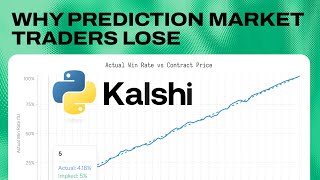
[04:17] so, if you look on his website, he has an interactive version published here and this graph is actual win rate versus prices on Kalshi are priced from 1 cent to 99 cent and you can see down here at
[04:30] the bottom level for these long shots, if you'll you're going to pay 5 cents for a contract, meaning it's implied this has a 5% chance of happening, but history, you'll find uh anything you paid 5 cents for actually only had a
[04:42] 4.18% chance of occurring. So, let's revisit my Houston Rockets trade here, where I paid 7 cents a contract. An emotional uh long shot bias type of person might say, hey, it's cheaper now, it's 4%, so I can
[04:55] buy it for 4 cents. Why don't I average down, double down, and I'll even have a bigger long shot. Well, it turns out when you do the analysis and run it through the data set, you'll see that the better trade is to say, no, this
[05:09] Houston Rockets will not win. And so, it's actually the better trade to buy it's actually the better trade to buy the 94% chance that uh something is not to buy the no. Houston Rockets are not going to win the NBA championship. The
[05:24] implied uh probability here is 94%, but what actually happens it is that this wins 95% of the time. So, you have an edge by buying the more expensive no contract or selling the yes to the guy that's betting on the long shot. Now,
[05:37] the second finding in his paper is on how you trade. So, his paper found that makers, so the people that are placing the limit orders and waiting for the trade to actually fill, are making a 2.5% excess returns per trade. And
[05:51] spamming the buy button and trying to get in at any price and just emotionally betting, uh are losing a corresponding amount. And this doesn't just apply to amount. And this doesn't just apply to Kalshi. Uh he references a 2025 study
[06:04] entitled Exploring Decentralized Prediction Markets. So, it's not just uh Kalshi, there's a paper that studied uh Polymarket uh betting uh by This is Reichenbach and Walther here. Uh and this goes through and shows uh the same
[06:18] effect in in Polymarket as well. And so, to illustrate this further, what I did was create a custom uh script here and what I wanted to do is find uh how much what I wanted to do is find uh how much money NBA takers lost on the NBA finals.
[06:31] And so, you think about it, there's like 29 or 30 teams, right? And then there's long shots and they're just paying whatever price uh they can to get into the trade. And so, we can do here, the uh first script uh that I ran and showed
[06:45] you was built into the GitHub repository called win rate by price, but I have an NBA study here and what I wanted to do was go through all the NBA teams and see uh which people lost the most uh money. And so, what I can do now is do make
[06:58] analyze uh NBA, right? And this will run my NBA.py here and what this does is aggregate all of the losses by across all the teams. So, uh Oklahoma City Thunder won the NBA finals, so a certain number of people won that bet on
[07:13] Oklahoma City Thunder Thunder, but everyone else that bet uh lost and we want to see how much. And so, if you look the output here, here's some of the markets. So, these are the top eight fan losses. A lot of people at the end there
[07:25] were betting that the Indiana Pacers would win the NBA finals. $5 million was lost in that trade. Uh over a million dollars was won on just betting on the favorite Oklahoma City Thunder to win the NBA finals, but Celtics fans, Knicks
[07:39] fans, Timberwolves, Cavaliers, Golden State Warriors, Nuggets, Lakers. And so, you see in aggregate uh nearly $7 million were lost in these taker bets on uh long shot teams to win the NBA finals. Now, next I want to talk about a
[07:52] bias that isn't in Becker's article. I was doing a little bit of research my own and finding other papers and I found that before he wrote his uh blog post, there was another article that he didn't reference uh that's called Makers and
[08:05] Takers, The Economics of the Kalshi Prediction Markets and that was written at University College Dublin, July of 2025. And this one uh studied Kalshi as well. And I saw another bias called the Yogi
[08:19] Berra bias. It ain't over till it's over. So, he's a baseball player that over, until the fat lady sings, whatever, right? And so, we'll find is that this is another type of bias uh in Kalshi prediction markets. So, what they
[08:33] originally identified that bias, It ain't over till it's over, Yogi Berra's bias in prediction markets. And this uh paper was written in 2012. So, people were talking about prediction markets for a long time before Kalshi and uh
[08:47] this bias is. Uh so, let's pretend it's an NBA game, for instance, and your team is down by like 20-something points with a minute and a half left or something like that, right? And the probability is probably uh 99% uh that your team is
[09:02] going to lose. But instead of you cashing out and taking what you can, right? You're just going to hold on till the very end saying, well, you know, you really you're making uh the wrong bet
[09:14] moving on, uh you're just going to hold on to your position or you might even buy more at 1 or 2 cents uh and just hope pray for pray for a miracle. And so, here you refuse to update your beliefs even though the outcome is
[09:28] so, you're basically just pouring money uh into a dead bet. And so, what I did here is write another custom script called the Yogi Yogi Berra study. So, you can study whatever you want on here. And so, this one uh I studied
[09:41] specifically uh NFL and NBA bets. And so, what you can do is find uh market so, what you can do is find uh market tickers on Kalshi like KXNBA or KXNFL to really hone in on particular uh markets. And so, in this script, uh I looked for
[09:54] yes contracts that were bought uh at 2 cents or less during the final 4 hours of the market. So, towards the end, even though uh there's a 98% chance your team's going to lose, these people bought 1 or 2% uh long shots anyway. And
[10:09] here, but it's a little bit different in that I'm basically doubling down on long shot or not cutting my losses. I'm holding on in even bigger hopes towards the end that a miracle is going to
[10:21] happen and that it ain't over uh till it's over and I can run this one. So, uh Yogi Berra, right? And I have this in my article. And so, when my Yogi Berra script runs, it'll find uh the top games where people
[10:36] were just buying till the very end, 1 or 2 cents, not updating uh their beliefs and losing money in the process. The other bias that was studied is the so-called optimism tax or the default bias. And so, people inherently just
[10:50] to say, "Yes, the Houston Rockets are going to win. Yes, K- Kamala Harris is going to be the president." They open up Kalshi or Polymarket and yes is highlighted by default and they just click buy a yes contract. That's them
[11:04] entering the trade. When really uh when he goes through and states the data, he shows that the yes contracts are actually at a disadvantage and you should actually be buying the no position. Now, if you happen to watch my
[11:16] uh prediction market assistant video where I used a large language models and news APIs, uh I made this about a year ago, prediction market assistant with Perplexity Sonar API and Kalshi API. And so, what I did in this video is I used
[11:29] Perplexity and I used Grok as well since it had a lot of uh current information and is able to search the news and I had it look through and figure out which of these markets were likely overpriced. And obviously, it said people like
[11:41] Stephen A. Smith, Michelle Obama, Mark Cuban, etc. are probably uh overpriced, right? Even though it would be really funny, a funny outcome if uh Mark Cuban or uh Stephen A. Smith became uh the president of the United States uh
[11:54] is probably not going to happen. It's better to just say no and go against that default. Um related to that, there's another bias called the emotional divide here and this is related to the category. So, we had uh
[12:07] biases of long shot gambling. We had biases of just selecting the default yes. We had the bias that's temporal, so time uh bias saying, "Oh, it's not over till it's over. You don't know." Um now, this isn't a category-related uh bias.
[12:21] And this says that certain categories are less efficient. So, uh what Becker found, if you run the analysis scripts here, you'll see that the entertainment category uh has a lot more emotional betting and so does crypto. People want
[12:34] to say, "I used to see a prediction that Ethereum was going to hit 150,000 uh in 2021 or 2022." There's a lot of videos of that on YouTube that were funny. And then sports as well, there's team loyalty biases as well. And so, um
[12:48] if you want to exploit some of these biases, what you would do is target the category. And he found uh boring categories like finance were a lot more efficient, right? And so, these these uh odds on rate cuts, CPI, and so forth,
[13:04] real information there. Whereas someone on an entertainment bet is just voting on their favorite person or their favorite team uh and so forth. Now, one while we've been discussing this is that occasionally long shot bets do pay off.
[13:19] live in the US, you might have watched the College Football National Championship where the Indiana Hoosiers of all teams uh won the championship. They went 16 and 0. And this team would They're not a traditional college
[13:32] football program that anyone would expect to win, but they beat Alabama, Ohio State, all these big-name teams and won the championship. So, the odds of occasionally one of these is going to hit.
[13:44] But uh how you really need to be thinking about this is like uh being the casino. And so, occasionally the someone's going to bet all their money on double zero and it is going to hit. Um but the idea is that you have enough
[13:57] bets out there that mathematically you know it's going to work out in your favor favor. So, most of the time this double zero is not going to hit, but one out. And so, this isn't really just a bet one time type of strategy. It's a
[14:11] diversifying over a large number of bets. You have slight mathematical edges if you approach it uh the right way. And so, uh how do you put all of this into a strategy, right? We discussed a lot of biases. Um right? And so, what what I'm
[14:25] these biases, is the nothing ever happens strategy. And um this is kind of a meme on Twitter. Uh and so, ba- basically, you're betting against these lottery tickets paying out. And so, every single year uh you'll you'll hear
[14:40] people saying, "Oh, World War III is going to happen. Uh someone's releasing Google's dead." And there's this narrative that happens where people overexaggerate the probability of some uh long shot happening, right? Google's
[14:53] going to get destroyed by LLMs. But actually, nothing happened. It's just a complete nothingburgers. And a lot of people have seen this chart or versions stock market is going to crash every year and it's all going to end. But
[15:08] nonetheless, over decades and decades of time, despite uh Russia invading Ukraine, COVID, uh deep seek, tariff tantrum, all these, and we're still at tantrum, all these, and we're still at new all-time highs. And so, despite all
[15:22] these black swans that are supposed to happen, there's very rarely um people overestimate how often one of these is going to uh happen. And the most likely case is things are just going to keep going as usual. And so, how do you
[15:35] implement this? Um number one, uh go through emotional categories that we identified like politics, sports, media, maybe crypto. Uh second, you want to look at the long shot contracts. So, these are ones that are like around 5
[15:48] cents, 10 cents uh in those emotional categories. Third, it's probably better to go on the opposite side, buy no against those particular uh long shot bets uh working out. Uh next, it's better to be a maker, so place a limit
[16:03] order, not a market order, and just wait for the bet to come to you. And then finally, diversify across a number of markets, a number of bets because one of them might work against against you, but you can make a number of bets and have
[16:16] that slight mathematical edge, at least according to the data that we studied in 72 million trades. And so, what you want to do here is not necessarily predict the future, but instead just place limit orders against these overly optimistic
[16:30] bettors that are betting on long shots and just collect the hope premium. And so, everyone wants to win the lottery. They want something to exciting to of the time, it doesn't. Usually, the boring outcome
[16:44] wins. Nothing ever happens. That's all. See you in the next video. Bye.
⚡ Saved you 0h 16m reading this? Transcribe any YouTube video for free — no signup needed.