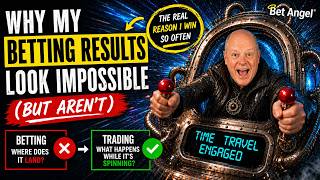

Why My Bets Look Too Good to Be True
56sThis segment directly addresses viewer skepticism by promising an explanation for seemingly impossible win rates.
▶ Play Clip"Delivers exactly what the title promises: a clear explanation of why trading results appear too good to be true."
The speaker explains why his betting results appear impossibly good, attributing it to trading rather than traditional betting. By profiting from market movements and reusing stakes through instant settlement, he achieves high win rates on major events like Cheltenham and the US Masters.
The speaker acknowledges that people are skeptical of his consistently high win rates due to a quarter-century of proven results.
He started trading over 25 years ago, faced skepticism, and has since won on every race at Cheltenham, a seemingly impossible feat.
Trading involves profiting from market movements during an event, not the final outcome. Unlike betting, trading is not a 50/50 chance.
The speaker compares trading to a coin toss where you bet on the number of heads as the coin spins, not the final result.
He profits from the market moving between start and finish, making win rates better than random chance.
When trading, money is available again after a trade, allowing reuse of stakes. For example, backing at 4.5 and laying at 4.4 yields profit with the same stake reusable.
Reusing a £100 stake 10 times generates £100 profit with limited risk, effectively trading with free money.
High liquidity events like Cheltenham allow more trades and reduce loss probability, while smaller events have narrow windows and lower win rates.
Events like Cheltenham offer 30-minute trading windows and high volume, enabling many trades that build a buffer against last-minute market shifts.
Success is not magic but a methodical approach using market structure, liquidity, and time to achieve high strike rates on major events.
The speaker's exceptional results stem from a methodical trading strategy that leverages market movements, instant settlement, and high liquidity events, rather than relying on luck or conventional betting.
What is the key difference between trading and betting according to the speaker?
Trading relies on market movements during an event, not the final outcome.
03:10
How does instant settlement benefit traders?
It allows the same stake to be reused multiple times, effectively leveraging small capital.
07:26
Why does the speaker have a higher win rate at events like Cheltenham?
High liquidity and longer trading windows allow many trades, reducing chance of loss.
11:14
What analogy does the speaker use to explain trading versus betting?
Tossing a coin: betting is predicting heads/tails, trading is betting on the spin before it lands.
04:47
What was the speaker's win record at Cheltenham?
He won on all 28 races.
03:39
Trading vs. Betting Distinction
Fundamental insight that trading profits from market movements, not event outcomes.
03:10Instant Settlement Power
Key technique that allows stake reuse and leverage, making trading profitable.
07:26Liquidity Drives Success
Principle that high-liquidity events enable more trades and higher win rates.
09:3828 Wins at Cheltenham
Impressive factual result demonstrating the effectiveness of the method.
03:39Methodical Approach Over Luck
Concluding insight that success comes from method, not magic.
14:16[00:01] a decent result, uh, because a lot of people struggle to come to terms with the fact that I'm, in fact, a time traveler and I know the results and can bet on it Either that or there's something that I'm doing that is actually conducive
[00:20] And what I want to talk to you in this video about is why I seem to win much more frequently than people reasonably expect.
[00:36] I do post, um, some very big results and my motivation for doing that isn't to get you to use my software or visit my YouTube channel or anything like that.
[00:49] It's to show you that I'm still doing it. When I first started doing what I do many, many years ago, nearly, well, a quarter of a century, over a quarter of a century ago, people were incredibly skeptical.
[01:01] and you know, come back in five years time and see if you can do that again. So earlier this year in March, I posted up my results from Chel, and in fact, I did
[01:16] it day by day and I won on every single race at Chel, which seems impossible, but And every year that I post up the results, I get the same sort But the fact is, I've won on every single race now at Chatham
[01:32] It just seems incredible that that could even be the case. Um, but the interesting thing is, not so long ago, I actually did
[01:44] And I did it strategically timed just before the Grand 'cause I pretty much knew that I was definitely gonna win pretty much. That's a weird way of putting it, but you know, I was as sure as can be
[01:59] that I was going to win, um, on the Grand National and the US Masters. And then maybe that will just temper the negative feedback that I get. I posted up my grand national results, um, and it wasn't actually that big this year.
[02:15] uh, I can explain elsewhere. Skeptics came out and sort of said, oh, you know, do you ever post a loss? I've had one loss in all the time that I've been active on the Grand
[02:28] I just messed up really. result at the halfway stage of the US Masters and um, and that just You know, it can't be genuine some way or another, or there's
[02:44] But the fact is there is absolutely nothing weird going on. I can get to this stage, but also the fact that yes, I do make losses, but
[02:57] Um, and also definitely not on the sort of events that I tend to post. Uh, let's move on to that and discuss those specific aspects now.
[03:10] So to put the first bit of context in here is what I'm doing when I'm active higher price than I lay out and I'm netting a profit between the two.
[03:22] you place a bet, say you place a bet on a horse that it's evens. That's about a 50% chance of that horse going on to win. So if you are able to find and successfully bet on 20 horses,
[03:39] uh, shot of getting that correct. However, with trading, it's a lot simpler to do that. And bear in mind, at Chatham, I managed to win on all 28 races now.
[03:57] you've got to figure out which direction it's going into and you've, and you Um, trading, there's no science or logic or anything to it. While you're definitely wrong there as well, because the problem is
[04:13] Know which direction the odds are going in and you can't because it's random. they found on the internet. somebody that doesn't trade.
[04:28] Uh, they probably gave it a go figured out it was easy to write a book about it and So I see a lot of really bad quality information on trading out there. Um, but yeah, you know, you could trade, treat trading as a 50 50 chance and
[04:47] therefore you're no better off than backing an even shot on a horse race. absolutely nothing like that. trading, uh, with a coin toss.
[05:01] That is the outcome of that particular. And the as a consequence, you know, if heads or towels, So no matter how many times you toss it, you're not gonna
[05:15] It's always gonna be at or about 50%. So as a consequence, you are tied to that in terms of the results that you Sometimes you're gonna lose others and you know, that's just the way that it goes.
[05:31] You're always gonna end up around that 50% mark. coin, you're not betting on the outcome of the event where it's gonna land. You're betting on the number of heads that are gonna show effectively, um,
[05:45] as the coin is spinning through the air on its path to its eventual outcome. market and jumping out and jumping in. You know, I'm betting on one particular turn of that coin and then
[05:58] And by the time the coin lands, whether that be before an event starts, or you know, at the cut at the US Masters or something, I'm trading in and out constantly through there in order to be able to profit,
[06:13] So when you look at this from a. A market perspective from a Betfair trading perspective, you're saying, here's the start, here's the finish. It's gonna fly around all over the place, and I'm gonna profit from that.
[06:28] is square and I'm out of the market. So you'll get radically different, uh, percentage return win rates, uh, when you It'll be a 50 50, but when you're betting on what happens during
[06:45] So that's one of the first reasons that you see me post results that are seemingly very, very consistent and much higher than you would typically expect. Because I'm not reliant upon the outcome, I'm reliant upon the market
[07:00] moving around a little bit between when the market starts and when it ends. So yeah, conceptualize that because that's one of the key advantages to trading over traditional vetting.
[07:12] pound on the favorite in the next horse race, when we put that a hundred pound down, we have to wait for that race to finish before we know. Uh, you know, if we've got that money back and, and we can use it again.
[07:26] available to, to, to use again. Now it's different in trading because what I'm, I'm going into a market. Um, and let's say that I backed something at 4.5.
[07:43] And then I lay the same selection back into the market at 4.4, then that is So let's say I was using a hundred pound. Um, stake value or trade value, if you prefer to call it that.
[07:57] And by backing it 4.5 and laying at 4.4. But the remarkable thing is, um, that money is available for me to raise again. Um, you don't hear people talking about it much, uh, but that stake
[08:12] So if I could go into the market again and perform the same trade 10 pound profit. Um, if I do that 10 times, I'm effectively trading with free money.
[08:25] pound profit within the market. And that means that you can leverage a relatively small stake If you put a hundred pound through the market 10 times, you're effectively.
[08:40] Trading with a thousand pound, and let's say that you were trading with a thousand pound and did it 10 times, you'd be trading with 10,000 pound in total stake But of course, your risk will always be limited to that individual stake.
[08:55] And really, if you're trading properly, only a small percentage of that. up with some pretty serious numbers. So yeah, the instant settlement process allows you to reuse your stake, and by
[09:08] reusing your stake and getting a positive trade, you're lowering your risk, but which flatters your individual results. course of the day, you could end up earning multiples of that a hundred
[09:23] But that's the wonder of instant settlement. So different events have different characteristics to them as well. So at an event like hanham, that's almost the perfect trading market for me.
[09:38] The higher the volume and liquidity there is within a market, the more But if we go to an average midweek race meeting or a smaller sports event.
[09:52] Um, then that becomes much, much harder to do. isn't gonna be enough volume and liquidity in them for me to do anything special, or, it's certainly not at the level of risk that I feel comfortable with.
[10:07] being traded on the US Masters, and therefore it's easy for me to pluck And over a long period of time.
[10:19] Take into account as well. So if we're looking at a, a small midweek race meeting or something like that, I've got a very narrow time window in which to make a decision.
[10:32] comes into the market, when that volume and liquidity is just right. actively trade and I can trade that.
[10:45] of the other events that I do. But also the amount of trades I can get through in that window is quite small. about, um, I can't get as many trades through the market and therefore
[10:59] And if you look at the average midweek, I'm gonna have wins and losses. That's how most of my trading tends. I get a mixture of wins and losses, um, but I just win more than I lose
[11:14] overall on the scheme of things, on your average day-to-day meeting. However, when we get to a much larger sports event, when the longer with bigger amounts of money.
[11:28] So if we look at an event like, uh, Cheltham, I'll be trading for a good 30 minutes on those particular markets and therefore it's much less likely that I'll end up with a loss simply because I can get so many more trades through.
[11:43] And the maths that I was sort of talking about before all begin to balance I can put that money through the market repeatedly with the same stake and gradually whittle away, um, to the position where it's very
[11:55] Even if the market turns against me in the last couple of minutes, I've probably got enough of a buffer in that markets to not to have to take a loss. for pretty much the whole day, the liquidity's there for most of the day.
[12:13] Uh, so that is another event where I'm very unlikely to be able to make a loss. Um, I can trade that for four days effectively if I really wanted to. market as possible, um, and get myself into the position where I can't lose.
[12:31] bigger events, is you're trying to get enough trades through the market that Your total profit is bigger than the stake that you put within the market. So yeah, bigger events, much, much more likely.
[12:48] volume, the liquidity, or the time to pull off the same sort of trades. So if you wanna know why I have such a high strike rate, it's because I'm a
[13:02] Or maybe not. Maybe it's just down to the way that I do things and the way But that very much relies upon the, the structure of the markets and the liquidity
[13:18] So if you look at a ordinary race meeting or pretty standard event. I'm gonna be less successful at, at that than I am at the much bigger events. And if we look at an ordinary race meeting during the week, then maybe I'll win
[13:31] Um, and you know, that's still a pretty high strike rate, but that's because I'm trading, remember the coin toss that explains why that strike rate is so high.
[13:43] So I sort of go into everyday expecting that I've got a good chance of winning, but I may not, I, you know, may just go on a bad run, not do particularly well But by the end of the week I do expect to be up.
[13:58] The large number of markets that I trade so I can trade, you know, maybe And if I've got a 1% edge on those thousand markets, then I only need over that sequence of events.
[14:16] Talked about staking, I've talked about the trading process. I've talked about various different aspects, but if you want to know why those numbers are particularly high, especially at those big meetings, at those big sports
[14:28] events, that's the reason why there's no secret trick, no particular magic. It's just a very methodical way of approaching these particular markets, and it's something that you can do too.
⚡ Saved you 0h 15m reading this? Transcribe any YouTube video for free — no signup needed.