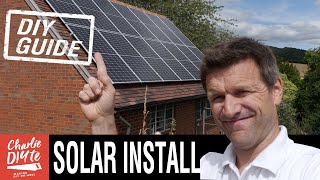

Solar Panels: DIY Install or Not?
45sThe speaker's honest assessment that DIY solar installation may not be worth the effort, despite cost savings, sparks debate and curiosity.
▶ Play Clip"Title accurately describes a complete run-through of a solar panel install from a homeowner's perspective."
A homeowner shares their experience installing a solar panel system, covering the decision-making process, equipment choices, installation steps, and cost considerations. They discuss the benefits of solar panels, inverters, and battery storage, and provide insights on whether DIY installation is worthwhile.
The video is a complete run-through of a solar panel install from a homeowner's perspective, discussing what to do and what to avoid.
Decided to install solar after getting a charge point, anticipating rising electricity bills due to price cap lift in April.
Two main panel options: all-black (less efficient, more expensive) and standard (more efficient, cheaper). Black panels absorb heat, reducing performance.
In-roof systems are more streamlined but take three times longer to install and cost more. Rail systems allow air circulation, keeping panels cooler and more efficient.
Panels should face south, southwest, or southeast for optimal sunlight. Direct sunlight can quickly charge batteries from 17% to 100%.
Inverter converts DC from panels to AC for home use, manages power distribution to house, batteries, or grid, and provides monitoring via an app.
Batteries store excess energy for use at night or during low generation. They can also be charged at cheap night rates for daytime use.
Contacted several local companies; many were unresponsive or busy. Eventually got kit from a company that also sent an electrician for inverter/battery install.
14 Canadian Solar 415W panels, Renusole roof hooks, rails, DC cable, MC4 connectors, Luxpower 3.6kW hybrid inverter, four 2.4kWh Pylon batteries (total 9.6kWh).
Chose to install panels himself because he was retiling the roof and wanted to create content for his channel. Installer charges £600 for a one-day install.
Concludes it wasn't worth it unless retiling the roof or making content. DIY voids warranty and requires significant effort.
Placed inverter and batteries in the loft, which required flooring. Used 22mm moisture-resistant chipboard flooring.
Self-installing inverter/battery is not recommended due to Part P regulations, DC safety risks, and need for certifications (MCS, DNO approval) for grid export.
System costs between £10,000 and £12,000. Payback period is now 4-5 years due to rising electricity prices.
LuxPower app shows real-time generation, consumption, and battery status. Allows monitoring and adjustments.
Indra charge point has problems with solar charging; recommends a solar ecosystem product like Zappi for better integration.
Real-time monitoring has made him more conscious of consumption, leading to behavior changes like managing hot tub usage.
Octopus Agile tariff offers higher export rates but is incompatible with cheap night rates for EV charging. Sticks with Octopus Go for now.
Plans to provide another update in 12 months with bill comparisons. Payback period now 4-5 years.
Installing solar panels can significantly reduce electricity bills, especially with rising energy prices, but DIY installation may not be worth the effort unless you have specific circumstances like retiling a roof. Proper planning, professional installation, and choosing the right tariff are crucial for maximizing savings.
What are the two main options for solar panels mentioned?
All-black panels and standard panels.
01:08
Why are black solar panels less efficient than standard ones?
Black gaps between photovoltaic cells absorb heat instead of reflecting it, and hotter panels perform worse.
01:22
What is the function of an inverter in a solar system?
It converts DC current from panels into AC for home use and manages power distribution to house, batteries, or grid.
03:23
What is the recommended orientation for solar panels?
South, southwest, or southeast roof.
02:56
What is the estimated payback period for solar panels according to the video?
4 to 5 years.
21:22
What certifications are needed to export surplus electricity to the grid?
MCS installation certificate and DNO approval.
15:18
What is the cost range for a solar system like the one in the video?
Between £10,000 and £12,000.
15:55
What is the advantage of a rail system over an in-roof system?
Rail systems allow air circulation underneath panels, keeping them cooler and more efficient (up to 10% more efficient).
02:41
What is the capacity of the battery system installed?
9.6 kWh (four 2.4 kWh Pylon batteries).
07:19
What is the export rate mentioned for the Octopus Go tariff?
4.1 pence per kilowatt hour.
19:52
Rodent entry point concern
The hook stops raise tiles, creating potential entry points for rodents, which the homeowner found concerning.
08:54DIY not worth it
The homeowner admits that DIY installation was not worth it unless retiling the roof or making content.
12:37Charge point compatibility issues
The Indra charge point has problems with solar charging, highlighting the importance of choosing compatible equipment.
17:32[00:00] In today's video I'm going to be doing a complete run-through of my recent solar panel install looking at everything from a homeowner's perspective. I'm going to be discussing what you can and perhaps shouldn't be doing yourself
[00:12] and telling you how I've got on with the solar panels, inverter and battery system. So let's start from the beginning. Why did I decide to install solar panels? Well
[00:27] Having just gone through the install process from my charge point, which you might have seen in a previous video, it seemed to make sense for me to install solar. Although I'll come on to it towards the end whether actually it's that beneficial in terms of charging up your car. With April fast
[00:41] approaching and the price caps about to be lifted, I had a sneaking suspicion a lot of people would pile into solar once they realised their electricity bills were going to soar. And it wasn't an easy decision for me to have to make because this kit is not cheap and it's basically cleared me out.
[00:56] And I didn't quite get in in time either, because I part-ordered the kit, the rails, and the solar panels before April, but availability plummeted and prices went up in May, once the price cap had gone.
[01:08] But what are your options when you're thinking of installing solar panels? Well, you've got two main options on the panels themselves, all black, or the standard panels that I've gone for. You might be thinking about black panels because perhaps you're worried about what the neighbours might think.
[01:22] Curve appeal, you might want to try and make sure it doesn't affect the look of your house. But you must remember that black panels are less efficient than the standard ones. Why? Because the black gaps in between the photovoltaic cells absorb heat instead of reflecting it.
[01:37] And the hotter a panel gets, the worse it performs. And you also need to take into account the fact that black panels are actually more expensive than the standard ones. The standard ones tend to be more powerful, mine being 450 watts.
[01:51] Should you go with an in-roof or a rail system? Now an in-roof system is clearly more streamlined. It also dispenses with the worry you might have about birds nesting underneath the solar panels. But let me tell you this, because of the way it's installed, it's effectively like installing, I don't know, a VLUX window,
[02:07] in the sense that you've got to take the tiles off, you've got to install soakers to go around the panels, I think. Again, you might correct me on that, but certainly they fit into some sort of a tray system. they, according to my installer, take three times as long to fit as the standard rail system that you'll see in today's video.
[02:25] And with three times the duration, it's going to cost you a lot more. And actually, given the massive domestic demand and lack of supply at the moment, a lot of the installers are choosing not to fit the in-route systems because it's so much quicker to fit rail systems like mine.
[02:41] The other point to make about integrated solar panels that you might not have thought about is because they're integrated into the roof rather than having all that lovely air circulating underneath them they do get warmer and a hot solar panel, as I mentioned earlier, is less efficient
[02:56] and they reckon they can be up to 10% less efficient than the on-rail systems At risk of staying the obvious, the orientation, the position you put your panels is really important You want them to be on the south, southwest or southeast roof of your house
[03:10] And if you don't think that's important, this was Tuesday at half past 12 on a hot classroom day but with no direct sunlight. Batteries only at 17% charge. A couple of hours of sunshine and they're straight up to 100.
[03:23] And the other point that you probably haven't considered when you're looking at solar panels is at the very least you're going to need an inverter because what that does is convert the DC current that comes out of the panel into AC that your house can use
[03:35] And the inverter will also do all the clever stuff, like decide when the power should be channeled into your house or into the batteries, or even exported to the grid if that's what you choose to do. And you'll have an app with that inverter which enables you to monitor what's going on and make changes.
[03:52] You might not be thinking about installing batteries, but I'd say this is pretty important, because otherwise you're only relying on powering your house during the day when the sun's shining. Once the solar panels have charged the batteries, you can use that excess energy that's still being degenerated by the solar panels to, I don't know, heat the hot water tank via the immersion heater, heat your hot tub, run your dishwasher, any other host of requirements.
[04:17] And there's another point to make here. In the winter, when the solar panels are not going to be generating anything like the electricity that they're doing in the summer, if, like me, you're on an In-Vita, if I'm on the Octopus GoTask, which gives you a cheaper 7.5 pence per kilowatt hour electricity during the night,
[04:34] for four hours during the night, between half past midnight and 4.30 in the morning than you get during the daytime, you're going to want to use that cheap rate at night to charge your batteries up so that then you can run your house off those batteries during the day.
[04:48] So what supply did I decide to use for my install? Well, it's surprisingly difficult, this. I googled and contacted, I think, maybe four or five local companies. A couple of them never bothered to come back to me.
[05:01] One told me to come back to them when I'd installed the new roof. I didn't understand why they couldn't do a survey before that. And one of them is the most local installer that I've got around here. They took about three months to come back to me with a quote and then told me that they couldn't do anything for me until September.
[05:16] Fortunately, Sam on our Discord chat group that you can access through my Patreon channel had done a similar install up north and I contacted the company that he used. They don't install this far south, but they did agree to supply me with the kit,
[05:32] which I'll come on to in a minute, so that I could install the solar panels myself and they agreed that they might send the electrician down for a day to install the inverter and batteries. What actually happened in the end is they were doing a job down in Cardiff and were able to pop back up on the way back to install the inverter and the battery system, which I'll come on to in a minute.
[05:51] I not going to mention who they are today because they so busy they actually don want any more work which is a great shame because they a fantastic company very conscientious scrupulous with all the paperwork that you have to provide and with the kit that they supplied Which brings us nearly onto that kit I going to quickly list here all the kit
[06:09] that I've used for this project. We've got the 14 Canadian Solar 415 Watt super high-powered solar panels. I've then got eight end clamps, 24 middle clamps, 36 of these Renusole roof hooks
[06:24] which I chose specifically for my plain Rosenreitz-style roof tiles. And on the rails I slotted a 4.4m rail into a 3.3m rail to give a 7.7m run across the roof,
[06:36] and obviously there are four of those up the roof, along with four rail connectors to splice each pair of rails together. I've got this roll of 4mm single core DC cable, 36 hook stops which enable you to walk on the rails,
[06:51] that's a very important point without breaking the tile below. I was also supplied with four male and four female MC4 connectors, although I actually only needed two of each. I've got the end caps that I've decided to use.
[07:03] You don't always see these but I thought it would be so much neater to put them onto the ends of each rail. Cable floor 22mm chipboard, I'll mention that more towards the end to go up and then off so that we could safely locate the inverter and battery systems.
[07:19] You've got a Luxpower 3.6kW hybrid inverter, four 2.4kWh pylon batteries, giving me obviously a total output of 9.6kWh, and a data cabinet to put them in. The system also has this generation
[07:34] meter and two rotary isolator switches. The tools I use the most significant would I'd say would be the impact driver, 6x80mm wood screws, although I went for marine grade A4 stainless
[07:46] steel probably not necessary my socket set crimping tool cable clips and nylon bands to tie the cables against the rails now I'll come down to whether this was a good idea or not before the end of the video but I decided because I was
[08:00] retiling garage roof there are a couple of videos well four of the videos on that to be precise you can check out on this channel I thought it would make sense for me to install the solar panels myself and with that in mind the
[08:13] company that supplied them provided me with a very helpful sequence of events which I've repeated here. So the first thing I had to do was install the hooks using the wood screws that I just mentioned. Renisole was in the supplier's
[08:25] opinion the best mounting solution and uses this rubber hook stop so the tile beneath doesn't break either when you're walking on the rails which is a very important point or I suppose later on when the wind is buffeting those solar
[08:38] the panels in the future. Now they are meant to be installed this way up but I wasn't going to do that because that's just going to be a massive dirt and dust trap so as a lot of other installers have done I've actually installed mine this way up. I've got to be honest with you I don't think
[08:54] this system is a perfect solution. I don't honestly like these hookstocks because they raise the tile up And this would provide a perfect entry point for rodents, bats, wasps and the like to get
[09:09] in underneath the tiles and make their home between the tiles and the breathable roof membrane. So after experimenting with everything from reticulated foam to lead roll, I decided the simplest thing to do would be to fill up the gaps with sand and cement mix.
[09:25] It was quite a tricky process trying to work out where to position these hooks and I ended up doing a very lo-fi diagram in Microsoft Word which gave me a bit of an idea of how
[09:37] to space the hooks on one hand and as you've probably guessed the hooks themselves are screwed into the rafters. Not going anywhere. And then it was just a question of trying to estimate
[09:50] how far up the roof to position them which isn't the easiest job. I did take some markers at this point from the Renusol installation guide, a link to which I'll enclose in the description, below this video and that tells you important stuff like spacing between panels and how long
[10:07] the rails should project out of the side. With the hooks in and the roof tiling nearing completion I was able to install the rails and this again was quite an important step because with most of
[10:19] the roof tiled the rails are an important way that you can walk across the tiled roof and a couple of ladders fitted neatly onto the bottom bottom rails which enabled us to walk up and down the rails on on the roof very safely.
[10:33] And my carpenter mate John, who you see here in this clip, has a brilliant idea of stringing a short line between the top and bottom rails, enabling us to get all four rails to line up perfectly. As I was retiling the roof, I put the DC cables in position
[10:46] and you can see here the two longer cables coiled up ready to be threaded across the length of the roof, tied off to the rails with cable ties. I was instructed to wire the panels up in two strings of seven, as you can see in this diagram,
[10:59] with the cables at each end of the string, so panels 1 and 7 go back to the inverter location. So in my case I ended up with 4 cables, 2 from each string going back to the inverter. The solar panels come supplied with male and female MC4 connectors, so that they can be easily connected to each other.
[11:16] But you obviously need to add a male and female MC4 to the DC extension cables at each end of the string. And for this you need a crimping tool, I bought this one from Amazon. We then had some fun and games trying to work out why we couldn't tighten our M24 connectors
[11:30] so that all the thread would disappear like the ones on the back of the solar panels, until we realised that they were two completely different designs that locked off very differently. It was time to install the panels themselves and we started from one end making sure the first two
[11:46] panels were trued up against the roof verges. Not an easy task if the verge itself wasn't completely level The end clamps were bolted in place and we could then work across the roof pushing each middle clamp into the rail and then bolting it down to fix the corresponding two panels tied to the rail
[12:23] At this point I had one panel missing. I had an accident clearing out the garage loft when a bedhead fell and smashed into it. So, after doing that install, you have to ask yourself, was it worth it?
[12:37] Well, I'll tell you, I actually don't think it was. Unless I'd been retying my roof, which gave me the huge opportunity to get all of those hooks in the right place, and unless I had a YouTube channel which was going to give us all
[12:50] a really interesting talking point by showing how this install is done, I really don't think I would have bothered to have done it. A couple of reasons for that. Number one, the installer said to me that he charges £600 for his team
[13:04] to do that install and it would normally take them one day. Seems quite cute to me, but anyway. But number two, because I did that part of the install, those works wouldn't be covered by their normal warranty care package.
[13:17] So with the panels in and the wiring in position, I turned my attention to the possible location for the inverter and batteries. I mean, you've only got to look at my garage to realise that it didn't make a lot of sense to have these located at ground floor level.
[13:32] So I decided to put them up in the loft, which wasn't bordered and has a lot of clutter in it at the moment. So my loft needed flooring at least partially to enable them to install the kit. And after a bit of research, I settled for this cable floor,
[13:46] 22mm moisture-resistant tongue and groove chipboard flooring, all of which I bought from buildingmaterials.co.uk and delivered by Travis Perkins. I should point out that I bought this stuff and I'm not being paid to buy them to mention them in today's video.
[14:00] Now, I'll probably do a video of this at some point but suffice to say for now I had an experiment with the rather bizarre but effective plastic rail system that comes with the YAB HP Circular Soar
[14:12] and glued the boards together with my Egger adhesive and these spec floorboard screws purchased and here's a first through WeShop, which I'll come on to at the end of this video. Now, I do plan to board out the whole loft space at some point,
[14:25] but for the time being this creates a good space for the installers to work with, and a suitable location for the inverter and batteries. Two other things to mention. The inverter is connected to the consumer unit in the garage,
[14:39] and because I've got battery storage I needed comes from the inverter to the meter box, where a CT clamp connects to the meter tails. I installed an Armoured Cat5e cable as part of the ChargePoint install, as the ChargePoint also has its own CT clamp
[14:51] and used a pair of spare wires from that for this connection. So let's talk now about the inverter and batteries for a minute. Can you self-install these? Well, the obvious answer is no, because you've worked almost certainly notifiable under Part P.
[15:05] But even if you did, and I personally wouldn't recommend it, given that you're working with direct current from the solar panels, But also I wouldn't recommend it if you're planning to perhaps export any of your surplus electricity back to the grid.
[15:18] Because you need a whole host of certifications and approvals that your installer, if they're any good, will organise on your behalf. For example, you need an MCS installation certificate. You need to notify the DNO or your district network operator that the installation has been carried out for their approval,
[15:37] should you wish to export, because what you then have to do is apply separately to your electricity provider for a smart export guarantee, or SEG. And when I did that to Oxford Octopus, I had to submit my MPAM, the DNO approval confirmation,
[15:55] and also the MCS certificate. And what about the cost for a system like this? Well, I'll include a full breakdown of the cost of my kit on my Patreon page, But suffice to say for the time being, a system like mine is going to cost you right now between £10,000 and £12,000.
[16:12] So is all this cost worth it and will I recoup it and how quickly? With average bills set to sore to £3,200 from October, payback for the sale outlay should be quicker than ever before. But what will my monthly bills be like with this new system?
[16:25] Well, let's have a quick look at how the LuxPower app works. With the inverse of a very intuitive interface, which at a glance shows you exactly what's happening. And remember what the inverter does, it converts that DC power to AC and then you have to configure it or it decides automatically whether to send that power into your batteries, into your house or if you've chosen to export it to the grid.
[16:48] At times like this you can clearly see the house is running entirely off the electricity generated from the solar and not drawing anything from the grid. And in this shot you can see how even though our house consumption is 7.5kW, that's the car charging in the background, we're only drawing 3.8kW from the grid
[17:04] because 3.7kW is being contributed by the solar and 196W from the batteries. And here was the house requiring just 524W early on today and the battery is fully charged. We're exporting to the grid and
[17:19] at this point the solar charging has kicked in. You can swipe right to see a full timeline of your solar and battery charging status, consumption and what you're drawing from the grid over a 24-hour period. And at this point I've
[17:32] got to say I'm having massive problems with that Indra charge point which I mentioned in my last video. It's randomly charging at full power and it should be waiting for the off-peak tower and it's a launch itself as to when it kicks in
[17:44] for solar charging which it should be doing now but it's not. In solar mode there no battery priority margin or DC coupled mode that you can change in the settings all of which will be designed to tell the charge point not to charge the car off the batteries as it doing here only to draw charge off excess electricity
[18:04] More for me for not buying a solar ecosystem product like the Zappi, but then things have moved very quickly since I installed the charge point, at which point I had no idea I'd be installing solar panels and batteries. Also, when you are charging in solar mode,
[18:18] as I was over the weekend, you get anything between one and three, just over three kilowatts which is the sort of power you get from the three pin plug i.e for my 78 kilowatt hour ev battery you're going to be charging incredibly slowly now i only have the
[18:33] system installed on the 28th may so i can't at this point compare bills across multiple months to tell you about the drop in consumption and the savings that i've made and it's further complicated the fact that we're now coming into a heat wave when our electricity consumption is
[18:47] going to be lower but the times when i've been off grid are massively going to impact on my build and the only two things that really distort that at the moment are the hot tub, which I'm using sparingly, and also the EV.
[19:00] But because of that interesting visual you get with the app, and now that I know real-time what I'm consuming, I have become quite obsessed and notice when the consumption skyrockets and take evasive action to try and prevent it.
[19:13] For example, by turning the hot tub heater down if it suddenly kicked in during the day. So I'm trying to treat the hot tub like a large hot water tank and sort of charge it sparingly, particularly during nighttime hours and when I've got excess electricity that I can charge it with.
[19:27] And I recently had an unvented hot water tank fitted with this Tesla Immersion, so I could, in theory, keep the hot water tank from surplus electricity as well rather than from using the boiler.
[19:40] Now, the EV does complicate matters. Without it, I would have been very tempted to switch to the Octopus Agile Tariff where you have no control over the electricity price that you're paying per kilowatt hour during the day.
[19:52] But the advantage of that is the export rates that you're able to sell it back to the grid at are so much higher. For example, my export rate is fixed at 4.1 pence. But with the agile tires, you can be being paid by your supplier
[20:07] anything between 30 and 40 pence per kilowatt hour. Some on my Discord forum, for example, have had negative bills as a result of this. But I can't do that with my EV, because when I've got a chunky 78kWh battery to charge,
[20:20] I'm almost invariably going to be dipping into the daily kWh price, which is going to be expensive. And the other point to make here is if you want to export to the grid, you have to negotiate an export tariff.
[20:32] In addition to that import tariff you've already got. So, for example, the Octopus Go tariff I've got is not compatible with the Agile tariff. because of course I would be having my cake and eat it if I was able to sell at super high rates
[20:45] whilst benefiting from that cheap electricity at night. And electricity supplies aren't that stupid. But at least we go unable to take advantage of that 7.1, I think it is at the start of the video,
[20:57] pence per kilowatt hour electricity I have for four hours at night. And I'm charging everything from the EV to the dishwasher, washing machine, tumble dryer, and of course the hot tub using that cheap nightly rate.
[21:09] So all in all, this whole process and being super aware now of my electricity consumption is bound to impact on my electricity bills. And I look forward to giving you another update in 12 months' time.
[21:22] And also, don't forget, prices are going up again, sadly, in October, which might also be a motivating factor for you to decide whether you want to take the plunge and install one of these kits. I hope this driver gives you more information in the next update, but suffice to say, they used to quote a 10-year payback on solar, but now with the sky-high price of electricity, you're looking at something closer to four to five years untold.
[21:46] So what's all this WeShop malarkey I hear you ask? Well, it's a difficult one for me to fix this, because if you watch my channel regularly, you'll know I only post about stuff that I feel passionately about and believe in, so please hear me out on this one. WeShop got me involved a few months ago as a founder, Influencer.
[22:00] It's only recently launched. And what's quite cool about the platform is you get shares when you buy stuff. They're giving away 90% of the company to people who shop on it. They've signed up pretty much all the major retailers you can think of.
[22:14] And what I like about it personally is since experimenting with it since launch, I've bought everything from dishwasher tablets through to nail guns. And it's completely removed my reliance, or you could say addiction, to Amazon.
[22:28] And now I'm supporting a lot of UK retailers that we tend to forget were out there before Amazon came along. You get 20% of the value of what you buy and share. And if you post about stuff that people then buy themselves, you get 10% of that value.
[22:42] And if you bring people onto the platform, you get 1% of what they spend. And on signing up, and you do that by downloading the app in the usual way, and then you put in my username, Charlie White, because you can't just sign in randomly.
[22:54] You can have a look at my profile. I've got a load of wish lists that mirror the store I've got on Amazon and also posts on everything that I've bought. Little video clips explaining why I like stuff.
[23:06] So it's a bit like exclusive content you get from me on Patreon but the benefit for you is you get shares every time you buy. Now the reason I'm a bit loathe to push this as a hard sell to you on my cherished videos is I don't know what's going to happen to the platform,
[23:19] how well it's going to be taken up by the British public. You have to hold on to your shares for 12 months before you can sell them. they're going to list the company on NASDAQ if all things go well. But the way I'm looking at it at the moment is I'm buying stuff I'd be buying anyway, it's not costing me any more
[23:33] I'm supporting British retailers and I'm getting a lovely little potential nest egg of shares in the process. Come and play around with it and let me know what you think. So that's it for today. Have you found this useful? If you are new to my channel it would mean so much to me to have you subscribe.
[23:47] You can do that by clicking on the link here and don't forget to click the bell notification icon so you get notified of all my future uploads. See you soon.
⚡ Saved you 0h 23m reading this? Transcribe any YouTube video for free — no signup needed.