[00:01]
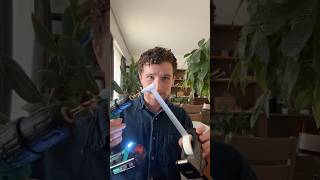
handy, unravel it and start moving it towards your arm. I'm attracted, baby. See, as tape pulls away from the roll, it leaves behind electrons through a process called contact electrification. I can take that
[00:14]
up a notch. If I use a drill, oh, if I use a drill to unwind the tape continuously, and I turn off the lights, well, I can see it starts to glow right here. The electrons leap from the negatively charged roll to the
[00:27]
positively charged tape, colliding with air molecules along the way, which then release photons. But what happens if there's no air at all? In a vacuum chamber, the leaping electrons travel at roughly a third of the speed of light
[00:39]
before smashing into the tape. And that sudden deceleration makes each electron lose kinetic energy, some of which is then emitted as X-rays. A group of researchers from UCLA were able to produce enough X-rays using this method
[00:51]
to image a finger. It's a DIY version of the process that Vilhelm Wernen developed in 1895 when he discovered X-rays. With it, he took the first images of the human skeleton, the start of radiology. Doctors started using
[01:04]
X-rays to image bones, lungs, and other organs less than a month after he published his results. It went on to transform medicine and won him the first ever Nobel Prize in physics. Meren spent his career on work that made the world
[01:17]
better, and 80,000 hours can help you to do the same. They're a nonprofit that gives free researchbacked advice on finding a career that tackles the you want to solve the next big problem or are simply looking for a path to a
[01:30]
more meaningful career, 80,000 Hours has the resources to help. Link in the the resources to help. Link in the description.