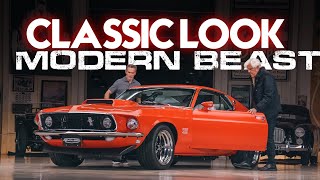

710HP Coyote in a '69 Mustang!
50sThe dramatic power upgrade from the original 375HP to 710HP creates a shocking contrast that car enthusiasts love.
▶ Play Clip"Title accurately describes a classic-looking Mustang with modern beastly performance; video delivers exactly that."
Jay Leno explores the Revology 1969 Boss 429 Mustang, a restomod that combines classic styling with modern engineering. Tom Scarpello, founder of Revology, details the car's all-new steel body, Coyote V8 engine with 710 horsepower, and advanced features like CAN bus wiring and structural adhesives.
The visual and dynamic aspects of a car are both art; performance is a key part of the art.
The car is a 1969 Mustang Boss 429 restomod with modern power, handling, and build quality.
Uses a Gen 4 5.0L TI-VCT DOHC V8 (Coyote) with a supercharger, rated at 710 hp; tested at 654 rear-wheel hp.
Only about 900-1000 built to homologate the engine for NASCAR; cars were sent to Carcraft for engine installation.
Revology uses a new all-steel body designed in CAD, with structural parts from the convertible for stiffness.
Heat-cured structural adhesive is used, an industry first in restomods, improving stiffness and corrosion resistance.
Original 429 was rated 375 gross hp (~320 net); modern Coyote with supercharger produces 710 hp with better drivability.
Customers want modern driving experience; many restomods neglect body structure, sealing, and electronics.
Re-engineered door handles, latches, and hinges for solid feel; seats and steering wheel redesigned by former Nissan designer.
Instrument panel uses genuine wood veneers; leather is Rolls-Royce Arctic leather from bulls raised at high altitude.
Hybrid CAN bus system reduces wiring by 75%; door modules control windows, locks, and mirrors.
All-new glass installed with polyurethane adhesive for safety and structural stiffness; made by Pilkington.
T-56 XL TK six-speed manual; clutch is progressive, shifts are precise.
Original cars had poor handling and build quality; modern restomods must meet high standards.
Car feels like a classic Mustang but with modern power and refinement; if Ford had continued, this is what it would be.
Car weighs 3,980 lbs, 425 lbs less than a modern Mustang GT; front/rear weight distribution 53/47.
Revology has delivered ~340 cars, 160 employees, two facilities totaling 85,000 sq ft.
Car costs $395,000; Leno endorses it as well-built and worth the price for a fully integrated restomod.
The Revology Boss 429 Mustang successfully bridges classic aesthetics with modern performance and reliability. Jay Leno praises its build quality, calling it as good as any factory car.
What engine does the Revology Boss 429 use?
Gen 4 5.0L TI-VCT DOHC V8 (Coyote) with a supercharger.
01:51
How many original Boss 429 Mustangs were built?
About 900 to 1,000.
02:20
Why were the original Boss 429 engines installed by Carcraft?
The engine was too wide to fit in the standard Mustang; Carcraft modified the cars to install the engine.
03:02
What is the horsepower rating of the Revology Boss 429?
Rated at 710 horsepower; tested at 654 rear-wheel horsepower.
01:51
What is unique about the body construction of the Revology Boss 429?
It uses an all-new steel body designed in CAD, with structural parts from the convertible and heat-cured structural adhesive.
03:41
How much does the Revology Boss 429 weigh?
3,980 lbs.
32:40
What is the front/rear weight distribution of the Revology Boss 429?
53/47.
32:53
What type of leather is used in the interior?
Rolls-Royce Arctic leather from bulls raised at high altitude.
13:48
How much has the CAN bus system reduced wiring by?
75%.
16:54
How many Revology cars have been delivered as of the video?
Around 340 cars.
34:04
What is the price of the Revology Boss 429?
$395,000.
39:14
Modern Coyote Engine
Highlights the massive power increase (710 hp) over the original 429, showcasing modern engineering.
01:51Structural Adhesive Innovation
First use of heat-cured structural adhesive in a restomod, significantly improving stiffness and corrosion resistance.
04:52CAN Bus Wiring
Reduces wiring by 75%, improving reliability and diagnostics, a major leap from original point-to-point wiring.
16:25Driving Impression: Modern Classic
Leno's verdict that this is what the Mustang would have become if production continued, validating the restomod approach.
29:06Weight Comparison
Revology Boss weighs 425 lbs less than a modern Mustang GT, demonstrating advanced materials and engineering.
31:57[00:09] automobile, right? The the visual aspect of it, but you know, the dynamic aspect of is also art. How the vehicle performs is is a big part of the art.
[00:27] engineers. You need guys that went to college. This is what they do, you know, people who believes engineers will save the world. You can't say it doesn't have Well, another episode of Jay Lo's Garage. The vehicle we're featuring
[00:41] today, an iconic automobile from my childhood. Now, it may appear as a 1969 childhood. Now, it may appear as a 1969 Mustang Boss 429, as is a 1969 Mustang. That is true. I think Resto Mild would be a good way to describe this. It
[00:55] certainly has a lot more power, a lot better handling, a lot better build quality than that car back in the day. You might remember a company named Revology. They do just a fantastic job on Mustangs, and that's they specialize
[01:09] lot of people that build every different kind of car in their shop, but to really get something right, you have to sort of specialize in one area. Let's meet uh Tom Scarpello. He's the founder, CEO of Revology. These are really incredible
[01:23] cars and there's so much art and science goes into these. Now, this is a 1969 >> correct? >> I remember when the Boss 429 came out, it was incredibly fast, but the engine was so heavy that as soon as you got to
[01:38] a corner, hey, hey, hey. I mean, it just it just plowed that road and track car and driver, everybody. That that was sort of the big problem with it. So, you're not using that big lump of iron in this. No, no. We're using a modern
[01:51] in this. No, no. We're using a modern engine. It's the Gen 4 uh 5 L TI VCT double overhead cam V8, affectionately known as the Coyote. great motor. And what's the horsepower? >> Um, well, it's rated at 710 horsepower.
[02:05] Now, our testing with this um vehicle, the car put out 654 rear wheel horsepower, right? Which at a 14% drive line loss would equate to about 760 at with the rating, but it's actually putting out a bit more than the rated
[02:20] >> I always remember this. I thought this was iconic, the white letters against the orange and the 429. And they only built about 900 or a thousand of these >> Yeah, right around that number. So, they had to build 500 to homologate the
[02:36] engine for NASCAR, right? And they ran a Torino in NASCAR. You would think they might have put those 500 engines in Torinos, but you know, they wanted to leverage the Mustang, right, >> and and really create some excitement
[02:49] engine in a Mustang. >> And I remember it took a lot to get that engine in there. They literally had to use a shoe horn because it was so wide >> you couldn't have an air conditioner. You couldn't have could you have Well,
[03:02] >> Did have power steering. Did not have air conditioning. Okay. >> Um they had to send the cars out. They were sent out to Carcraft in Brighton, >> That's right. Yeah, Carcraft. >> They were modified there. The the Boss
[03:14] 429 engines were installed. >> Carcraft was like the multimatic of the >> Yeah, that's kind of like what they're doing now. Kind of a race shop off to the side and they would get the bodies in white and then and then do the whole
[03:27] car cuz this was not an inexpensive car when it was new. base, >> right? Was like $6,000 or something, >> Oh, 5,000. Okay. Which >> it doesn't sound like much now, but
[03:41] >> it's about $42,000 in in today's money. >> Okay. Well, I love the look of it. I I I think it's really fantastic. For people who don't know your company, this is a >> It is a new body. Every car that we build has a new body. It's an all steel
[03:56] build has a new body. It's an all steel body. Uh we've designed this Boss body in CAD. This is the first car that we've actually designed completely in CAD >> right? >> And that really allowed us to do a lot
[04:11] of things. We were able to get all the packaging dialed in. So when we did really fit together the way we expected it to. So a lot more efficient, a much better quality outcome. We built the body with uh the structural parts from
[04:25] the convertible. So, we have the convertible torque boxes, the inner frame rails, the rear uh shock tower brace. So, that you've got a lot of extra structure in there. And we build it um not only with automated spot
[04:39] welding that uh is able to sense the thickness and the stack up of material and send the correct current to the weld, but also with seam welding, which you're familiar with is used often on race cars to stiffen the body. uh but
[04:52] really an industry first in the rest of segment. We use heat cured structural adhesive and we bake the body and this is something structural adhesives have really become pretty widespread in the OEM world in the last decade or so. Uh
[05:05] but but significant improvement in stiffness and rigidity. So that this stiffness and rigidity. So that this body structure is much much stiffer and stronger than the original. >> And you specialize just what 67 68 69
[05:18] Mustangs. We we used to do 65 and 66. We discontinued them to make space for the >> Well, I I like the fact that you specialize and you you you keep getting the finer points, you know. So, are you an actual manufacturer now? A builder of
[05:32] automobiles or >> Well, we think like a manufacturer. car is a restored >> cuz it did start out. It's a real 69 >> You're not trying to fool anybody. It's not it's not cuz I know so many guys get
[05:46] in trouble cuz they they make a chassis, they do everything and there's nothing pre you know emissions or whatever it is about the car and then they get hit with fines and other but this is a 69 Mustang that has been redone.
[06:01] >> Okay. Oh, very nice. But again, you've got all galvanized steel unlike the originals. It would just rust out pretty quickly. Everything is different about it. It it it's all steel, right? >> It's all steel now. Not all of it's
[06:14] all new steel. >> And the other benefit to structural >> And the other benefit to structural adhesive is that it it seals all of the the entire flange, so you can't get any moisture in there or you can get
[06:27] moisture between spot welds, right? >> You know, so it's it's definitely uh corrosion. >> Let's open the hood and see what we have here. >> Sure.
[06:43] And it's funny, although you think, "Oh, it's not a 429, it's so much better, more efficient, much faster, better, better everything." I mean, that's a 50-y old engine that uh you know, and it was rated at what about 40025,
[06:58] it. >> Well, it's an interesting story because it was rated at 375 or the magazine tests of the day would estimate the output was around 400 probably. Now, that was 400 gross, right? So that was
[07:11] before they're using net sape net rating. So equivalent net rating might be around 320 >> horsepower. Now you could you could get it um to to to have significantly more output by changing the carburetor, the
[07:24] intake cam, >> you know, and guys would do that, >> but then you know you're giving up some drivability. We don't want to give up anything and our customers don't want to give up anything. They drive the cars
[07:37] and sometimes in long trips and you know so you need to have an engine that not only produces the power but it has all the drivability and this does you know hot weather, cold weather. >> Oh yeah. And and nice installation.
[07:50] everything. Nothing resting against the header or any of that kind of nonsense, >> Oh, but you know, and this is one of the benefits of designing the car in CAD. We were able to lay out the packaging and just iterate and and try a lot of
[08:02] different things without actually having to build the physical prototype. And in, we were able to make the prototype. We were really close to the finished >> When it's in the Ford, does it have the Roush engine in it? I mean, these this
[08:17] from Ford or you get it from Rous? >> Well, we get the engine from Ford. This >> Oh, I see. Okay. >> And then we install the supercharger. what I thought. Okay. So,
[08:30] >> All right. Very nice. Yeah. I mean, look how easy you can access everything. Uh I >> Yes, that's clutch reservoir brain. Yeah. windshield. Yep. >> Oh, this is interesting. As opposed to
[08:44] >> Yeah. >> Yeah. It's all underneath the fender. >> That's power steering. >> Okay. Boy, it's it's certainly clean. And that that's your overflow there. >> Intercooler. This is engine coolant.
[08:58] you can see what kind of shape your coolant is in. Y yellow? That's the >> That's the fuse block. We have three different fuse blocks in the car. >> Oh, I like the Boss 429 emblem there.
[09:11] Take a look. That's kind of cool. You know, one thing I like about my Lancia. They do an amazing job on the hinges. Just just a well-designed hinge. And this is real. Look, you've got a uh a damper here. And it looks boy, this is
[09:24] terrific. >> We didn't design those. No, no, we >> But it really looks nice. Very good. Yeah. Very nice. Well, you know, it it's Yeah. Very nice. Well, you know, it it's fun to see things. I We enjoyed your
[09:37] early work, the 65 and stuff, and that was a great car to drive, but this is obviously so much better. And now you're just into just all the fine the fine tuning, the fine details, which make it exciting as opposed to just keep making
[09:50] the same thing. You know, a lot of people do hot rod Mustangs and we get some here and there. They're interesting, you know, but this is this is your business and it's just >> 67 68 69. That's it. Right.
[10:03] >> Correct. And and you know, Jay, the the whole rest segment is really taken off because you know people they want the cars to drive like modern cars, right? And but you look at that technology gap between today and back then 50 or 60
[10:19] years ago and people think a lot about you know powertrain and chassis what they don't think about are all the other elements of the vehicle like the body structure ceiling systems electronics the closures and you know
[10:33] those things tend to be ignored and then when the customer gets the car they're kind of let down. It didn't really measure up to their expectations. Yeah, it it drives like an old car. You know, you hit a bump and you see this tend to
[10:45] go boom and then the the bump hits your seat and it goes all the way through >> And obviously four-wheel disc brakes. You know, the original car had drums at >> discs in the front. That's correct. Four-wheel disc brakes, power rack, and
[10:58] >> Let's uh let's move to the interior here. did want to point out a couple things. So, we've spent a lot of time on haptics >> Okay. So haptics obviously the the feel of the controls and ergonomics is how
[11:14] you interface with the vehicle. So what's the first thing that you vehicle to get in? It's the door handle. You know, we've re-engineered uh the doors with a modern latch mechanism. So you you'll feel how that's solid and it
[11:28] it has a positive engagement. And then the of course the hinges >> Oh, and there's a light in here as well. >> Courtesy light. >> Oh, okay. Oh, that's interesting. Yeah. I see that little details.
[11:40] >> Uh then of course the next thing is when you sit in the you know the car you you sit in the seat and so these seats are also new. Uh we've revised them to >> Nice looking steering wheel. What is that off of?
[11:55] >> Oh okay. Okay. >> Yeah. So we, you know, when we designed designed a lot of parts, but we hadn't done many class A surface parts like the aesthetic parts that you see. So we um hired some real automotive designers. A
[12:12] gentleman I used to work with at Nissan, Victor Nif, uh headed up Nissan's design studio in La Hoya. He put together a team and they basically did the design for us that retains the original 69 Mustang appearance but elevates the
[12:27] craftsmanship. So we we think it has the appearance of the 69 Mustang but the that's the >> Well, the thing I really like is these >> They are. >> You know, as opposed to plastic.
[12:41] >> And I I like that feel. I like that, you know, like with watches. I like watches you don't get this sloppy >> kind of thing. >> And that's the haptics. >> And one thing I hated about the 69 was
[12:53] >> And one thing I hated about the 69 was they had that big steering with the middle. >> I guess that was pre was that pre-airbag? I guess it was pre-air. Pre-airbag was supposed to cushion. I
[13:05] [snorts] Whereas that that's really a nice looking and it mimics the original wheel with the with the u the holes there. Yeah. Very nice. I mean, it looks stock, but it looks like a modern version of stock, just slightly improved
[13:19] all the way around. It's still recognizable. So, I think that's great. conditioner. >> So, all of the the veneers are genuine >> right? Oh, it's real wood. >> It is. Yeah. And this the IP the
[13:33] instrument panel veneers were really complicated because it's a 3D shape. So, >> Oh, wow. Look at that. Oh, that is real wood. Simulated wood grain. That was always my favorite. You know, my 66 Ford has got the 7 L's got the simulated wood
[13:48] steering wheel, and they're trying to say it's wood, but they can't legally laugh. Very good. >> Very nice. is a Rolls-Royce leather. It's Arctic
[14:00] all of the >> sunloading and abrasion resistance >> Now, let me ask you something on this leather. Now most mo in modern cars when you use hide hide food it doesn't really work because the leather is sealed. Is
[14:16] this not sealed? I mean could would you use hide food to keep this supple or is it. >> Um you know for durability, >> Uh you know, have you heard the whole story about the Rolls-Royce leather?
[14:31] >> No. Go ahead. Yeah. Well, so they they use only bulls, not because the the cows in pregnancy that the le leather stretches, so they don't >> They um the bulls are raised at high altitude where they don't have insect
[14:46] >> And they and they roam free. They don't have barbwire fences that that could barbwire fences. That's interesting. >> So, they they live a really good life >> Yeah. Good. Until you get slaughtered to become a [clears throat] chair, you It's
[15:01] a great life until you get slaughtered to become a chair, but other than that, >> Yeah. >> Still got the the flip out window here. in the rear, did it, in ' 68? >> No, it didn't. So, when we re-engineered
[15:15] the body, uh we we went to a fixed rear seat and that allowed us we we I incorporated the convertible rear structure. So, that ties the the rear wheelhouses together. It makes the body even stiffer. So, we have a fixed rear
[15:29] for three-point belts in the rear. So, now we have three-point belts front and >> Okay. Very nicely done. >> Obviously, an upgraded stereo system. >> Upgraded stereo. This one has the optional Harmon Cardon uh system. It has
[15:42] 1,800 watts of power. There's a separate uh subwoofer in the trunk and component speakers front and rear. >> Pretty nicely done. >> What rear end ratio are you running on these? Uh, in the manual transmission
[15:56] car it's a 373 and in the automatic it's a 331. gives you some good acceleration. Yeah. Very nice. >> Tell me about the wheels. >> So, this is a Magnum 500. U basically
[16:11] reproduction wheel. So, it has the look of the original Magnum 500, but that was only a brand new wheel. Yeah. And that was only made in a 15 in. This is 17 in, modern brakes. >> Right. Right. Very good.
[16:25] >> Yeah. And so another new feature that we developed for the boss is a canvas electrical system. I should say a hybrid canvas. So you know a typical >> electrical system from this era was pointtooint. You had to wire every
[16:39] getting to the point where we have so many features. It's just a lot of wiring. And so it was logical for us to go the same way that the OEM world has gone, you know, to to can. So everything that's controlled within the door. So
[16:54] that's controlled within the door. So the power windows, power door locks, you know, your courtesy lighting, um we have power operated outside mirrors now, >> It all runs on CAN. So, we designed modules for each door and they take the
[17:07] signals um you know from the gateway and and it tells you know the components what to do and that's reduced wiring by about 75%. >> Makes it more reliable. It's easier to diagnose. Um so, so that's a nice
[17:22] >> Yeah. >> Less less risk. Lamborghini mural where they test fire. They run the wires through the body and the wires would do this. They would just rub up against
[17:34] and your car burn to the ground. You know, that's why I always carry a fire. in the mirrors because >> you don't you don't know where the wire's gone. That wire could be there from 1969. You know, it's just just
[17:47] just, you know, >> they've come a long way. >> Very nice. Obviously, all new glass. >> Yeah. >> Now, is this a all these proportions would these would these pieces fit on a
[17:59] 69 Mustang? Yeah. Oh, yeah. The parts would fit. Now, the glass is our own design because we install the glass with polyurethane adhesive the way modern >> You know, that's for safety reasons. The glass won't pop out in an accident, but
[18:13] it also acts as a structural member, so it increases the stiffness logo on it. It's made for us by Pilkington. in the the scoop insert here, little revology, ours, our little logo is
[18:27] >> okay. is there. So just little Easter eggs. >> And where does Revology come from? Just revving an engine. I mean any >> Well, it come it comes from revolutionary re-engineering and and we
[18:40] thought that >> you know the the suffixology, you know, the science of something made sense because we're taking a scientific approach to developing a restood. Well, I just like the fine-tuning aspect of
[18:53] it. To me, that's what's really fun because I would imagine even designing something as simple as getting a light in here is as hard as putting a different motor in because it's so much work involved, isn't it? It's just just
[19:06] on No, it's great. It's really terrific. Let's come around to the back. >> All stock Mustang in the back. >> Uh what exhaust system do we use here? >> We've been with Borla ever since we started. The lighting you you can't see
[19:19] >> Oh, okay. >> Yeah. Yep. >> And our trunk opens where? Right. >> Uh we Well, we have it. It's on the key fob and we also have a remote trunk release on the kick panel.
[19:34] >> Yeah. >> Yep. And the subwoofer is all behind >> You have another fuse block back here and the batteries on this side.
[19:46] >> Well, it's very nicely done. It just has a real air of quality about it which is Florida, right? >> In Florida. >> Okay. Y >> Oh, boy. That shit's nicely.
[19:58] >> So, these are the things, you know, we talked about like the closures, how much how far they've come, you know. Yeah. >> Uh and and so getting all those details >> Absolutely. Let's >> give it a shot.
[20:11] >> give it a shot. >> All right, let's go.
[20:26] What gearbox is that? TMC. >> It's a T-56 XL TK. Correct. job. >> Oh, it's a solid gearbox. Oh, >> Oh, it's a solid gearbox. Oh, >> I like the feel of it. It's very nice.
[20:59] you're breaking a chicken leg every time you push that crack. You just crack it just to drive me crazy. But it's so nice to see somebody doing just the detail work because the fun part is putting the engine, transmission, bra, it goes
[21:13] >> Like I said, we always get people they they don't they forget to hook up the you go back and do all the little detail work, getting everything to fit using real wood here, it's really impressive. Very nice. Thank you.
[21:30] Right. >> That people tend to overlook.
[21:42] >> This is a modern um parking brake switch and window switches. you're moving. You know, I've had a lot of old cars and the brakes go. I reach and it's progressive. I can feel it slowing as I I pull harder. At least
[21:57] it's helping me stop. But do these just lock up and lock the wheel and you slide >> No. above a certain speed they they don't. So it's a parking brake. >> Yeah. It's really mostly useful as a
[22:11] parking brake >> cuz in the old days you only had a your >> When the brakes went out, you lost everything. >> And now you have dual. >> So you added a emergency brake,
[22:25] >> Well, even on this brief piece of road, which is all pretty rough. Very nice. I mean, it feels tight. Mhm. >> That really is. And how it makes you feel, how it how it feels to you. And and I see what you mean about the
[22:39] steering wheel. Welldesigned, just the right size. gauges. They used to have that big piece on here, the horn bar, and you couldn't, you know, you can't even see the gauges. >> Yeah, that's true. You know, getting
[22:54] ergonomics right is is a challenge. You because people come in all kinds of It makes all the difference. You You have to feel comfortable in the car.
[23:08] of performance. Everybody pretends like the 60s when the 60s you just went fast. You couldn't stop. You couldn't go around corners. Build quality wasn't >> When you bought a Hemi in ' 66 that had a 90-day warranty. That was [laughter]
[23:21] you had 90 days. And they found out you took it to a drag ship. Boom. You lost that. You know, now they say, "Yeah, go beat the crap out of tells how, you know, I mean, it's pretty amazing how good cars have gotten.
[23:33] >> Yeah, it's it's really true and and that's why it's such a challenge to, you know, try to meet the expectation of a modern, you know, >> I like this panel that covers the screen so you don't uh you don't feel like
[23:48] >> That was customer feedback. You know, we we put together a a team of our current clients who are interested in the boss and they participated in the development process. They gave us feedback throughout the process. So, really
[24:02] reflects the voice of the customer. >> As long as your customers know what >> you know, Henry Ford used to do things and he asked people, "What do you want transportation?" And everybody said faster horses, right? You know, nobody
[24:14] want to see that. >> Yeah, that's true. You you do have to be where >> you have to interpret who >> that's true. >> But I do see all the little quality
[24:27] impressive. >> Now this covers up where where the there? >> Um yeah, I think >> that's probably where Yeah. the the regulator mechanism
[24:40] >> because in the old days I think did you guys have it where you just push the and the electric window was connected >> on our 6768? We do, but we weren't able to package that in the 69. >> And you know, we have a much bigger
[24:53] speaker here. So, the audio system quality is much better. You got a lot >> Um, and then just, you know, the design of the window regulator. So, this this has a modern window regulator. You can't see it, but
[25:06] powered versions of the original original window regulator. They just don't work great. They they just they they hang up and they jam. Um, but this is a modern window regulator. So, it it has, you know, proper functionality.
[25:19] >> Now, is this the first one you've built? >> This is the first car. In fact, this is like action company owned car. It's pre-production car. We actually did. We we built a mule car uh before this. Uh we fully assembled it. It
[25:33] >> was unpainted car. We we turned it into a running uh prototype. We took it out, we tested it, we validated, took it back apart. It's going back through production as a production car. This was the second car actually, but it's our
[25:47] first full completed >> uh vehicle. >> Oh, there you go. Well, thank you. >> Well, thank you. It's a honor to uh to
[26:01] have you drive it first. >> You know, I love Americanmade stuff. I America. You know, the American watch industry in the late 1800s was the best in the world because there had been a train accident in 1890
[26:15] >> and the government because two conductors had watches with the wrong >> and they said to be a railroad watch you've got to be the best watch in the world and they mandated it and America built the best watches in the world. And
[26:29] then slowly the business went overseas and went to Switzerland. >> But in the 1800s, early 1900s, there's a guy named Roland Murphy out of uh Mount Joy, Pennsylvania. He bought an old bank building. He's probably one of the
[26:44] no more than the three or four of them. And he builds these by hand. And it has >> What's it called? >> Uh RGM watches. >> And this is a guy named Ferguson designed this a railroad watch. See, the
[26:59] on the inside, >> but I just like that it I I went to his place. I met the people who built my watch. I mean, I I like all that, you >> Yeah. >> Do you ever have your guys sign the
[27:14] engine compartment? I do that in all my cars. My Mustang GTD from the If you open the hood, everybody signed it. One guy has the seat guy. He has signed the >> Well, there [laughter] you go. That seems fun. We just I I just like that,
[27:28] seems fun. We just I I just like that, you know. I like that that >> there's a personal touch. Yeah, >> of course. Well, we have a our a client, our most prolific client. He bought 14 Robology Mustangs and SH 14.
[27:43] >> Uh we recently presented him with a signed uh Boss 429 hood. We had everyone >> Yeah. >> Now, what did he give them to friends or >> No, no, he kept them. He He's He's a collector. He just he's really
[27:57] enthusiastic about what we do. He he was with us in the very early days. He he bought car number two, car number three, car number 17, car number 21, you know, and he's he obviously continued. But, you know, owner loyalty is is so
[28:13] important. We have we have 47 customers who have bought two or more uh vehicles from us. >> That's great.
[28:27] right there? >> Florida's Yeah, it's probably I mean, you would expect, you know, in the major metro areas, but yeah, historically
[28:39] we've done disproportionately well in Florida because we're we're based in >> But, you know, we sell all over the world. We have clients in 20 different >> Yeah. Our first car actually was shipped to Ethiopia
[28:53] customer is still driving it. >> Oh, that's funny. That's great. >> Uh 2014 we started. >> Oh, wow. Okay. >> 11 12 years.
[29:06] >> Yeah. Yeah. >> Let's put our foot in here. >> Yeah, it's got plenty of power. Now it feels like classic 69 Mustang,
[29:20] >> you know, just to get that >> very just enough rawness. I like this wheel. It's exactly the right size. A half inch big or too big. A/ inch smaller, too small. This is very nice. >> Thank you.
[29:48] stayed in production, this is what it would have evolved to. supercharger. >> Yeah, I think so. I mean, if they could retain the original styling, which obviously it can't do. It won't it won't
[30:03] meet modern crash standards. >> But yeah, I I think so. You know, I think that's why, you know, this era of automobile will will always be special automobile will will always be special because it was really the last
[30:18] uh time that designers could really just freely express. >> Mhm. >> You had the Mura, you had all these cars, and then the next couple of years,
[30:30] that's when, for example, the Ford GT, the first generation, was very successful. They would have continued building it. Yeah. But under the 2007 89 half tall and it would have thrown the whole they just had they couldn't build
[30:45] >> People think why are cars so boring looking now? Well cuz they're mandated. They have to be that way because of >> uh you know emissions and every crash standards and all that. >> Yeah.
[30:59] >> People talk a lot about the the the art of the automobile, right? the the visual aspect of it, but you know the dynamic aspect of is also art is performance art, right? And how the vehicle performs is is a big part of the art and that's
[31:16] what really what we focus on. >> And you know, so many cars are built by Not putting that down. Yeah. >> But with modern technology, you need engineers. You need guys that went to college. This is what they do, you know?
[31:30] people who believes engineers will save the world. >> And you know, we have 10 times as many cars as we had when I first came here almost 50 years ago. Yeah. >> But with nowhere near the amount of
[31:43] smog, but we have 10 times as many cars. [snorts] I mean, that's progress. You >> Yeah, of course. >> Should be. >> I mean, it feels as tight as any production automobile. And these days,
[31:57] good. There's almost there's really no bad cars anymore. It's just cars you like more than other cars, but there's no cars that are like, "Oh my god, this >> I remember the old days, you know, MGs would come across with the hoses mixed
[32:11] wrong way through the radiator, you know, every every just kind of weird.
[32:27] >> Sounds good. Just exactly the right note. Not too loud, not too quiet. >> Right. >> It's low enough, so it's
[32:40] >> 3,980 lb. >> Yeah, that's what I thought. Yeah. >> Not bad. >> So, that's about 425 lbs less than your >> I know. Isn't that amazing? >> Yeah. The power to weight ratio is
[32:53] >> Yeah. >> It feels very, very similar. Yeah. >> And the front rear weight distribution on this car is 53 47. >> Right. And what was it on the 429? >> Yeah. 57 12 42 and A2.
[33:08] >> Very very front biased. >> I remember driving one years ago like 30 years ago and you got on an exit ramp and if it says exit speed 35, if you're going 36 that the front tires are just Oh, it's
[33:23] hilarious. It made me laugh. Yeah, it definitely was not made to go around corners. >> No. No.
[33:37] >> Yep. >> I just finished a 67 Pontiac 2 plus two. We took out the Monty four-speed and we put in a the TME uh
[33:50] uh six-speed and Oh, yeah. It just be great. Now I can take it. It's not screaming at 70 miles an hour, 4,100 RPM, you know.
[34:04] >> Me neither. >> We've delivered around 340 cars. >> To date. >> Actually, almost half of those in the >> That's terrific. >> Yeah. Really grown a lot
[34:17] >> How many people work in the factory? >> We have 160 people now. >> Wow. That's great. and two facilities combined 85,000 square feet. >> We're already looking for more space. So, it's just this continual.
[34:31] >> That's terrific. >> You know, evolution. >> Yeah. It drives very nice. >> Thanks.
[34:43] race uh open wheel cars and so for me the the balance is really important just lot of people don't like a manual shift car in a seat like LA, >> but you know, the clutch is so progressive and the shifts are so
[34:57] >> click. I mean, it's actually I enjoy using it. I enjoy the mechanicals of it. the clutch or >> Yeah,
[35:12] DNA there. >> Yeah. I think the GTD will kill you in >> Oh, yeah. I mean, yeah, no question. >> I mean, that's that's really what that out, I when I first saw it, I thought,
[35:24] straight package, you know, >> but when I saw the chassis, I went, "Oh >> This is This is This is >> It's really sophisticated. >> It's It's really sophisticated. >> Yeah. Yeah, it is.
[35:42] this thing cuz like the fun part is the engine, the transm. Okay, now it stops >> Yeah. I always say we focus on the non sexy stuff. >> You know, but that's what makes it a real car that you can use. Our customers
[35:55] do drive a lot and they they take trips and they go cross country and >> Yep. >> Familiar with it. >> And he said built it drove him nuts cuz people come back. There's a squeak. Can
[36:07] you see if you can find And so he just built a car. No doors, no windows, nothing to squeak. No. You just sit in this tube frame. Hilarious. this tube frame. Hilarious. >> Yeah.
[36:25] 6789 Mustang and I come to you and I want just one thing done or you just >> Yeah, we only do the whole car. I I think it's something that we, you know, would consider branching into, you know, we've we've developed u you know, a
[36:39] service department now. We've got, you know, several hundred units in operation. you know, cars, people wanted sending cars back, you know, for service or for, you know, upgrades. And so, you know, we started doing that. And, yeah,
[36:51] it's something we would we would consider. But, you know, you know, I think one of the things that is a bit of a challenge is that everything on our cars are they're so integrated, you know, and and a lot of people, you know,
[37:04] they want to upgrade that, >> and it's just not that easy, >> You know, to do it. Like, >> yeah. I want I want to put a Coyote >> Yeah. >> Oh, well, got to change the the brake
[37:18] >> Oh, well, got to change the the brake master self locationing doesn't just bolt into an original Mustang front structure. You've got to
[37:30] remove the whole front structure and put our front structure in. It just >> it But that's what's necessary to have a a vehicle that really is fully integrated. Um, but then the drawback is you can't just kind of pick and choose.
[37:45] >> Oh, yeah. >> pick and choose things that you want. Yeah. >> Oh, it's put my foot in a little bit.
[38:02] >> Very good. Yeah. Okay. So, for the people that wonder why we don't have a answer. >> Well, yeah. I don't think the Boss 429 ever lived up to its expectations. >> I mean, I think the thing that hurt it
[38:17] was they advertised it at 375 horsepower. Well, you could get that in a few cars at the period. You know, the 426 Hemi 426 Hemi >> advertised at 420 425 horsepower, but
[38:32] you knew it was more. >> Yeah. this thing, you don't have to do anything else. I have friends of mine
[38:47] that have sent cars to restoration shops, have engines and transmission, do all kinds of work, and the hundreds and hundreds of thousand the car is not finished yet, and it's just not right. you know, it it's just not put together
[39:01] properly and they get very dissatisfied and it ruins the whole hobby for a lot >> Yeah. >> This is as good as any car I think that comes out of a factory. It It's very impressive. The build quality and the
[39:14] how much thousand? >> Uh 395. >> It's 395. It's $400,000 car. Yep. >> Yeah. I know that. That's crazy. But you know something? You get something that's done right. You know, anybody that's had
[39:28] a house and and tried to save money with a cut rate contractor, you find out exactly what a mistake that is. Yeah. But this way, these guys went to college. They know what they're doing. They specialize in just this car. And
[39:43] that's what I like cuz these days, you know, my favorite sign is in a a repair shop in Burbank. It says we specialize in all makes of cars. Okay. But how I how you specialize in everything, right? you know, and that's why you just you
[39:57] know things about this that I would assume by this point factory guys didn't >> and I think it really helps the whole the whole project along. It's it's it's much, my friend. Thanks, J. >> Very good. Thanks. You know, it's no
[40:11] nice when I don't have to sometimes you got to go the car didn't work right. I I and I I can't give a full endorsement, but this one really does. It It's really impressive. It's as good as something you could get from the
[40:25] factory. Easily. Easily. So, very nicely done. Very nicely done. Uh, I hope you enjoy this little piece of history or modern history, I guess. I I This was a great looking car when it came out and you have the look and the presence of
[40:39] that early car with the power of a modern uh high performance automobile. So, Tom at Revology did a great job. Go to the website, check it out. See you to the website, check it out. See you guys later. Thanks. Bye-bye.

⚡ Saved you 0h 40m reading this? Transcribe any YouTube video for free — no signup needed.