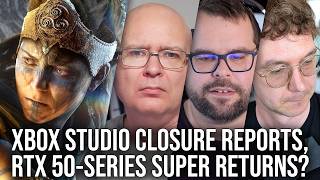

Xbox Studios in Crisis?
45sThe hosts' shock at Microsoft's possible studio closures and layoffs sparks debate about Xbox's future, highly engaging for gaming fans.
▶ Play Clip"The title accurately reflects the three main topics: Xbox studio closures, RTX Super rumors, and ARM ML rendering."
The DF Direct Q&A panel discusses the turbulent state of Xbox, including reports of studio closures at Ninja Theory and Compulsion Games, and the potential for an OEM-driven future like 3DO. They also analyze Nvidia's rumored RTX 50-series Super refresh, ARM's new open-source neural rendering suite for mobile, and a possible Intel-Nvidia collaboration. The conversation highlights frustration with Microsoft's inconsistent strategy and cautious optimism for new hardware and software technologies.
Reports from Tom Warren indicate Ninja Theory and Compulsion Games are closing, while Double Fine is in negotiations to spin off. Panelists express shock at the speed of changes after a positive showcase.
John notes the staggering whiplash from the recent showcase feeling good to now hearing about widespread studio closures. The panel sees it as a lack of coherent strategy.
Will argues Xbox has no vision, with decisions made on a whim. He fears the closures repeat the mistakes of the Xbox One era when first-party support was gutted.
John predicts a harsh reset with many studios facing layoffs. He worries about talent being removed and the cycle repeating.
Rich notes a clear conflict between Xbox leadership and Microsoft corporate, especially Satya Nadella's focus on AI. The panel believes Nadella would not hesitate to cut gaming.
Rich highlights how executive comments from just months ago are now contradicted. The lack of self-awareness is baffling.
A question compares Xbox's potential OEM strategy to the failed 3DO model. Will explains 3DO failed because OEMs didn't benefit from software licensing, while Xbox already has a strong software library.
John describes ARM's new open-source ML upscaling, denoising, and frame generation suite, demonstrated with Unreal Engine 5. It requires future Mali GPUs and could improve mobile graphics quality.
Rich and Will discuss rumors of a refresh using 3GB memory modules to boost VRAM (e.g., RTX 5070 to 18GB). Will gives pricing predictions ($349-$399 for 5060 Super).
Will explains the collaboration involves Intel SOCs with RTX graphics, potentially for laptops/handhelds, giving access to DLSS. The future of Arc remains uncertain.
John discusses the possibility of a Sega low-cost handheld similar to Evercade, noting Evercade's successful niche with cartridge-based games. He speculates on screen quality and game library.
The video ends with the panel hoping the Xbox cuts lead to a stronger focus on remaining studios, while remaining skeptical of Microsoft's corporate direction. They view ARM's open ML suite and potential GPU refreshes as bright spots, but caution that execution and market conditions remain uncertain.
Which Xbox studios did Tom Warren report as closing?
Ninja Theory and Compulsion Games are closing; Double Fine is in negotiations to spin off.
05:00
What is ARM's new rendering suite called and what does it include?
It's an open-source suite including upsampling, denoising, and frame generation for mobile.
31:44
What memory upgrade is rumored for the RTX 50-series Super cards?
Moving from 2GB to 3GB memory modules (e.g., RTX 5070 from 12GB to 18GB).
38:12
Why did the 3DO console fail according to Will?
OEMs like Panasonic didn't benefit from software licensing, so they didn't subsidize hardware, making it too expensive.
24:40
What is the rumored Intel-Nvidia collaboration about?
Intel SOCs with Nvidia RTX graphics for laptops/handhelds, giving access to DLSS.
46:00
What does Will hope for Xbox after the studio cuts?
That they invest in remaining studios to build a strong launch library for Project Helix.
20:27
What is the Evercade handheld?
A low-cost handheld that plays cartridge-based games, with hundreds of titles available.
51:02
Whiplash from Positive Showcase to Bad News
Illustrates the extreme inconsistency in Xbox's messaging and strategic direction.
04:17No Coherent Strategy at Xbox
Will's observation that decisions are made on a whim, repeating past mistakes.
07:26Acquisitions Unsustainable
John warns that creating large conglomerates through acquisitions often leads to closures and layoffs.
16:33ARM's Open ML Suite Could Democratize Mobile Graphics
An open-source upscaling/denoising toolkit could significantly improve mobile game visuals and battery life.
30:45RTX 50 Super Memory Upgrade Needed but Delayed
Shows the impact of the memory crisis on GPU refreshes and Nvidia's response to VRAM criticism.
38:12[00:02] Hello there and welcome to the latest
[00:05] edition of the DF Direct Q&A show.
[00:07] You've got questions, we've got answers.
[00:09] Uh hopefully joining me first of all,
[00:11] hello Will Jud.
[00:13] >> Hello. It's good to be here as
[00:15] infrequently as ever.
[00:17] >> However, there are questions
[00:19] specifically aimed at you. So, this is a
[00:21] good one. Um okay. And uh also joining
[00:23] us, John Lman. Hello.
[00:26] >> Hello. Happy to be here on this
[00:27] judacular Monday. Uh, it's great to be
[00:30] joined by Will Jud. It's been awesome
[00:31] having you back, Will. I just want to
[00:33] say that so the public can hear it.
[00:35] >> Uh, it's good having the proper support
[00:37] on the back end, the the website stuff.
[00:40] So, yeah, good job, man. Welcome back.
[00:42] >> Absolutely. Absolutely. Um, okay. Well,
[00:45] um, I guess we should just crack on with
[00:47] the questions, but first, this
[00:52] video is sponsored by CyberPower PC.
[00:55] Upgrading your hardware from scratch can
[00:56] often be a time-consuming process. But
[00:59] if you want to skip the wait, Cyber
[01:01] Power PC's next AP PCs are ready to go
[01:03] straight out of the box. Place an order
[01:05] before 2 p.m. Monday to Friday. Your
[01:07] fully built and tested system arrives
[01:09] the very next business day with free UK
[01:12] delivery. It's a highly practical route
[01:14] for jumping straight into high-end
[01:16] gaming without the hassle with these
[01:17] builds featuring the latest graphics
[01:19] cards from the RTX or RX9000 series. As
[01:23] an official launch partner for brands
[01:25] like Nvidia, AMD, and Intel, CyberPower
[01:29] PC ensures your system is packed with
[01:31] premium components. Plus, with over 25
[01:33] years of custom PC building experience,
[01:36] every desktop is backed by a 5-year
[01:38] warranty and over 12,000 positive Trust
[01:42] Pilot reviews. Finally, a quick heads
[01:44] up. Cyber Power PC's Corset and PS5
[01:47] bundle deal is set to end on the 30th of
[01:50] June. So to find out more, check out the
[01:52] link in the video description below.
[01:57] Okay, then. So let's kick off with our
[01:59] first questions of the week. And uh
[02:02] we're actually having to refilm this
[02:04] because the dynamic situation with
[02:06] Microsoft is so dynamic that it seems to
[02:09] be changing on a 24-hourly basis. So our
[02:12] previous responses to these questions
[02:14] needs to be completely recalibrated. Uh,
[02:16] let's kick off with this one from Skyrim
[02:18] 26 FPS edition. When I see Satcha
[02:21] Nadella quoted as saying, "Now we have
[02:23] to turn Xbox into a sustainable
[02:25] business. Why do I mentally insert or
[02:28] else afterwards? Supposed options are
[02:30] spinning it off presumably to die and
[02:32] and be reborn as Activision Blizzard 2
[02:34] private equity edition or turning it
[02:37] into a JV, i.e. dead but someone maybe
[02:40] Asus gets the brand. I think that's
[02:41] probably pushing things a bit. Although
[02:43] things are pretty dire seemingly, I just
[02:46] hope for a quick resolution of the Xbox
[02:48] fiasco as I want this industry to
[02:49] succeed and maybe taking a player off
[02:51] the board will help that. Um, Djako in
[02:55] brackets, Dan, uh, lads exclamation
[02:57] point, what do you think to the recent
[02:58] rumblings that Microsoft is even
[03:00] considering spinning off or selling
[03:02] Xbox? Who would your preferred buyer be?
[03:04] Could Elon Musk really do a worse job?
[03:07] Absolutely yes, without doubt. Um, and
[03:10] if he bought it under his macro hard
[03:12] anti-Microsoft uh company name, would we
[03:15] be living in some kind of mirror
[03:17] universe? More like a sort of dystopian
[03:19] reality where everything has kind of
[03:21] gone horribly wrong. Although some might
[03:23] say the last 10 years is pretty much
[03:25] evidence of a Kelvin style divergence in
[03:28] the timeline. Um John, um yes, we
[03:32] originally um uh responded to these
[03:34] questions in the first draft uh of the
[03:37] first recording session, but um we were
[03:40] kind of like wanting Microsoft to just
[03:42] shut up and get on with business
[03:44] basically. I think that was the uh the
[03:46] the overriding messages because Satcha
[03:49] Dadella was basically coming out and
[03:51] saying, "Hey, you know, um we've been
[03:53] subsidizing video games for the last 25
[03:55] years. It's time for them. It's time for
[03:57] video games to pay us back essentially.
[03:59] And in the time since we recorded the
[04:02] first response to this uh to this topic.
[04:05] Um well, basically
[04:09] parts of the plan are starting to become
[04:11] apparent and it's pretty pretty bad
[04:13] news, right? Uh yes.
[04:17] I man I was commenting earlier that the
[04:21] the whiplash from this whole situation
[04:23] is honestly staggering because I think
[04:25] we came out of that recent sort of
[04:28] pseudo E3 presentation feeling pretty
[04:31] good about things right like it seemed
[04:33] like they were heading in a good
[04:34] direction. And it seemed like, you know,
[04:36] there would be some sacrifices,
[04:38] unfortunately, but what seems to be sort
[04:41] of coming out now suggests that it's
[04:43] actually a lot worse than we're
[04:44] expecting
[04:46] with studios either being spun out as
[04:49] independent in the best cases or simply
[04:52] being shuttered. Uh, and the names that
[04:54] are being mentioned is what's so
[04:57] concerning. Like in the case of
[05:00] Compulsion Games, for instance, I
[05:02] actually I I don't like to see that. I
[05:04] think they made a really cool game.
[05:06] They've done some good stuff, but you
[05:08] know, they haven't made enough games,
[05:11] one could argue, and the sales and
[05:14] performance of it was really poor. I
[05:15] mean, I can understand where the
[05:16] decision would come from, but when
[05:18] you're hearing, you know, you see Arcane
[05:21] is mentioned, um, Ninja Theories being
[05:24] mentioned despite just announcing a
[05:26] brand new game, sounds like Double
[05:27] Fine's going to spin out on their own
[05:29] hopefully. And then even stuff like
[05:31] machine games and ID software comes up
[05:34] as potential things that could either
[05:36] get shut down or hit. We don't yet know
[05:38] what's going to happen, but like it's
[05:41] just going too far. It's like they're
[05:42] saying, "Hey, we're just going to close
[05:43] all the developers you guys like." Um,
[05:46] >> right. And that comment about them just
[05:49] wanting to chase, it sounds like they
[05:51] just want to chase like the ultra
[05:53] high-end AAA uh sort of experiences,
[05:56] whittle down their portfolio to just the
[05:59] basics that like hit that market and
[06:02] that's it. And
[06:04] >> right,
[06:05] >> I guess basically the the best thing we
[06:07] can hope for is that these developers
[06:09] are able to essentially exit from
[06:11] Microsoft gracefully and somehow
[06:13] continue, right? If they could continue,
[06:16] that would be okay.
[06:18] >> But I don't want to see studios shut
[06:19] down and mass layoffs occur over this.
[06:21] And if that's the case, if they're just
[06:24] essentially removing so much talent and
[06:27] experience, it just feels like they're c
[06:29] like they're creating the problem that
[06:32] got them in this position in the first
[06:33] place, right? Like if you really go back
[06:35] historically and look, the Xbox 360 had
[06:38] a remarkably strong first and third
[06:40] party lineup. So did the original Xbox
[06:42] even, but 360 especially. But then there
[06:45] was a point where, and I think this was
[06:47] on Don Matrix watch, where they
[06:48] basically like whittleled down their
[06:50] first party stuff to almost nothing and
[06:53] they either focused too much on connect
[06:55] or they just didn't have much uh because
[06:57] they were so, you know, convinced that
[07:00] the third party support was all they
[07:01] needed. And then they spent years and
[07:03] years and years building up their first
[07:05] party portfolio again. And now I would
[07:08] say over the last five years, Xbox has
[07:10] had a pretty great stream of games being
[07:13] released, right? Like their developers
[07:15] are producing. There's a lot of stuff in
[07:16] the works. Like it seemed like things on
[07:18] the software side were going well and
[07:20] now it sounds like they just want to
[07:21] close it all down again and they're just
[07:23] going to wind up in that same stupid
[07:24] situation.
[07:26] Um, and it's just it's just emblematic
[07:29] of this constant feeling that they have
[07:31] no vision for where to go forward. And
[07:34] it's just decisions are being made on
[07:36] the whim. And every year it could be
[07:39] different. There was that clip from
[07:40] Psycho Odyssey
[07:42] >> uh about the making of Psychonauts 2
[07:44] that always goes around where somebody
[07:46] was asking about like uh you know when
[07:49] corporate visits and like oh yeah we
[07:51] love like Matt Booty and Phil Spencer
[07:52] and them you know they're they're the
[07:54] fun guys. It's what happens when Bill
[07:56] from accounting and so and so from
[07:58] marketing comes in on Friday. That's the
[08:01] problem. And it just feels like they put
[08:03] on a face that's like says one thing and
[08:06] then you know the penny pinchers come
[08:08] in. It's almost like they just
[08:11] >> uh leave them to they they say oh we're
[08:13] going to be hands off of the studios but
[08:15] they provide no guidance or support and
[08:16] then all of a sudden they like look at
[08:18] the at the you know finances and say oh
[08:21] we got to do something about this. Sorry
[08:22] guys. And it just kind of keeps
[08:24] happening. So
[08:26] >> right. Yeah. I mean, um, I'm just
[08:28] looking at reporting from Tom Warren,
[08:30] who is very well, uh, integrated. Lots
[08:32] of sources within Microsoft. He's saying
[08:34] that Xbox is closing down Ninja Theory,
[08:37] Compulsion Games, and Double Fine are
[08:39] also in quote unquote active
[08:41] negotiations about spinning off. I I
[08:44] wish them well. Um, and um, he also uh
[08:48] refers to an interview that Asha Sharma
[08:51] and um, Matt Bouty gave with Windows
[08:54] Central. And I'm just going to quote
[08:56] this. Um, the first conversations Asher
[08:59] and I had when we first met to do all of
[09:01] this, to her credit, she immediately
[09:02] emphasized supporting our studios and
[09:04] our games. Our ecosystem is built to be
[09:06] a portfolio of everything from small
[09:08] games to ongoing franchises to the big
[09:10] blockbusters. We've built at our core uh
[09:13] to build everything from Kil to Call of
[09:15] Duty. Everything from um Minecraft to
[09:18] South of Midnight. That's core to how
[09:20] we're set up. This is Matt Booty here. I
[09:23] think we've got one of the best
[09:24] portfolios out there, even in the
[09:25] entertainment industry more broadly in
[09:27] terms of that range. We're dedicated to
[09:29] it. And here's why. I believe that
[09:31] almost everything big started out as
[09:32] something small. We cannot lose the
[09:34] ability to have those places where
[09:36] little sparks can grow into something
[09:38] big. The creative environment that lets
[09:40] us take bets and creative risks has to
[09:42] be part of Xbox's culture. We're
[09:44] committed. Our studio system is built
[09:46] for that. Well, are they committed based
[09:49] on the fact that um you know it doesn't
[09:52] look as though um a lot of these studios
[09:55] are going to be supported in the way
[09:57] that was suggested there. Uh it's it's
[10:00] kind of shocking really the the the you
[10:02] know there's always a legacy quote that
[10:05] comes up to bite Microsoft uh in the
[10:08] behind whenever there's a big move like
[10:10] this really does suggest that there's
[10:12] just no sort of coherent strategy. Um,
[10:16] well, this is I mean I'm I'm staggered.
[10:20] I shouldn't be based on everything
[10:22] that's happened, but I am.
[10:24] >> Yeah, absolutely. I mean, I think it's
[10:26] just that whiplash between, you know,
[10:28] the executive statements, which seem
[10:30] very reasonable and seem like there's a
[10:32] clear direction in place, the Xbox
[10:35] showcase, which was really positive,
[10:36] really exciting as, you know, an Xbox
[10:38] fan or somebody who just enjoys the
[10:40] games on PC. Seems like there's plenty
[10:42] going on. And you know, as they say,
[10:44] like a good range from AAA stuff down to
[10:46] double A stuff and indie games all kind
[10:48] of included. But you know, and then the
[10:52] other shoe drops and then this is the
[10:54] kind of stuff that we have to deal with,
[10:56] right? And that these developers have to
[10:57] deal with more importantly
[10:59] >> is that it seems like, you know, there's
[11:01] going to be a very harsh reset for a lot
[11:03] of studios. And I'm sure that beyond the
[11:06] closures and the studios being spun off,
[11:10] there's also going to be a lot of them
[11:11] that are facing layoffs, right? So,
[11:14] >> it's Yeah, it's just really problematic,
[11:17] I think, especially, you know, for Ninja
[11:19] Theory to have had a game announced and
[11:22] have such a positive reception to it and
[11:24] then to be in the headlines a few days
[11:27] later to say, "Oh, yeah, and probably
[11:28] the studio won't exist after that."
[11:30] Like, will that game even come out? will
[11:32] come out and then the studio closes
[11:34] down. Like neither of those are great
[11:36] options. And uh yeah, it's it's just a
[11:40] real shame. Like obviously there's a lot
[11:42] of pressure from Xbox and certain parts
[11:45] of it at least to be um always producing
[11:48] bangers, you know, being uh capable of
[11:52] producing these kind of evergreen titles
[11:53] that people will just spend almost
[11:55] unlimited amounts of money on. But I
[11:57] think it's really important for
[11:58] Microsoft and for Xbox to also be
[12:01] supporting these kind of mid-level um
[12:04] studios that have more reasonable
[12:05] budgets that aren't taking huge swings
[12:08] on everything and are able to come out
[12:10] with games that are made at a reasonable
[12:12] price and you know therefore you get a
[12:15] lot of different bites of the cherry,
[12:16] right? So
[12:18] >> yeah, just super disappointing news and
[12:21] uh yeah, hard to see how this kind of
[12:23] jes with everything that Microsoft's
[12:25] executives have said before.
[12:27] Right. Yeah. I mean, the ecosystem seem
[12:30] to be designed for Game Pass to create a
[12:32] range of um games of varying sizes and
[12:36] varying shapes and different types of
[12:38] games to support a vibrant
[12:40] subscriptionbased offering.
[12:42] >> And I think, you know, it took years to
[12:44] get there. And I think, you know, part
[12:45] of the issue that Microsoft had with
[12:47] Xbox Series in particular is that there
[12:49] was a failure to deliver games in those
[12:51] first few years.
[12:54] um that has kind of like been reversed
[12:56] at this point. We've had some
[12:57] sensational games from Microsoft. Um we
[13:00] had this fantastic showcase just a few
[13:02] weeks ago. There seems to be I don't
[13:04] know, John, there seems to be this
[13:05] incredible sort of lack of
[13:07] self-awareness about about everything
[13:10] that they're messaging to the audience
[13:11] at this point, you know, because
[13:13] obviously they went into this showcase
[13:15] and uh we're going to show great things.
[13:17] there was um a lot of interaction
[13:19] between um management and um the fan
[13:22] base and then this happens like weeks
[13:26] later. I just don't understand the
[13:29] reasoning or the strategy here. It just
[13:31] doesn't make sense. And you know, if
[13:33] there are poor decisions being made just
[13:36] on the messaging side, then what else is
[13:38] going on? I mean, man, this is this is
[13:41] just crazy stuff. From the outside,
[13:43] there's this sense that there's a huge
[13:45] conflict that's brewed between, say, the
[13:48] Xbox group and Microsoft corporate. You
[13:51] know, people like Satia Nadella at the
[13:53] top. What they want doesn't really seem
[13:55] to align well with this. And when you
[13:58] see them all interviewed separately,
[14:00] they often make statements that feel
[14:02] kind of conflicting, which makes it seem
[14:04] like they all have their own desires for
[14:06] things and kind of let that slip. And
[14:07] there's no like real unified message
[14:09] here, which makes me do it makes me feel
[14:12] like Xbox if it I don't know how this is
[14:15] possible, but I would just it would be
[14:17] interesting to see it spun out as its
[14:19] own thing somehow, at least somewhat
[14:22] separate from Microsoft corporate. I
[14:24] mean, we know that Satia is all in on
[14:27] co-pilot and AI and all that nonsense.
[14:29] Like to him like I think he is exactly
[14:32] the type of person that would feel zero
[14:35] remorse about laying off the entire
[14:37] gaming team, every single person, so he
[14:40] could, you know, invest more in AI. I
[14:42] genuinely think he would not care. Uh
[14:45] it's that type of like personality we're
[14:47] probably dealing with here. And I think
[14:49] this is not what's interesting to him as
[14:51] as a business leader. And it doesn't
[14:53] feel like it suits what Microsoft is
[14:56] right now. You know what I mean? like
[14:58] Microsoft of 2026 is not the same
[15:00] Microsoft that started Xbox. And I think
[15:04] I would like to see all this Xbox
[15:06] because we know we know a lot of people
[15:08] that work at Xbox, right? We have like
[15:11] friends and contacts within all these
[15:13] studios and Xbox proper. I do believe
[15:16] that the people working within that
[15:19] organization genuinely do actually care
[15:21] about this stuff and they want to make
[15:23] great things, but they're limited by
[15:26] this this management situation and being
[15:28] part of Microsoft as a company. So, if
[15:31] they could find a way to split, that
[15:33] would be wonderful. But how that's
[15:35] possible, I do not know.
[15:39] >> Right. I think, you know, fundamentally
[15:40] the issue with spinning off from um
[15:42] Microsoft is that they would still be
[15:44] the the effective owner. They would just
[15:47] be outside of the corporate structure to
[15:50] a certain degree.
[15:51] >> To a certain degree. And maybe that
[15:52] would be what's necessary to make the
[15:54] decisions that are actually good for the
[15:56] gaming business. I I don't know. Like
[15:58] this is
[16:00] there's just there's too much going on
[16:02] here and we don't have enough
[16:03] information. I think most of most of
[16:05] what we're saying is just born out of
[16:06] frustration of seeing a business that we
[16:09] love and care about essentially being
[16:11] like ground down into nothing and this
[16:14] like constant whiplash between like a
[16:16] positive message and then a negative
[16:18] message. And unfortunately, I feel like
[16:21] the Western gaming industry especially
[16:23] is just in a really bad place right now.
[16:25] Microsoft's not the only one doing this,
[16:27] but it's pretty severe from their camp.
[16:30] And
[16:31] >> I feel like what we're really seeing is
[16:33] the effects that we all cautioned about
[16:35] is like all these acquisitions and like
[16:37] creating large conglomerates built from
[16:41] so many different companies. It's not
[16:42] sustainable and it's going to end badly.
[16:45] And I think there's definitely cases
[16:47] where certain acquisitions may have
[16:49] occurred because the company could no
[16:51] longer operate independently and they
[16:53] essentially needed an out and this
[16:54] essentially just bought them time. But I
[16:56] don't believe that's the case in every
[16:58] situation.
[17:00] So, I don't know.
[17:02] >> Yeah, there does seem to be like um
[17:05] inconsistency in messaging because um
[17:07] and this goes back to um the whole uh
[17:10] four games situation um the business
[17:13] update where you know we heard about the
[17:15] the the beginnings of a multiplatform uh
[17:18] plan which everybody kind of knew was
[17:20] already fully formed or very close to
[17:22] it. And at the same time as that was
[17:24] happening, you know, there was very sort
[17:26] of careful messaging from management at
[17:29] that point, even though it didn't feel
[17:31] particularly accurate. Um, but at the
[17:33] same time, you had Sachin Nadella
[17:35] basically wading in with his size
[17:38] 12elves
[17:40] saying, uh, yeah, you know, what's the
[17:42] point of exclusives, that sort of thing,
[17:44] basically undermining management. So,
[17:46] you know, there does seem to be a
[17:47] continuing sort of um friction between
[17:50] Microsoft and and Xbox leadership and uh
[17:53] and now it seems to be the same thing
[17:55] happening again where you know we've
[17:58] basically got comments that were being
[18:00] made by new management just a few weeks
[18:02] or or you know a couple of months ago
[18:05] basically disappearing and uh complete
[18:09] about face on strategies just absolutely
[18:11] baffling. I think there's just got to be
[18:14] a firm sort of um strategy that they're
[18:18] going to commit to that is positively
[18:20] communicated to the community because
[18:22] what on earth is all of this about and
[18:25] it is just you this lack of
[18:26] self-awareness you know Sanchi was
[18:28] talking about um uh obviously the big
[18:31] hardware issues that we've got at the
[18:33] moment and you know complete sort of
[18:35] lack of self-awareness that Microsoft is
[18:38] a key player in actually causing all of
[18:40] that and no sort of evidence that
[18:42] Microsoft is, you know, going to help
[18:44] out uh to help out Xbox in navigating
[18:47] through this when surely they can to a
[18:49] certain degree. No, it looks as though
[18:52] that um they've made their investment
[18:53] over the last 25 years. Uh uh YouTube is
[18:57] making more money off Xbox than Xbox is,
[18:59] which is baffling. I don't know where
[19:01] that comment came from. I just don't
[19:03] know what to make of all of this at this
[19:04] point. And it's funny because we did
[19:07] record an initial response to these
[19:09] questions yesterday in fact where it was
[19:11] kind of like okay maybe they just need
[19:13] to shut up and get on with it and then
[19:15] you know come up with a strategy and and
[19:17] execute it and um uh you know it's sort
[19:21] of we have to redo our own content now
[19:24] to adjust to Microsoft's changing
[19:26] messaging over 24 hours. Absolutely
[19:29] baffling. Absolutely bizarre. But no, uh
[19:32] I still think that Elon Musk would
[19:34] probably do a worse job.
[19:37] >> Oh yeah, undoubtedly.
[19:40] >> Any final comments, Will?
[19:42] >> Um I would just say that, you know, if
[19:45] this is going to come to pass, I really
[19:47] hope that they say, "Okay, we've had to
[19:50] close some studios. We had made some
[19:52] layoffs, but from now on, we're going to
[19:55] invest in the studios that remain. we're
[19:57] going to be trying and get ourselves
[19:58] into a really strong position so that
[20:00] when Helix comes out it'll be supported
[20:03] by a really good like you know launch
[20:05] library right I think that has to be the
[20:07] goal here and if these cuts are
[20:09] necessary to make that happen then you
[20:11] know it still is incredibly painful but
[20:14] at least it would have been worth it in
[20:15] some sense right so I just hope that
[20:18] this is the start of a consistent
[20:20] strategy that actually sets them up for
[20:22] some kind of success in the future
[20:25] >> yeah I think I echo that I think the
[20:27] bottom line is that um we just need to
[20:29] know what the plan is and I think more
[20:30] to the point the staff at Microsoft in
[20:33] all the development studios and you know
[20:35] and within Xbox itself kind of need to
[20:37] know what's going on because I don't
[20:38] think anybody does at this point it's
[20:40] just absolutely absolutely baffling. Uh
[20:43] a final comment from you John.
[20:45] >> Um what you said will that sounds so
[20:48] hopeful. That would be nice. Uh, but I'm
[20:51] sure that's exactly what they thought
[20:52] when they launched Xbox Series X and S,
[20:56] right? And it didn't pay out. So,
[21:00] although they did actually end up
[21:01] getting the games, but I feel like now
[21:03] it's just I don't know. All I'll say is
[21:05] if they if they dare touch a company
[21:07] like ID Software or something, I will
[21:10] never forgive them.
[21:13] I was super angry over the things with
[21:15] like Bluepoint and all that with Sony,
[21:17] but if you go after a a studio like ID
[21:21] that has produced nothing but greatness
[21:23] and the best technology in the industry
[21:25] and try to shut them down or bring or
[21:28] cut them to to pieces, like no, it's not
[21:31] okay. I'm not I I could never forgive
[21:33] that.
[21:35] I think basically, you know, an
[21:37] explainer to the audience about what has
[21:39] happened and why rather than just, you
[21:42] know, we typically what happens is a
[21:44] memo from the CEO is sent to the staff
[21:46] and that memo is then shared with the
[21:48] audience and the memo is basically word
[21:50] salad. There's no real sort of proper
[21:53] explanation. It's challenging
[21:54] conditions, that sort of wordage. Um,
[21:58] what's going on? you know, you know,
[22:00] Xbox, you can't reach out to your fan
[22:02] base, uh, try to reconnect with them,
[22:06] show them amazing games, and then
[22:08] basically come back a couple of weeks
[22:09] later and say, "Well, actually, we've
[22:11] got some real problems here. Sorry, it's
[22:13] just absolutely bizarre." Anyway, I
[22:16] think we can all hopefully move on.
[22:19] Okay, sort of leading on from that,
[22:20] interesting question here from Dudley
[22:22] the Gentleman. Hello, renowned Pixel
[22:24] Purity Police. Do you see the Xbox brand
[22:27] becoming the next 3Dio where Microsoft
[22:29] defines the specifications and OEMs
[22:32] build the hardware? If so, how can they
[22:34] be successful where 3Dio and even Valve
[22:36] with the original Steam machines have
[22:37] failed? Uh I think that is probably a
[22:40] key part of the strategy, right, John?
[22:42] Where they're talking about um
[22:43] partnerships, hardware partnerships. Um
[22:47] uh yeah, Will, we had a a discussion the
[22:50] other day. It's like, well, why are
[22:51] Microsoft seemingly so badly affected by
[22:53] these component shortages when
[22:56] >> Microsoft is buying a lot of the
[22:58] components elsewhere within the
[23:00] business? And I'll come to you shortly
[23:01] on that, John. But 3DIDO, obviously, you
[23:04] know, there's associations that this
[23:05] this wasn't really a great thing. It
[23:08] didn't really um make an impact. It was
[23:11] an interesting idea.
[23:13] Is it the new 3Dio? Could Project Helix
[23:16] be the new 3DO?
[23:17] >> Is there a positive spin on that?
[23:20] I mean, maybe, but I I think
[23:22] conceptually what they did with 3Dio is
[23:24] interesting, but it's just like the time
[23:26] and place, the market conditions now are
[23:28] just so fundamentally different that I
[23:30] don't really think it's even remotely
[23:33] comparable. 3DIO ultimately the biggest
[23:36] issue there was um obviously software
[23:39] was not as good as it needed to be. uh
[23:42] though it's not bad but secondly that
[23:44] model at the time game consoles really
[23:47] relied on on being subsidized right so
[23:50] it was the blades and ra blades and
[23:52] razor model essentially or blade and
[23:54] razors model where essentially you know
[23:57] they sell the hardware often at a loss
[24:00] they make it up with software licensing
[24:02] but due to the way 3DO worked you know
[24:04] if you have Panasonic or Goldstar
[24:06] whoever making a 3DO back then they
[24:08] didn't get anything from the software
[24:11] really, right? So, there was no benefit
[24:14] to them selling units at a loss. So,
[24:17] they didn't. And that's kind of why the
[24:20] price had to be as high as it was. And I
[24:21] think at the time, it was just way too
[24:24] expensive. Didn't have enough software.
[24:26] Uh, and it was just a crazy time in the
[24:28] market in general. Everything was in
[24:29] flux. And so, you know, a year or some
[24:33] change later, Sony comes along and does
[24:36] a similar thing, but way better. Uh,
[24:38] yeah, there was no chance. Now we're in
[24:41] the era of I guess I mean hardware in
[24:44] general is more expensive. Uh
[24:48] Xbox as a brand is already established,
[24:51] right? 3Dio had to be uh built up from
[24:54] nothing and Xbox already has a very
[24:58] large library of games and publishers
[25:00] working for it and it owns tons of
[25:01] development studios. I mean they have
[25:04] what they need for software support. So,
[25:07] if they were to take this approach,
[25:10] conceivably like the software side
[25:12] wouldn't really be an issue, which is
[25:14] why it could still find success. Um, but
[25:17] I don't know what that would mean for
[25:18] prices. And I mean, if OEMs are building
[25:20] this hardware,
[25:23] but I don't think companies today take
[25:25] as much of a loss on hardware as they
[25:28] used to, it feels like. Uh, I I I we
[25:32] need to actually check the numbers on
[25:33] that, but I don't know. And I still
[25:36] think that Xbox itself at least I would
[25:40] imagine that it's still going to
[25:41] manufacture at least its own firstparty
[25:43] devices to some degree. Like I don't
[25:45] think it's all going to become like Asus
[25:47] ROG boxes and stuff like that. Like I
[25:50] still have a feeling that Helix or
[25:52] whatever it is is going to end up having
[25:54] an actual official Microsoft built
[25:57] device.
[25:58] >> Oh, sure. Yeah. They've committed to it.
[25:59] They're making it the reference device
[26:02] that's happening.
[26:02] >> Exactly. So that and that's a different
[26:04] thing. You know, if they allow others to
[26:06] make a similar thing, that's that's, you
[26:08] know, that is more like what the 3Dio
[26:10] did, but 3Dio never had its own
[26:12] reference device.
[26:14] >> Yeah.
[26:14] >> So,
[26:15] >> what we need is a uh Project Helix
[26:17] Wonder Mega.
[26:19] >> Oh my god. Yeah. That's Sega. Sega
[26:22] really did used to do that, right? Like
[26:24] they had their main systems, but then
[26:25] they let companies like JVC make their
[26:28] own stuff. And damn, if anybody has a
[26:31] Wonder Mega, man, that's the one that's
[26:33] my my white whale for for retro
[26:35] consoles. The original Wonder Mega. I've
[26:38] been wanting one of those for so long,
[26:39] but man, they're tough to get.
[26:43] Um, well, let's talk about this OEM
[26:45] strategy. I'm a bit confused by it
[26:46] because um
[26:50] it surely it's just adding somebody else
[26:52] to the supply chain that wants to make
[26:54] money out of these devices. So, you
[26:56] know, obviously there's going to be AMD
[26:58] making all of the um uh all of the
[27:01] chips, right? Uh TSMC probably making
[27:04] actually pro actually fabricating the
[27:07] chips. AMD, I don't know, are they are
[27:10] they kind of making a license? I guess
[27:12] it is a license deal with Microsoft. So,
[27:14] Microsoft would then sell the chips to
[27:17] Asus, MSI, whoever wants them, Dell. And
[27:20] you know, surely this is just like
[27:22] somebody else in the chain who needs to
[27:24] make money out of this device. And how
[27:26] how are they going to make money on it?
[27:27] I'm a bit confused by that.
[27:30] >> Yeah, it's a bit of a weird situation.
[27:32] Like with the ROG Ally, it kind of made
[27:35] sense because ASUS had already produced
[27:38] this device and Microsoft could make
[27:40] some small hardware changes, make some
[27:42] bigger software changes, and then they
[27:44] had a product that made sense. But for
[27:47] Helix, I don't know if that's kind of
[27:49] the same situation. Obviously, Asus and
[27:51] Dell and whoever isn't going to have,
[27:53] you know, 90% of a viable project Helix
[27:55] sitting around. So, I think if they do
[27:59] go down this route, it might be more
[28:01] about adapting it to different regions.
[28:04] Like, um, for example, like Valve, they
[28:07] kind of let other companies in China
[28:10] run, you know, the Steam network and and
[28:12] run, you know, and sell devices and
[28:14] things like that, right? where they're
[28:16] kind of handing over some
[28:19] responsibilities to local experts. So, I
[28:21] could see a situation like that where
[28:23] they say, "Okay, well, we're going to
[28:24] make Project Helix for China and it's
[28:26] going to be made by a Chinese company
[28:27] and it's going to have different
[28:29] software and it's going to have all
[28:30] these, you know, adaptations that make
[28:32] it more viable there." And, you know,
[28:34] you could do the same thing with South
[28:36] Korea or Japan or another kind of big
[28:38] but slightly different market. Um, in
[28:41] terms of just, you know, having it
[28:42] wholesale, I think, yeah, it does just
[28:45] kind of complicate things and there
[28:46] would need to be a good reason to do it.
[28:49] I guess diversifying, you know, the
[28:51] investments and things like that would
[28:53] be good, but yeah, it's hard to say that
[28:56] there's like a huge need for, you know,
[28:59] Project Helix to be made for like by 12
[29:01] different companies unless they're doing
[29:03] something genuinely interesting with the
[29:05] hardware or the software or something
[29:06] like that.
[29:07] >> Mhm. I mean, the only thing I can think
[29:09] of is that possibly they would have um
[29:12] uh superior procurement on stuff like
[29:15] SSDs and memory modules compared to
[29:17] Microsoft, but that is kind of
[29:19] staggering in its own. Yeah, just the
[29:21] conceit of that is kind of hard to
[29:24] believe. You know, Microsoft have been
[29:26] making even without all of the server
[29:27] stuff, they've been making laptops,
[29:29] they've been making consoles, they've
[29:31] had relationships presumably with TSMC
[29:34] and and the memory manufacturers for
[29:36] decades. So, I'm I'm still sort of a bit
[29:38] mystified by all of this. What I can see
[29:40] is that if Helix is indeed a machine
[29:43] that is just as much a PC as it is a
[29:46] console, then there could be uh bespoke
[29:49] designs designed for specific uh PC use
[29:52] cases because obviously the um the great
[29:55] thing about the PC is the diversity of
[29:57] the components that could go into one or
[29:59] the use cases, you know. So you could
[30:01] possibly have a helix machine that has
[30:03] more memory for example if you wanted to
[30:05] also use it for production tasks or
[30:07] something like that. Uh so then you sort
[30:10] of build up an ecosystem of Xbox
[30:12] adjacent or or even Xbox branded devices
[30:15] but they are made by like MSI Dell or
[30:17] whatever. And I do think, you know, from
[30:19] a value perspective, compared to some of
[30:21] the pre-builts, there is probably going
[30:23] to be a good value argument there. But,
[30:26] you know, a mainstream device, um, I I I
[30:31] find it really hard to imagine um those
[30:34] guys coming up with that, um, particular
[30:37] device for that particular audience
[30:38] because there's not really any money in
[30:40] it. Um, okay, let's move on. Okay. So, a
[30:45] question here from Marcus. Hi,
[30:46] Foundryman. exclamation point. What your
[30:48] thoughts on ARM's new quote unquote
[30:50] neural technology stack for mobile
[30:52] graphics with new super sampling, new
[30:55] frame rate upscaling, and neural super
[30:57] sampling and denoising? Seems like an
[30:59] unusually open attempt at an ML
[31:01] rendering suite for mobile covering
[31:03] upscaling, frame interpolation, and
[31:05] combined upscaling and denoising. Could
[31:08] this be important for vendors that do
[31:09] not have something like DLSS, Metal
[31:11] Effects, FSR, or a mature in-house
[31:13] solution? More broadly, could open
[31:16] developerfacing tools like this help
[31:18] raise image quality across Android
[31:20] phones, handheld class devices, and
[31:23] perhaps eventually Windows on ARM
[31:25] systems? I hope you have a great week.
[31:26] Explanation point. Uh, thanks for that,
[31:28] Marcus. Um, well, we were going to talk
[31:30] about this in the direct last week, but
[31:32] um, we didn't because well, you actually
[31:35] did the article on digitalfoundry.net.
[31:37] You spoke to the people involved,
[31:39] >> and I thought we'd save it up
[31:42] >> uh, for you to talk about.
[31:44] Yeah. So, it's a pretty cool uh
[31:47] announcement really. So, it's
[31:48] essentially a whole uh version of the
[31:52] kind of DLSS suite of technologies. So,
[31:55] there's uh upsampling, there's
[31:57] upsampling with dnoising, there's frame
[31:59] generation under a different name. And
[32:02] yeah, it's very very cool. It's got um
[32:05] you know some limitations but they've
[32:08] already demonstrated it by building an
[32:10] entire game with Sumo Digital which is
[32:13] about 2 hours which feels like a full
[32:15] length game for for a mobile uh mobile
[32:18] system and it seems to allow you know
[32:21] enough uh extra performance headroom
[32:23] that you can do some really cool uh more
[32:26] advanced graphical techniques on what is
[32:28] fundamentally a very low power device.
[32:31] So, they've demonstrated it with uh
[32:33] Unreal Engine 5 megal lights and they've
[32:35] got kind of an interesting cave system
[32:38] that has all these bioluminescent things
[32:40] in the background all drawing, you know,
[32:43] doing their own lighting and yeah, it's
[32:45] it's an interesting idea. I think the
[32:48] key limitation at the moment is that
[32:52] this is going to require future ARM
[32:55] hardware like I guess their next
[32:57] generation Mali GPU to work. So that
[33:01] means that until that hardware is
[33:03] actually in the hands of a significant
[33:05] number of people, you can't fully rely
[33:07] on it to produce a game, right? But what
[33:10] it does do is it makes the development
[33:12] process a lot quicker and easier as well
[33:15] because you don't have to bake out
[33:17] lighting and then see how it looks and
[33:19] then adjust things. You can, you know,
[33:21] have artists working and seeing their uh
[33:23] changes in real time. And then after you
[33:25] get to the end of that process,
[33:27] presumably you can then say, "Okay, and
[33:29] now we convert this to a baked
[33:30] alternative." So, it's still
[33:33] interesting. And the fact that they're
[33:34] releasing a toolkit and they're
[33:35] releasing all the assets from the game
[33:38] is a really cool move. And it seems
[33:40] like, you know, they just want to make
[33:41] sure that this level of technology is
[33:44] available to a whole new um, you know,
[33:47] platform, a whole new audience. And
[33:49] yeah, it's it's uh, fascinating. I think
[33:52] we'll probably have to wait until we see
[33:54] the game running, you know, on real
[33:56] hardware to get a better sense of how it
[33:58] does in terms of image quality. Uh
[34:00] certainly what they've released looks
[34:02] like the image quality isn't, you know,
[34:04] certainly the highest end that you would
[34:06] expect from a PC or a console. And there
[34:09] are some question marks over um
[34:11] performance as well, especially in terms
[34:14] of touch latency and how that interacts
[34:16] with uh 30 fps to a 60 fps uh frame rate
[34:20] upscale aka frame gen. So very very
[34:23] interesting so far. I think you know as
[34:25] an open source open kind of project it's
[34:28] it's really worth um you know mentioning
[34:31] and and highlighting and and gives a lot
[34:33] uh of interesting ideas for mobile
[34:36] developers no doubt but yeah really
[34:37] cool. Yeah, they put out a video asset
[34:40] and um
[34:42] sort of a bit sort of uh curious about
[34:46] why they did that because they're
[34:48] talking about, you know, upscaling frame
[34:50] generation, frame generation, and then
[34:51] they put out a 30 fps video.
[34:54] >> So, you know, show us the frame
[34:56] generation, please, because we're not
[34:58] seeing it in a 30 fps video. It's just
[35:00] kind of bizarre. But yeah, it's an
[35:02] interesting step forward. But, you know,
[35:03] I'm there've been kind of lots of um
[35:06] technology demos we've seen in the past
[35:08] for mobile that, you know, never really
[35:11] translate into final products and there
[35:13] isn't really any kind of need for them
[35:15] because, you know, cutting edge
[35:16] rendering on a mobile phone isn't really
[35:19] done anymore. So, I'm very curious as to
[35:20] why they did this. But, you know, the
[35:22] the sentiment behind it that, you know,
[35:24] to to actually go open with all of these
[35:27] technologies, I think is uh is to be
[35:29] commended. Um, do you have any thoughts
[35:31] there John?
[35:32] >> Sure. Yeah, I mean I think the open
[35:34] nature of this uh is actually
[35:36] potentially important if it can take
[35:38] off. I mean just being open doesn't
[35:40] necessarily mean success, but I mean
[35:42] they're targeting mid to lower-end
[35:44] devices and mobile in general where
[35:46] there's more sensitivity towards battery
[35:48] life. And Android traditionally, they
[35:50] haven't really had a solution for this.
[35:52] Uh other solutions like on Apple for
[35:54] instance, the metal effect stuff that's
[35:56] all closed proprietary, right?
[35:58] >> DLSS itself proprietary.
[36:01] uh FSR is and XESS are kind of open, but
[36:05] there's still more fixed functiony and
[36:07] there's still limitations there. So,
[36:09] this is kind of like, you know, this
[36:11] feels like a pretty awesome solution,
[36:14] especially when targeting those mobile
[36:16] devices. Uh, it could be good for
[36:21] basically allowing lower res rendering
[36:24] on mobile where battery is so important,
[36:27] but a lot of the other stuff, I'm not
[36:29] sure how important that'll actually wind
[36:30] up being in practice. talking to people
[36:33] that are into like big mobile games for
[36:35] instance, uh the high-end Unreal stuff
[36:38] for typically isn't very popular or
[36:42] there's issues with it because it is
[36:44] notorious for just being heavier on the
[36:46] phone, draining the battery faster,
[36:48] taking longer to load up. Uh one of the
[36:51] things that helped make like Mihoyo
[36:53] stuff so popular like Genchin is that it
[36:56] looks beautiful. Uh, but it's actually
[36:59] like pretty lightweight, right? It's a
[37:02] Unity based game, but it's it's fairly
[37:04] lightweight. It's quick to load. It
[37:05] actually runs quite well. Um, but maybe
[37:10] this could help make some of the more
[37:12] advanced stuff a little bit more
[37:14] reasonable. We'll see. I don't know.
[37:17] It's It's good though. It's always good
[37:18] to see additional open standards uh
[37:21] dropped into the market. It just reminds
[37:23] me of um what what was the uh the
[37:26] standard prior to Vulcan? Uh
[37:30] >> no, no, no. There was that one that I'm
[37:32] forgetting the name that was developed
[37:34] before Vulcan.
[37:37] >> Mantle.
[37:38] >> Mantle. Yes. Remember Mantle?
[37:40] >> I do.
[37:43] >> I don't know. That just sprung to mind.
[37:46] >> Okay. Yeah. Mantle. What a what a time.
[37:49] That was awesome.
[37:50] >> Yes.
[37:50] >> Uh okay. Uh, let's move on. Um, I got a
[37:53] question here from Andreas Wright. Hey,
[37:55] DFO over Overlords. I'm not sure who
[37:57] we're overlording over, but whatever.
[38:00] Uh, hey DF overlords. Due to leaks on
[38:02] Nvidia reportedly releasing 50 series
[38:05] super cards, do you think these are
[38:06] necessary? And what specs prices should
[38:09] we be expecting? So, yeah, I mean, we
[38:12] were kind of expecting this this year,
[38:13] but owing to the memory crisis, it never
[38:15] happened. But um the 50 series line was
[38:18] to receive a refresh which would have
[38:21] seen um essentially uh cards that have
[38:24] got 2 GB memory modules replaced with 3
[38:26] GB memory modules. So um an RTX 5070
[38:30] would go up from 12 GB to 18 GB which
[38:34] sounds pretty awesome, right? And 16 to
[38:36] 24 for like the 5070 Ti and 5080 and you
[38:40] know not too bad. potentially the idea
[38:44] of a 12 GB RTX 5060. I would be super on
[38:48] board with that. Um Will,
[38:51] what do you think?
[38:53] >> Yeah, I mean I think in a normal year
[38:56] this definitely would have happened and
[38:58] it would have made sense. And I mean I
[39:00] think one of the major criticisms of
[39:04] Nvidia graphics cards over you know the
[39:06] past 5 years has been that they haven't
[39:09] really kept pace in terms of VRAM
[39:11] allocations certainly compared to AMD
[39:14] which seems to see 16 GB as more of a
[39:16] standard for a mid-range and above card.
[39:19] So you know using more advanced memory
[39:22] uh chips that have 3 GB instead of two
[39:24] that makes total sense. It allows them
[39:26] to not have to change much else in terms
[39:29] of the design and still bump up the VRAM
[39:31] to levels which you know I feel 12 GB is
[39:34] is extremely reasonable for a 60 series
[39:38] uh class product. So
[39:39] >> absolutely
[39:40] >> I think it makes a ton of sense in terms
[39:42] of pricing. It's hard to say. Normally
[39:44] the super uh lineup kind of replaces the
[39:48] original cards at the same price because
[39:50] those original cards will have you know
[39:52] gone down in price in the intervening
[39:55] you know months or years but given the
[39:58] current memory crisis and how much
[40:01] everything costs that extends to VRAM so
[40:03] it's hard to see if that is necessarily
[40:05] what we should expect. Um, I ran some
[40:09] numbers and I'm kind of thinking 5060
[40:13] super would be 349 to 399 possibly. 5070
[40:18] super 559 5070 Ti super 749 and 5080
[40:23] super 9999 again if they're kind of
[40:25] replacing those original cards at a
[40:28] similar price. So I think you know
[40:31] competitively these look really good but
[40:34] again we're in such an unprecedented
[40:36] time at the moment that it's really hard
[40:38] to predict with any level of certainty
[40:40] what these things are going to cost but
[40:41] you know the the core concept is at
[40:43] least solid and I would welcome this.
[40:46] Yeah, I think um Nvidia in a hard place,
[40:48] right? Because if the um next generation
[40:51] GPUs have also been delayed, which seems
[40:53] likely, right? It's not beyond the
[40:55] realms of possibility, then you can you
[40:58] go 2 years without a new GeForce product
[41:00] launch.
[41:02] >> Uh that would be asking quite a lot,
[41:04] right? Um the question is availability
[41:06] of these um higher density memory
[41:09] modules and how much it costs them to
[41:11] buy, which we just don't know. So
[41:13] pricing could be anything really. We
[41:15] just have no idea whatsoever.
[41:17] >> The weird thing is from from my
[41:18] perspective is that we are in the middle
[41:20] of a memory crisis. We have seen um
[41:23] comments from Asher Sharma from Xbox
[41:25] about you know ballooning prices and and
[41:28] yet you can still buy um an RX970 XT and
[41:33] a 9070 for reasonable prices. Uh the
[41:37] other week you could buy an RTX 5070 in
[41:39] the UK for less than its original launch
[41:42] price. I'm wondering what's going on
[41:44] there. Is there is there something in in
[41:46] terms of the sort of supply chain that
[41:48] we're missing here? Um because those
[41:51] prices, you know, they're not bad.
[41:54] Certainly nowhere near as bad as what's
[41:55] been happening on the SSD front and um
[41:58] on the DDR5 side of things. So, I'm I'm
[42:01] kind of curious as to how that's all
[42:03] sort of panning out.
[42:04] >> Uh but John, new graphics cards, even if
[42:07] they are essentially the same generation
[42:09] with more memory, that would be pretty
[42:10] good, right? I mean, sure, but we
[42:12] already have a product coming out again.
[42:14] It's called the uh RTX 3060.
[42:17] >> Yes, somehow it has returned.
[42:21] >> Uh I mean, sure. Yeah.
[42:22] >> Style.
[42:24] >> It's more cards would be nice. I guess
[42:29] it's just we're we're still in this
[42:31] weird spot with pricing and
[42:33] availability, so it's really hard to
[42:34] say. And launching anything new is just
[42:37] going to sell out quickly. They probably
[42:39] won't make that many. I don't know is
[42:42] we're we're still in a weird I said the
[42:43] other day like it feels like they they
[42:46] made it to the 5090 and then they like
[42:48] put the you know they they marked their
[42:51] spot on the rock and they're like all
[42:52] right we've we've gone far enough let's
[42:55] go back down the mountain and like it's
[42:58] like we're are we going to see anything
[43:00] beyond that level anytime soon any
[43:03] >> soon? No the 6090 I guess possibly yes
[43:06] but that's going to be some time away.
[43:09] Yeah someday.
[43:09] >> I don't know. It's just the it feels
[43:11] like the whole GPU situation is really
[43:14] strange right now and there isn't that
[43:17] much demand I think for new faster cards
[43:20] at the moment. Like they're they're
[43:23] already very fast for all software
[43:24] available. Um the prices are really
[43:28] really high. I I think at this point
[43:31] most gamers would be like well if I have
[43:33] cash for a better graphics card that
[43:36] probably already exists and I'll just
[43:37] put my money on that. You know what I
[43:39] mean?
[43:40] >> Yeah, I do think that the sentiment
[43:42] might be changing, John, because uh it's
[43:44] interesting you make that point that
[43:45] when the 5070 came out, you know, it was
[43:47] basically um it was it was badly
[43:51] reviewed because it wasn't that much
[43:53] better than a 4070 Super. Um and um
[43:57] obviously Nvidia made these crazy
[44:00] comparisons with the 4090 and uh that
[44:03] didn't work particularly well. However,
[44:06] the 5070, you know, it's it's a good
[44:09] card. I think you could do path tracing
[44:11] on it. You could do multi-frame
[44:13] generation. I could play Pragmata with
[44:14] path tracing at 1440p
[44:17] um you know, at like 160 frames pers.
[44:20] It's it's all right, you know. And I
[44:23] guess the fact is that when the 5070
[44:25] came out, you couldn't buy a 4070 Super
[44:28] anymore. So, the comparison there was
[44:30] kind of a bit strange. I think there's
[44:32] obviously a um push back against the
[44:35] fact that um raw performance hadn't
[44:37] improved. I think that's a valid point,
[44:39] right? But ultimately, if the scope of
[44:42] the requirements of games isn't actually
[44:44] changing either, then effectively it's a
[44:47] replacement product that's got some nice
[44:49] extra features, which you know is it's
[44:52] okay. I think if I was unable to play
[44:54] like uh great games on the 5070 or or,
[44:58] you know, I wasn't able to do path
[44:59] tracing on it, that'd be a different
[45:00] thing. But it's it's kind of been okay.
[45:03] Um let's move on to another question
[45:06] here. And um yeah, what can we say about
[45:09] this one? Spot asks um please can you
[45:13] summarize Intel and and Nvidia
[45:16] suspected collaboration
[45:19] and what this means for the future of
[45:21] Arc? Uh we're going back a while here,
[45:23] aren't we, Will? But um there is it's
[45:26] not a suspected collaboration. There is
[45:28] a collaboration between Nvidia and Intel
[45:30] and I believe Nvidia owns good chunk of
[45:33] Intel stock as a result of that
[45:35] collaboration. But it is potentially
[45:38] quite exciting what they're doing there,
[45:39] right?
[45:40] >> Yeah, definitely. I mean, I think the
[45:42] the core idea is that there will be an
[45:44] Intel SOC for like a laptop or a gaming
[45:47] handheld or whatever. And instead of an
[45:50] ARC graphics portion, it'll have an RTX
[45:52] graphics portion, which could be, you
[45:55] know, potentially uh more powerful,
[45:58] could have a higher top end. And
[46:00] probably the most important thing is it
[46:01] gets access to DLSS then, which is from
[46:04] what we've seen on the Switch 2 and from
[46:07] obviously just general PC gaming is the
[46:10] best uh upscaler package generally. So
[46:14] yeah, it's it's pretty exciting. It's
[46:16] interesting to think about potential
[46:18] products that could use this. Certainly,
[46:20] you know, Intel just launched their own
[46:22] gaming handhelds powered by ARC
[46:24] graphics, and we'll have to see how they
[46:26] do in terms of power and performance and
[46:29] everything else, but this kind of gives
[46:31] them another option for a co-branded
[46:33] device that is able to potentially hit
[46:35] higher performance levels and do so with
[46:37] better upscaling.
[46:38] >> Mhm. Yeah. What do you think about the
[46:40] future of Arc? Because um there have
[46:43] been lots of rumors as usual. I mean,
[46:45] seems to be like pretty much every few
[46:47] months there's a new rumor that Arc is
[46:49] in terms of its discrete graphics cards
[46:51] is a thing of the past, but then you see
[46:53] Panther Lake where you see a very very
[46:55] good integrated solution. What do you
[46:57] think is the future of Arc?
[47:00] >> Oh gosh, it's hard to say, right? I
[47:01] mean, I I get the idea that maybe Intel
[47:04] is a bit like Microsoft and there might
[47:06] be different factions within the company
[47:08] that see different paths for it.
[47:11] Um because you know certainly we have a
[47:14] lot of people that are genuinely seem to
[47:16] be really big fans of ARC internally and
[47:18] want it to do well and you know have
[47:20] plans for all these you know discrete
[47:22] graphics cards and mobile chips and
[47:24] everything else and the work that Intel
[47:27] engineers have done to you know make it
[47:29] a viable solution both discrete and in
[47:31] terms of uh you know laptop integrated
[47:34] has been you know really promising. So
[47:37] from that point of view, you would say
[47:39] that the Nvidia stuff is maybe, you
[47:42] know, just a contractual obligation or
[47:44] it's something that, you know, is not
[47:46] going to be the main thing going
[47:47] forwards. But I think it does give
[47:50] perhaps other factions within Intel that
[47:53] don't think that ARC is worth the
[47:54] investment a good kind of get out clause
[47:57] to say, "Ah, but we don't need to do our
[47:59] own things. We can just ask Nvidia, who
[48:02] are already really good at this, to just
[48:03] handle these things going forward." So
[48:06] yeah, it's obviously all kind of based
[48:08] on rumors. We don't really know what
[48:10] these first products that are um you
[48:13] know, combining these two uh Intel and
[48:16] Nvidia uh SOC's to you know, we don't
[48:20] know what they'll what they're going to
[48:21] look like and we'll have to wait until
[48:22] they're actually out and we can test
[48:23] them in terms of performance and
[48:25] features and everything else.
[48:26] >> But yeah, it's it's a complicated
[48:28] situation for sure. Yeah, I think you
[48:31] know ultimately it is just going to be
[48:33] um integrated processors with a Intel
[48:35] CPU and Nvidia GPU which sounds like you
[48:38] know um the scale of it could be
[48:41] relatively limited. It could be
[48:42] something bigger. I mean in the past
[48:44] Intel actually did a similar
[48:45] collaboration with AMD uh which was um
[48:49] very very very shortlived. you had like
[48:52] an Intel uh CPU and like a Vega GPU, not
[48:56] the Radeon 7, I'm afraid there, John
[48:59] Fury X,
[49:01] >> my favorite,
[49:03] >> but you know, potentially this could be
[49:04] really, really cool. um you know
[49:06] bringing those technologies together. I
[49:08] think it could be quite compelling from
[49:10] a gaming perspective maybe more
[49:12] compelling than the Windows on ARM stuff
[49:14] that Nvidia is pursuing at the moment
[49:16] because it bypasses the whole ARM
[49:18] situation and um Intel CPU cores are
[49:21] actually pretty good. Right.
[49:22] >> So, you know, potentially good stuff
[49:24] there. what it means for the future of
[49:26] ARC. I honestly think that's a separate
[49:28] discussion because you know um releasing
[49:31] a product with an Nvidia GPU doesn't
[49:33] mean that you know you you suddenly have
[49:36] access to Nvidia IP and um if Intel want
[49:39] to be competitive on the graphics front
[49:41] on the AI front they need good GPUs I
[49:44] don't think ARC is going away the
[49:46] consumerf facing side of it from gaming
[49:49] might change not really sure at the
[49:51] moment um what do you what do you make
[49:54] of this suspected collaboration, John.
[49:58] >> I mean, it seems not that different from
[50:01] uh what we've seen already with like,
[50:03] you know, laptops with Intel CPUs and
[50:06] Nvidia GPUs. I guess it's just would be
[50:09] an integration.
[50:10] >> Yeah.
[50:10] >> Uh this just feels like an a way to
[50:13] offer a high-end option while still
[50:15] leveraging Intel CPU cores because as we
[50:18] know, ARC doesn't really play in the
[50:20] high-end GPU market at all. So I think
[50:23] ARC would remain for now as a part of
[50:27] their mid to lower-end stack and you
[50:30] they could deploy Nvidia technology
[50:32] working together with them and higherend
[50:35] systems basically right. Um so that's
[50:39] basically the idea I guess and that
[50:41] sounds good to me.
[50:43] >> Um going to round off with a final quick
[50:45] question. Uh this one comes from KBAC.
[50:47] Uh, what do you think of the rumors of
[50:49] Sega supposedly working on a lowowered
[50:51] handheld akin to the Everade handhelds?
[50:54] Uh, have you heard any rumblings on the
[50:56] digital web or is this pure hogwash,
[50:59] John? Is it pure hogwash? Is there
[51:01] something of it, do you think?
[51:02] >> I don't know. I haven't heard anything
[51:04] about this rumor. Uh, that's interesting
[51:06] though because it may it's Evercade has
[51:11] quietly Blaze Entertainment. They have
[51:13] quietly carved themselves a weirdly
[51:15] successful little niche. Evercade
[51:18] devices are really cool. Like they're
[51:20] lowcost handheld units that play
[51:22] cartridge-based games. And they've now
[51:25] got like hundreds of games on that
[51:26] thing, including games that otherwise
[51:29] don't really have easily accessible
[51:31] physical versions at all. And just due
[51:34] to that low cost, it's just like a fun
[51:36] little system to collect for. And um it
[51:39] plays well. And some of the units have
[51:40] TV out. there's a console as well. Like
[51:43] it's just it's a it's a fun device and
[51:45] the price is low enough that it's
[51:48] managed to find that audience. So maybe
[51:50] something somebody like Sega sees that
[51:52] and says, "Hey, we could do that."
[51:53] Because unlike the mini consoles which
[51:55] are like locked down devices, this could
[51:58] be a way to sort of more easily bring
[52:02] their classic catalog back again
[52:05] somehow. But they've done that enough
[52:06] where I feel like they'd have to find
[52:09] some kind of spin to make this more
[52:11] interesting. I I don't know. And also
[52:15] like doing a handheld
[52:19] well to make it actually compelling is
[52:21] tricky in terms of screen quality,
[52:23] screen selection. Like if they just
[52:26] slapped like a 16x9 LCD of some sort
[52:28] like in there, that would be pretty
[52:30] crappy for for that, I have to say. Uh,
[52:33] but if they actually properly source
[52:35] like a good 4x3 panel, you know, they
[52:37] take care of the treatment correctly,
[52:39] something like what was in the Ambernick
[52:41] RG477M,
[52:44] a panel like that maybe too expensive
[52:46] for what they want to do would be pretty
[52:48] nuts. Uh, in a little dedicated handheld
[52:50] unit. So, I don't know if they're going
[52:52] to do it. I'd like to see them try
[52:54] something. I still have my Game Gear
[52:56] Mini, though, which or no, it's the Game
[52:58] Gear Micro. I don't know if you ever use
[53:00] one, Rich, but the screen it's like the
[53:01] size of a thumbnail. Like literally,
[53:03] it's very very small.
[53:05] >> Yeah. To which my question is why? I
[53:08] mean,
[53:08] >> it was just it was a fun it was a fun
[53:10] little toy in that case.
[53:12] >> Um I guess from my perspective, the
[53:14] question is like what kind of games do
[53:16] they want to run on it? Cuz I know the
[53:18] games that I really want to play and it
[53:20] would be like, you know, the Dreamcast
[53:21] and the Saturns, that sort of
[53:23] >> arcade games is what I would want.
[53:25] >> The arcade games. Yeah. You know, the
[53:26] model one, two, and three games. I mean,
[53:28] that would be awesome. a handheld with,
[53:30] you know, model one, two, and three
[53:32] titles on it would just be incredible.
[53:34] Um, it would,
[53:35] >> but, you know, all of that sort of
[53:37] custom hardware,
[53:39] how's the emulation on that could be a
[53:40] bit tricky. Uh, I don't know. Um, well,
[53:44] do you have any thoughts on this?
[53:46] >> Um, I don't have any thoughts on this
[53:47] particularly, but I just wanted to say
[53:49] that I already have the uh Sonic the
[53:51] Hedgehog mechanical keyboard.
[53:55] That
[53:55] >> our audio listeners can't see it, but he
[53:57] held that up and it is indeed very Sonic
[54:00] the Hedgehogy.
[54:01] >> Hold it up again. I want to see it. Just
[54:04] >> This is the show and tell portion of the
[54:05] show.
[54:06] >> Yeah.
[54:06] >> Yeah. Mhm.
[54:07] >> Wow. Okay. That's That's quite nice.
[54:10] >> This is made by High Ground. They also
[54:12] do a different design in black for uh
[54:15] you know, shadow obviously
[54:17] >> and they do various mouse pads and this
[54:18] is currently what is on my uh PC for
[54:21] testing purposes.
[54:22] >> Huh. I like it. Looks cool.
[54:24] >> Okay, good stuff.
[54:25] >> So, you know, if if they want to take
[54:27] any design notes from that, then, you
[54:29] know, get in touch.
[54:30] >> Fair enough. Okay, what a great way to
[54:32] end the show because that was indeed the
[54:33] last question. So, if you enjoyed it,
[54:35] please do like, subscribe, share, that
[54:36] kind of stuff. Ring bells for apparently
[54:38] instant notifications, that sort of
[54:40] thing. patreon.com/digitalfoundry.
[54:44] Join us. um high quality video downloads
[54:46] of everything we do, early access to DF
[54:48] direct, the chance to pose questions for
[54:51] this show and the main direct um ad free
[54:54] website which uh will beautifully create
[54:57] Q8 for us. Um that's all from us on this
[55:01] one and I guess we'll see you soon.
[55:02] Thanks for watching and supporting
[55:04] Digital Foundry.

⚡ Saved you 0h 55m reading this? Transcribe any YouTube video for free — no signup needed.