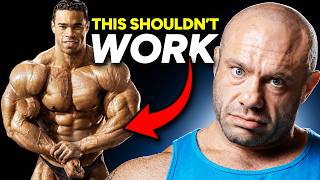

Kevin Levrone's 6-Month Training Breaks
45sReveals a shocking training strategy of a top bodybuilder taking half-year breaks, sparking debate on consistency vs. recovery.
▶ Play Clip"The title accurately reflects the critique of Kevin Levrone's strategy, thoroughly exploring his training, diet, and lifestyle choices with expert analysis."
The video analyzes Kevin Levrone's unconventional bodybuilding approach, where he took six-month breaks from training and steroids to play in a rock band, yet returned to compete at elite levels. Dr. Mike from RP Strength highlights the critical lesson that regaining lost muscle is significantly easier than building it initially, while also cautioning against rushing heavy loads after a layoff.
Kevin took six months off yearly to play in a rock band, losing 40-50 lbs, but always regained and improved.
He consistently placed top four at Mr. Olympia during the stacked mid-90s lineup, beating legends like Flex Wheeler and Ronnie Coleman.
After competitions, he dropped to 205 lbs soft and stopped steroids entirely, then rebuilt to 245 lbs shredded in six months.
Once you achieve a certain muscularity and leanness, regaining it is about 10 times easier than building from scratch.
Muscles and nervous system recover faster than tendons; avoid heavy loads early to prevent injury—wait 3-4 months.
Kevin gained 31 lbs of muscle in 3 months (225 to 256 lbs), but extreme growth caused health issues like nosebleeds and high blood pressure.
Exceptional physiques don't always indicate expertise; beginners must learn fundamentals independently, not just copy elite athletes.
There is no one-size-fits-all rep scheme; experiment from 5 to 30 reps for each muscle to find what gives the best pump and growth.
Kevin's 455-500 lbs bench demonstrates genetic exceptionalism, not a safe or necessary method for average bodybuilders; higher reps reduce injury risk.
Kevin's side chest and most muscular poses are among the best ever; his chill attitude shows bodybuilding isn't everything, and life breaks are okay.
Kevin Levrone's unique approach—extreme breaks followed rapid regains—underscores the power of muscle memory and genetics, but also teaches caution: don't copy elite methods blindly and prioritize injury prevention.
How many times did Kevin Levrone place second at Mr. Olympia?
Four times.
1:25
What did Kevin Levrone do during his 6-month breaks from bodybuilding?
He played in a rock band called Full Blown and did not lift weights.
0:02
How much weight did Kevin typically lose during his off-season, and how much did he regain?
He lost 40-50 lbs and then regained it back to 245 lbs shredded.
0:09
What is the key takeaway about regaining lost muscle after a long layoff?
Regaining lost muscle and leanness is about 10 times easier than building it for the first time.
4:09
Why should you avoid heavy loads for the first 3-4 months after a return from injury?
Because muscles and nervous system adapt faster than tendons, leading to increased injury risk.
5:08
What health issue did Kevin experience due to rapid muscle growth?
High blood pressure and nosebleeds from fast bodily transitions.
6:12
What is a better alternative for building chest muscle compared to sets of 5 reps heavy bench press?
Sets of 10-15 reps with proper technique, which lower injury risk while still building muscle effectively.
17:25
How can you determine your optimal rep range for each muscle group?
Experiment with rep ranges from 5 to 30 and track where you get the best pumps, soreness, and intramuscular fatigue.
14:01
What was Kevin Levrone's best competitive era?
The mid-1990s, considered one of the golden eras of professional bodybuilding.
0:23
What body parts of Kevin Levrone are considered among the best in bodybuilding history?
His shoulders, chest, and triceps.
0:35
Name two other bodybuilders from Kevin's era who preferred higher rep training.
Markus Ruhl and Nasser El Sonbaty.
15:30
Unconventional yearly cycle
Shows that elite success doesn't require year-round grind; breaks can be part of a sustainable strategy.
0:10Muscle memory principle
Quantifies the ease of regaining lost muscle (10x easier), valuable for anyone returning after injury or break.
3:41Tendon adaptation lag
Highlights a common injury mechanism often overlooked; practical for safe return-to-training.
5:08Individual rep range optimization
Challenges one-size-fits-all advice and provides a method to personalize training effectively.
14:15Risk vs reward of heavy loads
Distinguishes between evidence of genetics and necessary exercise choice; promotes safer training.
17:17[00:00] Kevin is one of my rivals. Could have
[00:02] been better than he was because many
[00:04] years he took like 6 [music] months off
[00:05] and played in a rock band and didn't
[00:06] even lift a weight and lost like 40-50
[00:09] lbs and he put it back all on again. So,
[00:10] if he didn't [music] do that, he
[00:11] potentially could have been better, but
[00:13] he chose to do what he did.
[00:14] >> Let's process this. He would finish
[00:17] [music] the Mr. Olympia, he would do the
[00:18] Mr. Olympia usually taking top four,
[00:20] which is crazy because his best
[00:22] competitive situation was in the
[00:23] mid-90s, which as you guys know is kind
[00:25] of one of the golden eras. Just legends,
[00:27] just stacks of legends and Kevin was
[00:29] well in the mix. [music] I mean, he beat
[00:30] a ton of those guys. Kevin Levrone
[00:32] probably has some of the best shoulders,
[00:35] chest, and triceps ever [music] in the
[00:38] history of the bodybuilding game.
[00:42] >> [music]
[00:45] >> Hey folks, Dr. Mike here for RP
[00:47] Strength. I've been a long-time
[00:49] professor of exercise and sport science
[00:51] and a long-time bodybuilder. And I have
[00:54] to admit that one of my top two
[00:57] inspirational [music]
[00:58] physiques of all time for me personally
[01:02] is our video of the day, a Mr. Kevin
[01:06] Levrone. I always pronounced it as
[01:08] Levrone because I spent a lot of time in
[01:11] Philadelphia.
[01:12] >> [music]
[01:12] >> And I would look at the last name and be
[01:14] like,
[01:15] from Levrone.
[01:18] But, with all due respect, it is Levrone
[01:20] as far as I can tell. Kevin Levrone
[01:23] has taken second at the Mr. Olympia, I
[01:25] believe off hand, four times.
[01:28] And um I was going to say it wasn't for
[01:30] lack of trying, but [music] we'll get to
[01:32] that in a bit because Mr. Kevin Levrone
[01:33] had a very interesting approach to
[01:35] lifestyle and training [music] and diet
[01:37] and being the man overall. Huge mega
[01:39] props and respect up front. Let's dig
[01:41] into some training and nutrition, Scott.
[01:44] >> Yeah, yeah.
[01:45] >> Yeah, do your job, Scott.
[01:48] >> Kevin is one of my rivals from the '90s.
[01:51] Could have been better than he was
[01:53] because many years he took like 6 months
[01:55] off and played in a rock band and didn't
[01:56] even lift a weight and lost like 40-50
[01:58] lb and then put it back all on again.
[02:00] So, if he didn't do that, he potentially
[02:02] could have been better, but he chose to
[02:03] do what he did.
[02:05] >> Let's process this. He would finish the
[02:08] Mr. Olympia, he would do the Mr. Olympia
[02:09] usually taking top four, which is crazy
[02:12] because his best competitive situation
[02:14] was in the mid-90s, which as you guys
[02:16] know is kind of one of the golden eras
[02:18] of competitive bodybuilding in the pros
[02:19] like Flex Wheeler, Ronnie Coleman,
[02:22] Dorian Yates, Nasser El Sonbaty, Chris
[02:25] Cormier. I mean like we just like
[02:27] legends, just legends, just stacks of
[02:29] legends and Kevin was well in the mix. I
[02:31] mean like he beat a ton of those guys.
[02:33] And then as soon as that was over in the
[02:35] fall, he stopped lifting weights.
[02:39] I know.
[02:40] And he stopped taking steroids. And he
[02:43] would go on tour with his rock band,
[02:47] which I know from memory was called Full
[02:49] Blown. You like that, Scott? Still know
[02:51] that.
[02:51] >> It's a double entendre.
[02:53] >> Maybe. Kevin would compete at about 245
[02:57] lb on stage, shredded. [music]
[02:59] He would come all the way down in many
[03:01] instances to what I believe is about 205
[03:05] soft [snorts] pounds.
[03:07] >> [music]
[03:07] >> And then what he would do, about 6
[03:09] months-ish before the next Olympia, is
[03:11] literally just click into place and
[03:14] begin to live the bodybuilding lifestyle
[03:18] full blown, no irony there. And that
[03:21] combination would balloon him back up
[03:23] and at the [music] same time shred him
[03:25] down to a roughly 40 lb heavier physique
[03:30] with something like, I don't know,
[03:32] [music] 15 lb less absolute amount of
[03:35] fat at the same time. So, here's what we
[03:37] can take away from Kevin's insight.
[03:39] >> [music]
[03:40] >> One
[03:41] is if you want to make your best gains
[03:43] overall, you can't take 6 months off
[03:47] every year. Not [music] going to happen.
[03:48] However,
[03:49] big insight here
[03:51] is that with just 6 months of getting
[03:54] back into training drugs and lifestyle,
[03:56] he was able to build back every single
[03:59] gram of muscle
[04:02] and burn off every single gram of fat
[04:04] that had switched their contexts over
[04:06] the past 6 months. Once you achieve a
[04:09] certain muscularity and a certain
[04:11] leanness,
[04:13] getting back to that muscularity and
[04:15] leanness is like
[04:18] an order of magnitude of factor of 10,
[04:21] 10 times
[04:23] easier than getting it for the first
[04:25] time. This is incredible, incredible
[04:29] news for all of us. You might have to go
[04:31] on a long trip.
[04:32] You might have to
[04:34] go and do some other stuff in your life.
[04:36] You might get hurt and have to take time
[04:38] off to heal. And the reality that
[04:40] presents us here today is
[04:43] >> [music]
[04:43] >> it takes months to get it back. By the
[04:46] way, this works both with drugs and
[04:48] without drugs. [music] Just a matter of
[04:49] getting your diet and training locked
[04:51] back in, you regain lost muscle so god
[04:54] damn fast and it's not hard, it just
[04:57] happens. The thing I'll tell you is
[04:59] watch out for one big mistake. Your
[05:02] muscles will grow stronger rapidly and
[05:05] bigger rapidly and thus also stronger
[05:07] again.
[05:08] Your nervous system will make your
[05:10] muscles be able to produce way more
[05:12] force, way faster
[05:14] than your tendons adapt. Resist the
[05:17] temptation to go heavy early. After 3 or
[05:19] 4 months, okay, yeah, then your tendons
[05:21] are strong again, you can sort of do
[05:22] normal stuff. It's a going to take that
[05:24] long. So, yes, you can pull off what
[05:26] Kevin Levrone did if you have to come
[05:28] back after a long layoff and it's
[05:30] amazing, amazing news, but don't you
[05:32] dare rush back because that's how you
[05:34] get snapped the fuck up.
[05:35] >> Is there a place in your mind where you
[05:37] think had I kept going all year round,
[05:40] maybe I would have been better?
[05:41] >> No. No.
[05:42] >> You know that for certain?
[05:43] >> Yeah, cuz when I did go, I went balls to
[05:45] the wall for 4 My body was hurting. My
[05:47] body was maxed out. There was times,
[05:49] man, where I didn't think I was going to
[05:51] make it, to be honest with you, because
[05:53] I realized that my body was a hyper
[05:55] responder, and I could gain muscle so
[05:57] quick in such a short period of time. I
[05:59] could go from 225 to 256. I was 256 at
[06:03] the Arnold one year.
[06:05] And I put on all that weight in 3
[06:07] months, [music] and it was muscle. I was
[06:08] like, "This is crazy." Look, man, there
[06:10] were times when my blood pressure was
[06:12] up. I knew it was up. My body was just
[06:14] transitioning so quick and so fast that
[06:16] it was too much. Sometimes I would have
[06:17] nosebleeds. I remember this. If I had
[06:19] [music] a stayed on that pace all year
[06:21] round, I wouldn't be here right now.
[06:22] Guaranteed. Guaranteed.
[06:27] >> Some folks do get banged up a lot of
[06:30] training, and staying gigantic and
[06:33] staying on tons of gear
[06:35] does absolutely reduce your literal
[06:37] lifespan and your bodybuilding lifespan.
[06:40] So,
[06:40] >> [music]
[06:41] >> with Kevin coming down or off of the
[06:43] gear entirely for 6 months every year,
[06:45] that definitely almost certainly
[06:47] extended his lifespan. I don't know if
[06:48] replacing it with the rocker lifestyle
[06:50] did a lot of favors there, but, you
[06:51] know, you got to have some fun. But,
[06:53] there is probably
[06:54] uh some kind of third option there,
[06:57] where training very smoothly and
[07:00] lowering gear substantially, but still
[07:02] training for maintenance,
[07:03] maybe not getting down to 205 lb, but
[07:06] getting down to 235 or something,
[07:09] could have seen him come back more
[07:11] slowly after that when you really crank
[07:13] the gear and the training,
[07:14] >> [music]
[07:14] >> but um some people psychologically, you
[07:17] know, they like the shit. They don't
[07:19] love the shit. And so, after about 6
[07:22] months of hardcore prepping, they're
[07:23] like, "Fuck this." And you got to
[07:25] respect [music] that. As a human
[07:26] individual, you know, technically
[07:28] speaking, anytime you see anyone have
[07:29] any kind of fun [music]
[07:31] that doesn't comport 100% with
[07:32] bodybuilding, you know, you could make
[07:34] the critique that they could have been
[07:35] better. And maybe that's a valid
[07:36] critique. But, a human's going to human.
[07:39] >> At 189 lb, I could bench press 405, you
[07:44] know, clean and naturally. 405 without a
[07:46] bench shirt.
[07:47] >> I believe it. Let me say something that
[07:49] I've said before, but it bears
[07:50] repeating.
[07:51] The spectrum of human genetics
[07:53] >> [music]
[07:53] >> is a lot wider than most people think.
[07:55] There's not only just genetics for being
[07:57] a baller early, but there's genetics for
[07:59] adaptability. Kevin just kept growing.
[08:01] [music] And the reason he was able to
[08:03] bench so much isn't because I think he
[08:04] had some kind of magical tendons or like
[08:07] a neural drive that was crazy. That's
[08:09] John Hack. You guys can look him up.
[08:11] Scott, can we link a John Hack video
[08:12] somewhere? That That just makes no god
[08:14] damn sense.
[08:15] >> [music]
[08:15] >> But Kevin Levrone probably has
[08:18] a combination of some of the best
[08:21] shoulders, chest, and triceps ever in
[08:24] the history of the bodybuilding game.
[08:26] >> [music]
[08:26] >> And so if those muscles are that big and
[08:28] that growth prone, of course you're
[08:29] going to bench a shit load. And he did.
[08:32] >> [music]
[08:32] >> Does that mean that you can make a natty
[08:35] goal for yourself
[08:37] of benching 405 at 190 lbs? No. When
[08:40] people look up to naturals
[08:43] versus look up to enhanced folks,
[08:45] sometimes they like to tell themselves,
[08:47] "I look up to natties because it's
[08:49] attainable. It's realistic."
[08:52] But the reality is that it is not
[08:54] necessarily
[08:55] >> [music]
[08:56] >> any more attainable to look up to
[08:57] natties because you're obviating
[08:59] genetics entirely. You're never going to
[09:02] look like anyone except the best version
[09:04] of yourself.
[09:04] >> [music]
[09:05] >> So Kevin's shit, benching 405 at 190 lbs
[09:08] drug free, inspirational.
[09:10] Not
[09:12] something you should aspire to do
[09:14] because you can only aspire to be a
[09:15] little bit better every [clears throat]
[09:16] other week than the version you are
[09:18] today.
[09:20] >> It was easy to like
[09:22] gain muscle and put on size and get
[09:25] strong. I remember when I first joined
[09:27] Powerhouse Gym
[09:29] and I was like 21, 22 years old,
[09:33] you know, my diet would consist of a
[09:35] chili cheese hot dog. Now I get two of
[09:38] those. My diet was just stop eating, you
[09:41] know, uh chili dogs with cheese on them.
[09:44] And uh just clean my diet up for 4 weeks
[09:46] and and I went and Mr. Maryland show.
[09:50] >> I hate him. Just kidding.
[09:52] >> Just [laughter] kidding. That's the
[09:53] jealousy talking.
[09:54] >> That's genetics right there. And there's
[09:56] an important lesson we can draw from
[09:58] that. When you see someone with an
[10:00] exceptional physique, especially when
[10:02] they're younger, it is not immediately
[10:04] apparent that they [music] know much. If
[10:06] you told Kevin Levrone right now, like,
[10:08] "Hey, so you were 21 years old like
[10:10] winning the Mr. Maryland, you knew a ton
[10:11] of shit." He'd be like, "No, I knew
[10:13] nothing." Look, we'll look at your
[10:14] physique, brother. Again, I'm just here
[10:17] on vibes. I have no idea how the hell
[10:18] this is happening. Why is this
[10:19] pertinent?
[10:20] >> [music]
[10:21] >> Because many people
[10:23] will look towards results, {quote}
[10:26] {unquote}, or the state of the athlete
[10:28] to see who they want to follow. The bros
[10:32] sometimes know shit, a lot of shit.
[10:35] Sometimes they don't know diddly dick.
[10:37] Sometimes the guys that aren't even
[10:39] remotely jacked know a ton. How do you
[10:41] disambiguate the two? You got to go on
[10:43] your own learning journey and know at
[10:46] least the basic facts.
[10:47] >> That's why I love Kevin cuz I think he
[10:48] says he got second at the Olympia before
[10:50] he started like trying to learn
[10:52] anything.
[10:52] >> Yeah.
[10:53] >> It was pure ambition.
[10:54] >> He just showed up.
[10:55] >> So, like, you know, what are you going
[10:57] to learn from that? You got to learn
[10:58] some reservation about uh guessing who
[11:00] knows things and who doesn't know
[11:01] things. Uh, 100-lb dumbbell curls. This
[11:04] is really impressive. So, I have been
[11:06] sent this video on social media in
[11:09] response to my not invention, but
[11:11] repopularization of the lying dumbbell
[11:13] curl, aka the clown curl,
[11:15] and was told that I would become much
[11:17] larger if I wasn't a {quote} insert
[11:20] expletive at the expense of homosexuals,
[11:23] and uh actually manned up and did some
[11:25] real weight. Now, uh two things I'd say
[11:28] [laughter] about that, three things. I I
[11:30] it right?
[11:31] Fact, I'm a little bitch. So, no no
[11:34] absolutely no debate there. The reality
[11:36] of why the 100-lb dumbbell curl is a
[11:39] thing that correlates to Kevin Levrone's
[11:41] arm size is because Kevin Levrone
[11:44] couldn't avoid big arms if he wanted to
[11:46] by simply showing up to the gym. And so,
[11:49] can you do one-arm dumbbell curls with
[11:51] as much weight as possible for sets of
[11:52] five? Yes. Is that needlessly risky?
[11:55] Yes. Would you get a better stimulus if
[11:57] you did something that actually
[11:59] stretched the bicep and put tension on
[12:01] them at the same time? Yes. Is it
[12:03] totally fine to do incline or totally
[12:05] fine to do standing dumbbell curls
[12:06] alternating if it's something that you
[12:08] feel is hitting your muscles well?
[12:09] Absolutely. But if you're doing it
[12:12] because IFBB pros from the '90s did it
[12:15] and they were jacked, you're
[12:16] misconstruing the confluence of
[12:18] genetics, drugs, and years of any kind
[12:21] of hard work for this exercise as the
[12:23] exercise to do. The 100-lb dumbbell
[12:25] curls are the most insane shit. Mega
[12:28] respect. This is actually Scott, this is
[12:29] really good technique.
[12:31] >> I was shocked.
[12:32] >> Yeah, 100%.
[12:32] >> He's lifting them. He's not just like
[12:34] >> Dems is real 22-in arms. But is there
[12:37] some kind of magic where if you try to
[12:39] do the one-arm dumbbell curl with as
[12:41] much weight as possible that your biceps
[12:43] will grow better than any other
[12:45] legitimately decent bicep exercise? No.
[12:48] No, there is not. Unless you want to
[12:51] extend that logic and say to yourself,
[12:53] "The way I'm going to become sized like
[12:55] Ronnie Coleman is I'm going to squat and
[12:57] deadlift 800 lbs for [music] a double."
[13:00] Um that's not a good way to train for
[13:02] bodybuilding. Do you guys know why
[13:04] Ronnie did it? Because he could.
[13:07] And God bless him. But if you think
[13:09] that's the path to your best physique,
[13:11] maybe you're right.
[13:12] >> [music]
[13:12] >> But you're probably wrong.
[13:14] >> You might do reps, but I'm not a rep
[13:15] guy. Reps doesn't do anything for me. It
[13:18] burns too many calories for me. I
[13:20] already have a super fast metabolism.
[13:23] >> Okay.
[13:24] >> So, for me I needed to do six to eight
[13:26] heavy movements, you know, compound.
[13:28] >> Squats, bench press.
[13:30] People who are incredibly responsive to
[13:32] growth, on average, have faster twitch
[13:35] muscle fiber composition. There are a
[13:37] few things going on in there.
[13:39] >> [music]
[13:40] >> One is, if you do happen to be fast
[13:42] twitch dominant, that is possibly true
[13:45] for you, though it might not even be
[13:46] true for you. So, you might like higher
[13:48] reps better.
[13:49] The other thing is this,
[13:50] someone huge like Kevin Levrone says 68
[13:53] reps are better. You may steer your
[13:55] animal the ship and say to yourself, you
[13:56] know what? I'm just going to do sets 68
[13:58] reps cuz good enough for Kevin, good
[13:59] enough for me, and that's bullshit.
[14:01] [music] Because you have to try every
[14:02] single rep range, do diligence, from
[14:05] sets of roughly five reps all the way to
[14:06] sets of roughly 30 reps, and do
[14:09] everything in between, and see per
[14:11] muscle where you get the best responses.
[14:14] The good news is, you don't have to just
[14:15] track your growth, though you can, you
[14:17] have to check out where you get your
[14:19] best pumps, where you get your best
[14:21] soreness, and that deep intramuscular
[14:23] fatigue, versus the fatigue of just
[14:26] being like,
[14:27] "I'm just done lifting. This sucks." So,
[14:30] if you do higher reps and your muscles
[14:31] feel kind of flat and tired, nah, that's
[14:33] not it. If you do lower reps and your
[14:35] joints hurt, but your muscles don't feel
[14:37] shit, that's not it. Somewhere between
[14:39] very high and very low reps, sometimes
[14:41] there's just only right answers, and
[14:43] sometimes only a particular rep range
[14:45] will be the best for a particular
[14:46] muscle. It's up to you to find out what
[14:48] that is. If you use the RPE hypertrophy
[14:50] app, you can program any reps and any
[14:52] sets and any muscles that you want, and
[14:54] really track the progressions like that.
[14:56] That correlates it with pumps and
[14:58] soreness for you, so you don't even have
[14:59] to do that work, and you'll notice like,
[15:01] "I'm typically getting really pumped
[15:02] from sets of 68 on leg press." Then that
[15:05] is at least the answer for a little
[15:06] [music] while. The other thing is, there
[15:08] are very many videos of Kevin Levrone
[15:10] doing um
[15:12] higher reps, cuz he'll do core work of
[15:14] 68 reps, but then he'll do drop sets of
[15:17] higher reps. So, sometimes what folks
[15:20] preferred the most isn't even the only
[15:22] thing that worked for them. And
[15:24] there were many bodybuilders of even
[15:26] that era that loved higher repetition
[15:30] training. Many, many, many Markus Ruhl
[15:32] loved higher repetition training, was
[15:33] bigger than Kevin Levrone. Nasser El
[15:35] Sonbaty loved higher reps for variety of
[15:37] exercise. One of my favorite
[15:38] bodybuilders of all time, a little bit
[15:39] late in that era, was a gentleman named
[15:41] Chris Dim, who if they had the 212 class
[15:44] back in the day would have almost
[15:45] certainly won the 212 Olympia. He's a
[15:47] Vietnamese-American bodybuilder,
[15:48] phenomenal, phenomenal bodybuilder and
[15:50] awesome human being as far as I could
[15:51] ever tell. He did higher reps, didn't
[15:54] call them that back in the day. Scott,
[15:56] he would do sets with mini breaks of
[15:59] like 100 reps on the leg press, right?
[16:02] And like Chris Dim was fucking enormous.
[16:04] And so before you say, "Yeah, man, on
[16:07] vibes only
[16:08] getting heavy weight, man, slag iron
[16:11] getting best way to train, brother, is
[16:14] you show up to the railroad track and
[16:15] just start eating railroad ties."
[16:18] Uh that always [clears throat] throws
[16:19] down the gauntlet. My uncle didn't even
[16:21] lift weights, man. He just drank
[16:22] excessively and beat the shit out of me
[16:24] and that's why he was jacked. That's
[16:26] hardcore.
[16:28] Kevin Levrone had huge muscles, but he
[16:32] also had a huge member. In our members
[16:35] section, you can see the longer extended
[16:37] version of this video where we may or
[16:39] may not show a little bit of extra
[16:42] something special about Kevin. That last
[16:44] part's joke, but member section is real
[16:46] and you can subscribe to it, pay a
[16:48] little money for a ton of value. All
[16:50] right. Click around, do that. Now back
[16:52] to video.
[16:56] 455 lbs. 455 pound lay ass pounds.
[17:10] Scott, how many times have you seen
[17:11] somebody do a full range of motion bench
[17:12] press 455? [music]
[17:15] >> Very rare.
[17:16] >> Yeah.
[17:17] Huge.
[17:17] >> If you warm up properly, this could be
[17:20] an [music] ultra-effective way of
[17:21] building muscle. Would I recommend it?
[17:23] No, I wouldn't. Here's why.
[17:25] >> [music]
[17:25] >> There's probably nothing you can't get
[17:27] out of sets of 10 to 12 reps, even sets
[17:29] of 10 to 15 reps with that same amazing
[17:32] technique Kevin is doing,
[17:33] that you would get out of sets of five
[17:35] or six [music] reps. But the probability
[17:37] of injury is way, way [music] lower with
[17:41] sets of 10 to 15 reps than sets of five
[17:43] reps because the mechanical load is just
[17:46] way lower, and the amount of load into
[17:48] your joints, and [music] tendons, and
[17:49] muscles is the number one causative
[17:52] factor of injury.
[18:00] >> [screaming]
[18:05] >> 500 for threes wild.
[18:07] Like [music]
[18:08] that is less of a cause of bigger pecs
[18:11] and more of evidence of bigger pecs. You
[18:13] have to have big pecs in order to do 500
[18:16] FOR THREE.
[18:18] OH, MAN, these are so good, man.
[18:20] >> And this is after the flat.
[18:22] >> Same [snorts] workout. Same workout. 455
[18:26] lbs on the incline, which like almost
[18:28] nobody could do. If you're wondering
[18:30] what kinds of weights
[18:32] build Kevin Levrone's pecs, shoulders,
[18:36] and triceps, here's your answer.
[18:54] Kevin Levrone, and I've probably said
[18:56] Levrone by accident about 10 times
[18:57] during this video, is a legend of the
[18:59] sport. We can learn
[19:02] from his technique. We can learn from
[19:04] his dedication.
[19:05] We can learn from his chill attitude. We
[19:07] can also learn that maybe bodybuilding's
[19:09] not not the end all be all all the time,
[19:11] and it's totally cool to take some time
[19:13] off and get right with life until you
[19:14] get back in Eugene Teo style. Kevin
[19:17] Levrone's physique to me is one [music]
[19:19] of the greatest of all time. I would say
[19:21] his side chest and his most muscular are
[19:25] like
[19:26] maybe unbeatable still. And because of
[19:29] that, he lives in the pantheon of the
[19:31] gods and deserves our endless respect.
[19:33] He is rated a
[19:35] monster god out of 500.
[19:40] And I'll see you guys next time.
[19:46] All right, that was fun. I personally am
[19:48] going to do two things. I'm going to go
[19:50] home, stare into the mirror at my
[19:52] pathetic triceps, realize I'm not Kevin
[19:54] Levrone,
[19:55] >> [music]
[19:55] >> and then cry. But then also, I'm going
[19:57] to click on this video right here to
[19:59] watch more content. [music] You want to
[20:00] do any of the combination of the two, be
[20:02] my guest. See you next time.

⚡ Saved you 0h 20m reading this? Transcribe any YouTube video for free — no signup needed.