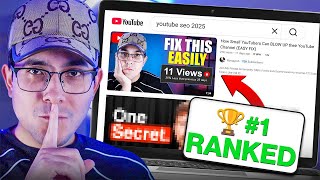

SEO is Boring but Vital for YouTube Growth
47sRelatable frustration about SEO's importance mixed with a bold challenge to other coaches creates high engagement.
▶ Play Clip"The title promises 'step by step' hacks, and the video delivers actionable tips on tags, descriptions, and metrics, making the claim mostly accurate."
A seasoned YouTube automation expert shares his proven SEO strategies for ranking higher on YouTube, especially for beginners and small creators. He emphasizes that SEO is crucial due to YouTube's new AI (Gemini), which scans videos to determine content and recommendations. The video covers tags, descriptions, titles, thumbnails, and metrics like AVD and CTR.
Disagrees with coaches who say tags don't matter; recommends filling all tags using VidIQ or TubeBuddy.
Feed full transcript to ChatGPT with a prompt to generate an SEO-optimized description for both YouTube and Google.
Base titles on successful competitors in your niche; keep thumbnails simple with yellow text, black drop shadow, and max 4 words on bottom left.
Aim for 13-14 minutes video length, with at least 5-minute AVD for 14-min videos, 6-minute AVD for 20+ min videos. High CTR (13%+) can compensate for lower AVD.
Focus on SEO and CTR first to get views; after reaching 2,000-3,000 views per video, use AVD data to refine content.
What technology has YouTube implemented to analyze videos?
YouTube's AI (Gemini) now scans videos to identify content and recommend to the correct audience.
01:06
What is the recommended approach for video tags?
Fill up all tags using tools like VidIQ or TubeBuddy.
01:53
How can you create an optimized YouTube description quickly?
Give ChatGPT the full transcript with a prompt to write an SEO-optimized description.
02:11
What is the recommended sweet spot for video length?
13 to 14 minutes.
04:30
What AVD (average view duration) should you aim for in a 14-minute vs 20+ minute video?
At least 5 minutes for a 14-minute video, and at least 6 minutes for a 20+ minute video.
04:37
What metric can compensate for a low AVD?
High CTR (above 13%) can compensate for lower AVD.
04:51
Using ChatGPT for Descriptions
Provides a specific prompt to generate SEO-optimized descriptions from the transcript.
02:11Transcript Matters for AI
Explains that Gemini scans the entire transcript to determine monetization and relevance.
03:49Algorithm First, Audience Later
Advocates optimizing for the algorithm initially to gain traction before focusing on content quality.
05:41[00:00] If you're a complete beginner or a small
[00:02] YouTuber, one of the things that could
[00:03] be holding you back is SEO. And listen,
[00:06] if you're anything like me, SEO, tags,
[00:08] description, all of that [ __ ] is a
[00:11] snoozefest. It is the most boring parts
[00:13] about this entire process. But the worst
[00:16] part is that it's one of the most
[00:17] important. So that's why I'm going to
[00:19] try and make this as painless as
[00:20] possible for both of us. Now, if you
[00:22] don't know who I am, my name is Romero.
[00:23] I've been doing YouTube automation since
[00:24] 2018. I've made over $1.9 million across
[00:28] all of my faceless YouTube channels. And
[00:29] that's pretty much it. I don't have much
[00:31] of a personality. I need to get better
[00:33] at intros. Anyways, let's go ahead and
[00:35] get started. So, what's the truth about
[00:36] tags? Is it actually important? Is it
[00:38] something you need or are you just
[00:39] wasting your time? Well, if you've ever
[00:41] heard a YouTube coach say that you don't
[00:43] need video tags, I want you to let them
[00:45] know that I said that they can go [ __ ]
[00:47] themselves because that's exactly what I
[00:49] did. I would listen to coaches that say
[00:51] SEO doesn't matter. video tags don't
[00:53] don't have any importance with the
[00:55] algorithm and because of them I wasted
[00:57] years of my life. Listen, we're at the
[00:59] end of 2025. We're about to hit 2026.
[01:02] YouTube has changed a lot. It is not the
[01:04] same as it used to be and that's because
[01:06] they soft launched Gemini. Now, if you
[01:08] don't know what Gemini is, Gemini is
[01:10] Google's chat GBT. It's their own
[01:12] version, right? And they implemented
[01:13] Gemini into YouTube in late 2024. Point
[01:17] is, they've been training it this whole
[01:18] time. And what they've been training it
[01:20] to do is to scan videos. They're
[01:22] essentially trying to replace their
[01:24] employees, the the human reviewers. Now,
[01:26] it is very important that I say that
[01:28] YouTube did not announce this. This is
[01:30] not confirmed. This is just a theory
[01:32] that I have. I think it's a pretty good
[01:33] [ __ ] theory, right? But it's not
[01:34] confirmed. Anyways, my point is YouTube
[01:37] now uses AI to identify what your video
[01:40] is about and to send it out to the
[01:42] correct audience, right? So, now it's
[01:43] even more precise with how it's going to
[01:45] recommend your videos. So, when it comes
[01:47] to SEO, you can argue that now it's one
[01:49] of the most important parts of the
[01:51] entire process. So, do yourself a favor
[01:53] in your tags. Fill them up all the way.
[01:55] Use tools like Vid IQ, TubeBuddy, Next
[01:58] Lev, whatever it is. There's a bunch of
[02:00] free [ __ ] out there. Just please make
[02:02] sure you fill up all of your tags. Okay.
[02:03] Now, what about video descriptions? Do
[02:05] video descriptions really matter? Do you
[02:07] have to make them long? Do you have to
[02:08] make them short? Do you have to put
[02:09] hashtags? Do you have to put links?
[02:11] Easy. Use Chad GBT. So, what you want to
[02:14] do is give your entire video transcript
[02:15] to Chad GBT and you want to give it this
[02:17] prompt. Pretend you're an SEO expert who
[02:19] specializes in ranking YouTube videos in
[02:21] Google search results. I'm giving you
[02:23] the full transcript of my video. Based
[02:25] on it, write a YouTube description
[02:27] that's strategically worded to rank high
[02:29] on both YouTube and Google. Use high
[02:31] traffic keywords and make it sound
[02:33] natural and persuasive, not spammy.
[02:35] Prioritize retention, relevancy, and CTR
[02:38] keywords, and structure it like a
[02:40] professional SEO copywriter would. And
[02:43] that's pretty much it. You don't have to
[02:44] go too crazy about it. Now, remember,
[02:46] you have to make your tags and your
[02:48] description very, very specific and
[02:51] detailed. And that's because you no
[02:52] longer want to just rank high on
[02:54] YouTube. You want to rank high on
[02:56] Google. Because what I've noticed is
[02:57] that they're both kind of merging
[02:59] together. Now, what about video titles?
[03:01] Should your keywords be in the front of
[03:03] your title or in the back? That's not
[03:05] important. Matter of fact, every video
[03:07] title you create, it needs to be based
[03:09] off of a successful YouTube video,
[03:11] right? That's how you should be doing
[03:12] YouTube to begin with. If you've been
[03:13] posting original content for the last 2
[03:15] 3 years and you haven't seen any
[03:17] results, I'm going to give you a word of
[03:18] advice. Start following the trends, man.
[03:20] Go to your niche, find your competitors,
[03:22] and create video titles and get all of
[03:24] your video ideas based on what they're
[03:26] posting. Now, what about thumbnails? Do
[03:28] thumbnails have anything to do with SEO?
[03:30] Technically, no. But with the whole
[03:32] Gemini thing going on right now, and
[03:34] with my little theory, I'm pretty sure
[03:35] it does. So, I think having text on your
[03:37] thumbnails is very, very important. And
[03:39] here's more advice. Don't add more than
[03:41] four words. Make the text yellow. Add
[03:43] black drop shadow and put it on the
[03:45] bottom left of your thumbnail across the
[03:47] board for any niche you could think of.
[03:49] That's kind of how it works. Now, what
[03:50] about what you actually say in your
[03:52] video? Your actual transcript. Does that
[03:54] matter? Again, yes. Gemini analyzes the
[03:56] entire transcript of your video. That's
[03:58] how it's able to tell if it can monetize
[04:00] it or not. Like if you say anything, you
[04:02] know, for example, you know, not
[04:04] communityfriendly.
[04:06] I almost just said it for some reason.
[04:08] But if you were to say anything that was
[04:10] out of pocket, then obviously YouTube
[04:12] has to tell somehow. But yeah, I mean,
[04:14] if you're on topic with your video, then
[04:16] it kind of automatically happens. Now,
[04:18] what about audience retention? Like the
[04:20] actual time that they spend watching the
[04:21] video. So, let's talk about that. My
[04:23] advice to you is that you don't post a
[04:25] single video that is shorter than 8
[04:26] minutes. The longer you can make your
[04:28] videos, the better. And the sweet spot
[04:30] is about 13 to 14 minutes. Anything over
[04:33] 20 minutes is also pretty solid. Now,
[04:35] for a YouTube video that is 14 minutes
[04:37] long, you want to have at least a
[04:39] 5minute AVD. For anything that's over 20
[04:41] minutes, you want to have at least a
[04:43] six-minute AVD. Now, of course, this is
[04:45] just based on my experience. This is
[04:47] just based on my analytics, what I've
[04:48] seen, and that seems to be kind of the
[04:50] sauce. But here's the thing. If you have
[04:51] a high CTR, anything over a 13%, and
[04:55] your AVD is, let's say, 3 minutes, your
[04:58] chances of competing in rank is still
[04:59] relatively high because you got to have
[05:01] one of the two. It's either going to be
[05:02] high CTR or high AVD. So, try to get
[05:05] good at one. Now that we're on topic, I
[05:07] get a lot of questions from members in
[05:09] my school community, and they always
[05:10] tell me, "Hey, um, I'm trying to get the
[05:12] video tags from competitors, but they
[05:14] don't use video tags." And then I go
[05:15] ahead and check out who their competitor
[05:17] is, and it's some random YouTube channel
[05:18] with like 2 million views, and they
[05:20] average 100,000 views per video, and
[05:22] it's like, no [ __ ] You know, they have
[05:24] way too many subscribers, and they have
[05:26] reoccurring viewers. So, tags, I think
[05:29] they don't really care. They have a fan
[05:30] base that is going to watch their videos
[05:32] regardless. So, you have to find those
[05:34] competitors that kind of have a balance.
[05:36] You know, they don't have too many
[05:37] subscribers and not every video they
[05:38] post is a banger. You want to get tags
[05:40] from those guys. But anyways, what
[05:41] should be your focus? Should you focus
[05:43] on pleasing the audience or pleasing the
[05:45] algorithm? And again, from experience,
[05:47] complete honesty, you got to sell out at
[05:49] first. You have to sell out. You know,
[05:51] that's what I did. I sold out for the
[05:53] first 2 3 years. You got to get on the
[05:55] good side of the algorithm first because
[05:56] if not, it's not going to push it to an
[05:58] audience, right? Your content could be
[05:59] good. whatever structure you have for
[06:01] your videos could be great, but if
[06:02] you're not cool with the algorithm,
[06:04] you're not meeting a certain standard,
[06:05] which was the AVD and CTR. You know,
[06:07] you're never going to find that
[06:08] audience. Again, it doesn't matter what
[06:10] your content is, how great it is, how
[06:12] high your quality is, how funny you are.
[06:14] The algorithm could care less. You got
[06:16] to focus on the analytics first before,
[06:18] you know, trying to please the audience.
[06:20] Now, what about uploading times? What
[06:21] time should you upload your videos? It
[06:24] doesn't matter, right? As long as you're
[06:26] not posting at like 4:00 a.m., you
[06:28] should be fine. If you live outside of
[06:29] the US and you're targeting US-based
[06:31] viewers, try to schedule your videos to
[06:33] PST time. So, I would say anywhere
[06:36] between 8 to 9:00 a.m. PST. At least
[06:38] that's what I do. The latest I've ever
[06:40] uploaded was 9:00 p.m. PST, but I've had
[06:42] a lot of students in my school community
[06:44] get results posting at like midnight.
[06:46] Now, what about video category? Does the
[06:48] category of your videos really matter?
[06:50] Not anymore. Uh, I mean, YouTube kind of
[06:52] did it at the beginning because they had
[06:54] specific sections where it'd be like,
[06:56] "Oh, the top 10 uh videos in the sports
[06:59] category and people would care, you
[07:00] know, people would watch that." Yeah,
[07:02] nobody cares. It's kind of like
[07:03] subscribers. It's not important anymore.
[07:05] And if you're not sure what to
[07:06] categorize your your YouTube channel,
[07:08] hey, just ask Chad GBT. Now, if I was to
[07:11] give you one piece of advice, that would
[07:14] be get good at SEO. I wouldn't go too
[07:16] crazy with the content as long as it's
[07:18] not complete dog [ __ ] Get good at SEO,
[07:20] get good at tags, get good at video
[07:22] ideas, get good at marketing, and then
[07:25] you can focus on your video content. If
[07:27] you're posting every day and you're
[07:29] getting like 20, 30 views per video and
[07:31] you're like, "Oh man, I got to make
[07:32] better content." You're looking at this
[07:34] wrong. Just focus on SEO and CTR first.
[07:37] Get people to watch your videos. Make
[07:38] dog shake content at first if you have
[07:40] to. Now, with practice, you're going to
[07:41] get SEO and CTR, right? which means
[07:44] you're going to get a higher pool of
[07:45] people that watch your videos and that's
[07:47] going to lead to a more accurate AVD,
[07:49] you know, average view duration. You're
[07:51] going to know how long people watch your
[07:52] video for. So, from there, you can start
[07:54] tweaking your content. But do not go
[07:56] based off of 20, 30, even 100 views. Get
[07:59] a video that gets like 2,000 3,000
[08:01] views. See what the AVD is. Then it
[08:04] would make sense to actually start
[08:06] tweaking things. Of course, the more
[08:07] views the better. But you got to get
[08:08] good at marketing. That's what YouTube
[08:10] is. Again, I run over six faceless
[08:12] YouTube channels. I've gotten hundreds
[08:13] of millions of views. And here's the
[08:15] crazy part. I haven't watched a single
[08:16] one of my YouTube videos since like
[08:18] 2021. I have a lot of big creators, a
[08:21] lot of big YouTubers come to me for for
[08:22] assistance with their YouTube channels.
[08:24] And it's kind of like, wo. That's when
[08:25] it kind of clicked. You know, that's it
[08:27] goes to show that YouTube just isn't
[08:29] content. YouTube is marketing. So, try
[08:31] and look at it that way. Now, for those
[08:32] of you that want to take YouTube serious
[08:34] and you want to learn how I do YouTube,
[08:36] you can go ahead and click the link in
[08:37] the description of this video or in the
[08:39] pin comment and that's going to take you
[08:40] to my school community. And here in my
[08:42] school community, you get a blueprint
[08:43] step by step which shows you from A to Z
[08:46] on how to start a YouTube automation
[08:47] channel. But where all of the videos are
[08:49] are in the tutorial vault. And this is
[08:51] 70 videos plus where I go into extreme
[08:54] detail about SEO, Photoshop tutorials,
[08:56] editing tutorials, and pretty much
[08:58] everything that I've learned about
[08:59] YouTube since 2018. And matter of fact,
[09:01] there was a 2025 Vault update where, as
[09:04] you can see, [ __ ] got a little bit more
[09:05] advanced. But the best part is that I go
[09:07] live two times every single week. And
[09:09] this is where I speak with you guys
[09:10] directly, answer any questions, review
[09:12] your channels, all of that good stuff.
[09:14] But for those of you that don't give a
[09:15] [ __ ] thanks for watching. I would
[09:16] appreciate if you liked and subscribed
[09:18] to the channel. But for those of you
[09:19] that are actually going to go check it
[09:21] out, I'll see you in one of the live
[09:22] calls.
⚡ Saved you 0h 09m reading this? Transcribe any YouTube video for free — no signup needed.