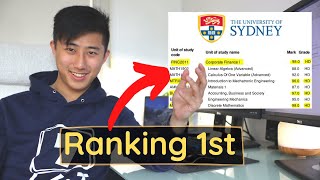

How I Ranked 1st in University with Minimal Effort
54sThe speaker's impressive achievement and counterintuitive claim immediately grabs attention, making viewers curious about the 'minimal effort' strategy.
▶ Play Clip"Delivers solid, actionable study tips, but the 'minimal effort' claim is overstated—consistency and strategic planning still require significant work."
Shane, a third-year mechatronics engineering student at the University of Sydney, shares five practical strategies that helped him rank first in four subjects while working part-time. He emphasizes shifting focus from competitive goals to personal improvement, identifying 'WAM boosters,' tailoring study approaches to assessment types, staying consistent, and leveraging lecturer consultations.
Instead of aiming to come first, focus on doing your best and achieving a mark you're happy with. This reduces stress and leads to pleasant surprises.
WAM (Weighted Average Mark) boosters are easy subjects where you can score high. Focus on these to maximize your overall average, while being aware of 'WAM killers' that are difficult for most.
Each subject has different assessments (homework, exams, projects). Tailor your study strategy to the format—e.g., memorize for exams, apply for open-book projects.
Avoid falling behind by watching recorded lectures weekly and completing tutorial work. This prevents last-minute cramming and reduces stress before finals.
Visit lecturers during office hours to get personalized help, gain insights into exam content, and potentially receive more lenient marking.
Complete participation and small homework tasks early to get full marks before exams. These are 'free' marks that are easy to lose if neglected.
Shane's approach centers on smart effort allocation—focusing on high-yield subjects, understanding assessment formats, and staying consistent—rather than grinding endlessly. By adopting these strategies, students can improve grades dramatically without sacrificing all their time.
What is a WAM booster?
A subject that is easy to get a high mark in, which boosts your Weighted Average Mark (WAM).
01:47
What is the recommended goal instead of aiming to rank first?
To do your best and achieve a mark you're happy with, which reduces stress and leads to pleasant surprises.
00:42
How should you adapt your study strategy for exam-based vs. project-based courses?
For exam-based courses (e.g., 80% exam), memorize and convert content to memory; for project-based, focus on applying concepts in an open-book setting.
04:48
What is a key benefit of attending lecturer consultation hours?
You get personalized help, insights into exam content, and potentially more lenient marking.
08:35
Why is it important to secure easy marks early in the semester?
Participation and small homework marks are 'free' marks that are easy to lose; getting them early ensures you start with a high baseline before exams.
09:45
Goal Setting Reduces Stress
Shifting from competitive goals to personal best reduces anxiety and improves outcomes.
00:42Strategic Subject Selection
Focusing on WAM boosters maximizes average marks with less effort.
01:47Consistency Beats Cramming
Weekly review prevents overwhelming last-minute study and reduces stress.
05:26Leverage Lecturer Access
Using consultation hours provides insider knowledge and potential grading leniency.
08:35[00:02] tricks and strategies that i use to come first in my university subjects consistently and that doesn't actually require you to spend all your time know me my name is shane and i'm a third year
[00:14] university of sydney i also completed a london for a mechatronics engineering component of my degree so far in my first three years i ranked first in four of my subjects
[00:27] and also received academic prizes based on my results and a lot of this working in a part-time job working three to four days each week so the first tip that i can give you guys is to make sure you have the correct
[00:42] in university is to just i want to come first in this subject or i want to come in my degree that's actually the wrong mentality and all it does is just stress be instead what your goal should be is just
[00:56] pressure on you to get this marked i like a failure in the end after you've tried your best you'll get and all that means is you'll be pleasantly surprised and happy for
[01:10] the best i could overall make sure i didn't fail any of my subjects and make sure i tried to achieve at least a distinction average which was that would force me to require my university scholarships
[01:23] i never actually had the intention of coming first or ranking first or even in the top five percent for any of my subjects at all my goal was simply to just do the best i could and make sure i got a mark that in the
[01:35] end of the day i would be happy with and not really compete with any of my can't do well in every single one of your subjects so what you should be doing is making sure you focus specifically
[01:47] on what we call wam boosters for those of you not in the southern hemisphere wham stands for weighted average mark which is similar to what the northern hemisphere would call gpa or grades so a wham booster is
[02:00] boost your wham what this means is a really easy subject to get a very high marking and you want to be focusing on these subjects to maximize your marks to boost your wham overall on the other
[02:13] killers and these are subjects that's very difficult and very hard to get a very good mark in for example it might be just everyone is or the assessments are just very difficult and most people don't do so
[02:27] again these subjects can be different for everyone some people might like a find it very easy for them it might be a wham booster for them it could be a wham killer what you should be doing is to be
[02:39] weaknesses and finding out which subjects are when boosters for you for me these were subjects where a lot of logic and so these included financial math subjects such as accounting and basics
[02:52] of finance and also a few probability math subjects and also introduction to engineering subject i knew these subjects was where i had a big comparative advantage and i didn't even need to put that much effort to end
[03:05] subjects and therefore allowed me to have a higher chance of actually ranking even though that was never my intention or my goal the second tip is to each subject and therefore study for it appropriately for each
[03:19] for example they could be individual homeworks individual assignments group assignments mid-semester exams small quizzes throughout the semester or big final exams or big projects at the very end
[03:33] assessments you perform better in is it exams or is it take home assignments where you have more time but generally the and you need to apply yourself a lot more make sure if there
[03:46] are easy marks such as participation marks small homework assignments that task on time to get full marks early in the beginning these are marks that are pretty much just given to you
[03:58] and they're there for you to lose not gain so what you want to do even before you do your first mid-semester exam you want to be on a 10 out of 10 just based on these little pieces of homework or participation in
[04:11] then for the smaller assignments or smaller pieces of homework what you can also do is just work together with other people in your course since generally and by working together you can help each other understand things a bit more
[04:23] and also make sure you guys are all working towards the right answers things you want to consider is how is it being assessed for example is it using or do you have to write extended
[04:36] response essays it's a very mathematical and right or wrong answer based or is a very subjective and essay-based furthermore you want to take into account whether that course that you're doing is based and
[04:48] assessed on a lot of projects and assignments or is it very heavily exam so what this means if it was a probably worth about eighty percent
[05:00] down each week's content and tutorial material those in the final exam whereas if it was a project-based task worry about memorizing it and converting it to memory just need to
[05:13] be able to have an open book and work through and apply these questions in a compared to it was the final exam but it means you're not very stressed out by having to memorize all these things so just overall make sure you use
[05:26] and whatever you're more comfortable with my third tip is make sure you keep up throughout the year this can be a very costly mistake if you don't do this and personally i've been guilty of this a few times
[05:39] of the time in cases where i don't like the subject or just find it really hard and difficult to understand the concepts the worst feeling whenever you're in uni is spending the last week during stuvac
[05:53] exam and having to memorize and learn for the worth of content and if you're doing this for more than one subject you're difficult time this doesn't mean you have to attend all
[06:06] the lectures in person if you want which is what i do i like to prefer and watch my lectures later because personally i find the speed of slow for my liking so i like to skip around maybe replay
[06:19] lecture at home it's a lot more better for me that way the weekdays what i'd do is in the weekends i'd watch the recorded lectures to make sure i was on track and up to
[06:33] this will save you just so much stress throughout the semester and especially where you finally have no idea what you're learning and you might need to information as you can days before the exam and that's a lot of
[06:48] to be able to do it you want to be making sure that you're making sure you've done them before the tutorial class if you can make sure you get those questions answered during the tutorial by asking
[07:02] later on through an email or something like that this way you can see where you went wrong and make sure those mistakes are fully fresh in your mind and you can studying for the final exam generally the content each week builds
[07:16] previous week so what this means if you struggled let's say you fell behind in week three then the week four material you're not gonna have any idea how to do because you weren't there for week three
[07:29] maybe in week five you wanted to catch up now you're behind on week four and the week five content as well keeps going until in the end you're just overwhelmed
[07:43] really make sure you're up to date with everything and that you're not falling lot of work all there is to just watch the lecture each week and do the that's literally it you don't really have to do any additional study material
[07:57] outside of what's taught in the lecture and tutorial one way of knowing that you're on top of things is how you're feeling before the final exam by this is four subjects where i've done this and
[08:10] kept up the day each week by the time the final exam comes about i don't feel much stress at all and i don't actually need to do any revision if much at all because i know i've already understood
[08:23] all the concepts and i just need to apply myself maybe all i need is just to quickly skim through it and make sure that everything that i know is actually my fourth tip is to make sure you go to the lecturer's consultation hours or
[08:35] whenever you need to if you're stuck on a difficult problem with the concepts then what you can do is just go to the lecturer's room and ask them the and there it helps you catch up really quickly by making sure you're focusing
[08:49] your 100 of the effort and getting them to explain struggling with by doing this you can also get some insights possibly about and also what kind of things the lecturer will probably put into it
[09:03] because they probably made the exam they might just let slip a few things here unfair advantage with regards to understanding and knowing they're looking for for smaller subjects where there's less
[09:16] students in a course the lecturer will know you a lot more personally and think and therefore they might just mark you that little bit more leniently when it ask for help from senior students who've done the subjects
[09:30] study materials sometimes they might have access to past and these are generally very similar year-on-year and you can use these past as a good practice to get a feel of what's likely to come up in the final
[09:45] my fifth tip is to scan marks in the early assessments so let me explain the lectures mentality generally lecturers and sometimes they're very lazy when it comes to teaching they're a little more focused
[09:58] and teaching just something on the side that they've kind of forced and have to just keep emailing them and kind of nagging them all the time asking questions about the content asking them to explain things asking
[10:10] it kind of really annoys them a bit so they really want to get you off their with you they don't want the hassle of getting complaints from bad students about their work so
[10:24] they'll generally just give up a lot more easily when it comes to for example giving new extra marks or marketing a bit more leniently when sometimes if you email them asking questions or just complain in general
[10:38] missing information or any areas that were present by conveying how serious you are about getting those good marks they'll be a bit worried and make sure you get what you want or else you might make a complaint this means it's just a
[10:51] extra marks that you probably didn't deserve and push yourself to get a mark that's a bit higher and possibly even just come hopefully from this video you've learned something useful that you can use to
[11:03] improve your grades dramatically and boost up your gpa and wham let me already use and what you think i might have missed if you enjoyed this video then make sure you give it a big thumbs up and also
[11:16] subscribe to this channel to not miss out on my future study content where it effectively and efficiently as always take care and i hope to see you guys in the next video




⚡ Saved you 0h 11m reading this? Transcribe any YouTube video for free — no signup needed.