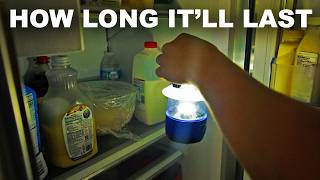

How long does fridge food last in a blackout?
39sSurprising government food safety guidelines challenge common assumptions about fridge and freezer food during power outages.
▶ Play Clip"Title accurately promises practical advice on eating during a blackout; video delivers food safety and cooking tips."
This video covers essential food safety tips during a power outage, advising that fridge food lasts about 4 hours while a full freezer can keep food safe for up to 48 hours. It also discusses practical cooking alternatives like gas stoves and charcoal grills, and emphasizes the importance of community interdependence over individual prepping.
Government guidelines state food in the fridge lasts about 4 hours without power.
A half-full freezer can last 24 hours; a full freezer can last up to 48 hours.
Opening the door repeatedly lets cold air escape; open once and take out everything you need for an hour.
Food remains safe after 24-48 hours but quality suffers—e.g., freezer burn or gummy texture.
Factory flash freezing creates tiny ice crystals; home refreezing makes large crystals that damage cell walls.
Use thawed meat/veg in wet dishes like stews where falling apart is fine.
Soda, beer, and similar items don't require refrigeration; leftovers and milk are unsafe after 4 hours.
Consider eating the most perishable items by candlelight during an extended outage.
Modern gas stoves have electric igniters; use a fire stick or match to light them, and ensure ventilation.
A charcoal grill or chimney starter can cook food and boil water when power is out.
Modern survival depends on a global network of sharing; prepping for short disruptions is fine but don't ignore systemic issues.
Prepare with canned goods and bottled water, but focus on maintaining the societal systems that keep us all fed—individual bunkers won't replace collective interdependence.
How long does food in the fridge stay safe without power?
About 4 hours (according to government safety guidelines).
0:21
How long can a full freezer keep food safe during a power outage?
Up to 48 hours, assuming the door is not opened frequently.
0:47
Why does a full freezer stay cold longer than a half-full one?
More mass of food absorbs ambient heat, slowing temperature rise.
0:50
Why should you minimize opening the fridge door during a power outage?
Every opening lets cold air sink out and warm air push in, raising internal temperature.
1:00
What causes freezer burn on partially thawed food?
Large ice crystals that form during slow home refreezing puncture cell walls, leading to dry texture and quality loss.
2:16
What type of cooking method works for partially thawed meat?
Use it in a wet dish like stew, where the meat is supposed to fall apart.
2:54
How can you safely light a gas stove if the electric igniter fails?
Use a fire stick or a match to light the gas manually.
5:48
What safety precaution is necessary when using a gas stove during a blackout?
Ensure proper ventilation because the power outage also disables ventilation systems.
5:58
How much land would be needed to grow food for a family of four in a survival scenario?
About 5 acres (5 times the speaker's 1-acre property).
7:01
Fridge food safety: 4 hours
Establishes a concrete, actionable time limit for perishable fridge items during a power outage.
0:21Freezer food lasts 24-48 hours
Provides a useful guide for freezer food safety, differentiating between safety and quality loss.
1:53Flash freezing vs. home refreezing
Explains the science behind texture degradation, helping viewers understand why refrozen food is less palatable.
2:16Interdependence over prepping
Shifts the focus from individual survival to the need for collective societal systems, offering a nuanced perspective on resilience.
6:46[00:00] It's thunderstorm season here in East
[00:02] Tennessee, and we live in a neighborhood
[00:04] with tall trees, so it's only a matter
[00:07] of time until one of them falls on the
[00:09] power lines again. How do you feed
[00:12] yourself when the power goes out? What
[00:14] about all the stuff in the fridge? How
[00:16] long is this stuff going to last without
[00:18] power? Well, let's start there. The food
[00:21] safety guidelines that you will get from
[00:23] any government generally tell you the
[00:25] same basic ballpark figure, which is
[00:27] food in the fridge lasts about 4 hours.
[00:30] Now, that's the government safety
[00:32] talking. And so, it's probably a pretty
[00:34] conservative figure, but nonetheless one
[00:36] that we should all keep in mind. The
[00:38] freezer, on the other hand, is actually
[00:40] a lot more forgiving. Even according to
[00:42] the officials, uh, a half full freezer
[00:44] could last 24 hours. If it's chock full
[00:47] of stuff, like my basement freezer here,
[00:50] this is just a whole lot more mass for
[00:52] the same amount of ambient heat to warm
[00:55] up. So, the stuff in here can last for
[00:57] up to 48 hours. This is assuming that
[01:00] you aren't opening and closing the door
[01:02] constantly. Every time you open the
[01:04] door, the denser cold air sinks and
[01:06] spills out the bottom of the opening.
[01:09] This creates a vacuum inside the box,
[01:11] allowing warm air to push in. Opening
[01:13] the door a few times to get what you
[01:15] need is like no big deal. Most of the
[01:18] cold inside the fridge is effectively
[01:20] stored inside the mass of the food
[01:23] itself and the walls, etc. So, even if
[01:26] you fill this box with warm air, the
[01:28] ambient temperature in here is going to
[01:30] drop again as soon as we close the door.
[01:32] But definitely minimize door action.
[01:35] Open it once, take out everything you
[01:37] think you might need in the next like
[01:39] hour or so, and then close it. Why is
[01:42] the freezer different? Do the laws of
[01:44] thermodynamics work differently in here?
[01:46] No, of course not. It's just starting
[01:48] off way colder than the stuff in the
[01:50] fridge. Plus, it doesn't really like
[01:53] last 24 to 48 hours. It just remains
[01:56] safe after 24 to 48 hours. The quality
[02:00] is going to suffer. Like the
[02:01] construction crew that we have working
[02:03] down here right now accidentally
[02:04] unplugged this freezer the other day and
[02:06] it was off for almost a whole day before
[02:08] I noticed. Look at these nuggets. Look
[02:11] at the freezer burn on them. I mean,
[02:13] they're still safe to eat, but they're
[02:14] not going to taste as good. Most of
[02:16] today's frozen food is flash frozen at
[02:19] the factory. They get it incredibly cold
[02:22] incredibly fast, and that results in
[02:24] tiny, tiny little ice crystals. When we
[02:27] freeze or refreeze food at home with our
[02:29] home technology, it doesn't go as fast
[02:32] and the result is big ice crystals that
[02:35] puncture the cell walls of vegetables
[02:37] and meat. Like look at all this meat
[02:40] that I've got frozen in here. This stuff
[02:42] partially thawed and then refroz. Which
[02:45] means that if I were to just like grill
[02:47] it up, it would come out super dry cuz
[02:50] it would lose a lot of juice and the
[02:51] texture might be kind of gummy. I mean,
[02:54] if you use it in a stew or something,
[02:56] then you're going to be fine because
[02:58] it's a wet dish where things are
[02:59] supposed to fall apart. And that's why
[03:01] I'm saving this stuff. I'm going to use
[03:02] this in like sundae sauce. And that's
[03:04] what I think you should probably do if
[03:06] you lose power for a day or two. Don't
[03:09] expect your meat and veg to be anywhere
[03:11] near as good once it refreezes. It's
[03:13] going to fall apart. So, make a big old
[03:16] stew or something where the food is
[03:17] supposed to fall apart. As for the stuff
[03:19] in the fridge, the the soda and the beer
[03:22] and all of that, that's going to come
[03:23] back just fine. It's shelf stable. You
[03:25] don't even need to refrigerate it. But
[03:27] like the leftovers and the milk, yeah,
[03:31] that stuff you probably are going to
[03:32] need to throw out after you've had an
[03:34] extended power outage of more than 4
[03:36] hours. So, if the power goes out,
[03:38] consider having yourself a little feast
[03:40] of your most spoilable food over candle
[03:43] light. It'll be fun. And remember that
[03:45] your most effective food storage device
[03:47] is uh your own body. Once calories go in
[03:50] here, it can actually be pretty hard to
[03:52] get them back out again. Don't I know
[03:54] it. Of course, you may need to cook your
[03:56] most spoilable food before you can eat
[03:58] it. And if you have an electric stove,
[04:01] that could be a problem if the power's
[04:02] out. So, you might consider the sponsor
[04:04] of this video, the Jackaryi Home Power
[04:07] 3600 Plus, the standard essential home
[04:11] power solution. This thing holds enough
[04:13] power to get a family of three to six
[04:15] people through a pretty extended power
[04:17] outage. For example, you could plug the
[04:19] fridge into the utility hookup right
[04:21] there and you could run it for up to 2
[04:23] weeks. You can just plug it into the
[04:24] wall to charge it in advance. But if the
[04:26] power is out for a long time or you're
[04:28] off the grid, you can buy these super
[04:30] portable solar panels and charge it up
[04:32] with about 4 hours of sunshine or 2 and
[04:35] 1/2 hours with a gas generator. Plug in
[04:37] your phone right there while you wait.
[04:39] Plug in the stove to cook, or you could
[04:41] plug in a little hot plate. In a
[04:43] snowstorm, I can use it to power my
[04:44] greenhouse, keep the heater and all the
[04:46] pumps working for my plants and my
[04:48] fishies. It's the lightest, most
[04:50] portable 3.6 kW LFP power station. Great
[04:54] for road trips, camping. There's an app
[04:56] to monitor everything. You can even set
[04:59] it to charge during low demand periods
[05:01] when power may be cheaper. It comes with
[05:03] an extendable three-year warranty, and
[05:05] it lasts a long time. You just leave it
[05:07] unplugged in the closet. It'll only lose
[05:10] 5% of its juice every year. Great gift
[05:13] for dad. Check out my link in the
[05:15] description to learn more. Thank you,
[05:17] Jackie. Anyway, if you have a gas stove,
[05:19] you're going to have a much easier time
[05:21] in a power outage. Gas lines are just a
[05:24] much harder target than power lines
[05:26] because a gas leak is a much bigger deal
[05:29] than a power outage. The gas lines are
[05:32] generally all buried and they're pretty
[05:34] tough. But modern gas stoves generally
[05:37] have electric igniters that might not
[05:39] work when the power is out. Here, let me
[05:41] unplug this to simulate. You might turn
[05:44] the knob and nothing happens even though
[05:46] you can smell the gas coming out. That's
[05:48] bad. This is a reason to keep one of
[05:50] these uh fire sticks around just to
[05:52] light it up and then turn the gas on and
[05:54] it ignites just fine. My grandma used a
[05:56] match. And just remember that if your
[05:58] power is out, that means your
[05:59] ventilation system is out. So, don't
[06:01] cook with a gas stove unless you've got
[06:04] big old windows that you can open. But
[06:06] this is one reason I always keep a
[06:08] charcoal grill around along with some
[06:09] charcoal to grill on. All you need for
[06:12] this is just some chunk of the out of
[06:14] doors and you can cook your food on it.
[06:16] Uh if your water isn't safe to drink,
[06:18] you can boil it on here. And even if I
[06:20] didn't have the grill, I could just cook
[06:21] with my charcoal chimney starter right
[06:24] here. These things are great not only
[06:25] for lighting charcoal generally, but
[06:27] also just as a cooking device. You can
[06:29] just start it going and then when it
[06:32] gets hot, you just take a grate and you
[06:34] can cook directly on top of the starter.
[06:36] Or you can take some hot charcoal, put
[06:38] it into like a metal bowl or something,
[06:39] put the grate on top of the bowl. All
[06:41] kinds of things you can do with
[06:42] charcoal. Now, if I've got you feeling
[06:44] like you can survive the apocalypse, uh,
[06:46] no you can't. These are all just
[06:48] techniques for coping with momentary
[06:50] disruptions to the systems that make all
[06:53] of our modern lives possible. By
[06:55] suburban standards, I live on a pretty
[06:57] big piece of property. It's a full acre.
[06:59] If I wanted to grow all of the food that
[07:01] I would need to feed my family of four,
[07:03] I would probably need about five times
[07:05] this much land. And I'm lucky that I
[07:07] live on dirt and not on rock or sand as
[07:10] so many other humans do. And obviously,
[07:12] I would need to cut down every single
[07:14] tree and then bust up all of this turf.
[07:16] And then I would need inputs. I would
[07:19] need seed. I would need fertilizer. I
[07:21] would need a lot more equipment than I
[07:22] have. And even then, think about the
[07:25] lives that our ancestors lived. People
[07:28] who had ancestral subsistence farming
[07:30] knowledge that you and I have lost. Even
[07:33] with all that knowledge, they still
[07:35] starve to death all the time in horrible
[07:38] famines when there was just uh one
[07:40] summer of bad weather or when uh one
[07:43] warlord came through and took your
[07:45] harvest to feed his men. Most of us on
[07:47] this planet are only alive right now
[07:49] thanks to a delicate web of
[07:51] interdependence or let's call it
[07:53] sharing. We're only able to survive
[07:55] because we have this global network of
[07:58] sharing. Prepping is not an excuse to
[08:01] opt out of the difficult social,
[08:03] economic, and political work of keeping
[08:06] all of these delicate systems up and
[08:08] running. Your bunker may be nice, but
[08:11] believe me, bro, you don't want to ever
[08:13] have to use it. By all means, stockpile
[08:15] the canned goods and the bottled water.
[08:18] Prepare for the worst, but let's work
[08:20] real hard to avoid the worst. Okay?



⚡ Saved you 0h 08m reading this? Transcribe any YouTube video for free — no signup needed.