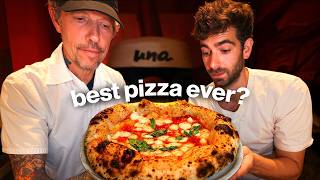

World's #1 Pizza Chef Reveals His Secret
45sHigh intrigue and authority as the chef explains the 30-year evolution of his pizza style.
▶ Play Clip"Delivers a genuine behind-the-scenes look at the world's #1 pizza chef, though the title slightly oversells the 'mind' aspect."
In this video, the host visits Anthony Mangieri, chef-owner of Una Pizza Napoletana, ranked the world's best pizzeria multiple times, to learn the secrets behind his acclaimed sourdough pizza. The conversation covers Anthony's 40-year journey, his philosophy of natural fermentation, high hydration dough, and the challenges of wood-fired baking. The host tastes several pizzas, including a summer special, and shares insights into what makes Una Pizza unique.
The host visits Anthony Mangieri, chef-owner of Una Pizza, ranked best pizzeria in the world multiple years, to learn the differences between his pizza style and Vito's, and to absorb pizza knowledge.
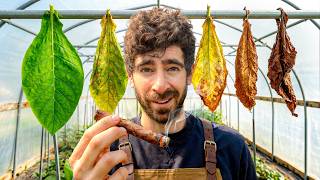
The host brings cured garlic from his garden as a gift, harvested in fall and cured for three weeks, showing appreciation for fresh ingredients.
Anthony started making pizza at 15, now 53, with 40 years of experience. His initial draw was the food of southern Italy, influenced by family stories and trips to Naples with his mom.
The word 'pizza' is a Neapolitan word from 'pia'. Pizza originated in Naples and spread worldwide, evolving into different ethnic versions.
Anthony's pizza is a hybrid, a 30-year slow evolution from the original Neapolitan idea. He emphasizes finding your own way to express yourself within a craft.
Special pizza requires great ingredients and balance; toppings shouldn't be so abundant that they mask the dough. The dough is always the focal point.
Working with a wood-fired oven is like driving a manual car; it's a different skill set. The oven's heat fluctuates, and with highly hydrated dough, it's tricky to handle, making it interesting.
Anthony chose natural fermentation from day one, even before opening Una, wanting to make pizza as imagined in Pompeii. He hand-mixes dough, wood-fire bakes, and uses no refrigeration.
When he started, no one made naturally leavened pizza dough; even in Italy, people said pizza shouldn't be naturally leavened. He argued that's how it was originally made before packaged yeast.
Natural leavening is where the art starts, making dough super digestible and allowing better nutrient assimilation. It's harder to manage and bakes differently than commercial yeast.
People recognize Una Pizza's dough for its personality, which has evolved to be puffier and irregular. Some days it's great, some days not, due to natural, unrefrigerated product variability.
Anthony makes dough in the morning, no refrigeration. Hydration is around 85%, varying with flour: some can go to 90%, some need 70% to avoid a wet mess.
Anthony believes if you're cocky and confident you've got it all, you're not a good cook. You should feel nervous and care about your work, always wanting to improve.
A customer from Singapore compared the pizza to Domino's, noting it's 'gooey'. The host explains that a classic Neapolitan margherita is gooey inside, cooked for 90 seconds, with a fluffy crust and slightly wet sauce, eaten with fork and knife.
The host initially found the pizza fresh and well-crafted, but after a few slices, realized the light, fluffy texture and complex flavor, feeling light after eating a whole pie.
Vito, a traditional Neapolitan baker, wasn't into sourdough pizza, but commercial yeast only goes back 150 years. Anthony's natural fermentation goes way back, but sourdough alone isn't enough; it's heartier.
Anthony counters the heartier sourdough by jacking up hydration levels to levels most pizzaiolos aren't comfortable with, resulting in a light, fluffy crust with complex flavor and better digestibility.
The summer special with coita cheese, summer corn, and micro cilantro was one of the most unique pizza experiences. The host also loved the cantaloupe sorbet and plans to make it with his homegrown melons.
Anthony handcrafts 150 pizzas by himself every night, maintaining a connection to the art. He doesn't want to open many restaurants; he wants to be there making pizzas, which you can taste.
The host is inspired to test higher hydration sourdough pizzas at home, promising a video soon.
Anthony Mangieri's approach to pizza—natural fermentation, high hydration, and wood-fired baking—creates a unique, digestible, and flavorful pie that stands out in the world. His dedication to the craft and humility in the face of variability are key to his success, inspiring home cooks to experiment with higher hydration sourdough.
What is the hydration level of Anthony Mangieri's pizza dough?
Around 85%, but it varies with flour; some can go to 90%, some need 70%.
07:37
How long has Anthony Mangieri been making pizza?
Since he was 15; he is now 53, so about 40 years.
01:55
What is the origin of the word 'pizza'?
It's a Neapolitan word from 'pia'.
02:55
Why does Anthony use natural fermentation instead of commercial yeast?
Because that's how pizza was originally made before packaged yeast; it makes dough more digestible and allows better nutrient assimilation.
05:49
How long is a Neapolitan pizza cooked?
90 seconds.
09:25
What is the key to making a light and fluffy sourdough pizza?
Using very high hydration dough, which counterbalances the heartier nature of sourdough.
11:11
How many pizzas does Anthony make by himself every night?
150 pizzas.
12:17
Natural Fermentation from Day One
Anthony chose natural fermentation before it was popular, showing a commitment to tradition and quality over convenience.
05:06High Hydration Dough
The 85% hydration level is a key technical detail that home bakers can use to improve their sourdough pizza.
07:37Humility in Craft
Anthony's belief that confidence leads to complacency is a valuable mindset for any craftsperson.
08:10High Hydration Counterbalance
Explains the science behind why high hydration makes sourdough pizza light and fluffy, solving a common problem.
11:11Dedication to the Art
Anthony's choice to handcraft 150 pizzas nightly rather than expand shows that passion and quality can coexist with success.
12:17[00:01] of having Pizziola Vito Yakapelli over to my studio to teach me the art of Neapolitan pizza. And those two days changed my life forever because it just completely elevated my pizza making skills to a whole new level. And I know
[00:14] that's true for a lot of you as well, because that video went on to become my most popular video of all time. And tonight, I have another incredible to meet with Anthony Maniieri who is the chef owner of Una Pizza which was
[00:28] actually ranked multiple years the best pizzeria in the entire world. And what's fundamental differences between his pizza style and Veto's pizza style. So to whip up some pizzas and I'm just going to try to absorb as much pizza
[00:43] knowledge as possible and of course share that with all of you. So I've got before I head out, there's one thing I want to do. I was thinking what I could bring him from the garden. I figure any Italian chef would appreciate some fresh
[00:56] garlic. Well, cured garlic at this point. About 3 weeks ago, we harvested planted in the fall. And it's been curing here. It's ready to go. It just which I'm going to do right now. All I'm doing is cutting off some of those
[01:09] roots. The skin peels off nice and easily when it's dried like this. And beautiful those bulbs are. This one is slightly more purple, just a different bag is packed. Check out the garlic. It's a bit of a hike over there. I got
[01:22] the Long Island Railroad all the way over to Penn Station, and then I'll take the subway down to Una Pizza, which is in the Lower East Side. in the Lower East Side. [Music]
[01:55] pizzas? >> Since I'm 15. So, I'm 53. So, whatever >> Many years. Many years. >> 40 years, if I can add. Something like >> Yeah. Almost. Almost. Yeah. >> That's wild. So, what was the initial
[02:11] draw into pizza? Um, the initial draw into pizza probably started more as like just a draw into like the food of the southern Italy area. That's what you family was from there originally and I grew up hearing stories about Naples and
[02:27] to go quite a bit with my mom especially. Yeah, man. And I just fell in love with the food. You know, I grew up Italian-American, but when I started to experience the food in Italy, it tasted so ethnic and so different than
[02:41] what I had grown up eating. And the funny thing is then I kind of ended up not liking it and being like, "This is not good. It's not like authentic." As I got older, it's full circle and I appreciate both cuisines and I love
[02:55] really think about what we know of as pizza, that is the origination of pizza. The word pizza is a Neapolitan word from the word pa. And so to think like that city and what that was, you know, they created there then spread throughout the
[03:10] world and then spread and changed and evolved and now all different kind of ethnicities have their own versions of pizza and their own way of doing it, their own toppings. It's amazing. The thing with Neapolitan pizza or staying
[03:24] close to that style, I think what we make is our own kind of hybrid, which has been a 30-year kind of slow evolution from that original idea of it's got to be cooked this way and all this stuff. We don't really do that now
[03:37] because I think when you do anything for so long day after day you start to find good and which is what you need to do and in whatever your profession is I think is find your way to express yourself within that. What makes it so
[03:52] yourself within that. What makes it so special is one it usually requires really great ingredients cuz it's very balanced. It's never going to be something to in my mind where the toppings are so abundant that you can
[04:05] doesn't matter. >> The dough is always the focal point for me. Also, working with a woodf fired oven, I think when you bake pizza in a is tough, but if you're cooking in a woodf fired oven, you're like making
[04:18] something tough really, really tough. And not cooking in one makes it way easier. It's like you're basically driving an automatic car or a manual car. It's just a completely different skill set. You're deal,
[04:38] oven's like this. And if you're busy, it starts to go this way. And I think when you add all that up with a very highly hydrated dough, you end up with something that like is very tricky to to handle. And I think that's what makes it
[04:51] so interesting and why, you know, I'm still into it and excited every day to do it. When did the decision come to go with a naturally fermented, you know, >> Day one. Day one since like before I opened Una. Like when I was thinking and
[05:06] coming up and named it Una Pizzaano when I was like, you know, whatever 20 years old, I did it because I just felt like I wanted to go back and make pizza the way wanted to go back and make pizza the way I imagined it was made in Pompei. And I
[05:20] used to joke with a basically it's like we're in Pompei because at that time the hand was like I'm hand mixing the dough. It's woodfire baked. Nothing is refrigerated. I'm like
[05:34] air conditioner for the guests >> we could be in Pompei. Um so for me like naturally leaven dough when we started no one was making naturally leaven pizza dough and people even in Italy I can remember this very clearly. I would talk
[05:49] would be like, "Pizza shouldn't be naturally leavened. You need to use yeast." Well, I was like, "Well, how do you think it was originally made?" You know, you couldn't buy packaged yeast back then. Naturally leavened bread in
[06:01] back then. Naturally leavened bread in general is just where you go. I have no interest in making pizza that isn't naturally leavened. It's where all the beginnings of the art of it starts. It's where you can have the possibilities of
[06:15] making a dough that's super digestible. your body can assimilate the nutrients better. It's just like, you know, like Yeah. everything, the flavor. I mean, granted, it's much harder to manage. It bakes not as well because naturally
[06:28] yeast commercially yeasted dough. >> Is that the biggest difference between your pizza and say commercial yeast pizza? Is it the texture? Is it the >> It's probably a little bit of all that. I think probably what people recognize
[06:43] the most about our pizza is the dough. just because I think it has such its own personality. Again, it's just an evolution. It didn't start like that and it's gotten much more puffy and kind of irregular and weird and some days it's
[06:58] >> break baking. always like, "Oh, like whatever." And they think that we're like just set and we got it. And I'm just like, "Look, we don't have anything. Like it's all over
[07:11] the place and every day I never know if it's going to be great." Like I'm just like, you know, when you're dealing with a natural product and an unrefrigerated product, you're kind of always like, well, I did the same thing, but it
[07:23] I don't know why. >> So, you make the dough in the morning? >> Yes. I finish it in the morning >> and it's no refrigeration. That's really interesting. What uh what hydration do you do? You know, the hydration you kind
[07:37] >> I mean, it's probably around like 85%ish. It really depends honestly on the flour. Some flour, you know, you can push it to 90. Some flour you want to do like 70 and it's going to be a wet mess.
[07:56] >> It's refreshing to hear just that you're not, you know, some >> expert. I think if you are cocky and confident and you think you got it all, >> you are not a good cook because I just
[08:10] feel like, you know, and I think it's like that in all forms of like craft and art and anything. It's like you should be nervous. You should feel like >> what am I doing? Or there's days where I'm here and people see us and I'm just
[08:23] like I just want to be done with this and go home and pretend tonight never happened and tomorrow will be better, you know? And I think that that's the way you should feel when you're doing something that you care about. I'm not
[08:35] confident and at a point in my life where I feel like I've got it. We're still want it to be better. You know, we know somebody is in that we really want to like blow their minds. We're just like, ah. And you know, I'll be like,
[08:48] damn it, that's the worst one of the whole night we just sent them. Awesome. from Singapore who found out about this place from a Ryan Trey video.
[09:01] >> Oh, yes. >> And I asked them how they like their pizza. And the first thing they said was, "It's kind of gooey. Not quite like a Domino's pizza." And I was just laughing inside that they were comparing
[09:13] one of the best pizzeras in the entire world to Domino's Pizza. But the truth is, they are not wrong about that review. A classic margarita pizza that you're going to get in Naples is going to be a little bit more gooey on the
[09:25] interior of the pizza. It's only cooked for 90 seconds, so you get this insanely fluffy crust, but the crust just does not have long enough to get super the sauce is is going to be slightly wet, which is why when you eat a proper
[09:39] Neapolitan pizza, they serve one pizza per person and you eat it with fork and knife like it is a main course. And the pizza experience tends to evolve over time, which is why I don't think Neapolitan pizza, say, works for like a
[09:52] one bite review. It takes time for to really set in. And that's exactly what happened when I was eating this pie. After the first few bites, I'm like, "Okay, this is really fresh. All of the ingredients are really singing. It's
[10:04] perfectly crafted. I could taste the love that went into this pizza." But it wasn't until I took down a few slices that the light bulbs just started popping in my head. and I ended up running directly to the kitchen to talk
[10:17] to Anthony about my discovery. So, when I first was learning Neapolitan sourdough bread baking at the time. So, I asked Veto his thoughts on sourdough pizza. And just like Anthony mentioned, he really wasn't that into it because it
[10:31] wasn't the proper traditional way that he learned how to make bread in Italy with commercial yeast. But that tradition, of course, only goes back 150 years with the creation of commercial yeast. Anthony takes it way far back and
[10:44] keeps everything naturally fermented. But just making a sourdough pizza alone is not enough. And I can tell you from experience, I've tried it many times to the point where it's been fine, but there's one glaring reason why I don't
[10:58] love it, which is that sourdough is a hardier bread. If you were to take the sourdough loaf versus a commercial going to be much fluffier and lighter, which works really great for that
[11:11] cloudlike crust on Neapolitan pizza. But what Anthony does to counterbalance what would be a heartier pizza that I personally don't love is that he jacks the hydration levels up in his dough to levels that most pizza iolas are just
[11:24] not comfortable with. And this super high hydration sourdough when baked gives you that really light and fluffy experience that you're used to with a regular commercial yeast, but on top of that, you get much more complex flavor
[11:37] digestible than a regular commercial yeast, which for me was the real game changer. Not only was the flavor incredible, but after eating an entire pie, I felt pretty light, like I was ready for the next pizza, which was that
[11:51] summer Mexican special, which completely blew my mind off. The flavors of the coita cheese with the summer corn and the micro cilantro just works so well together and was one of the most unique pizza experiences I've ever had. And
[12:04] cantaloupe sorbet, I ran back to the kitchen to ask him the recipe because I have so many melons growing. So, I will be making that shortly once they ripen. So, I totally understand the hype of Pizza Una now. Not only is Anthony
[12:17] leading the charge in this world of sourdough pizza and creating this unique down to his dedication to the art form. This guy is handcrafting 150 pizzas pretty much by himself every single night. And I love the fact that
[12:31] he still has that connection. It's not about opening a ton of restaurants. He wants to be in there every single night making those pizzas and doing what he loves. And you can taste that in the pizza. And it's certainly inspired me.
[12:44] I've already been hard at work testing out higher hydration sourdough pizzas. out higher hydration sourdough pizzas. And that will be coming in a video soon.
⚡ Saved you 0h 12m reading this? Transcribe any YouTube video for free — no signup needed.