
Best Beginner Mic? FiFine vs Shure vs Rode
45sDirectly addresses the video's core question, hooking viewers looking for a mic recommendation.
▶ Play Clip"Title accurately reflects content: a beginner mic comparison with clear recommendations."
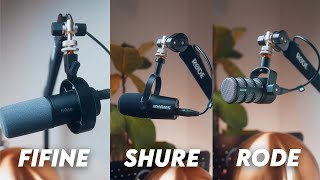
This video compares three popular beginner microphones: the FiFine K688, Rode PodMic, and Shure MV7. The creator evaluates design, features, sound quality, and value for money, providing recommendations for different use cases like podcasting, streaming, and YouTube.
Compares FiFine K688, Rode PodMic, and Shure MV7 for creators and streamers.
FiFine feels cheapest but good for price; Rode PodMic is built like a tank; Shure MV7 is in between.
FiFine has USB-C, XLR, headphone monitoring, and mute switch. Rode PodMic has only XLR. Shure MV7 has XLR, micro USB, touch panel, and software.
Shure MV7 has least hiss and best noise rejection. Rode PodMic is second. FiFine has noticeable hiss on USB.
Out of box, Shure MV7 sounds best. FiFine sounds good with XLR and EQ. Rode PodMic needs EQ to sound its best.
FiFine ~$70, Rode PodMic ~$90, Shure MV7 ~$179. Rode PodMic is best value considering build and sound.
Shure MV7 best for podcasting (versatile), FiFine for streaming (fixed position), Rode PodMic for YouTubers (post-processing).
Creator's personal favorite is the Rode PodMic, but choice depends on use case and experience level.
The best microphone depends on your specific use case and experience level. The Rode PodMic is the creator's personal favorite for its build quality and sound after EQ, but the FiFine offers great value for streamers on a budget, and the Shure MV7 is the most versatile out of the box.
What are the three microphones compared in the video?
FiFine K688, Rode PodMic, and Shure MV7.
Which microphone has the best build quality according to the creator?
Rode PodMic, built like a tank and mostly metal.
01:36
Which microphone has USB-C connectivity?
FiFine K688.
05:10
Which microphone has only XLR output?
Rode PodMic.
05:45
What is the price range of the three mics?
FiFine ~$70, Rode PodMic ~$90, Shure MV7 ~$179.
12:56
Which microphone had the most background hiss when using USB?
FiFine K688.
08:38
Which microphone does the creator recommend for streamers?
FiFine K688, because streamers sit close to the mic at a fixed position.
14:26
Which microphone does the creator recommend for YouTubers?
Rode PodMic, because YouTubers have time to EQ in post.
14:40
What is the creator's personal favorite microphone?
Rode PodMic.
14:59
Rode PodMic build quality
Described as built like a tank, likely to last 5-10 years.
01:36FiFine USB hiss issue
Significant background hiss when using USB, making it nearly unusable at high gain.
08:38Price comparison
Clear price tiers: $70, $90, $179, highlighting value differences.
12:52Use case recommendations
Provides tailored advice for podcasters, streamers, and YouTubers.
14:08[00:00] you a Creator or streamer looking for
[00:02] the perfect beginner microphone whether
[00:04] you're on a budget or need the best
[00:06] audio quality or just need something
[00:07] easy to operate today we're going to
[00:09] compare three very popular options the
[00:12] fine K 688 the road pod mic and the
[00:15] Shore mv7 by the end hopefully you'll
[00:17] know exactly which one of these mics
[00:19] will suit your needs because I'll be
[00:20] sharing my top pick for which one of
[00:22] these microphones is worth the
[00:24] investment and a big thanks to Riverside
[00:26] for partnering on today's video and as
[00:28] we go throughout the video I'm just
[00:29] going to be cutting between each
[00:30] different mic so you get a bit an idea
[00:32] of what each one sounds like in action
[00:34] for reference I've got the fine and the
[00:36] mv7 both plugged in via USB and then the
[00:38] Pod mic is plugged in Via XLR basically
[00:41] because that's kind of how they're
[00:42] designed to be used out of the box all
[00:44] right so first of all let's talk about
[00:45] the design and build quality of these
[00:47] three different microphones cuz they do
[00:49] range quite a bit now starting out with
[00:51] a f fine it's kind of a combination of
[00:53] metal and plastic and overall I would
[00:55] say this one definitely feels like the
[00:57] cheapest microphone but despite that in
[00:58] terms of the amount of money you're
[01:00] actually paying for this microphone I
[01:01] actually think it's a really good deal
[01:02] the metal definitely feels on the
[01:04] thinner side but it doesn't feel like
[01:05] they've skimped on build quality when it
[01:08] comes to the materials it feels well
[01:10] constructed while also being on the
[01:12] budget end it's also relatively light
[01:14] which again isn't necessarily a bad
[01:15] thing I am actually quite a big fan of
[01:17] the overall design it looks quite nice I
[01:19] like the green the black aesthetic also
[01:21] quite like the shock mount design I
[01:23] think the main downside when it comes to
[01:25] build quality with the F fine is
[01:26] probably where it attaches to your boom
[01:29] arm this does feel a little bit
[01:30] plasticky but again I'm definitely not
[01:32] disappointed considering the price point
[01:34] of this mic now moving up slightly in
[01:36] price we've got the road pod mic and
[01:38] this one to me is a huge contrast in
[01:40] overall build quality this one feels
[01:41] like it's built like an absolute tank
[01:43] it's actually quite heavy almost all of
[01:45] the components are made of metal with
[01:47] the exception of just a couple of things
[01:49] like the tightening knobs on the side
[01:51] but these feel like really high quality
[01:53] plastic and I've said it in my previous
[01:54] review videos of the podmic I think this
[01:56] thing is built to last like I think it
[01:58] will last easily 5 to 10 years in terms
[02:00] of the overall design I think when I
[02:02] first saw it I wasn't as crazy about it
[02:04] but over time it's actually really grown
[02:06] on me I actually really like the kind of
[02:07] old school Timeless classic look that
[02:10] the Pod mic has it doesn't have a
[02:12] removable pot filter like the fine does
[02:14] but again I don't necessarily see that
[02:16] as a downside it's kind of one less
[02:17] component to worry about which is kind
[02:19] of a good thing in my opinion and
[02:20] overall I just think it's a really solid
[02:22] microphone when it comes to the build
[02:24] quality and the design then lastly
[02:25] moving on to the short mv7 which is the
[02:27] most expensive of these three mics I
[02:29] would say it's sits kind of somewhere in
[02:31] between the first two mics although
[02:32] definitely on the Pod mic side when it
[02:34] comes to Quality so overall i' would say
[02:36] it's not quite as solid as the Pod mic
[02:39] but definitely a lot more solid than the
[02:40] fine similar to the Pod mic it's mostly
[02:43] made of metal with the exception of a
[02:45] couple of components like the tightening
[02:47] nods on the side this one does have a
[02:49] removable pop filter the actual mic
[02:51] casing underneath feels really solid and
[02:53] in terms of weight again it's somewhere
[02:54] in between the first two mics it's not
[02:56] super heavy like the Pod mic but it's
[02:58] not really light like the 5 fine in
[02:59] terms of the design I'm a fan I think it
[03:01] looks sleek kind of understated but in
[03:03] some ways maybe just because it's a
[03:04] little bit of a smaller form factor than
[03:06] the five kind of feels like it's not
[03:08] quite as premium somehow even though
[03:10] this is the more expensive microphone
[03:12] but overall I think the winner for me
[03:14] probably is the road when it comes to
[03:16] the design and build quality and
[03:18] especially when you consider how much
[03:19] money you pay for it I think it's an
[03:21] absolute bargain so as you can see these
[03:23] mics overall offer solid build quality
[03:25] which is key for any serious content
[03:27] creator but great gear alone isn't
[03:28] enough to get that perfect sound another
[03:30] really important thing that a lot of
[03:32] people forget about is how you actually
[03:34] record because no matter how great the
[03:36] microphone if you're recording setup
[03:38] isn't solid it's not going to sound good
[03:40] I've seen plenty of content creators
[03:42] invest in really high-end microphones
[03:44] but end up with subpar audio because
[03:46] they record on devices and platforms
[03:48] that don't fully preserve the audio
[03:50] quality one thing to definitely watch
[03:52] out for is using traditional video
[03:54] calling platforms like Zoom that often
[03:56] heavily compress your audio which ruins
[03:59] the quality that you be paid top dollar
[04:01] to achieve that's why if you're doing
[04:02] remote interviews podcasts or any type
[04:05] of remote recording you need a platform
[04:07] that's going to record your audio at its
[04:08] best without bad compression now I use
[04:10] Riverside for all of my remote
[04:12] recordings including my own podcast it's
[04:14] an all-in-one platform that allows you
[04:15] to record stream and edit all of your
[04:18] content right within your web browser in
[04:20] the highest quality possible it's able
[04:22] to do this by recording your audio and
[04:24] your video locally onto your computer
[04:26] meaning you get uncompressed studio
[04:28] quality files which then then get
[04:30] uploaded separately and with Riverside
[04:32] you can also automatically generate
[04:33] captions for your videos and then use
[04:35] the edit to add music and overlays
[04:37] whether you're a YouTuber doing remote
[04:39] interviews or hosting a podcast
[04:41] Riverside makes it easy to keep your
[04:43] production polished and professional if
[04:45] you want to try it out I've got an
[04:46] exclusive discount with the code nick2
[04:48] to get 20% off your subscription of
[04:50] Riverside just click the link in the
[04:51] description and you can even try it out
[04:53] for free with a free account has
[04:55] personally saved me tons of time without
[04:57] compromising quality so I hope it will
[04:59] for as well but of course the design
[05:01] isn't all that matters when it comes to
[05:03] microphones you've also got to consider
[05:05] the features so let's talk about some of
[05:06] the different features of these mics
[05:08] once again starting off with the fir
[05:09] fine so in terms of connectivity you can
[05:10] plug it in Via USBC which is really nice
[05:13] because that's quite modern it's going
[05:14] to connect to most modern laptops or
[05:16] computers you can also connect it via
[05:17] XLR which is a very nice option to have
[05:19] especially on a microphone of this price
[05:21] point you can also plug in your
[05:23] headphones directly so you can get audio
[05:25] monitoring live then you can adjust your
[05:27] monitoring levels with a little knob as
[05:29] well as your level so that's two very
[05:31] nice additions to have right on the
[05:33] microphone itself because it does give
[05:34] you that bit of extra fine control the F
[05:36] fine also has a mute switch on top which
[05:39] is very prominent which changes color
[05:41] depending on whether it's muted or
[05:42] unmuted then moving on to the Pod mic
[05:45] this one is actually pretty feature slim
[05:47] it's purely got an XLR output it's got
[05:50] no headphone monitoring controls it's
[05:51] got no game controls built in it's just
[05:53] the mic and an XLR Port that's
[05:55] essentially all that it's got so if
[05:57] you're looking for lots of onboard
[05:58] features the pod mic might not be the
[06:00] microphone for you then finally we've
[06:02] got the short mv7 this one also has
[06:04] quite a few features so this one
[06:05] features a touch panel which enables you
[06:08] to control the monitor levels because
[06:10] you can also plug in your headphones
[06:11] into the back it also allows you to
[06:13] control the gain of the microphone it's
[06:14] also got a mute switch which is really
[06:16] nice and then again the mvy servant has
[06:18] xli out as well as micro USB out now
[06:21] micro USB is definitely on the older
[06:24] side and I've mentioned in previous
[06:25] reviews that I found the cable that came
[06:27] with the mic has gotten a little bit
[06:29] bent over time so it tends to fall out a
[06:31] little bit I wish the mv7 had USBC like
[06:34] the fine the other thing to mention is
[06:35] that the short mv7 has Associated
[06:38] software which you can install onto your
[06:39] computer and you can use this to do
[06:40] things like change the preset EQ and
[06:43] even record directly to your computer
[06:45] that's the Sha motive app that's what
[06:46] I'm recording this microphone through
[06:48] right now so I consider that kind of an
[06:50] extra feature of the mv7 so for me the
[06:52] winner when it comes to overall features
[06:55] I would probably argue is actually the
[06:57] fine and that's mainly because I really
[06:59] like the knob control of the microphone
[07:02] gain and the headphone output instead of
[07:04] the touch panel the touch panel can be a
[07:06] little bit finicky to use and I also
[07:08] really like the USBC it's very hard to
[07:10] beat USBC in this day and age but even
[07:12] more important than the actual features
[07:14] of these microphones is arguably how
[07:16] good they sound so let's talk about the
[07:18] actual sound quality of these three
[07:20] microphones and one thing that a lot of
[07:22] beginners might notice is any background
[07:24] hiss and that's something that can
[07:25] really destroy your audio quality very
[07:27] quickly this is often caused by too much
[07:30] gain in the microphone or just a lower
[07:32] quality microphone overall now I'm going
[07:33] to start off with the best and then go
[07:35] to the worst when it comes to this so
[07:37] the absolute best is the short mv7 in my
[07:39] experience when you have it set to
[07:41] pretty normal gain levels either on USB
[07:43] or on XLR is almost no background hiss
[07:47] which is pretty amazing when you start
[07:48] to boost the gain a bit you do start to
[07:50] introduce a bit of a background hiss but
[07:52] it's still pretty manageable next in my
[07:54] experience was the road pod mic this
[07:56] definitely has some more noticeable
[07:58] background here just a standard gain
[08:00] levels overall to me it's totally
[08:01] acceptable you can probably e it out
[08:03] pretty easily same deal when you boost
[08:05] the gain on this mic it does increase
[08:08] that background his a bit but I think
[08:09] overall it's still quite manageable now
[08:11] when it comes to the F fine I had two
[08:13] different results depending on whether I
[08:15] was using USB or XLR so when I was using
[08:18] XLR it was actually pretty similar I
[08:20] found to the podmic maybe slightly
[08:22] better so at normal gain levels the fine
[08:25] had pretty manageable background hiss
[08:27] however I first started to notice a b
[08:28] issue when I boosted the gain and
[08:30] stepped back from the fine a bit that's
[08:32] what I noticed more of a background hiss
[08:34] and it was a bit more noticeable I think
[08:36] than the Pod mic however the big problem
[08:38] came when I was recording through USB
[08:40] which is what I'm doing right now and
[08:42] even at standard gain levels the
[08:43] background hiss on this microphone was
[08:45] relatively significant to the point
[08:47] where it was quite noticeable even with
[08:49] a bit of background music and then when
[08:50] I boosted the gain through USB the hiss
[08:53] was pretty much unusable like it was
[08:55] quite loud and very noticeable so I
[08:57] think that's something definitely to
[08:58] keep in mind with with the F fine if
[09:00] you're planning on using it with USB you
[09:02] will definitely have a noisier audio
[09:04] signal than you would if using it just
[09:06] with XLR now moving on to background
[09:08] noise rejection So currently there's
[09:10] actually some construction noise outside
[09:12] my window I've got a whole bunch of
[09:13] construction happening so you might be
[09:14] able to pick up on that as I go through
[09:16] these mics but that's actually a really
[09:17] good test to see how well each of these
[09:19] mics can reject background noise now
[09:21] once again my experience was that the MV
[09:23] Ser was by far the best and not only
[09:25] removed heaps of that background his
[09:27] when I was doing some testing earlier I
[09:28] was picking up pretty much no
[09:30] construction noise coming from the next
[09:32] block over once again I found the Pod
[09:34] mic to be second it was decent when it
[09:37] came to that noise rejection but I could
[09:39] hear a bit of that construction noise
[09:40] coming through and when I stepped back
[09:41] from the mic there was a little bit of
[09:43] echo being picked up for my room and
[09:44] then again I found the fir fying to be
[09:46] the worst when it came to background
[09:47] noise Rejection it seemed to be the most
[09:49] sensitive when it came to picking up
[09:50] that construction noise it was okay but
[09:52] it was definitely less pronounced than
[09:54] the other two microphones and lastly
[09:56] let's talk about the actual sound
[09:57] quality from each of these and the sound
[09:59] signature and I'm actually really
[10:01] interested to hear your thoughts on
[10:03] which one you think sounds the best so
[10:04] I'm not going to go in order of which I
[10:06] think is best I'm just going to go in
[10:07] random order so let's start with the Pod
[10:09] mic this is what it sounds like through
[10:10] XLR with basically no EQ added so I've
[10:13] added a bit of compression and a limit
[10:15] just so it's equal volume to all the
[10:17] other mics but I haven't eqed anything
[10:18] this is what it sounds like coming out
[10:20] of the box to my ear it's a little bit
[10:22] mid-range heavy and as a result sounds a
[10:24] little bit muffled sometimes or maybe
[10:26] not quite as well-rounded as I'd like it
[10:28] to however but once I've eqed it like I
[10:30] have now I think it sounds excellent it
[10:32] sounds quite warm and well-rounded it's
[10:34] got a little bit more punch I think on
[10:36] the highend which is probably good for
[10:38] me to give me some extra Clarity cuz I
[10:40] tend to mumble a bit but that is the
[10:41] road pod mic now let's move on to the F
[10:43] fine so this is currently coming through
[10:45] the USB which to me I think sounds
[10:48] decent although it does sound a little
[10:49] bit muffled I think that's partly
[10:51] because of that background his that you
[10:52] get through the USB now this is how the
[10:54] fine sounds been recorded through XLR
[10:57] and this is with no EQ and actually
[10:59] think it sounds pretty decent it's
[11:01] definitely got a little bit more lowend
[11:02] and it's not quite as clear on the high
[11:04] end in my experience but overall it
[11:07] sounds quite decent and then this is
[11:08] what it sounds like once I've applied
[11:10] some basic EQ to the signal and honestly
[11:14] I actually think it sounds really good
[11:15] tell me what you think in the comments
[11:17] it's really quite warm and actually kind
[11:18] of reminds me of the Sha sm7b which is
[11:21] kind of like the gold standard for
[11:23] microphones so I think that says a lot
[11:25] about this mic considering it's very
[11:27] cheap price point and then lastly the
[11:28] short mv7 this is currently being
[11:31] recorded through USB using the natural
[11:34] preset EQ and again I think it's kind of
[11:36] similar to the Pod mic and then it's a
[11:37] little bit mid-range heavy but overall I
[11:39] think it sounds quite nice it's quite
[11:41] warm and I'll definitely be happy with
[11:43] this audio signal so now I'm currently
[11:45] recording the shaw through XLR I think
[11:48] to me this is when it sounds the most
[11:50] balanced it sounds quite well-rounded it
[11:52] sounds quite warm and I think it sounds
[11:54] pretty good and then once I've eqed it I
[11:56] actually think it sounds pretty similar
[11:58] to the fine but maybe not quite as warm
[12:00] so overall out of the box I think in
[12:03] terms of which one you're going to get
[12:04] the best sound quality from without
[12:06] having to do too much extra work I think
[12:08] it's going to be the sh mv7 and just
[12:10] overall sounds really quite decent then
[12:12] I think it's probably going to be the F
[12:13] fine after that I think with USB it
[12:15] doesn't sound bad apart from that
[12:16] background hiss and so to me the key
[12:18] thing is just making sure you're sitting
[12:20] quite close to the fire and then finally
[12:22] the Pod mic is probably going to be the
[12:23] most work cuz you're going to have to
[12:24] put the most amount of EQ on this in
[12:27] post you can use it straight out of the
[12:28] box but it's not going to sound as nice
[12:30] as it could if you do some basic EQ so
[12:33] in my opinion which is the best sounding
[12:35] to be honest I actually think I might go
[12:37] with the F fine I think it actually
[12:38] sounds really quite nice but with the
[12:40] caveat that it's only when you're
[12:42] sitting quite close to it if you sit
[12:43] back a bit and try and record yourself
[12:45] from a bit of a distance you do
[12:47] introduce too much background gain and
[12:49] noise and it just kind of falls off
[12:51] pretty quickly so with that said let's
[12:52] talk about the actual price and value
[12:54] for money when it comes to these mics so
[12:56] the fine is currently the cheapest at
[12:58] around 70
[12:59] then you've got the road at about $90
[13:02] and then finally the mv7 which comes in
[13:04] at Double the price of
[13:06] $179 and to be honest I was trying to
[13:09] decide which one I think is the best
[13:11] value for money and it's actually kind
[13:13] of hard to say because they all kind of
[13:14] have different strengths and weaknesses
[13:16] I think the road pod mic is probably the
[13:18] best value for money overall when you
[13:20] consider the build quality and the sound
[13:23] quality they're both really solid I
[13:25] think the big downside is that it's
[13:26] going to be harder to use for beginners
[13:28] because you're going to have to get get
[13:29] an external USB interface to be able to
[13:31] plug it into your computer since it's
[13:33] only XLR plus you're going to have to
[13:35] spend more time eqing in post so if
[13:37] you're kind of a semi-pro or
[13:38] professional content creator the Pod mic
[13:40] might be a good choice and previously I
[13:42] would have said the shore would have
[13:43] been worth the price considering it's
[13:45] significantly more expensive than the
[13:47] other two microphones but now that I've
[13:48] used the F fine I think this overall
[13:50] sounds really nice I think what the mv7
[13:52] has over the fine is that background
[13:55] hiss which makes it overall a more
[13:57] versatile microphone I'd much more
[13:59] confidently use this in a range of
[14:00] different scenarios especially if
[14:02] there's any background noise instead of
[14:03] the F fine just because I think it's
[14:05] going to be more reliable basically
[14:06] which kind of leads me to my use case
[14:08] recommendations starting off with a mic
[14:10] that I think is best for podcasting and
[14:11] I would argue that probably the mv7
[14:13] might be best for podcasting again
[14:15] because of that versatility so you can
[14:17] take this into different setups and use
[14:18] it confidently with different people
[14:21] different speakers and you know it's
[14:22] going to be reliable when it comes to
[14:24] the best microphone for streamers I
[14:26] actually think the F fine might be the
[14:27] best because chances are if you're
[14:29] streaming you're going to be sitting at
[14:30] a desk with the microphone at a fixed
[14:31] position in front of you and that's when
[14:33] you're going to get the best audio
[14:34] quality out of the ffi so I think if
[14:35] you're a streamer especially if you're
[14:36] on a budget I think the fine could be a
[14:38] really solid option and then lastly if
[14:40] you're a YouTuber obviously I'm a bit
[14:42] biased but I think the Pod mic might be
[14:44] the best because if you're recording
[14:46] YouTube videos like this you've got time
[14:48] in post to go and really dial it in to
[14:51] match your voice create a preset and
[14:52] just make sure you're maximizing audio
[14:54] quality which is why I recommend the Pod
[14:56] mic for YouTubers so finally which is my
[14:59] personal favorite which one do I
[15:01] recommend the most I think I'm still
[15:03] honestly going to go with the Pod mic
[15:04] for now it might change in the future I
[15:06] think these other two microphones are
[15:07] still great choices and again I hope
[15:10] what I've conveyed is that what it
[15:11] really comes down to is your use case as
[15:13] well as your own particular experience
[15:15] level and hopefully by watching this
[15:17] video you've got a better idea of which
[15:19] one might suit you best so over to you
[15:21] let me know in the comments which one
[15:23] you think is the best which one do you
[15:24] think sounds the best and which one
[15:26] you're going to be buying don't forget
[15:27] to check out Riverside using the Link in
[15:29] the description and if you decide to
[15:31] look more into the road pod mic then
[15:32] check out my full review of the podmic
[15:34] right here in case you're ke to hear
[15:36] more about it
⚡ Saved you 0h 15m reading this? Transcribe any YouTube video for free — no signup needed.