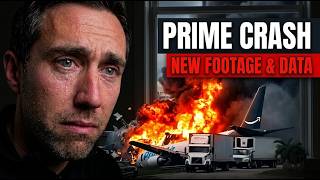

First Amazon Air 767 Overruns Runway!
45sThe dramatic opening reveals a unique aircraft involved in a runway overrun, immediately grabbing attention.
▶ Play Clip"Delivers a solid breakdown of the accident with data and analysis, though some filler and self-promotion at the end."
An Amazon Air Boeing 767-300 cargo plane overran the runway at Miami International Airport. This video breaks down the known facts and potential contributing factors, including weather, wind conditions, approach instability, and possible excessive landing speed. The analysis uses landing footage, METAR data, and ADS-B records to provide an initial assessment.
An Amazon Air Boeing 767-300 cargo plane overran the runway at Miami International. The aircraft's tail number is N1997A, the first branded Amazon Air aircraft, unveiled in Seattle in 2016. 1997 is the year Amazon IPO'd and is also a prime number.
60 rescue crew members responded. No official word on fatalities or injuries at the time of the video. The creator avoids speculation and rumors.
Significant weather was built up in the background, common for Florida afternoon thunderstorms. The storm was moving east and had just cleared the airport. Gusty wind conditions were present.
One minute before landing (1753 Zulu), winds were 190 degrees at 17 knots gusting 26. This is within the aircraft's limits but creates a gusty condition. The wind had a crosswind component of about 16 knots and a tailwind component up to 9 knots.
ADS-B records show the aircraft was scheduled to land about 8 minutes earlier, indicating it may have been behind schedule. The flight from San Juan was about 2 hours 12 minutes, potentially allowing for a heavier cargo load due to less fuel burn.
The approach was unstable, with rapid changes in vertical descent rate. The aircraft was descending at 1,250 feet per minute, nearly twice the normal 750-850 feet per minute. This suggests the crew was chasing the glide slope after dodging weather.
ADS-B data indicates a landing ground speed of about 181 knots, while the aircraft typically lands at around 140 knots. Even accounting for crosswind, the aircraft was potentially 20-30 knots fast.
The runway was about 7,900 feet available (shortened by displaced thresholds). Dry runway landing distance is 3,200-3,400 feet, with wet adding 15%. The question is whether the crew could execute all steps within the factored distance.
The aircraft appeared nose-over more than expected on a stabilized approach. There was a slight float during the flare that may have extended the touchdown point down the runway.
The creator hopes this becomes a learning experience with only equipment loss. He emphasizes mitigating compounding factors in aviation to prevent similar accidents.
What was the tail number of the Amazon Air aircraft involved in the Miami overrun?
N1997A
00:28
Why is the tail number N1997A unique to Amazon?
It was the first branded Amazon Air aircraft, and 1997 is the year Amazon IPO'd.
00:28
What were the wind conditions at the time of landing according to the METAR?
Winds from 190 degrees at 17 knots gusting 26.
03:58
What was the crosswind component and tailwind component during the landing?
Crosswind component about 16 knots, tailwind component up to 9 knots.
05:01
What was the aircraft's landing ground speed according to ADS-B data?
About 181 knots.
11:08
What is the typical landing speed for a Boeing 767-300?
Around 140 knots.
11:08
What was the vertical descent rate on final approach, and what is normal?
The aircraft descended at 1,250 feet per minute, nearly twice the normal 750-850 feet per minute.
12:49
What is the typical landing distance required on a dry runway for this aircraft?
About 3,200 to 3,400 feet with flaps 30.
11:48
How much extra landing distance is generally added for a wet runway?
About 15% extra factor.
12:03
What was the available runway length at Miami International for this landing?
About 7,900 feet, shortened by displaced thresholds.
15:45
Unique Tail Number
The tail number N1997A is historically significant as the first Amazon Air aircraft, adding context to the accident.
00:28METAR Wind Data
Provides concrete weather data that is a key contributing factor to the accident analysis.
03:58Unstable Approach
Highlights the rapid descent rate changes, indicating a high workload and unstable approach.
07:52Excessive Landing Speed
The 20-30 knot excess speed is a critical factor that could have led to the overrun.
11:08Learning Opportunity
Emphasizes the importance of learning from accidents to improve aviation safety.
16:31[00:00] An Amazon Air cargo plane has overrun the end of the runway at Miami International. In this video, we're going to break down what we know so far and what some contributing factors
[00:12] may have been to this accident, and there are a lot of them. Now, there are a few things to know. This Amazon aircraft is a cargo aircraft. It's a Boeing 767-300. Its tail number is November
[00:28] 1997A. That's actually a very unique tail number because this particular aircraft was the first branded Amazon Air aircraft unveiled in Seattle in 2016, and 1997 is the year that Amazon IPO'd.
[00:46] 1997 also happens to be a prime number. And so this particular aircraft is particularly unique to Amazon in that it was the first.
[00:58] And so, tale number 1997, Alpha, unfortunately, is going out in a way that's not ideal for anyone in aviation. No word yet on fatalities or injuries.
[01:10] We know that 60 rescue crew have been responding to this. There are rumors about fatalities and injuries, but I don't like highlighting rumors and speculation because we know facts change quickly after these accidents.
[01:24] So let's just go through the information that we have and what we can observe. The first thing that I'd like to point out that we can observe is landing footage that we have. In this landing footage, you can actually see significant weather built up in the background.
[01:40] This is very common for Florida. It's those darn afternoon thunderstorms, and they move quickly. They also mess with your expected weather on arrival a lot.
[01:52] You can have one set of weather 10 minutes or 10 minutes ago, and then a completely different set of weather that you're dealing with when it comes time to actually land. Florida moves fast around these low-pressure storms, and it sucks.
[02:05] But this particular storm was moving to the east, so it actually just cleared the Miami International Airport. This aircraft coming in for its landing, though, you can see it's coming in what looks like either getting pushed by crosswinds,
[02:20] we'll talk about those details in just a moment, or coming in with a rapid descent rate. We'll be looking at the flight data in just a moment. Let's look at the actual landing here. So here we go. You can see the aircraft coming in, trying to maintain that alignment with centerline.
[02:33] We get a little bit of a sway there, unclear if we've got a gust of crosswind. We do know that we have gusty wind conditions. We'll be looking at the METAR in just a moment. You can even see right there at the end a little bit of an extra float or a dust,
[02:48] something that kept this flying potentially a little bit longer. Let's zoom in just so we can see it a little bit. Oh, we can't zoom in any bit. Okay, there we go, right there. You can kind of see that almost float as it was coming in during that flare.
[03:03] And in the background, of course, you can see the storm, the weather, and the raining in various different areas. It's very common, but it doesn't look like we have a standing water issue on this grooved runway, which is really important because standing water on a runway is very different from a wet runway
[03:19] because your aircraft has to move a whole lot slower for your brakes to actually function. Fortunately, from what we can see from this video, it doesn't look like standing water was an issue on this grooved runway.
[03:32] What I will say appeared to have been an issue came down to two initial factors. that I saw when I'm first looking at this. First, it has to do with this right here. And this we get off of the METAR.
[03:45] So the time this aircraft was landing, the provided weather report was this information here. We can see the METAR just one minute before landing at 1753 Zulu time.
[03:58] The aircraft touched down about 154 p.m. Eastern, so approximately one minute before. We get a report right here that winds are 190, and they are going 17 knots, gusting 26.
[04:12] Now, this is well within the threshold for this aircraft to handle. We can generally land even with a 30-knot wind in the type of aircraft that I'm rated in, a Phenom 300E, which is obviously a much smaller aircraft.
[04:24] But the point is, it's still a gusty condition. You're still, you know, knuckling these controls a little bit. You're yoked in the Boeing. It's a windy situation. The alignment of these 190 degree winds though not the most ideal for a potentially still wet runway and potentially a heavy cargo load
[04:49] Some contributing factors to that. First, let's consider this. if we are heading 300 degrees and we have wind coming here, the blue line, which is right here,
[05:01] wind coming from 190, 17 knots with gusts going up to a total of 26, right? It's not an extra 26. That means we do have this crosswind. It's mostly a crosswind factor of about 16 knots.
[05:14] I think that's why we're seeing that sort of bobbing of the aircraft coming into landing here. Not heavily unusual. But because we have the wind coming slightly from behind, we are getting a little bit of a tailwind component up to nine knots in gusts pushing you.
[05:32] And generally, when you land, you want to land into the wind, so that way you can slow your aircraft down sooner. This tailwind component is not unusual.
[05:44] It's not unsafe in areas like Miami, where you're constantly trying to get around the weather. but it certainly makes landing more challenging because you're going to land with a higher speed. And unfortunately, that's exactly what we see based on some of the data when we look at the ADS-B records.
[06:02] Now, keep in mind, ADS-B records aren't perfect. These are little snapshots in time. The FAA is going to have much more accurate information once they actually collect the real logs. So this is really, think of this as like a first look and an approximation.
[06:17] But there are some red flags that we notice. First, there were discussions that the aircraft was scheduled to land about eight minutes earlier, which does indicate there's a chance the aircraft may have been slightly behind schedule.
[06:31] That doesn't help when you're running a logistics company for worker stress loads inside of an aircraft. Of course, I don't work for Amazon, but I have a feeling they're really tight on their schedule
[06:43] to get these sort of overnight and same-day deliveries done. This aircraft came from San Juan and flew for about two hours and 12 minutes. What's actually interesting about that is it would enable them to have loaded this aircraft up with more cargo
[06:59] because they weren't going to burn as much fuel. So you could actually load the aircraft up with less fuel, maximize the cargo space, because you're just going a short distance,
[07:11] and that leaves you with potentially more of a heavy load at landing than you would have if, let's say, you had a full tank of fuel going from the United States to, say, Europe and then landing with an empty tank of fuel, right?
[07:25] You're not burning as much potential weight. So there's a chance here on a shorter haul flight, two hours for a Boeing 767, relatively short, that you were loaded up a little bit more.
[07:37] We don't know, of course. We don't have the manifest, but that could be a contributing factor here. But I want to look at this data, because I notice here that if we landed at 154, that was the arrival time, 154.10 per the ADS-B data here,
[07:52] I notice a very unstable approach. Generally, we're going to want to descend at around 750 to 850 feet permitted on this aircraft, and it's entirely possible that this was because of the weather conditions.
[08:06] dodging weather, you're breaking out of the clouds at 2500, you realize you're potentially too high, and you're trying to chase getting back onto your glide slope. That's the three degree path, which again with the lines, what about a 750 to 850 foot per minute descent rate?
[08:24] These rapid changes in the vertical feet per minute level right here, indicate there was some stress going into this landing. I don't ever want to point the blame at pilots.
[08:37] I think there are a lot of contributing factors here that could have made this workload extreme. Crosswinds, gust factors, changing weather, you're late, you just dodged a thunderstorm.
[08:51] And at the same time, you're trying not to get windsheared into the ground. Now, we don't have any reason to suspect that there was windshear, but I know as a pilot, I always think to myself, I get a winkier alert right before I'm about to get to the ground.
[09:05] I've got to gas this thing up fast. And usually, it's an escape, essentially. And usually, when we think of a jet aircraft, we think, oh, if we throttle up, or it like stepping on the gas of a Ferrari we going to be able to accelerate instantaneously We going to get that instant Tesla torque But that actually false See a jet engine takes time to spool up
[09:29] And there's nothing worse than that moment, those maybe, I don't know, second and a half, two seconds of feeling where you full gas it, and you're like, uh, totally normal.
[09:43] Pilots know to anticipate this. I'm just saying, this is all the stuff you're trying to keep in your head. And if you end up going around at Miami International, you might have to be in the air for another 30 minutes
[09:55] just to re-sequence in with all of the other aircraft that are trying to dodge storms. And then you're even later, assuming you even have enough fuel and you're not at that point in your emergency reserves,
[10:08] and then you have to declare an emergency, and a lot of people will come to that. So the point is, stress factor here is massive. to massive, massive stress factors. This was not, in my opinion, stable.
[10:22] And again, I'm not looking to make excuses for folks, but when I'm looking at just the data, let's just let the data speak for itself. Ten minutes before landing, we're sitting at about 9,000 feet of altitude.
[10:36] We're slowly descending. We can see this variability here where, and then some of this can be due to air traffic control asking us to stay at certain heights, obviously our approach procedure, I'm less worried about this information into the past.
[10:52] I'm more worried about those four minutes of final approach speed. And this aircraft is generally supposed to land at around 140 knots. At the time of landing, ADS-B data is indicating we have a landing ground speed,
[11:08] in this case, in knots of about 181. that does suggest, even if we add in a crosswind factor of 5 to 10 knots, that the aircraft was potentially 20 to 30 knots fast.
[11:21] Now, ordinarily, does that matter? No, it's already factored into the landing distance required, your weight's already factored in, the fact that the runway is likely wet is already factored in,
[11:33] and all these things we already know are normal contributions to a landing calculation. In fact, if we look at the usual landing distance required on a dry runway,
[11:48] we're at about 3,200 to 3,400 feet for an aircraft flaps 30 like this. Auto breaks, maybe a little bit more, 5,400 to 6,500. But with wet, we're generally going to add about a 15% extra factor.
[12:03] The question isn't, hey, is it dangerous for an aircraft to land wet? No. We had about 8,000 feet of runway available. The question is, was this aircraft in a position to execute all of the required steps to land in that factored speed or in that factored distance?
[12:23] Was the aircraft and the flight crew able to execute all of those steps? And did they execute all of those steps in the required time to actually meet the calculated landing distance, or did something break?
[12:36] Did something fail? Did the aircraft hit the ground hard where something happened to the speed brakes, the spoilers, the reverse thrusters? We don't know. Those are all the mechanical things we just don't have the answers on at this point.
[12:49] But what we know is in these final four minutes right here, We can see a vertical descent rate of 1,250 feet per minute, which is close to twice what we should be seeing on final.
[13:02] 1,200, 1,100, 1,175, 1,125. We're trying to chase that glide slope down. We know we're too high. Our equipment is telling us we're too high.
[13:16] Our crew is likely telling us we're too high. So we're nosing over, trying to get down. and you're nosing over trying to get down and you're trying to control the aircraft in a dusty and windy situation,
[13:29] your airspeed's going to be higher. One of the reasons you want a higher airspeed is to actually be able to control the gusts and the wind. But the problem with that is, if you're trying to chase altitude down as well,
[13:42] you might just be picking up too much extra airspeed. And so it looks like this aircraft may have landed about 20 knots, 20 potentially to 25-ish knots, too fast,
[13:54] a tailwind component could have pushed them down the runway even more Although I think that was probably a smaller component That said even just two and a half minutes before landing we got down to 670 feet vertical you know feet per minute here
[14:10] then 227, almost flattening out our descent, then back to 600 and back to 1200, then right before landing to 1700 and 1800. That is a relative dunk into your landing.
[14:26] And, frankly, when we look at the footage again right here, we can see this aircraft is, you know, a little more nose-over than you would typically expect coming into that landing on a stabilized approach.
[14:39] So, let's try to put some of these factors together. There was a lot going on here. We've got thunderstorms, I wouldn't say on the field, but that had just passed the field.
[14:51] So, we have a wet runway. I don't think we have a flooded runway. Gusty crosswind, small tailwind. Absolute issues here. Slowdown and rapid descent. Those are the issues that we just flagged, along with coming in fast.
[15:06] We don't know if that float that we see right here ended up contributing to them touching down the runway further down the runway than they would have wanted to. A little challenging here to see where the landing bars are,
[15:20] but that could have removed some of the distance that they had available to land. is unclear at this time. Obviously, we know at this point no go-around was chosen, so that's obvious. We talked about the heavy weight.
[15:33] And keep in mind, this was a relatively shorter runway. So there are longer runways, around 12,000 feet, and this particular runway is shortened by some displaced thresholds on both ends,
[15:45] down to just about 7,900 feet. And then, of course, you get a fence and a perimeter road, and then Northwest 67th Avenue. Would it have been possible that we could have changed runways?
[15:57] Of course. There were other runways that did have a headwind rather than a tailwind component. But again, this all has to do with we're late. ATC is sequencing us over here. We've done tailwind lands before.
[16:10] But now we need to factor in the other potential holes. Getheritis, stress, fatigue. We don't know some of these factors, obviously. We know we're behind on schedule. And so, to me, I hope everybody is okay on this, and that this can be a learning experience where the only loss ends up being equipment.
[16:31] That would be the best case scenario, because then everybody in aviation can learn without permanent injury or death, because that is the worst. Obviously, there's a lot more information that we need to get here, but at initial glance, this particular accident had a lot of things going on.
[16:50] with him. And there's no reason to point the finger or point blame. There's simply reason to say, if you're in aviation, this is the perfect opportunity to think about how do we mitigate our own compounding factors to prevent accidents like this to whatever degree
[17:08] we can. Obviously, if we have a mechanical issue, such as a nose gear breaking on landing, Unfortunately, sometimes, nothing we can do.
[17:20] It's just the cards we are dealt with. This, by the way, did happen with a prior 767. There was a flat issue on a 767 cargo jet back in 2024 that landed in Vancouver.
[17:32] And that particular aircraft did end up having a landing gear collapse on its overrun. So this has happened before. now another thing that is at least giving me hope I should say is that it does look like the
[17:50] cockpit area of this aircraft is more intact of course that doesn't make it survivable but it certainly doesn't look flush like what we have seen in other accidents and so I would say
[18:06] there is hope and reason to be optimistic here. Generally, I like to say, aviation is extremely safe here. It's just very un-victim. And so anytime you can learn from any scenario in aviation,
[18:20] you can get a copy of it. Thanks for watching this video. I don't know how to advertise these things each other here. I feel like nobody else knows about this. Let's try a little advertising and see how it goes. Well, congratulations, man. You've done so much. People love you.
[18:32] People look up to you. Kevin Pass left there. financial analyst and YouTuber, meet Kevin. Always great to get your take.




⚡ Saved you 0h 18m reading this? Transcribe any YouTube video for free — no signup needed.