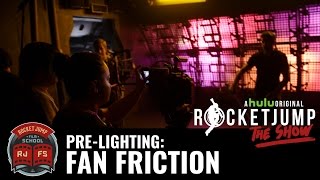

Lighting a Spaceship Set in One Day
52sReveals behind-the-scenes secrets of pre-lighting a spaceship set, appealing to film enthusiasts and curious fans.
▶ Play Clip"The title promises a look at lighting a spaceship set, and the video delivers exactly that with practical details, though it's more of a behind-the-scenes walkthrough than a deep technical tutorial."
In this video, cinematographer Lauren (Dina the Rock) from RocketJump School walks viewers through the pre-lighting process for the Hulu show Fan Friction. She explains how she and her gaffer, Justin Dixon, collaborated to design and set up lighting for three distinct sections of a spaceship set, emphasizing the importance of pre-lighting to save time on a busy shoot day.
Lauren introduces herself and the video's focus: explaining how she lit the spaceship set for Fan Friction, a Hulu show. She highlights the unique experience of shooting two shorts for the show.
The shoot day is packed with action, dialogue, and slow-mo effects, leaving no time for lighting setup. Therefore, they pre-light almost everything in advance to ensure a smooth production day.
The spaceship set is the only one in Los Angeles, making it recognizable. Lighting is crucial to differentiate it and create the desired mood and atmosphere.
Lauren worked closely with her gaffer, Justin Dixon, and director Ashley to discuss colors and the overall feel. Justin contributed creative ideas using LED and fluorescent tube lights, leading to a collaborative lighting plan.
The electric department handles power and lighting, while the grip department manages physical equipment like C-stands and diffusion. The gaffer oversees both, with a clear division of responsibilities, especially in union contexts.
A fog machine or hazer is used to introduce tiny particles into the air. These particles catch the light, raising light levels by almost a full stop, enhancing the visual depth and texture.
The pre-light covers three sections: the main hallway, a second hallway, and the final standoff/make-out room. Each section is lit separately to create distinct looks.
The spaceship walls are made of crates or grates with holes, allowing light to pass through. They lined the walls with diffusion to create soft, attractive light and prevent seeing through to the other side.
The main hallway uses four tubate Kinos outside the set with aqua green gel, red fluorescent tubes on a timer for a blinking effect, and white Kino tubes on the other side. Vertical placement creates depth and perspective.
The second area uses black duvetyne to block unwanted light and reflections. Light is shot through the grid to create streams, with decorative colors and a heart shape on the back wall for a romantic scene.
Light Gear RGBs are used for pink color, offering quick setup, low power consumption, and affordability. LEDs are praised for revolutionizing filmmaking, especially for students and low-budget productions.
The final room uses Source 4 Ricohs with pink and purple gels shooting into a silk, and two-pin lights with gold gels for overhead actor lighting. The goal is to create a dramatic and romantic atmosphere.
Lauren advocates for embracing LED technology, noting its ease, affordability, and versatility for various applications, from cars to sets. It's a cost-effective solution for productions of all sizes.
Pre-lighting allows for creative time to experiment and finalize looks, ensuring the shoot day runs efficiently without lighting concerns. It fosters collaboration between the cinematographer and gaffer.
Lauren wraps up by inviting questions in the comments and promoting Fan Friction on Hulu and the shorts on RocketJump's channel. She hints at more lighting tutorials and on-set experiences in the future.
Pre-lighting is a critical step in filmmaking that saves time and enhances creativity, allowing for a smooth shoot day. The collaboration between the cinematographer and gaffer is essential for achieving the desired visual style, and embracing modern LED technology offers flexibility and cost savings.
Pre-lighting saves time
Emphasizes the strategic importance of pre-lighting to handle a packed shoot schedule efficiently.
00:15Haze raises light levels
A practical tip that haze can increase light levels by almost a full stop, useful for achieving desired exposure.
02:09LEDs are game-changers
Highlights the affordability and versatility of LED lights, making professional lighting accessible to students and low-budget productions.
04:29Creative lighting for mood
Shows how lighting design can create specific moods, like the romantic heart shape, demonstrating the artistic side of cinematography.
05:20[00:00] Hey guys, it's Lauren, and you guys know me as Dina the Rock at Jump Dome School, but I also got the unique experience this year to shoot two of the shorts for the Hulu show, and today I'm going to talk a little bit more about how I lift the spaceship set for Fan Friction.
[00:15] What we're doing today is we have a whole day to pre-light for a one-day shoot, so we have to cram a ton of action all into one day on top of dialogue scenes, on top of slow-mo special effects. Clothes are going to be a flying thing.
[00:28] wait, it's going to be crazy, so we don't have any time to set up lights and do all that stuff on the same day. So luckily, we are pre-lighting almost everything we can, so we don't have to do that on a day.
[00:40] So here, this is the only spaceship set in Los Angeles, so it's very recognizable. Everyone who's here, and the more you can do with lighting to differentiate it, the better.
[00:52] During the pre-light, the only people there are me, the gaffer, and our electric and grip department. So me and my gaffer, Justin Dixon, who is amazing, had actually already started talking about what we wanted this to look like.
[01:05] And I spent a long time with Ashley, our director, talking about colors and the feel of it. And I brought that to Justin and kind of showed him the look I wanted. And he brought some really awesome ideas, especially some creative use with LED and fluorescent tube lights to me.
[01:21] And we created this writing plan together. So you have cinematographer and gaffer at the head, and we have Tina, that's the best boy, in charge of everything electric. So electric is responsible for anything
[01:33] that involves electricity, it's burning power, it's putting up the lights, and then anything with grits is C-stands, equipment, flags, diffusion, like physical things to shake lights or support lights So Justin our gaffer is heading both and working with our best boy to do electric And he also working with Dom who in charge of RIP
[01:56] Exactly. There's Dom, or he's RIP. That's good, Lauren. Yeah, I'm happy. I'm getting happy. You're doing a really good job. Thank you. So, the two departments are distinct, especially when you get into unions and stuff.
[02:09] There's a very distinct line between who touches electricity and who doesn't. One other thing that we're doing in here is bringing in a fog machine or a hazer. And the interesting thing about haze or fog is that it has tiny little particles that go and spread out through the air.
[02:24] And then so when you have lights like this, they hit all the particles and it raises your light levels almost a full stop. So today we're pre-lighting three separate sections of the ship.
[02:36] There's the main hallway, which leads into a second hallway. And lastly, there's the final standoff, make-out room. So the thing about this particular spaceship is that most of the walls are these crates or grates that have holes and grids.
[02:53] So you can shoot right through, but if you turn around and shoot at it, you can see straight through. So we lined all the walls with diffusion, and it makes this kind of soft, very attractive light.
[03:05] So in the first section, our main hallway, we have four tubate Kinos just outside the set, shooting through diffusion with aqua green gel. Inside the set, we have a line of red fluorescent tubes on a timer so they blink as they travel down the hallway.
[03:21] And on the other side of the hallway, we have a whole other set of white Kino tubes. The Kinos are placed vertical to kind of leave the eye to get space and get perspective and depth. that lighting is not just illuminating That one thing that I would say it not just turning lights on but it creating shape it creating mood it creating texture it leading the eye in those areas
[03:48] And so that's what we definitely want to see. And this is our other second area. We're lighting this separately as well. We're in the process of putting up black duvetyne, which is a non-reflective black cloth.
[04:03] So when you shoot down there, you don't see black. You don't see rocks or something light. You don't see anything like that. We're going to shoot light through the grid. We have some cool light streams coming out of it. We're going to have more light savings here.
[04:17] We're going to have more light coming in here. Decorative color, that kind of stuff. We're going to put a heart shape on this back wall for Melissa to kiss. It's going to be really over the top and dramatic and romantic,
[04:29] but that's a fun little lighting gag you can do in camera. Back here we're using Light Gear RGBs to get that pink color. Quick, easy, plug-in, low power consumption.
[04:42] And Light Gear has really revolutionized, really filmmaking. Film students, I think it's really nice and cheap to use when you're starting out in different things like that.
[04:55] And to carry out through your career. To put into your little kit. You no longer have to go around with these big old lights in your car. you can now just use LEDs and put them in your trunk, put them in your... So, and they're affordable.
[05:08] You save cost with production, and I think growing up as a gaffer, you learn those types of things. So we're literally writing every single section of the set, so as we move, everything is already ready to go.
[05:20] And lastly for our final room we had four or five Source 4 Ricohs with pink and purple and pink shells shooting into a 12x20 silk just behind the graded set In the main part of our set we had three two pinos with gold gels
[05:36] lighting our actors from overhead. You've got to keep up with the technology of lighting in this business and what people are creating to make things easier, not harder. So I'm embracing LEDs. I would light everything with LEDs now.
[05:50] I just think it's really, really great for the industry and especially for young filmmakers and young film students and for any applications, including cars, including bills. I mean, just tape it, paper tape it everywhere.
[06:03] It's just really, really easy and affordable. So the whole purpose of this one is to have time for me and Justin to talk about what we want it to look like and have that kind of creative time to play and get everything done
[06:16] so on the day we can go straight into shooting and not have to worry about it. Basically, on the GAP, I can give a few questions. You know, those grand concepts. We collaborate and we talk about everything. And it's fun and I enjoy what we're doing even more than the future.
[06:31] So I hope this was a unique look into how we whipped the spaceship set for FanFriction and a deeper look into the DC and GACA relationship. This is just the beginning. We're going to be having more writing tutorials and more on-set experiences as we go.
[06:44] And if you have any questions for me or Justin, you can ask us in the forums or in the comments below. and check out Sam Friction. It's on Hulu now, and The Shorts is on our main RocketJump channel.
[06:56] So thanks, guys, and we'll see you next time.

⚡ Saved you 0h 07m reading this? Transcribe any YouTube video for free — no signup needed.