
AI Summary
A new preprint claims to have found a key signature of superconductivity in treated graphite at room temperature. The video explains the significance of room-temperature superconductors, details the experimental procedure, and provides a critical assessment of the findings.
Chapters
A new candidate for a room-temperature superconductor has been proposed in a non-peer-reviewed preprint, generating excitement.
Superconductors are materials with near-zero electrical resistance, allowing current to flow without loss. They typically require extremely low temperatures (below -100°C).
A room-temperature superconductor would make electronics dramatically more efficient, ease electricity transport, enable stronger magnets for fusion, and speed up supercomputers.
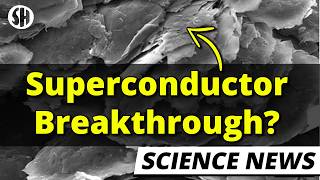
The candidate is not an exotic material but graphite subjected to a specific treatment: grinding for 30 hours, then heating in air at 400°C for 24 hours, creating a network of tiny wrinkles.
The team observed magnetic field trapping in the wrinkled graphite, a key signature of superconductivity, persisting up to 390 Kelvin (about 120°C). They did not directly measure electrical resistance.
A similar finding on wrinkled graphite was published years ago but never reproduced. The new result is a preprint, not peer-reviewed, and needs independent verification.
The video rates the claim 7/10 on the 'craziness meter,' noting the lack of direct resistance measurement but praising the reproducibility of the procedure.
Previous candidates like Ranga Dias' discovery and LK99 have not been confirmed, with issues of fraud and faulty measurements. Many labs and AI are now pursuing this goal.
Mentioned in this Video
💡 Key Takeaways
Potential Impact of Room-Temperature Superconductors
Explains the transformative potential of such a discovery, from energy efficiency to fusion power.
00:52Magnetic Field Trapping as Evidence
Highlights the specific experimental evidence and its significance in superconductivity research.
02:27Importance of Peer Review
Emphasizes the need for independent verification and the provisional nature of preprint claims.
03:15Full Transcript
[00:00] We have a new candidate for a room temperature superconductor. It's not a peer-reviewed paper, but of course that wouldn't stop me from getting excited about it. Let's have a look. Physics is
[00:13] full of supers. We have super symmetry and super fluids and super positions. We have super massive black holes and super cooled liquids. And of course, we have superconductors.
[00:25] Superconductors are materials whose electric resistance drops to almost zero. This means that electric currents can travel without loss. Superconductors are not hypothetical. We know many
[00:38] materials which have this property. The problem is that they usually only become superconducting at super low temperature below - 100 Celsius or so. There is however no reason why this
[00:52] needs to be the case. In principle, a material could be superconducting at room temperature. And if we found such a material, that would be a pretty big deal because it'd make almost all electronics dramatically more efficient. It would make it easier to transport electricity. So,
[01:08] we could finally plaster the Sahara desert with solar panels to power Europe's non-existing data centers. It would make it easier to build strong magnets and with that achieve nuclear fusion ignition to power Europe's non-existing data centers and that it make supercomputers faster
[01:25] to speed up Europe's non-existing data centers. It would be great because we could sell it to China. The new paper is quite remarkable because the new candidate for a superconductor isn't some
[01:37] complicated new material. It's graphite just with a weird treatment. encouraging because graphite is somewhat easier to obtain than unobtanium. The new result comes from a team
[01:49] in Russia. They write they found quote one of the key signatures of superconductivity and that persists up to 390 Kelvin and above. For this they ground the graphite for 30
[02:03] hours which produced flakes a few micrometers across and only tens of nanometers thick. They then divided the material into different samples. One they left as it was, one they heated in vacuum,
[02:15] and the third they heated in air for 24 hours at about 400° C. It's this third group that developed interesting properties. They used an electron microscope and found that the graphite had
[02:27] developed a dense network of tiny wrinkles. They cooled the wrinkled graphite down to 10 Kelvin and applied a magnetic field. When they slightly dislocated the magnetic field, they found that the
[02:39] field lines had gotten trapped. This magnetic field trapping is the key signature of super- conductivity that they refer to. They then heated the material to almost 120° C and showed that the
[02:51] effect survived. Now, let me be clear. They did not directly show that the electric resistance dropped to near zero. as we've seen with the LK99 episode a few years back. This is actually a very
[03:03] difficult measurement to do especially with such small samples because whatever you use to measure the sample also has a resistivity and you somehow have to properly account for that and the magnetic
[03:15] flux line trapping is indeed a key property of superconductors. So it's an interesting candidate. No more and no less. How crazy is this? Not super crazy indeed. There was a paper already
[03:28] a few years ago about such wrinkled graphite being a potential superconductor. However, this finding was never reproduced until now. So, this isn't entirely out there. However, I must warn you that this is a preprint and not a peer-reviewed paper. Even if it was correct,
[03:45] this wouldn't prove that the material superconducting. And even if that turns out to be the case, that still be the question of whether the material can be produced in a form that makes it useful in electronic applications. So I give this a 7 out of 10
[04:00] on the [ __ ] meter. They haven't actually looked at electric resistance, though understandably so, meaning we don't know anything about the conductivity. But I think it speaks in the author's favor that the procedure seems quite easy to reproduce by other labs. So their findings can
[04:17] be independently checked and I expect this will happen soon. A lot of labs all over the world are working on room temperature superconductors. It's not just because the impact could be so huge but
[04:29] also because the required equipment is relatively modest. This is why every couple of years we have a new candidate. So far none of them has been confirmed. There was for example Ranga Dias'
[04:42] discovery from a few years ago that however was never reproduced and allegations of fraud were raised against him. Then there was the LK99 summary excitement that eventually turned out to be a faulty measurement of resistivity. And now this meanwhile about a thousand AI labs are trying to
[05:01] do the same thing. This might be the ultimate showoff of humans versus AI. But don't worry, if AI wins, it will summarize the result for you in five simple bullet points. This video
[05:14] does not have a sponsor, which means that I paid to bring it to you. If you like my science news, please consider supporting me on Patreon or right here on YouTube. If you already support me, thank
[05:27] you so very much. A big thank you especially to my supporters in Patreon tier 4 and higher. This channel would not be possible without your help. Yet another way to help me is to buy a t-shirt in my store. Most of the revenue goes straight into my videos. Thanks for watching. See you tomorrow.