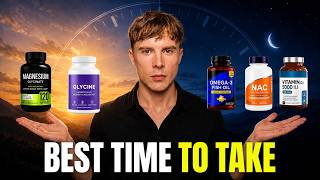

The 3x Supplement Absorption Secret
43sReveals a shocking fact that timing can triple absorption, immediately grabbing attention.
▶ Play Clip"Delivers exactly what the title promises—a practical, evidence-based guide to supplement timing, with minimal fluff."
This video explains how the timing of supplement intake can significantly affect their absorption and effectiveness, based on circadian rhythms and fat solubility. It provides specific recommendations for 10 common supplements, emphasizing that taking them at the wrong time can reduce benefits or even cause side effects like sleep disruption.
The timing gap for supplements can cause a 2-3 times difference in absorption, not just 5-10%. Your body's circadian clock affects every organ and metabolic pathway, so some supplements work with or against this cycle.
Vitamin D is fat-soluble; taking it with a fat-containing meal increases plasma levels by 32% short-term and 57% over 2-3 months. Take it with your first meal containing fat (e.g., olive oil, eggs). Avoid taking it in the evening as it may disrupt sleep via serotonin/melatonin effects.
Taking EPA/DHA with a fat-containing meal increases absorption by 69-90% compared to empty stomach. Ethyl ester forms are worst; triglyceride forms are best. Timing doesn't matter, but avoid large meals before bed for sleep quality.
Creatine's effects depend on daily muscle saturation. A 20-25g/day load saturates in a week; 3-5g/day takes 4 weeks. Taking it pre-workout does little. Separate from caffeine by 30-60 minutes if concerned. Take earlier in the day to avoid sleep issues.
CoQ10 (ubiquinol) is fat-soluble; take with fat for better absorption. Since it supports energy production, taking it late may keep you up. Take it earlier in the day, ideally with breakfast.
NAC absorption is reduced when taken with food due to transporter competition. Take it 30-60 minutes before eating, or before bed to support antioxidant defense. It can also be taken pre-exercise to enhance performance.
Collagen is flexible; take it on an empty stomach. For joint benefits, take 15g (or 5g) with vitamin C 1 hour before exercise to enhance collagen synthesis. Glycine in collagen may also aid sleep if taken before bed.
L-theanine can be taken anytime for stress/anxiety. In the morning, it blunts caffeine's alertness; before bed, it promotes relaxation. No evidence that food reduces its absorption.
Magnesium glycinate and threonate are best taken 1-2 hours before bed for relaxation and sleep. Magnesium oxide has only 4% bioavailability (worst type). Taking with food reduces GI side effects.
Glycine complements NAC for antioxidant defense. Take it before bed to lower body temperature and promote relaxation. Combining with NAC may cause nausea on empty stomach; take together before bed.
A 2024 meta-analysis of 26 RCTs found optimal timing is 3 hours before bed, not 30 minutes. Taking it early shifts circadian rhythm earlier, helping you fall asleep faster. Doses of 4mg are optimal due to 15% bioavailability; smaller doses are less effective.
The video concludes that supplement timing is crucial for maximizing benefits and avoiding side effects. It provides a simple map: fat-soluble vitamins with fat, NAC on an empty stomach, creatine daily (not too late), and magnesium, glycine, and melatonin in the pre-sleep window.
What is the optimal timing for taking vitamin D?
With your first meal containing fat, during the daytime.
01:06
How much does taking omega-3s with fat increase absorption?
By 69-90% compared to empty stomach.
02:14
What is the recommended daily dose of creatine for saturation?
3-5 grams per day, taking 4 weeks to saturate.
03:20
Why should NAC be taken on an empty stomach?
Food competes for the same transporters, reducing absorption.
05:03
What is the best time to take collagen for joint benefits?
1 hour before exercise, with vitamin C.
05:44
What is the bioavailability of magnesium oxide?
Up to 4%, making it the worst type.
07:20
What is the optimal timing for melatonin according to a 2024 meta-analysis?
3 hours before bed, not 30 minutes.
08:40
Why is a 4mg dose of melatonin optimal?
Oral melatonin has ~15% bioavailability, so 4mg gives ~0.6mg absorbed, matching natural production.
09:48
Timing gap can cause 2-3x absorption difference
Highlights the critical importance of timing, not just dosage, for supplement efficacy.
00:02Vitamin D with fat increases levels by 57%
Provides a concrete, evidence-based number that motivates a simple change in intake habits.
01:06Creatine consistency over timing
Debunks the pre-workout myth, emphasizing daily intake for saturation.
03:20Melatonin optimal timing is 3 hours before bed
Challenges common practice with recent meta-analysis data, offering a clear actionable change.
08:40[00:02] take. Almost nobody tells you when to take them. And for some supplements, the timing gap isn't 5 to 10% difference in absorption. It can be up to two to three times difference. Your body runs on a circadian clock. Every organ, every
[00:15] metabolic pathway, every hormone, they all cycle through 24 hours. Some supplements work with that cycle. Some directly interfere with it if you take them at the wrong time. and some are just fat soluble, which means that
[00:27] without dietary fat, your body absorbs much less of them. There are three most important timing variables that matter. The absorption window, the circadian indications between different supplements. In this video, I'm going to
[00:39] apply all these three rules to 10 of the most common supplements people take. So, after watching this video, you can get the most of your supplements. Timestamps you want to discover your own health percentile to know what level of health
[00:52] of biomarkers like your fitness markers, body composition, and blood work, what weaknesses, then take the health assessment in our top 1% health community link in the description. The first supplement is vitamin D. Most
[01:06] with their other supplements. They might take it with regular water or some because vitamin D is fat soluble. Without dietary fat present, you absorb significantly less of it. It's shown that taking vitamin D with a fat
[01:21] containing meal increases plasma vitamin D3 levels by 32% in the short term. And over the course of 2 to 3 months, you'll end up having 57% higher blood vitamin D levels if you take it with fat compared to nut. The solution is quite simple.
[01:34] Just take the vitamin D with your first meal that contains some fat. It can be olive oil, it can be cottage cheese, it can be yogurt, it can be eggs, just a thing for vitamin D is timing.
[01:46] during the daytime when the sun is the hottest. The highest vitamin D somewhere between 10:00 a.m. and 2:00 p.m. But you don't need to take your vitamin D supplements during the midday. However, taking the vitamin D in the
[02:00] the perspective of circadian rhythms. the day interrupts their sleep. The reason for that might be how vitamin D affects serotonin, which then affects melatonin. Next, we have omega-3s. These
[02:14] them with some fat. Yes, omega-3s themselves are fats. They come in a soft gel, so it's the fat inside. But the absorption would be slightly higher if you take it with a meal that also has some extra fat, again, like olive oil,
[02:28] maybe some yogurt, etc. Research shows that taking EPA and DHA with a fat containing meal can increase absorption by 69 to 90% compared to taking them on an empty stomach. Especially for the ethylster formulations, which is the
[02:41] worst type of omega-3s, the triglyceride form being the best. There's no evidence other foods would reduce the absorption of omega-3s. So, you just have to take it with some extra fat. When it comes to timing, then it doesn't matter. You can
[02:54] long as you take it with some fats for optimal absorption. But for optimal sleep, you would want to stop eating a few hours before bed and not eat omega-3s. If you forgot to take your omega-3s during the day, then take the
[03:08] omega-3s with a teaspoon of olive oil or some nuts, but don't have a massive meal right before bed. Supplement number three is creatine. When it comes to creatine, then the most important thing is consistency and taking creatine every
[03:20] day. That's because the effects of creatine become real once your muscles are saturated with creatine over many weeks. If you mega dose 20 to 25 grams of creatine every day, you reach that in a week. If you take 3 to five grams a
[03:32] day, it will happen in four weeks. The only difference is the speed. That's why taking creatine before a workout isn't going to do much. You can't saturate your muscles with creatine 1 hour before the workout. Even if you take 30 g of
[03:45] creatine, what does matter is taking creatine every day if you want to reach the muscle saturation. Mix creatine with water or any beverage you prefer. Taking containing carbohydrates and protein, may slightly increase muscle creatine
[03:58] is small, and daily consistency matters coffee and caffeine reduce creatine's effect on muscle fossil creatine. However, that's based on only one single study that hasn't been replicated. If
[04:11] you want to be safe, then separate your creatine and your caffeine by about 30 to 60 minutes. One word of caution, creatine reduces sleep demand, which is why it can restore your cognition after sleep deprivation. Because of that same
[04:23] reason, some people report trouble sleeping when taking creatine too late window for creatine is the earlier part of the day. Next, we have another fats soluble supplement, CoQ10 or ubiquininal. You know it already. Take
[04:36] it with some fat for better absorption. People take CoQ10 for supporting production. This means that it could keep you up at night if you take it too late in the day. So, the recommendation is the same as with creatine. Take CoQ10
[04:49] earlier in the day, ideally with breakfast. Supplement number five is NAC, which is a potent antioxidant that's good for longevity. Now, I know fat or some food, but that's not the case with NAC. NAC absorption is
[05:03] stomach. When you take it with a meal, food competes for the same transporters and you absorb less. The recommendation is 30 to 60 minutes before eating or interesting circadian rhythm element is that antioxidant defense peaks in your
[05:18] sleep. Taking NAC and glycine before bed could potentially support that. So, the best time to take NAC might actually be first thing in the morning on an empty stomach or before bed. You could also take NAC on an empty stomach before
[05:31] exercise because that's been shown to increase exercise performance and delay what's the correct dose and timing of up to 100 supplements, then check out my new book called The New Science of Supplements on Amazon. Supplement number
[05:44] supplement that many people take in the morning. Collagen has a very flexible food, you can take it on an empty stomach because collagen itself is and amino acids. However, if you were to
[05:58] take collagen, then it's probably 1 hour before exercise. Taking 15 grams of gelatin, which is collagen, with 48 mg of vitamin C 1 hour before exercise, has been seen to enhance collagen synthesis more than exercise alone. A dose of 5 g
[06:13] before exercise resulted in higher collagen synthesis than placebo, but 15 g was more effective. The reason for this is because exercise impacts the joints and the collagen probably migrates to the joints that are being
[06:25] exercised. So, if you want collagen for joint benefits, take it before exercise. appear to be any difference when you take it, unless you maybe take it before for the skin. You can also take collagen before bed because the glycine helps
[06:39] elenine that many people use as a neotropic or to counteract stress and anxiety. If you're stressed or anxious, then it doesn't matter when you take theine. You can take it before bed or even in the morning for an angelic
[06:52] anotropic with caffeine in the morning to blunt the alertness and over coffee doesn't appear to reduce the absorption of theine. Supplement number eight, magnesium. One of the most universally deficient minerals that a
[07:06] lot of people take. The glycinate and thriionate are best taken 1 to two hours before bed. Magnesium glycinate promotes relaxation through GABA and magnesium and is often used for sleep quality and cognitive function. Although the timing
[07:20] for 38 matters a lot less. Magnesium oxide has a bio availability of up to 4%. So that's the worst type. If you take magnesium in the morning or midday, getting the sleep benefits. You would have to take it again before bed. Taking
[07:33] magnesium with food can also improve the absorption slightly or at least reduce gastrointestinal side effects. It's fine to take magnesium in the daytime, but is generally going to be a few hours before bed. Supplement number nine is
[07:48] glycine which is going to complement the effects of NAC on antioxidant defense. The studies on glyc or glycine and NAC are also very interesting and they show that it helps with inflammation, mitochondrial function, body composition
[08:00] and other biomarkers. Yes, you can take glycine and n together for a synergistic effect in terms of raising glutathione status. However, NAC and glycine alone will already raise glutathan, so you don't need to combine them. Plus, taking
[08:14] stomach might make some people feel nauseous because glycine is very sweet and it lowers blood sugar. So, you might go hypoglycemic. However, glycine is because it lowers blood sugar and reduces glycation. Glycine also lowers
[08:28] body temperature and promotes relaxation which makes it suitable to be taken before bed. So, if you want to take glycine with NAC, do so before bed. It would be the best time to take glycine and add rest of the glycine throughout
[08:40] supplement is melatonin. And this is where things get interesting. Most people take melatonin 30 to 60 minutes before bed. However, this might be the experience melatonin hangover in the morning. A 2024 meta analysis of 26
[08:55] randomiz control trials found that the optimal timing is 3 hours before bed, not 30 minutes. Taking melatonin 3 hours before bed resulted in significantly shorter time to fall asleep compared to 30 minutes or even 1.5 hours before bed.
[09:08] Here's the reason. If you take melatonin early, it shifts your circadian rhythm earlier. You feel sleepy before you even get into bed and you fall asleep faster you take melatonin too close to bedtime,
[09:20] circadian rhythm later and you create the jet lag in the morning. You during the day, although there are some studies that it increases growth will also mess up your circadian rhythm to a certain extent. So, the best time
[09:34] to take melatonin is 3 to 4 hours before bed and at the absolute latest 1 hour optimal as I just shared with you. How much melatonin also matters. The same is optimal for total sleep duration. Doses smaller than that resulted in
[09:48] lower sleep duration. Why not less? Because oral melatonin has about 15% bioavailability. 4 millig gives you roughly 0.6 millig absorbed which is almost exactly what your body produces naturally. So if you take 0.1 or even 1
[10:01] you're going to absorb a lot less. So here's the full timing map. fats soluble vitamins with fat, NAC on an empty stomach, creatine daily, anytime pretty much except too close to bed, magnesium, glycine, and melatonin in the pre-leep
[10:15] window, and theineine based on your goals, either for sleep or as a fine. Timing isn't everything, but if you're already spending money on these them at the right time. If you want to know about all the evidence-based
[10:29] my video where I rank 100 supplements from Worst the Best. Next.
⚡ Saved you 0h 10m reading this? Transcribe any YouTube video for free — no signup needed.