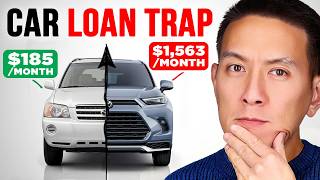

The 1963 vs 2026 Car Loan Shocker
45sReveals the shocking shift from 3-year to 7-year car loans, making viewers question modern car buying norms.
▶ Play Clip"Delivers on the title with solid data and actionable advice, though some sections feel padded."
This video analyzes the historical shift in car loan terms from the 1960s to today, revealing how longer loan durations have become the norm and why this constitutes a financial trap. It examines the three main forces driving this trend—wage stagnation, bank profitability, and dealer incentives—and provides actionable strategies to avoid falling into the trap.
In 1963, 69.5% of car loans were 31-36 months, with only 0.7% exceeding 36 months. Today, the average new car loan term is 69 months, and 22.4% of loans are 84-108 months.
In 1963, the average new car cost $3,233, representing 52% of median household income ($6,200). By Q4 2025, the average new car price is over $50,000, representing 60% of annual household income ($84,000). Adjusted for inflation, the 1963 car should cost ~$32,000 today, but it's $50,000—a 56% premium.
Comparing a 36-month vs. 72-month loan on $40,000 at 6% interest: monthly payment drops from $1,217 to $773, but total interest paid increases from $3,800 to $25,599. Longer loans generate more interest and fees for lenders.
Dealers focus on monthly payments. For a $500/month budget, a customer can buy a $30,000 car with a 60-month loan, a $35,000 car with a 72-month loan, or a $40,000 car with an 84-month loan—all same monthly payment, but higher profit for the dealer.
Longer loan terms make it easier to become underwater. Example: a Tesla Model Y bought for $72,000 in 2022 had a remaining balance of $52,000 in 2024, but the car was worth only $38,000—underwater by $14,000. A shorter loan would have reduced this risk.
For a $32,000 Toyota Camry with 20% down and a 36-month loan at 6.5%, monthly payment is $767, total interest $2,612. Including gas, maintenance, and insurance, the all-in monthly cost is ~$1,200. Over 6 years, total cost of ownership is $43,812 after subtracting the car's residual value.
1) Focus on total cost, not monthly payment. 2) Choose low-maintenance, low-insurance cars. 3) Follow the 20/4/10 rule. 4) Buy a 2-3 year old used car. 5) If stuck, make extra principal payments, drive longer, or refinance.
The car payment trap is a systemic issue driven by financial incentives that encourage longer loans, leading to higher costs and underwater situations. By understanding the forces at play and applying the provided strategies, consumers can avoid this trap and achieve financial freedom.
What percentage of car loans in 1963 were between 31 and 36 months?
69.5%
00:01
What is the average new car loan term today?
69 months
00:16
What percentage of new car loans are 84 months or longer?
22.4%
00:29
In 1963, what was the average new car price and median household income?
Average new car: $3,233; median household income: $6,200
01:11
What is the average new car price and annual household income as of Q4 2025?
Average new car price: over $50,000; annual household income: $84,000
01:24
How much more expensive are new cars today compared to 1963, adjusted for inflation?
56% more expensive
01:50
What is the total interest paid on a $40,000 loan at 6% over 36 months vs. 72 months?
36 months: $3,800; 72 months: $25,599
02:47
What is the 20/4/10 rule?
Put 20% down, finance for no more than 4 years, and keep total transportation costs under 10% of monthly gross income.
10:48
What is the recommended used car sweet spot?
Cars that are 2 to 3 years old
11:14
What is the true cost of ownership for a $32,000 Camry over 6 years, after subtracting residual value?
$43,812
08:10
Cars are 56% more expensive than in 1963
This stark statistic highlights the core problem of wage stagnation versus car price inflation.
01:50Longer loans cost thousands more in interest
The comparison between 36-month and 72-month loans shows how lenders profit from longer terms.
02:47Underwater loans are exacerbated by long terms
The Tesla example illustrates how long loans increase the risk of negative equity.
05:14Focus on total cost, not monthly payment
This is a fundamental principle to avoid the payment trap.
09:16The 20/4/10 rule remains relevant
This simple benchmark helps buyers stay within their means.
10:48[00:01] Federal Reserve back in 1963. It's titled Automobile Installment Loans at commercial banks. Back then, the majority of car loan terms were under 36 months with 69.5% of them being between 31 and 36 months. And only.7% of car
[00:16] loans were over the 36-month mark. Fast forward to today, and the average new car loan term is 69 months. That's more than double the length of most loans back in the 60s. Currently, 22.4% 4% or one in five people are taking out loans
[00:29] with terms of 84 months, 96 months, and even 108 months on a depreciating asset. This is the car payment trap that we as a society are falling so hard for. But I'm going to show you exactly how we got here, why this is the most dangerous
[00:46] most importantly, what you can do about it if you are thinking about buying a car this year. So immediately upon finding this Federal Reserve data, my actually go from a three-year car loan being the norm and now it's all of a
[00:59] sudden in six years, 7 years, or maybe 8 years? I think there are three major forces at play. The first being wage stagnation versus car price inflation. So in 1963, the average new car cost about $3,233
[01:11] at the time. The median household income back then was around $6,200 per year. That means if you took the average price of a new car versus the median household income, the average new car would represent 52% of the annual household
[01:24] income at that time. Now, as of Q4 2025, the average new car price is just over $50,000. I know that sounds crazy, but it is. I double checked it. And the annual household income these days is $84,000. That means the average new car
[01:37] price now represents 60% of annual household income in 2026. So, cars went from taking about half your salary to taking nearly 60% of it. But what's crazy is that adjusted for inflation, the 1963 car should be costing about
[01:50] $32,000 in today's dollars. Instead, a new car costs about 50,000. And that's an $18,000 premium or 56% more expensive than they were back in the60s. Now, yes, modern cars are more advanced. You get better safety features, fuel efficiency,
[02:04] and technology. This is true, but that doesn't offset the fact that we didn't get 56% richer to match the 56% increase in car prices. The prices of other common expenses has also increased at a faster pace relative to income, such as
[02:18] rent, gas, and groceries. So, affording a car payment now is still harder than it was relatively back then. So, the car industry solution to selling a $50,000 afford them is to simply make the loan term 6 years, 7 years, or 8 years
[02:33] my second force here, which is that banks realize that longer loan terms are way more profitable for them. Let's simply compare a 36-month loan on $40,000 at an interest rate of 6%. Your monthly payment is going to be 1217 per
[02:47] month with $3,8 in total interest paid over the life of loan, but stretch it out to 6 years, you can see that the monthly payment goes down to $773 a month. That's pretty nice, but the total interest you pay is
[03:00] over the life of that loan. By stretching out the loan, the lender receives $25.99 more from you. And you thousands if not millions of car buyers. And you can see how lucrative this can
[03:13] perspective is that the longer that you have a loan, the more opportunities are going to be for, let's say, missed payments, which means more fees, or even loan, which means that you can't refinance your car loan, and then you
[03:26] may even be tempted to roll your negative equity into a new long loan. So car loans to be longer, they can make way more money for every single car possible without force number three today, which is that car manufacturers
[03:40] and dealers realize that longer loans help them sell more expensive cars. In America, when you visit a car dealership, they love to focus on what basis. If you look at all the car commercials out there, of which there
[03:53] advertise a monthly payment at the end of those commercials. From a dealer's perspective, pretend your customer comes in and they can only afford $500 a month. Here are your options for them. They can either buy a $30,000 car with a
[04:06] 60-month loan, a $35,000 car with a 72-month loan, or a $40,000 car with an 84-month loan. To the customer, it's the same monthly budget, but selling a more more a profit. So, if car dealers are incentivized to sell pricier cars and
[04:21] car salesmen are also benefiting because they get a higher commission, you can see where the incentives are here and how misaligned they are. The car goalposts on what's considered acceptable and most people haven't even
[04:34] noticed it's happening. Why should a 6 to sevenyear loan feel normal? And why is the average new car payment close to $750 per month? This is not normal by any means, but this is where our society is. To prove my point even further,
[04:47] payment amounts from this popular auto dealer video on Tik Tok. seen? >> 1,200 bucks >> Suburban. Jeff, highest monthly payment you've ever seen?
[04:59] >> Now, those payments are crazy, but I also want to quickly recap the state of actually compounds this problem even further. If you watched my last video on that millions of people who bought cars during the pandemic markup era are now
[05:14] deeply underwater on their loans. But what I didn't talk about enough was that the longer loan terms have made this situation exponentially worse. So, in guy who bought a Tesla Model Y for $72,000 in 2022. However, in 2024, he
[05:29] still owed $52,000 on his loan, and the car was only worth 38K. That means he was underwater on his loan by $14,000. Now, if he had taken out a 3-year or paying it off, if not already paid off, despite the depreciation and Elon
[05:44] repricing the Model Y's. Of course, you could probably point out that maybe he seven-year loan because if he made it a shorter loan in the first place, maybe reason people are going underwater on car loans is that cars can depreciate
[05:58] paying down their loan balance. So, I think that having a shorter loan term significantly reduces your risk of being underwater. So, here's an example. on a $30,000 car with a 36-month loan, you might owe $20,000 on the principal
[06:11] balance after 1 year, while the car is still worth $24 to $25,000. But when you have a 72-month loan, after 1 year, you might still owe $26,000 on the car while the car is worth $24,000 and it's already putting you in the negative.
[06:25] a higher down payment and try to combine it with a shorter loan term, even if it's harder on your budget. But we will talk about that a little bit later in that everyone should do in order to not fall into this payment trap before you
[06:39] ever buy a car is to calculate your real costs. Let me show you what a car everything. So, we're going to use this Toyota Camry with a $32,000 sticker price. And this is still far below the average new car price in America. Let's
[06:53] look at a 36-month loan where you put 20% down. Your down payment is going to be 7K and you're getting a loan on 25K. With an interest rate of 6.5%, you will have a monthly payment of $767 a month. And the total interest paid on this loan
[07:07] is 2612 over the course of this loan. Now, here's what your monthly payment might look like after you factor in gas, maintenance, and insurance costs, as well as your car payment. You're looking at about $1,200 a month. And this is
[07:19] you were shelling out $1,200 a month, you'd be able to afford something like a BMW 5 series or something like that. That's a huge misconception and is the exact reason why so many people you see are driving fancy cars like lifted
[07:32] trucks or exotic, you know, German cars, but they're in mountains of debt. Realistically, 127 a month allin on transportation payments is going to get you something like this Toyota Camry if you want to be within reason on your
[07:44] are over and your monthly cost with no car payment is still $500 a month. I did $50 since as the car gets older, you'll more per month. At year six, that means the total that you paid in payments,
[07:58] insurance, and maintenance, and gas is $34,200. $34,200. Your total car payments totaled $27,612, bringing your total cost of ownership to $61,812
[08:10] over 6 years. The car at the end of that term is still worth about $18,000. So, you want to subtract the value from your total cost of ownership, which means that your true cost of ownership for these 6 years was $43,812.
[08:24] Now, listen, if you get a six-year loan, the numbers are somewhat comparable. The roughly $2674 more in interest over the course of that if you opt for a three-year loan, you will have 3 years with no car payments
[08:38] will have 3 years with no car payments in years 4, 5, and 6. That's $767 a month you aren't paying during those years, versus if you had a 72-month loan. Yes, you are paying a lower monthly payment of 420ish a month, but
[08:50] time you have that car. There's a lot of freedom to not having a car payment, including the risk of being underwater on your loan. You can also use the extra investing where that money could be earning you 7 to 8% annually in the
[09:03] market. Over those 3 years, for example, that could add up to over $30,000. So, I think the trap here is that a long loan term keeps you trapped in payments longer, even if they are more technically affordable. All right, so
[09:16] if you need to buy a car this year in 2026 or maybe even next year? There are five strategies that I'd like to share with you today. So, strategy number one, payment. You want to do this always if you can because the dealer is focused on
[09:30] focused on the total cost. The easiest framework for this is to take your monthly transportation budget, multiply it by 36 months or maybe even 48 months, and then subtract your down payment. This gives you a very conservative price
[09:43] of a car to target. So, for example, if you know that you can spend $500 a month on transportation, that comes out to 18K in payments over 36 months or 24K in payments over 48 months. You then want to subtract your down payment, which
[09:56] means the car that you should realistically target with this $500 a month budget is somewhere between 15 and 21,000. This target might limit you to just used cars, which is a good thing. It's essentially the market and your
[10:10] afford without overextending yourself. The second strategy is to choose a car with low maintenance costs and insurance costs if possible. You can go visit edmmonds.com to check out the true cost to own on different cars and see which
[10:23] maintain. For insurance, you can try to save some money on insurance by comparing insurance offers across different providers or just simply optimizing the type of coverage you are paying for. I will link a free insurance
[10:35] description where you can easily check to see if you're already getting the to save some money that way. The third actionable item that you should be keeping in mind as you buy a new car in 2026 is to follow the 2410 rule. This is
[10:48] still a really good benchmark rule and it still applies today. It states that you should put 20% down on any car that you buy, finance the car for no more transportation costs under 10% of your
[11:00] monthly gross income. So, for example, if you make $84,000 a year, that's about $7,000 a month, your total car cost should be under $700 a month as a simple should keep in mind if you must buy now is to look for a car that's between 2 to
[11:14] three years old, that is the used car sweet spot. Right now, because of the markup era during the pandemic, 22 to 2023 vehicles are actually really good they've already had most of their depreciation paid for by somebody else.
[11:28] certified pre-owned car that feels like new. Let's use the Camry from earlier's example. A Camry brand new will cost you $32,000, but after 3 years it might be worth $24,000. That's $8,000 in depreciation that someone else paid for
[11:43] that's always a good option. Now, strategy number five has to do with if feeling stuck. There are three options you can pursue if you find yourself in this situation. The first is to make extra principal payments. So, if you're
[11:57] in a 72-month loan right now, you can shave off 12 to 24 months off of that loan if you're willing to pay an extra $100 or $200 a month in prepayments. You want to check that your contract allows for this. But most contracts, you should
[12:09] the principal balance of that loan. The next is to simply drive it longer than pay off the car in 72 months, make sure you can at least drive it for a minimum of three to four more years with 0 car payments. The worst mistake here is
[12:23] rolling your loan into another long-term loan. That would be falling into the for you is that if you are feeling a little stuck is to try to refinance the loan. If your credit score has improved or interest rates drop, you could
[12:37] refinance the loan to a 36-month loan. The car payment might go up, yes, but at least you escape the trap faster and pay less in interest overall. In 1963, people took out three-year car loans, paid off their cars, and drove them for
[12:49] certainly a lot harder to do that in 2026, but if you're watching this video and you want to compare yourself to the average American, they never stop having three or fouryear car loan, you're going to be in such a better spot financially
[13:03] going to be able to take that extra money and actually invest it. The auto that 6, seven, and 8year loans are normal. But don't let them do that. If enjoy this one right here on car affordability. I share my full formula
[13:17] you can afford. I'll see you guys in that video or a future one on the that video or a future one on the channel. Thank you for being here again.


⚡ Saved you 0h 13m reading this? Transcribe any YouTube video for free — no signup needed.