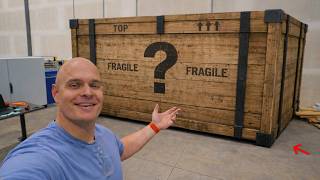

1,000 lbs to shear a finger?
45sOpens with a shocking safety fact that hooks viewers, then teases the massive machine being unboxed.
▶ Play Clip"The title accurately describes the arrival of a powerful machine, though it's not the 'most powerful' in absolute terms."
The video documents the arrival and setup of a 100-ton CNC press brake (Trump TruBend 2100) at a wheelchair factory, which will enable mass production of off-road wheelchairs. The host explains how the machine bends sheet metal into 3D parts, the safety features, and the factory's goal to reduce costs and increase production.
It takes about 1,000 lbs of pressure to shear off a human finger, a fact relevant to the machine's power.
A 12,000 lb brake press is delivered using a custom forklift with a crane and extendable back for counterbalance.
The factory aims to mass-produce off-road wheelchairs (Rig 2.0) to lower costs, inspired by Henry Ford's assembly line.
The machine is a 100-ton CNC press brake with the crushing force of 20 elephants, used to turn 2D sheet metal into 3D parts.
A CNC laser cuts intricate shapes from 5x10 ft sheets by melting metal with a laser beam and blowing out molten metal with compressed air.
The laser can cut all parts for one wheelchair in about 20 minutes.
The used brake press cost $100,000; HBADA sponsored with office chairs to offset the cost.
Building seats in-house costs tens of dollars per seat instead of hundreds if outsourced.
The press brake uses 'jaws' and 'teeth' (dies and punches) with back gauges for precise flange length.
A laser beam system stops the press if anything (like a finger) disrupts the beam, preventing accidents.
Hydraulics in the lower jaw offset the natural flex (crowning) of the bed and ram for precise bends.
A 1-ft segment of 1/2-in steel requires 40-50 tons to bend; the press is overkill for this.
The laser cuts a giant wrench shape from steel for a bench; the press brake bends it past 90° to account for springback.
The machine could shear off about 200 fingers at once, but safety lasers prevent accidents.
The new press brake enables efficient mass production of off-road wheelchairs, reducing costs and increasing output. The video highlights the machine's power, precision, and safety features, while also promoting the wheelchair pre-orders and sponsor.
How much pressure is needed to shear off a human finger?
About 1,000 lbs of pressure.
What is the weight of the brake press?
About 12,000 lbs.
00:18
What is the crushing force of the Trump TruBend 2100?
The force of 20 full-size elephants (100 tons).
01:31
How long does it take the laser to cut parts for one wheelchair?
About 20 minutes.
03:02
How much did the used brake press cost?
About $100,000.
03:32
What is the purpose of the back gauges on the press brake?
To ensure the metal is not pushed too deep into the machine and to set the flange length.
05:26
How does the safety laser system work on the press brake?
It watches the tips of the punches; if anything disrupts the laser beam (like a finger), the press stops.
06:10
What is crowning compensation in a press brake?
Hydraulics in the lower jaw offset the natural flex (crowning) of the bed and ram for precise bends.
06:39
How much pressure is needed to bend a 1-ft segment of 1/2-in steel plate?
About 40 to 50 tons.
07:28
Why does the press brake bend metal past 90°?
So that the metal springs back to the desired angle (90°).
08:22
Finger Shearing Fact
Sets up the machine's power and safety context.
Mass Production Goal
Explains the business motivation behind the machine purchase.
01:13Crowning Compensation
Demonstrates advanced engineering for precision.
06:39Springback Compensation
Illustrates how the machine accounts for material behavior.
08:22[00:00] Fun fact: it only takes about 1,000 lbs worth of pressure to completely shear off a human finger. This tidbit of information will come in handy later. Here at my wheelchair factory, of off-road wheelchairs this summer as we relaunch our redesigned Rig 2.0. And
[00:18] this machine, secretively wrapped up in white, is going to help us do it. The brake press weighs about 12,000 lbs. So, we have this custom forklift—a rigging forklift—which has a crane on the top. But it's also interesting that the back of the forklift can extend farther
[00:33] out to better counterbalance the weight that we have on the front. Take a look at this over here. Kind of fun. Pretty heavy-duty equipment to move heavy-duty equipment. This is what we are trying to build with our new machine. What you see here is a few of
[00:46] our one-off prototypes—prototypes that we've been using for testing and filming for the past year. Building them one at a time, though, is slow and rather expensive. So, just like Henry Ford did with the automobile back in 1913,
[00:59] we'll be mass-producing our off-road wheelchairs to bring the price way, way down. There are about 5 1/2 million people in the United States who use a wheelchair as their primary means of mobility. And our goal is to build enough of our Rig 2.0s for everyone,
[01:13] which is where our new machine comes in. It's called a Trump TruBend 2100. And while its name is rather unfortunate, its abilities are extraordinary. The TruBend 2100 is a 100-ton CNC press brake, and we can use it to turn 2D sheets of metal into three-dimensional
[01:31] Basically, this has the crushing force of 20 full-size elephants; but since we don't have the resources to feed that many elephants, we bought we have to get our laser-cut parts from inside the laser. A lot of our off-road wheelchair parts and
[01:51] wheelchair parts use sheet metal for, like, the seatbacks and kind of like the frame design. So, we put a giant 5x10 sheet on this side, and it gets pulled into the laser where laser beams can cut out the exact dimensions we need. The laser is what helps take the 2D flat
[02:08] sheet metal and gives us a dimensional shape that we can then make 3D with the brake press. Flat sheet metal is one of the most common ways metal is manufactured and distributed. And we can use a literal laser beam to cut out the intricate shapes we need for the off-road
[02:22] wheelchairs. Basically, the CNC laser concentrates a beam of light onto the surface which melts the metal into a molten lava. Then, high-pressure compressed air blows the molten metal out the
[02:34] backside of the cut. Thumbs up for that. It's an extremely impressive machine. If you want to learn more about lasers, I did make a whole video on this guy when we bought it last year. Our wheelchair factory is growing super fast thanks to you watching our videos. And here
[02:47] comes all of our laser-cut parts. The sheet is actually still really hot because of all the energy that went into making the cuts. But as you can see, some of the parts are already coming out of the metal. This piece is going to become the base of the battery box,
[03:02] and this will become the lid. They're flat right now, but not for long. Basically, any shape we can dream of out of aluminum or steel, this laser can provide for us really quickly. We can probably cut out all the individual parts we need for a single off-road wheelchair in about 20 minutes.
[03:17] Then, it's time to take the parts over to our press brake. This machine is going to help us turn flat sheets of aluminum into our next-generation off-road wheelchair. Creating something out of nothing doesn't happen by magic, and it doesn't happen overnight. And really big machinery like
[03:32] this is what helps make it happen. We got this machine used for about $100,000. But luckily, and decided to hook us up with their heated and cooled massaging office chairs and help offset
[03:48] a significant portion of the brake press machine. So, thank you, HBADA, for supporting the factory. These chairs are pretty epic, by the way. It's called the HBADA X7 Smart Ergonomic Chair. And not only does it have automatic lumbar smart tracking to make life easier on your lower back, but it
[04:03] also has 8D biometric hand massaging built right in. The chair can auto-massage you after prolonged sitting with three levels of red light therapy that heats up deep into your muscles. Imagine
[04:16] being at a spa while gaming, because that's what you get with the HBADA X7. The automatic lumbar support moves with me automatically every time I change position. There's a magnetic charger, a 5,200 mAh internal battery for 3 hours of full-power use, and dual-fan ventilation built
[04:33] right into the seat to help keep all your bits cool, and a super comfy zero-gravity recline. of its own. But until then, there's a link in the description; because if you're sitting down
[04:46] for most of the day, it's probably time to treat yourself to something nice. You can give yourself a promotion with the HBADA X7 Smart Ergonomic Chair, and the link is down in the description. But let's get back to building our off-road chairs. We might not have automatic lumbar
[04:59] support, but the improved suspension makes up for that. Instead of outsourcing our seat manufacturing, which could cost us hundreds of dollars per seat, we build everything here. So, it only costs tens of dollars per seat. We have the tooling set up in a way that each
[05:12] of the operations has its own set of teeth. Uh, what's interesting is that they call this top piece the "jaws" and then obviously this the "teeth." So, it's like a big old mouth that just clamps down on the metal. So, each of these stations is a different operation.
[05:26] And the stops on the back make sure that we're not pushing the metal too deep into the machine. The CNC brake press knows the length of the flange that we're trying to create, and the back gauges make sure that we don't screw it up. Each of these individual teeth—this one,
[05:40] the lower portion—is called a die, made out of hardened tool steel. And then up here, these are called the punches, and they have like a little indention at the top which helps them clip into this groove and hang where we tighten it with these Allen bolts here. But these allow
[05:56] us to set how long each of the bends is going to be, up to a total of 10 ft. So, we could put a whole flat sheet of steel in here and bend it at the same time—assuming, of course, that the bend itself wouldn't require more than 100 tons, because that is the limit of this brake press.
[06:10] One way to keep all of our fingers intact is a laser beam system that watches where the tips of the punches are at. Kind of like the laser below your garage door. If anything disrupts the laser beam that's not the punch itself, like a finger or an arm, the brake press will stop and hopefully
[06:25] not shear off any of your digits. It's super nice that the machine does all of the measuring for us, which saves the operator a lot of time as we build our off-road wheelchairs quickly. What's interesting, though, about this TruBend 2100 is that obviously dealing with the downward
[06:39] force of 20 elephants stacked on top of each other, or the weight of two whole excavators, the bottom jaw is bound to flex. So, what Trump has done on their press brake is to hollow out a cut in the super-thick lower steel plate and adds reinforcing hydraulics on either side of the jaw
[06:56] so that it can offset the crowning or bending of the tool itself. The lower hydraulics compensate for the natural deflection of the bed, which is the lower part, and the ram, which is the upper portion. The amount of flex is predictable, so the compensation needed to offset that flex is
[07:13] also predictable. The large hydraulic pump on top is regulated by two proportional valves which allow the hydraulic fluid to flow on both sides of the ram for super precise positioning. It's hard to see with the thin aluminum, but I got some 1/2-in steel plate that we can also try
[07:28] bending as well. A 1-ft segment of 1/2-in steel plate would probably require about 40 or 50 tons worth of pressure to bend. So, our press is still overkill for even 1/2-in steel. But,
[07:40] it's super cool watching our laser slice through the steel like butter. We are cutting out the shape of an oversized wrench just for fun so we can turn it into a wrench bench. The steel wrench is a tad more complicated to place inside the opening since we don't
[07:54] have a flat spot on the flange of the CNC back gauges to reference off of, but I'll just eyeball the lines we scribed on the metal and hope for the best. Glorious.
[08:09] You'll notice that the bottom die we are using is quite a bit larger this time around, since the radius or curvature of the metal is also going to be larger. The punch on the top is also quite a bit thicker. And the coolest part that's now easier to see with the steel is that
[08:22] the press brake actually bends the metal past the 90° we want so that it will spring back to the angle we request. Intelligent machines are extremely helpful, and luckily metal is pretty predictable. As long as the machine knows what type of metal it is, it can predict the flex.
[08:38] It's nice. That's a good height. We're going to have a nice wood seat on it. You've got to try this. It's nice. I'll have to add a wood top to our wrench bench later, but I think it turned out super cool. And speaking of intelligence, like I mentioned earlier,
[08:52] it only takes about 1,000 lbs to shear off a finger. And this machine would probably be capable of shearing off about 200 fingers all at the same time. We'll have to save that test for a different video. But luckily, there's a level of safety with a
[09:04] laser sensor to keep that from happening on accident. Protection is always a good thing. we could basically reconstruct society from scratch or build really cool,
[09:16] inexpensive off-road wheelchairs. I'll leave a link down in the description for the HBADA X5, as well as we are doing pre-orders for the off-road wheelchair. That'll be down in the description as well. Thanks a ton for watching, and I'll see you around.
⚡ Saved you 0h 09m reading this? Transcribe any YouTube video for free — no signup needed.