
Stop Calling It Caramelization!
45sChallenges common cooking terminology, sparking debate among food enthusiasts.
▶ Play Clip"Title accurately describes the content; the video thoroughly explains all three browning reactions."
This video explores the three main types of browning reactions in food: enzymatic browning, caramelization, and the Maillard reaction. It explains the science behind each process and clarifies common misconceptions, particularly the tendency to use 'caramelization' as a catch-all term for any browning.
All food browning reactions can be sorted into two categories: enzymatic and non-enzymatic.
Enzymatic browning occurs when cut fruit is exposed to air. An enzyme called polyphenol oxidase oxidizes phenols into quinones, which then react with proteins and amino acids to form melanin, the same brown pigment found in human skin.
Caramelization is a non-enzymatic browning reaction that happens when sugar is heated. Only heat and sugar are involved. The required temperature depends on pH and the type of sugar; for example, fructose caramelizes at lower temperatures than sucrose.
During caramelization, sugars break apart and reform into new compounds, including large polymers called caramelans, caramelens, and caramelins that absorb light and appear brown. Volatile molecules like diacetyl create buttery aromas.
The Maillard reaction occurs when sugars and amino acids react under hot, dry conditions. It produces a complex chain reaction resulting in brown melanoidins and a variety of flavors (toasty, nutty, umami).
The Maillard reaction is enhanced in alkaline conditions (e.g., pretzels soaked in lye) and inhibited by acid. In contrast, caramelization is enhanced by extreme pH in either direction.
In most cooking, both Maillard and caramelization happen simultaneously because foods contain both sugar and protein. The dominant reaction depends on the food's composition.
To avoid pedantic criticism, simply refer to any browning as 'browning' rather than incorrectly labeling it as caramelization.
Understanding the three browning reactions—enzymatic, caramelization, and Maillard—helps cooks achieve desired flavors and colors. While they often occur together, knowing the differences allows for better control in cooking.
What are the two categories of food browning reactions?
Enzymatic and non-enzymatic.
00:28
What enzyme is responsible for enzymatic browning in cut fruit?
Polyphenol oxidase.
01:15
What brown pigment is produced by enzymatic browning?
Melanin.
02:00
What two components are required for caramelization?
Sugar and heat.
04:06
Which sugar caramelizes at the lowest temperature?
Fructose, especially in acidic conditions.
04:18
What are the large sugar polymers formed during caramelization called?
Caramelans, caramelens, and caramelins.
05:14
What volatile compound in caramel smells like butter?
Diacetyl.
05:46
What two components are required for the Maillard reaction?
Sugar and amino acids.
06:42
What are the brown compounds produced by the Maillard reaction called?
Melanoidins.
07:33
How does pH affect the Maillard reaction?
It is enhanced in alkaline conditions and inhibited by acid.
08:05
How does pH affect caramelization?
It is enhanced by extreme pH in either direction (basic or acidic).
08:31
Two Categories of Browning
Provides a clear framework for understanding all browning reactions.
00:28Melanin in Fruit and Humans
Connects food science to human biology in an engaging way.
02:00Why 350°F is Common
Offers a practical hypothesis for a standard oven temperature.
04:47pH Effects on Maillard vs. Caramelization
Highlights a key difference that can be used to control browning in cooking.
08:05Just Say 'Browning'
Provides simple, practical advice to avoid pedantic criticism.
10:02[00:00] It is common among cooks to refer to any food browning under heat as "caramelization." People will say that meat is caramelized when it gets a good crust on it, or bread.
[00:13] Is this wrong? Well, I think it depends on what you mean by "wrong." There are multiple browning reactions that happen in food and caramelization is but one of them.
[00:28] All the food browning reactions can be sorted in two categories: enzymatic and non-enzymatic. Enzymatic is the kind of browning that happens
[00:40] when you cut fruit and leave it open to the air. It's a kind of oxidation. Plants naturally biosynthesize a broad class of chemicals known as phenols. Phenols are involved in lots of the colors and smells that attract pollinators to plants,
[00:58] or attract fruit-eating animals, like us, who might help the plant reproduce by taking the fruit somewhere to eat it and dropping the seeds. When you cut the fruit, you bust through cell walls and release an enzyme,
[01:15] which is a kind of protein, called polyphenol oxidase. You also expose the cut surface to air, and in the presence of oxygen, polyphenol oxidase oxidizes the phenols, or chemically
[01:30] changes them with oxygen into new things — specifically, in this case, quinones, which are another class of organic compounds that are toxic to microorganisms and yucky to insects.
[01:44] Basically, when the plant is wounded, it produces this layer of polymerized quinones to protect itself. It's a band aid. The quinones then react with proteins and free amino acids in the fruit to
[02:00] produce a class of brown-colored compounds known as melanin. Yes, melanin. The stuff that makes fruit brown is the same stuff that makes people brown.
[02:13] It's fun that we can use science to better understand each other. Just as we can use language to better understand each other with Babbel, sponsor of this video. I have this dream of going to Indonesia to scout aquarium
[02:27] plants on Borneo. So I'ma need to learn at least a few words of Indonesian with Babbel, You can learn American or European Spanish, Italian, Turkish, all kinds of things.
[02:42] Babbel courses are created by over 200 language experts. It’s like having a private tutor in your pocket. I like how you can practice actually talking with enhanced speech recognition and an in-app conversation partner.
[03:03] Babbel has over 25 million subscriptions sold and over 1.6 million 5-star app store ratings. It's tough for me, but I just think the phonology of Indonesian so,
[03:15] so colorful and fun, like the aquarium plants I hope to find there. To start speaking a new language in 3 weeks, click the link in the description or go to Babbel dot com slash Ragusea and you’ll get up to 55% OFF your subscription. That’s up to 55% off
[03:32] your subscription when you use my link. Join the millions of Babbel learners breaking the language barrier every day and Babbel dot come slash Ragusea. cut fruit and leave it out, and none of that is caramelization. Caramelization is one of
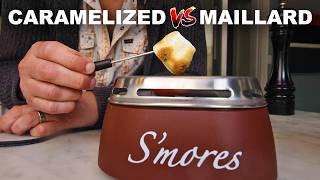
[03:50] the two non-enzymatic browning reactions in food, both of which can be observed via this little 'smores maker toy my kids won at one of those kiddie casino arcades. We kinda love it.
[04:06] Camelization is something that happens when sugar meets heat. Only heat and sugar are involved. How much heat is required depends on the ph of the environment,
[04:18] and on which sugar you're caramelizing. In low ph, acidic conditions, fructose can caramelize at just over the boiling point, which is not very hot at all. That's
[04:32] why high-fructose foods are more likely to have those caramel flavor notes. Glucose caramelizes at like low-baking temperatures, sucrose caramelizes at normal baking temperatures.
[04:47] One hypothesis as to why 350ºF/180ºC is a common default oven temperature is that's the lowest heat that is likely to caramelize most sugars,
[05:00] though maltose needs it a little hotter than that. And what is this caramelization? Basically it's just the sugars breaking apart and reforming into a million new organic compounds.
[05:14] Some of the sugars polymerize, or link together into giant structures known as caramelans, caramelens, and caramelins — solid naming convention there,
[05:29] science. No opportunity for confusion at all. Anyway, these big sugar polymers absorb light and so they look brown. You also get a lot of much smaller, volatile molecules that easily vaporize and we smell
[05:46] them. The big one in caramel is called diacetyl, which smells intensely like butter, because it's also in butter, and with massive exposure it's responsible for
[05:59] the disease known as popcorn lung, but that's not a real hazard of eating caramel. If you over caramelize sugar with too much heat you start breaking these compounds down
[06:11] into chemicals that get gradually closer and closer to pure carbon, so the sugar turns bitter and black. That's burning. The other kind of non-enzymatic browning in food is the famous Maillard Reaction,
[06:28] named after the French chemist who first described it in 1912. He was trying to replicate the natural process of protein synthesis in a lab and then he stumbled on this thing. The Maillard Reaction happens when sugar and
[06:42] amino acids react with each other in hot, dry conditions. Mashmallow is a great example because it is a sugar syrup foam stabilized with protein,
[06:54] like egg white or gelatine, which provides the amino acids. Between low to middle baking temperatures, the sugars and proteins break down and parts of them
[07:06] recombine to make new compounds that are super unstable and lead to more compounds that are unstable and a whole crazy chain reaction unfolds resulting in lots of complex chemicals with
[07:19] complex flavors. It's really too complicated to explain in much greater detail here. The particular compounds that create the brown color are known as melanoidins,
[07:33] which is to say they're not melanin but they're like melanin. Some of the compounds created by the Maillard Reaction smell toasty, some smell nutty, others taste umami-y, and it all depends on the specific amino
[07:50] acids and reducing sugars involved and the exact heat and the exact conditions. One useful thing to know is that the Maillard Reaction is enhanced in high ph, or alkaline
[08:05] conditions. That's why you soak pretzels in lye, to make them Maillard faster. You get a super brown thin piece of bread that's still soft on the inside, because it browned so fast.
[08:18] Acidic, low ph conditions inhibit the maillard reaction. The more yogurt you put in your naan dough, the less it's gonna brown, because of the acid.
[08:31] That's a big difference compared to caramelization. Caramelization is enhanced by extreme ph in either direction, basic or acidic. And that,
[08:43] alone, may be a good enough reason to keep these two things linguistically separate. And yet, cooks often refer to either kind of non-enzymatic browning as "caramelization," and generally speaking, I think that's fine, if you care.
[09:03] Fact is, both kinds of browning are usually happening when you brown almost anything, because virtually all foods contain at least a little sugar and a little protein. Meat is
[09:18] mostly protein but it naturally contains some sugar, because animals run on glucose. Onions contain a ton of sugar, but also some protein, because all known lifeforms contain protein.
[09:33] The more protein and sugar your food has, the more browning you'll get. Both Maillard and caramelization are generally happening in most cooking, it's just a matter of
[09:46] which is the dominant reaction. But, if you want to keep yourself out of most trouble, if you want to immunize yourself against attacks by pedants, just say "browning." Whether it's caramelization,
[10:02] maillard, enzymatic browning, just call it browning. It's all browning. That is all.
⚡ Saved you 0h 10m reading this? Transcribe any YouTube video for free — no signup needed.