

I Withdrew $390K Using These 3 Concepts
44sThe huge payout claim and promise of a simple strategy hook viewers immediately.
▶ Play Clip"Title promises essential concepts, but the content is thin and lacks depth, feeling more like a teaser than a full guide."
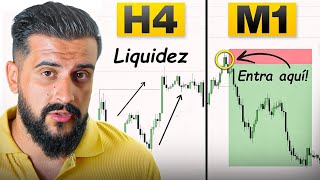
The video presents a trading strategy that the creator claims has generated over $390,000 in payouts from funded accounts. It focuses on three price action concepts: liquidity, trading schedules, and imbalances, providing a concise framework for entering trades.
Every maximum and minimum on the 4-hour timeframe is considered liquidity. The price is likely to react at these points, so the strategy involves selling above highs and buying below lows.
The creator trades during stock market openings in London and New York, specifically from 9 a.m. to 11 a.m. and 2 p.m. to 4:30 p.m. Spanish time. Viewers are advised to convert to their local time.
After price exceeds liquidity points, drop to a lower timeframe (1 or 5 minutes) and look for a sequence of three candles that leaves an imbalance. Place orders there with a risk-reward ratio of 1:2.
The strategy is a simple, rule-based approach to price action trading, emphasizing liquidity, timing, and imbalance entries to achieve consistent payouts.
What is considered liquidity in this trading strategy?
Every maximum and minimum on the 4-hour timeframe.
00:01
What are the recommended trading hours in Spanish time?
9 a.m. to 11 a.m. and 2 p.m. to 4:30 p.m.
00:14
What lower timeframes are suggested for finding imbalances?
1 minute or 5 minutes.
00:28
What risk-reward ratio is recommended?
1:2.
00:40
Liquidity as Reaction Points
Establishes the core premise that price reacts at 4-hour highs and lows, forming the basis of the strategy.
00:01Time-Based Trading
Emphasizes the importance of trading during specific market sessions for higher probability setups.
00:14Imbalance Entry Model
Provides a concrete entry trigger using a three-candle sequence, making the strategy actionable.
00:28[00:01] trading strategy with which I have withdrawn more than $390,000 in payouts with funding accounts. The first is liquidity. Every maximum and minimum in the time frame of one 4-hour hour [snort] is liquidity.
[00:14] Therefore, the price is quite likely to react to those points. He always looks to sell above highs and buy below lows. The second concept is schedules. He always trades during
[00:28] stock market openings, in London and New York, from 9 a.m. to 11 a.m. and from 2 p.m. to 4:30 p.m., Spanish time. If you're from any other country, just do the time conversion and don't be lazy. And the third concept is
[00:40] imbalances. Once the price has exceeded those liquidity points, simply lower a timeframe such as 1 minute or 5 minutes and look for a price in a sequence of three candles that leaves you with an imbalance. Place your
[00:54] order there, either in sales or purchases, and put your risk-benefit ratio at one to two. And trading strategy, follow me on my profile.



⚡ Saved you 0h 01m reading this? Transcribe any YouTube video for free — no signup needed.