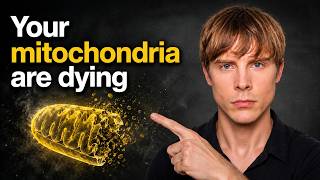

Mitochondria: The Domino Effect of Aging
45sExplains a complex biological process in a simple, relatable metaphor that resonates with anyone concerned about aging.
▶ Play Clip"Delivers on the promise with solid science and practical advice, though a sponsor segment and some repetition pad the runtime."
This video explains mitophagy, the cellular process that removes damaged mitochondria, and its critical role in aging. It argues that exercise, particularly high-intensity training, is the most effective way to activate mitophagy, far surpassing supplements, and provides practical recommendations for combining exercise, nutrition, and fasting to maintain mitochondrial health.
Mitochondria are the powerhouse of the cell; with age they weaken and damage nearby cells. Mitochondrial dysfunction contributes to all other hallmarks of aging, acting like a domino effect.
Mitophagy is a quality control process (a type of autophagy) that eliminates worn-out mitochondria. It is not an entity but a spontaneous process that degrades damaged mitochondria inside lysosomes.
Mitophagy declines with age, promoting accumulation of damaged mitochondria and oxidative stress. It is impaired in neurodegenerative disease, cardiovascular disease, and cancer. Loss of mitophagy propagates mitochondrial dysfunction.
ATP producing capacity decreases by about 8% per decade, but physical inactivity, not aging itself, is the main driver. Exercise is the most powerful way to increase mitophagy, both by maintaining mitochondrial efficiency and removing old mitochondria.
Exercise and calorie restriction activate the energy sensor AMPK, which upregulates autophagy and mitochondrial biogenesis. High-intensity exercise is the most potent signal for AMPK activation.
A human skeletal muscle study found autophagy activation was dependent on exercise intensity; low intensity didn't meaningfully activate it, while higher intensity increased markers like LC3B2. Sprint interval training was more time-efficient than moderate continuous training.
Longer duration moderate intensity exercise (zone 2) creates sustained energy demand, driving mitochondrial turnover over time. Low intensity exercise may be better for mitochondrial biogenesis, and HIT benefits plateau after a few weeks, whereas low intensity keeps giving benefits over months and years.
The best combination: high-intensity training for strong mitophagy signal, lower intensity longer duration exercise for mitochondrial density, and daily frequent movement (walking) to prevent dysfunction from inactivity.
Urolithin A, a gut metabolite from pomegranates, berries, and walnuts, increases mitophagy in worms and mice. The popular supplement Mitopure is expensive and research is not strong: it increases hamstring strength by 12% without exercise, but has no effect on VO2 peak, grip strength, or body composition, and the human study had a suspicious 80% drop rate.
Polyphenols in coffee, vegetables, nuts, berries, and olive oil activate stress response pathways like AMPK and SIRT, but are much weaker than exercise. If you exercise, exercise does probably 90% of the job.
Fasting and calorie restriction create energy stress, depleting ATP and activating AMPK while suppressing mTOR, triggering autophagy. Calorie restriction without full fasting can have similar effects over time. But aggressive fasting can impair recovery and reduce muscle mass.
The most powerful way to activate mitophagy is high-intensity exercise. Add polyphenolic compounds, periodic energy stress (intermittent fasting or calorie restriction), and possibly supplements like urolithin A, but exercise is free and more effective.
Mitophagy is a basic maintenance system that declines with age, leading to damaged mitochondria accumulation. The most effective way to counter this is through high-intensity exercise, supplemented by polyphenols and periodic energy stress, rather than relying on expensive supplements.
What is mitophagy?
Mitophagy is a type of autophagy that breaks down dysfunctional or damaged mitochondria, acting as a quality control process.
00:39
How does mitochondrial dysfunction relate to aging?
Mitochondrial dysfunction contributes to all other hallmarks of aging, acting like a domino effect.
00:15
What is the approximate decline in ATP producing capacity per decade in humans?
About 8% per decade.
01:43
What is the key energy sensor activated by exercise and calorie restriction that upregulates autophagy?
AMPK.
02:13
Which type of exercise is the most potent signal for AMPK activation?
High-intensity exercise, either HIT cardio or resistance exercise.
02:27
What did a human skeletal muscle study find about autophagy activation and exercise intensity?
Autophagy activation was dependent on exercise intensity; low intensity didn't meaningfully activate it, while higher intensity increased markers like LC3B2.
02:42
What is the advantage of low-intensity exercise like zone 2 cardio for mitochondria?
It may be better for mitochondrial biogenesis and provides sustained benefits over months and years, while HIT benefits plateau after a few weeks.
03:32
What is the most studied supplement for mitophagy?
Urolithin A, a gut microbiome metabolite made from compounds in pomegranates, berries, and walnuts.
05:18
What are the reported effects of Mitopure (Urolithin A) in human studies?
It increases hamstring strength by 12% without exercise, but has no effect on VO2 peak, grip strength, or body composition, and minor effects on six-minute walking test.
05:44
Why is exercise considered superior to supplements for mitophagy?
Exercise creates energy stress by depleting glycogen, which is a much bigger activator of AMPK than any supplement; exercise does probably 90% of the job.
07:06
What is the role of fasting in mitophagy?
Fasting creates energy stress, drops ATP levels, activates AMPK, and suppresses mTOR, triggering autophagy including mitophagy.
07:33
What is the risk of aggressive or prolonged fasting?
It can impair recovery, reduce muscle mass, reduce bone density, and limit mitochondrial rebuilding.
08:00
Mitochondrial dysfunction as a central aging hallmark
Explains the domino effect linking mitochondria to all other hallmarks of aging, establishing the importance of mitophagy.
00:15Exercise over aging for mitochondrial decline
Challenges the assumption that aging itself causes mitochondrial decline, pointing to physical inactivity as the main driver.
01:43Intensity-dependent autophagy activation
Provides concrete evidence that high-intensity exercise is necessary for meaningful autophagy activation.
02:42Critical review of Mitopure
Offers a balanced, evidence-based critique of a popular supplement, highlighting weak research and limited effects.
05:44Exercise does 90% of the job
Emphasizes the overwhelming superiority of exercise over supplements for mitophagy, a key practical takeaway.
07:06[00:00] One of the central hallmarks of aging is mitochondrial dysfunction. We've all heard about the mitochondria, the powerhouse of the cell. And without your mitochondria, you can't produce energy. With age, the mitochondria become weaker, more worn out, and they start damaging nearby cells.
[00:14] Because the mitochondria are central to all cellular functions, mitochondrial dysfunction contributes to all other hallmarks of aging. It's like a domino effect. Once the mitochondria fall, so do the other hallmarks.
[00:26] Fortunately, there are ways to remove and repair these broken mitochondria. You can do that via the process of mitophagy or mitochondrial autophagy. It's basically like a quality control process that eliminates young material and worn-out mitochondria.
[00:40] So in this video, I'm going to break down what is mitophagy, why it matters for aging, and the most effective ways to activate it. One of the major causes of aging is thought to be the accumulation of worn-out old cellular debris, especially old mitochondria that are inside cells.
[00:55] Mitovagi is a type of autophagy that is needed to break down dysfunctional or damaged mitochondria. Mitovagi isn't an entity or a specific organelle. It's almost like a spontaneous formation that engulfs the old mitochondria and degrades it inside lysosomes.
[01:10] With age, you see a decline in mitophagy, which has been seen to promote the accumulation of damaged mitochondria and oxidative stress. It's a two-way process. Loss of mitophagy promotes the accumulation of old cell particles, and that accumulation is what reduces mitophagy.
[01:23] autophagy. Metaphagy is also impaired in various pathological conditions, such as neurodegenerative disease, cardiovascular disease, and cancer. With absent or inadequate autophagy, which is one of the new hallmarks of aging itself, you propagate mitochondrial dysfunction, which is another
[01:38] hallmark of aging. So it is a very central process to aging and longevity. Let's talk about the most powerful way to increase metaphagy. Aging contributes to mitochondrial decline, as ATP producing capacity decreases by about 8% per decade in humans. However, this is thought
[01:53] to be more because of physical inactivity rather than aging itself. That's why exercise is the best thing for your mitochondria, both in terms of maintaining mitochondrial efficiency for energy production, but also through the removal of old mitochondria via the process
[02:08] of mitophagy. The key to increasing mitophagy is inducing physiological stress and causing energy depletion in the body. When you're exercising or experiencing calorie restriction, to activate an energy sensor called NMPK.
[02:21] NMPK then leads to the upregulation of autophagy At the same time NMPK is also the key sensor for mitochondrial biogenesis the growth of new mitochondria The most potent signal for AMPK activation comes from high exercise
[02:37] It's either hip cardio or resistance exercise. For example, one human skeletal muscle study found that autophagy activation was dependent on exercise intensity. Low-intensity exercise didn't meaningfully activate autophagy, whereas higher-intensity exercise increased autophagy markers like LC3B2 and was linked to stronger ANPK activation.
[02:57] Another human study compared sprint interval training with moderate-intensity continuous training and found that both increased ANPK activation and autophagy markers. However, sprint training produced a more time-efficient stimulus.
[03:09] Now, this doesn't mean that you should only do high-intensity exercise or all-out exercise. Longer duration, moderate intensity exercise like zone 2 cardio also plays a key role It may not spike AMPK as aggressively in the moment as high intensity exercise
[03:23] But it creates a sustained energy demand Which will still drive mitochondrial turnover over time There's also research that low intensity exercise like zone 2 cardio Is better for mitochondrial biogenesis, the growth of new mitochondria
[03:36] The benefits of HIIT training also plateau after a few weeks whereas you keep getting benefits with low-intensity exercise over several months and years. In practice, here's the best combination of exercise for mitochondrial health.
[03:48] High-intensity training. It sends a strong signal for mytopathy and adaptation. Lower-intensity, longer-duration exercise builds mitochondrial density and efficiency. Daily frequent movement like walking keeps your mitochondria active
[04:01] and prevents mitochondrial dysfunction from inactivity. I want to take a quick break to tell you about the Bond Charge Infra-Sona Blankets, My go-to way of getting 20-minute sauna sessions on the go without needing to spend an hour to warm up a regular sauna.
[04:14] Taking a sauna is in my opinion one of the best things for your overall health and heart function. Studies show that taking a sauna regularly is associated with 63% lower risk of starting cardiac death, 63% reduced heart disease mortality, 46% lower risk of hypertension, and 40% reduced all-cause of ality.
[04:30] This is mediated by an increase in body temperature and increased heart rate that mimic a cardiovascular workout, while at the same time improving arterial stiffness, endothelial function, blood flow, immune system function, blood pressure and metabolic health. It doesn't matter if
[04:43] it's a traditional woolen sauna, an infrared sauna, an infrared sauna blanket or anything else that elevates your body temperature above what normal Born charged infrared sauna blankets have the advantage of shining far infrared light that can penetrate deeper into your tissues than regular saunas can It warms up in two minutes to the optimal temperature of 70 degrees Celsius and is low in EMF You can get
[05:03] a 15% discount by heading over to borncharge.com for Shazin Lund and use the code SEAM for 15% discount. Right back to the video. Now let's talk about supplements. There are certain nutrients and supplements that can increase the process of autophagy and mycophagy. The most studied one
[05:18] is Euroleafon A, a gut microbiome metabolite made from compounds in pomegranates, berries and walnuts. In worms and mice, Euroleafon A increases metabology and improves muscle function. The most popular Euroleafon A supplement online is MitoPure. Now, I've made many videos about
[05:33] MitoPure. It's very expensive and the research isn't that good in my opinion. Here's a short overview of that. Number one, MitoPure does increase hamstring strength by 12%, 12%, but that's without exercise. When you exercise, the effects are probably minimal.
[05:48] Mitochlor doesn't have any effect on upper body strength or grip strength. Number three, it has no effect on VO2 peak or peak power output. Number four, it has minor effects on six-minute walking test. Number five, muscle endurance as tested by a muscle contraction test
[06:03] was not seen to result in improvements compared to placebo after four months. Number six, no effect on body composition and fat loss or muscle mass. And number seven, there's conflicting results on information markers, with some studies finding an effect and others not. The claim that URSN-A
[06:18] is a mitophagy activator in humans is based from a study on six individuals who got muscle biopsies. However, the study enrolled 59 people who got MitoPure, so they saw an 80% drop rate in their sampling, which is suspicious, and it's a very small sample size to begin with. Now, I do think
[06:34] that MitoPure and URSN-A are mitophagy activators in humans. It's not a problem to activate mitophagy. Many other compounds do it, and they do it for a lot cheaper price. For example, all different kinds of polyphenols found in foods like coffee, vegetables, nuts, berries, fruit, olive oil, etc.
[06:50] These don't directly clean mitochondria like a drug, but they can activate stress response pathways like AMPK and SIRT1, which are connected to autophagy, mitochondrial biogenesis, and mitophagy. But all of these compounds, including UFNA, are much weaker at increasing mitophagy than exercise.
[07:07] And exercise is a much bigger activator of AMPK. So if you are taking these compounds while you are also exercising, then exercise does probably 90 of the job The reason is because to increase autophagy and to increase metabology you need to experience energy stress And exercise creates that energy stress by depleting your glycogen
[07:26] You can also experience that with fasting. Fasting as well as calorie restriction are powerful ways to increase metaphygy. When you grow without food for a period of time, your body experiences energy stress. Your ATP levels drop and this activates AMPK while suppressing another growth pathway called mTOR.
[07:43] That shift is one of the main triggers for autophagy, including myotophagy. Calorie restriction, even without full fasting, can have similar effects over time. By keeping energy intake slightly lower, you create a mild chronic signal that promotes cellular cleanup.
[07:57] But just like with exercise, more isn't always better. Aggressive or prolonged fasting without proper nutrition can impair your recovery, reduce muscle mass, reduce bone density, and limit mitochondrial rebuilding.
[08:09] So the goal isn't constant energy deprivation, whether with fasting, calorie restriction or exercise. The goal isn't constant overnutrition either, by eating a lot of protein and a lot of calories and not exercising. The key is creating periodic energy stress and cycling between energy abundance and energy
[08:25] scarcity. So to sum it up, the most powerful ways to activate metabolic is high intensity exercise. No supplement or drug comes close to that. The second thing I would add is consuming different kinds of polyphenolic compounds
[08:37] that also activate NMPK and increase the topology. The third point would be periodic energy stress through either daily intermittent fasting or time-restricted eating or some periods of calorie restriction, basically fat loss.
[08:49] You don't need to starve yourself, you don't need to be on a low-calorie diet for the rest of your life, but you do want to lose fat at least every once in a while. And the last part of increasing my topology is taking certain supplements. You run a SNA potentially, but it's very expensive compared to just exercising, right?
[09:02] You can just go for some sprinting drill training that's for free and it gets you more my topology. You can also take some other compounds, berberine, different kinds of polyphenolic compounds, curcumin, ginger, egg, garlic extract, coffee polyphenols, etc.
[09:15] They all can increase the value, but they don't come close to exercise. Mitochondria isn't some sort of exotic hack. It's a basic maintenance system that your body relies on. As you get older, this process becomes less efficient.
[09:27] Your mitopathy levels decline, which then leads to more damaged mitochondria accumulating inside cells. That's a problem. So you need to actively work on removing these mitochondria and building new ones. Alright, thanks for watching. If you want to discover your health percentage and get your roadmap to top 1% of health, then join the community using the link in the description. I'll see you there.
⚡ Saved you 0h 09m reading this? Transcribe any YouTube video for free — no signup needed.