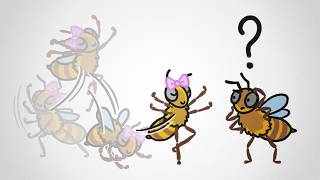

The Waggle Dance: Bee's GPS
48sClearly explains the complex mechanics of bee communication in an easy-to-understand way, making it highly shareable.
▶ Play Clip"The title accurately reflects the core surprising fact that bees usually ignore the waggle dance, and the video fully supports that with evidence and explanation."
Honeybees use the famous 'waggle dance' to communicate the location and quality of food sources to other workers. However, studies show that bees ignore these detailed directions up to 93% of the time, because they prefer familiar patches and weigh the risks of following uncertain guidance. This behavior mirrors how humans selectively use crowdsourced information.
Bees use a complex set of movements to share direction (relative to the sun), distance (duration of waggle), and quality (intensity) of a nectar patch.
Up to 93% of the time, bees observe the entire dance and then continue with their own foraging, not immediately following the directions.
Workers are experienced foragers with known patches; they also consider the risks of getting lost, overestimation by the dancer, or directional mistakes.
Bees weigh the value of the new dance against their current knowledge, similar to how humans need multiple consistent reviews before changing a habit.
In early spring, late fall, or after storms, when familiar patches are empty, or when multiple bees dance for the same spot, workers are more likely to follow the dance.
Though the waggle dance is a sophisticated communication tool, bees rarely act on it immediately; instead, they treat it as communal knowledge to be used when conditions change. This selective following mirrors human decision‑making with online reviews.
What percentage of the time do bees ignore the waggle dance?
Up to 93% of the time.
1:19
What three pieces of information does the waggle dance convey?
Direction relative to the sun, distance (time spent waggling), and quality (intensity of movement).
0:43
Why is ignoring the waggle dance often a good strategy for bees?
Experienced foragers have known reliable patches; they avoid risks of getting lost, dancer errors, or overestimations.
1:28
Under what circumstances are bees more likely to follow a waggle dance?
When their own patches are empty (e.g., early spring, late fall, after storms) or when multiple bees dance for the same patch.
2:16
Waggle dance sophistication
Reveals that bee communication is a precise code encoding direction, distance, and quality.
0:0293% ignorance rate
Highlights a counterintuitive behavioral insight about bee decision‑making.
1:19Bees weigh risks like humans
Draws a parallel between animal behavior and human crowdsourcing logic, making it relatable.
1:44Context‑dependent following
Explains the adaptive value of ignoring vs. following based on environmental scarcity.
2:16[00:00] You've probably heard that bees use a
[00:02] complex set of movements, often called
[00:04] the waggle dance, to tell other worker
[00:06] bees where to find new sources of
[00:07] nectar. It's a super clever and
[00:09] sophisticated system. But it turns out
[00:11] that bees almost never immediately jump
[00:14] up to follow the directions they just
[00:15] got, which weirdly is also super clever
[00:19] and sophisticated. Hi, I'm Cameron and
[00:21] this is Minute Earth. Most communal
[00:24] insects lead their nestmates to
[00:25] promising food sources with pheromone
[00:27] trails. But bees like Beatatric here fly
[00:30] long distances to find flower patches.
[00:32] Chemical signals would just disappear
[00:34] into the air. Instead, after returning
[00:37] to the hive, bee shares information
[00:39] about a promising patch through
[00:41] choreography. The direction she moves
[00:43] describes the exact direction to the
[00:45] patch relative to the sun. The time she
[00:47] spends waggling tells her sisters how
[00:49] far the patch is in that direction, and
[00:51] the intensity conveys how promising Bee
[00:54] thinks the patch is. This complicated
[00:56] set of movements adds up to a set of map
[00:58] coordinates tagged with a starred review
[01:01] for bees. And Bee might repeat her
[01:03] choreography as many as 50 times to make
[01:06] sure the other workers catch every move.
[01:08] And at this point, I guess I should
[01:09] mention that the inside of a beehive is
[01:11] completely dark. Nearby workers have to
[01:13] follow Bee's every move by touching her
[01:16] with their antenna. But as much as 93%
[01:19] of the time, the other workers will
[01:21] observe this long, intricate set of
[01:23] movements and then just go on with their
[01:25] day, which actually makes sense. I mean,
[01:28] most of these workers are expert
[01:29] foragers themselves. They already have
[01:31] patches they know and like. There's also
[01:33] the risk of getting lost while following
[01:35] someone else's directions. Plus, bee
[01:37] might have overestimated how promising
[01:39] the patch actually is or might have made
[01:41] a mistake in her directions. Instead, a
[01:44] bee analyzes the information conveyed by
[01:46] a waggle dance. They weigh the risks of
[01:48] venturing into the unknown versus
[01:50] sticking with what they know and then
[01:52] make a decision. And the vast majority
[01:54] of the time, bees end up passing on that
[01:56] suggestion, which probably isn't
[01:58] different than how you use crowdsourced
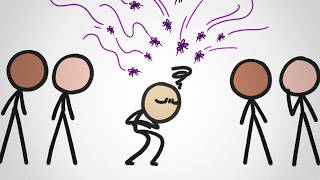
[02:00] information. One five-star review
[02:02] probably wouldn't convince you to visit
[02:04] a new place instead of one you already
[02:06] love. But let's say your favorite place
[02:08] was closed or there were dozens of
[02:10] five-star reviews for this new place.
[02:12] Then you might be convinced to take the
[02:14] chance. It's the same with bees. In
[02:16] early spring and late fall when flower
[02:19] patches are few and far between or after
[02:21] a destructive storm, a bee's go-to spots
[02:23] are more likely to be empty. And in that
[02:26] case, it might be worth taking a chance
[02:28] on what another bee is buzzing about.
[02:30] And if multiple bees are giving the same
[02:32] information about the same patch, the
[02:34] worker is more likely to take a chance
[02:36] and visit it. So even though most of the
[02:38] time bees don't follow the directions
[02:40] conveyed by waggle dances, the
[02:42] information becomes part of the hive's
[02:44] communal knowledge, even if they don't
[02:46] make a beline for it.
[02:51] Now, here's a boogie you should totally
[02:53] pay attention to. Minute Earth is
[02:55] nominated for a Webby Award, and we
[02:57] would love it if you would buzz over to
[02:59] the link in the description and give us
[03:00] your vote. Making buzzworthy videos that
[03:03] explore the incredible science of insect
[03:05] communication and so much more takes a
[03:08] lot of effort from the workerbees over
[03:09] here. And if you love what we do, please
[03:11] consider joining Minute Earth on
[03:13] Patreon. Your support helps us keep
[03:15] digging into these topics and bringing
[03:16] them to you. Plus, our highle patrons
[03:18] get exclusive perks like this season's
[03:20] t-shirt club design, which shows
[03:22] everyone exactly how to do the waggle
[03:24] dance. Come join the dance party at
[03:26] patreon.com/minuteearth.
⚡ Saved you 0h 03m reading this? Transcribe any YouTube video for free — no signup needed.