
Why You Can't Escape a Black Hole
45sVisually explains light cones and why nothing can escape a black hole, sparking curiosity about spacetime.
▶ Play Clip"The title accurately reflects the content: the video explains how time and space swap inside a black hole."
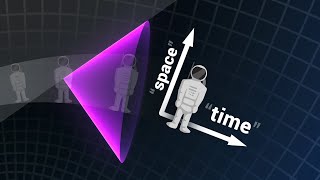
This video explains how light cones illustrate the structure of spacetime, the difference between time and space, and how gravity bends spacetime to create black holes where time and space swap roles.
A candle emits a flash of light that travels in all directions, forming a growing bubble. In a 2D slice, this bubble forms a circle that grows over time.
Stacking images over time creates a cone where the sides are tilted at 45 degrees because light travels one light-year per year.
An event like a supernova cannot affect Earth until its light cone reaches us, limiting cause-and-effect to the speed of light.
Through space we can move in any direction, but through time we are forced to move forward. Light cones show this: we cannot turn around in time.
Time is the direction in which light cones are oriented, the direction we cannot turn back, while space is all other directions.
In empty space, light cones are aligned and time is global. Near a massive body, light cones bend, curving time toward the center.
A very compact massive object bends spacetime so much that below a certain altitude, all light cones point downward, creating a black hole.
The horizon is the boundary where light can no longer escape. Inside, all paths lead to the center; time points toward the singularity.
For a distant observer, the horizon is static. For the falling astronaut, at the horizon time and space are tilted 45°, and inside they swap roles.
Below the horizon, time points downward (formerly a spatial direction), and the center becomes an unavoidable future event.
A collapsing star emits a final light bubble that appears static from outside due to curvature. The horizon is a light cone from which nothing escapes.
Compactifying the diagram shows the outside and inside as distinct regions; crossing the horizon means the universe is in the past.
Light cones are essential for understanding spacetime, causality, and black holes. In a black hole, time and space swap roles, making the singularity an inevitable future.
What is a light cone?
A diagram showing the path of light from an event, with sides tilted at 45 degrees because light travels one light-year per year.
00:49
Why can't we escape a light cone?
Because we would have to exceed the speed of light.
00:30
How does a light cone illustrate causality?
An event cannot affect another until its light cone reaches it, limiting cause-and-effect to the speed of light.
02:03
What is the difference between time and space according to light cones?
Through space we can move in any direction, but through time we are forced to move forward; light cones show we cannot turn around in time.
02:46
How is time defined in relativity?
Time is the direction in which light cones are oriented, the direction we cannot turn back.
03:52
What happens to light cones near a massive body?
They bend, curving time toward the center of the body.
05:25
What is a black hole?
A region where spacetime curvature is so strong that all light cones point downward, trapping everything inside.
06:43
What is the horizon of a black hole?
The boundary above which some light can escape, below which all light is captured.
07:22
From the perspective of a falling astronaut, what happens at the horizon?
Time and space are tilted at 45 degrees; the horizon becomes a diagonal like a light cone.
08:30
What does 'time and space swap' mean inside a black hole?
Time points downward (formerly a spatial direction), and the center becomes an unavoidable future event.
09:29
What is a Penrose diagram?
A compactified diagram showing the outside and inside of a black hole as distinct regions.
11:11
We cannot turn back in time
A clear, intuitive explanation of the fundamental difference between time and space using light cones.
03:10All light cones point downward
The dramatic moment when the concept of a black hole is introduced as a region where even light cannot escape.
06:43Time and space swap inside a black hole
The mind-bending conclusion that inside a black hole, time becomes a spatial direction and the center is an inevitable future.
09:29[00:00] Welcome back to ScienceQuick. Today, light cones and black holes.
[00:14] Imagine lighting a candle. The candle emits a flash of light that travels in all directions, forming a bubble that grows. This bubble is in three dimensions and surrounds us completely.
[00:30] If we are inside this bubble, it is impossible to get out of it because we would have to exceed the speed of light. Imagine that we only perceive a 2D slice of space. The bubble forms a circle that grows all around us.
[00:49] If we decompose the situation image by image, and if we stack the images one after the other, we can construct a diagram in which the bubble of light, which grows over time, forms a cone.
[01:06] This cone widens from the past to the future, and inside of it we trace the trajectories through time. The sides of the cone are tilted at 45 degrees because for any given amount of time, light
[01:22] always travels a set distance. In one year, light will always travel a distance of one light year through space. This type of object is called a light cone.
[01:37] As time passes, the cone expands at the speed of light, and whatever we do, our path remains bounded by it. It's impossible to escape it.
[01:51] In relativity, these light cones are essential to understand the structure of the universe. In particular, they restrict cause-and-effect relationships.
[02:03] To understand, imagine an event that occurs far from Earth, such as a supernova explosion. This event won't be able to affect us until its light cone has reached Earth.
[02:16] Before that, no information about the explosion can reach us since nothing can be transmitted faster than light. This explosion can only be seen and felt on Earth as soon as we enter its light cone.
[02:34] Causality, the fact that one event can trigger another, is limited by the speed of light.
[02:46] More importantly, light cones allow us to understand the profound difference between the notions of time and space. What is the difference between time and space Through space we can move in any direction turn around or trace a path that loops back on itself
[03:10] But through time, all objects are forced to move in the same direction. In time, it is impossible to turn back. We always move from the past towards the future.
[03:23] Light cones allow us to clearly see this difference. Through space we are free to choose any direction.
[03:36] But through time the successive light cones force us to always move forwards. We cannot turn around because we are bound to remain within these light cones.
[03:52] This property allows us to define rather rigorously what we call time. Time, in relativity, is simply the direction in which the light cones are oriented.
[04:05] It is this direction along which we cannot turn back, the direction towards which all allowed trajectories point, and in which our future necessarily lies.
[04:17] Space, on the other hand, is the set of all other directions perpendicular to time.
[04:29] In an area where the universe is empty with no gravity, its structure, space-time, is straight. Time and space form a symmetric, rectilinear grid, and the light cones are all aligned
[04:42] in the same direction. We can thus define time globally. In this diagram, time goes from left to right.
[04:57] But imagine now that the universe contains a very massive body, for instance the Earth. If we drop an apple, the apple will gradually fall downwards, deflected by the gravity of
[05:09] the planet. However, gravity affects not only matter, but also light. If the apple emit bubbles of light over time they will also be drawn downwards.
[05:25] Close to a massive body the light cones are no longer aligned with each other. They curve more and more, bent by gravity.
[05:37] Near a massive body the direction of the light cones curves. And in other words, time is bent towards the center of the planet.
[05:50] If the apple falls, although it was motionless at first, it is because its future points downwards. Mass distorts the geometry of the universe Space and time become relative their orientation depending on where we are This is general relativity
[06:14] The more massive a body, the more it bends space-time.
[06:29] But imagine a massive object that is very compact. Such a body would generate a curvature so strong that below a certain altitude all light cones would be completely oriented downwards.
[06:43] If we were to light a candle in this place, all light rays, whatever their direction, would be destined to fall towards the centre. This is what we call a black hole.
[06:57] A black hole is a spherical region of the universe, a sort of bubble in which the curvature of spacetime drives all objects towards the centre.
[07:09] If we consider a 2D slice of space, the black hole manifests as a circle which stays static and traces a cylinder through space-time.
[07:22] The boundary of the black hole is called the horizon. Above the horizon, some light rays can escape, but below the horizon, all light is captured.
[07:36] In a black hole, light cones force the path of any object downwards. Time itself points towards the centre of the black hole.
[07:50] To understand what a black hole really is, it is wise to consider two different points of view. That of an astronaut who falls into the black hole, and that of a distant observer stationed
[08:03] at a great distance. For the distant observer, gravity is very weak, and in his vicinity the grid of space-time is flat. For him, time flows from left to right.
[08:16] The horizon of the black hole seems motionless as it traces a straight line from the past to the future. But let's now take the perspective of the falling astronaut.
[08:30] As she gets closer to the horizon, time and space curve more and more, bent by the presence of the black hole. When she finally reaches the horizon of the black hole, the astronaut does not realise
[08:45] it but at this point time and space are tilted at 45 degrees. For the astronaut, the horizon is not a horizontal line from the past to the future.
[08:58] It's a diagonal which rises at 45 degrees, exactly like the surface of a light cone While the distant observer sees the black hole is stationary
[09:14] for the astronaut at the horizon, time and space are tilted, such that the black hole behaves like a light cone, which explains why it is impossible to escape.
[09:29] When she crosses the horizon, the notions of time and space seem swapped around compared to the outside. Time is now pointing downwards, which before was a direction through space.
[09:43] The horizon of the black hole is no longer a place in space, but a moment in our past. And the centre of the black hole is no longer a point, but an event in our future, a destiny
[09:58] we cannot avoid. Below the horizon all objects inevitably fall because it is in this direction that their future lies.
[10:14] When a massive star collapses in on itself, it emits one last flash of light, a last bubble that tries to grow but within a curved space-time bent by the mass of the star such that the
[10:27] bubbles seem static from the outside. A black hole has formed. It is a light cone, rendered motionless by the curvature of space-time. If we straighten back the diagram, we recover
[10:46] a global direction of time from left to right. In this straightened diagram, we see explicitly that the horizon of the black hole forms a light cone emerging from the collapsing star
[10:59] and from the inside of which it is impossible to escape. Once below the horizon we are forced to hit the centre, a place where the curvature becomes so intense that our models no longer
[11:11] work. The centre of the black hole is an event in the future. Finally, if we compactify this diagram, we get a Penrose diagram, in which the outside
[11:28] and the inside of the black hole form two distinct regions. As soon as we cross the horizon, the rest of the universe is behind us in our past. We won't ever be able to access it again.
[11:42] Our only possible future is to fall to the singularity. Thank you.
⚡ Saved you 0h 12m reading this? Transcribe any YouTube video for free — no signup needed.