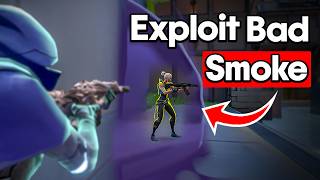

Why Smurfs Always Win?
42sOpens with a relatable pain point for Valorant players, immediately hooking viewers who struggle against smurfs.
▶ Play Clip"Delivers on the promise with five concrete peeking techniques, though some filler and sponsor segment slightly dilute the value."
This video by Kompeki presents five peeking techniques in Valorant designed to exploit common bad habits of opponents, such as lazy smokes, overstaying in smokes, poor peeking fundamentals, passive angle holding, and hesitation. The techniques are aimed at improving gameplay and winning more fights.
Peek from the sides of a smoke, pre-aiming where enemies might be, and swing out using A or D keys with your back to the wall to reduce flicks and maintain speed.
Understand who might be inside the smoke, communicate with teammates to peek together, or use utility to take space. If alone, spam bullets, reposition, and enter from a different spot to exploit sound dependency.
Always peek perpendicular to the enemy to move fastest across their screen, be aware of your player model to avoid showing pixels, and keep mental notes of map geometry to avoid obstacles.
Use shoulder peeks to bait out shots without committing, and jiggle peeks to gather info, bait shots, or delay enemies. Master the dead zone technique for accurate shots during direction changes.
Practice jump spots in custom games, enter smokes with chosen techniques, and improve jiggle peeks in deathmatch. Also, control breathing: deep breath before fights, exhale before peeking, and hold breath during the peek to reduce stress.
Mastering these peeking techniques and maintaining calm breathing can significantly improve your ability to exploit opponent habits and win more fights in Valorant.
What is the recommended way to peek out of a smoke?
Peek from the sides, pre-aim, and swing with A/D keys with your back to the wall.
00:02
What is the dead zone technique?
Taking the split-second window when changing direction of movement keys to fire an accurate shot.
09:10
What is the purpose of a shoulder peek?
To bait out a shot without committing, especially against operators.
07:28
How can you enter a smoke when alone without utility?
Spam a few bullets, reposition, and enter from a different spot to exploit sound dependency.
03:45
What is the recommended breathing technique before a peek?
Take a deep breath before the fight, exhale before peeking, and hold breath until after the peek.
11:33
Exploiting Lazy Smokes
Provides a concrete technique to counter a common mistake, improving space control.
00:02Entering Smokes Alone
Offers a practical solution for a worst-case scenario, showing high-level adaptability.
03:45Peeking Fundamentals
Emphasizes core principles that many players overlook, foundational for improvement.
05:18Dead Zone Technique
Explains a precise mechanic that can turn fights, valuable for advanced players.
09:10Breathing Control
Highlights a psychological aspect that can drastically affect performance in clutches.
11:20[00:02] Elo that they're in? You try to make the right plays, have calm aim, and communicate to your teammates. No matter what you do, the Smurfs always seem to have your number. This is because they're taking advantage
[00:17] of habits that most players don't even realize that they have. Maybe someone trusts a smoke too much, or maybe they sit inside for too long, or maybe they hold angles the same way every round, or never fully learn the fundamentals of
[00:30] peeking. Smurfs see these habits immediately and know exactly how to Hey guys, it's Kompeki and I have five specific peeking techniques that I've learned through thousands of hours of gameplay and coaching in Immortal and
[00:43] Radiant that anyone can use to start exploiting these bad habits in their own games. So, let's get right into it. The first bad habit we're going to exploit is people throwing lazy smokes and assuming that they've completely stopped
[00:56] you from taking space. It's easy to call your team to rotate to another site when you're unsure of who or what can be lurking on the other side of that smoke. But never fear, you can actually get out of a smoke without even needing a
[01:10] peeking out of a smoke, you want to peek from the sides to ensure that as many angles are isolated within your field of view as possible. Go to the edge of a smoke, pre-aim where you think an enemy
[01:22] will be, and swing out using the A or D key with your back facing the wall. This reduces the need for flicks and maintains your speed of exiting the smoke. You're essentially using the bad smoke itself as cover, which makes you
[01:35] way harder [music] for enemies to trade you. And not needing to rely on anyone is great, but first we need to know how to get into the smoke in the first place. But before we touch on that, if you want to become an indestructible,
[01:47] self-sufficient gamer, my team of Radiant and VCT coaches can give you the tools you need to go from the bottom of the leaderboard to the the in no time. We can help you gain 500 RR in 10 weeks or less, and if not, we'll give you a
[02:01] full refund. So, check out the link in the description below to book a free call with me or one of our coaches to see if we'd be a good fit. Now, back to smokes. Playing inside of a smoke can feel comfy and safe, and that's exactly
[02:14] the next bad habit that we're going to exploit. A lot of players get inside a smoke and overstay because they feel safe. So, for our second tip, we need to know how to peek into smokes. This is crucial to stopping your team from
[02:27] stalling out in a round, no matter what role you play. So, let's use this retake situation on Breeze as an example. When retaking on A, we must enter the smoke to have a chance at winning the round. And the number one most important thing
[02:39] here is understanding who could be playing inside the smoke first. If your comfortably inside the smoke, they're that's exactly what we're looking to punish. So, the first best option here
[02:53] You can communicate your intention clearly and peek together, which will the smoke. And you don't need to make it complicated. If you see someone close to a smoke, just go to the other side of it and ask whether they're ready. But since
[03:08] ranked is a coin flip most of the time, there's a very high chance your teammate is just likely to run into the smoke by themselves. So, in this case, you'll running in first and follow right after them so that you can trade. And that's
[03:21] why being able to read your teammate's body language is the key factor in being able to time your trade. However, there are also times when no one's brave enough to step into the smoke first. So, in order to avoid getting stalled and
[03:33] wasting extra time, you can use a piece of util, either from yourself or a teammate, to also take that space. However, if we're in the worst-case scenario where we don't have a teammate or we don't have any utility, there's
[03:45] still a way that high-level players know how to use to pressure someone that's actually really straightforward. Just spam a few bullets first, then reposition away from where you shot to avoid the counter spam, and quickly
[04:00] enter the smoke from a different spot. Players sitting inside smokes have to rely heavily on sound cues. So, by changing where you enter from, you're exploiting that dependency and forcing them to guess. You make it way harder
[04:13] smoke, which gives you a window to kill them before they can adjust their spray. And this technique can also be used to try and beat them into actually peeking you, which is just another free kill. So, instead of trying to enter after
[04:26] spamming the smoke, you can even just hold the edge of the smoke after you reposition to see if enemies will actually peek out of the smoke. And lastly, pros and high-ranked players often take matters into their own hands
[04:38] by peeking into a smoke sideways. This who've settled into a comfortable position inside the smoke and are waiting for a predictable peek. Make sure as if you're swinging a normal
[04:51] angle and step in using only your A or D keys. You'll have to be prepared to make a 90° flick in order to take down your opponent, but this technique will avoid your gun barrel poking into the smoke first, and this allows all of your body
[05:05] to appear at once, which reduces an enemy's time to react to your peek. Next up, the third bad habit we're going to learn how to exploit is poor peeking fundamentals. A surprising number of players never fully master the basics of
[05:18] peeking. So, for our third tip, let's briefly lay out the basics of what makes a peek successful. The first principle is to always peek perpendicular to your will allow you to move at the fastest speed across their screen. Players with
[05:32] weak mechanics struggle to track this movement properly, which makes your peeks much harder to hit. You also need to be aware of your player model. Accidentally showing a pixel of your shoulder or your gun barrel, especially
[05:44] when you're trying to slowly slice the pie, will indicate to your opponent that you're about to swing, and this will always lead you to dying faster. And to make sure that we're always peeking perpendicularly using the T rule, you
[05:56] also need to keep a mental note of map geometry and how it affects your peaks along with your aim. For example, if you're standing too far back and you're trying to peek perpendicularly, you might accidentally bump into a wall. Or
[06:08] accidentally hit a small ledge that throws off your momentum. So to avoid this, you have to work on knowing what the map looks like without having to Think of it like sitting down at your desk. You don't always need to look
[06:21] Valorant, knowing how you can move without needing to look away from the action is crucial. And remember that even though these are the basic fundamentals, situations may occur where not all of tips apply. Your situation
[06:34] and how you peek will change depending on lots of different factors, which is why we need to take a look at some of the different ways to adjust our swings to make us less predictable. This brings us to the fourth bad habit we're going
[06:46] to exploit, and that's passive angle holding. A lot of players get waiting for you to walk into their crosshair, which is exactly why for our fourth tip, we'll go over how the best players use these techniques to set up
[07:00] their fights against angles that are difficult to peek. We probably know what a jiggle peek is and often confuse it with a shoulder peek, but both of these scenarios. Jiggle peeks are like throwing a fake in a boxing match. It's
[07:14] opponent's guard or their footwork. And jiggle peeks can often be a little more complicated and risky compared to its brother, the shoulder peek. A shoulder information without throwing away your life pointlessly. You often use this
[07:28] type of peek when facing operators. To do this, you need to walk up to a wall player model. You can practice this in a custom with a friend, and you can usually tell if you're peeking out too far if you see the enemy on your
[07:41] mini-map afterward. You don't need to have full vision on an enemy to bait out the shot. You just need to get them to fire, so they'll be stuck dealing with their weapon's reset animation to fire before you swing. The exceptions to this
[07:53] situation would be Chamber's alt and his Headhunter, or a duelist that can use an ability to get away quickly. Now that we know how to use the shoulder peek, let's take a look at the other type of peaking mechanic, the jiggle peek. You want to
[08:05] your crosshair, use your utility, or gather information. This also includes jump peeks or jump spots. Both of these are crucial peaking mechanics every Valorant player must learn, and it's really simple. You're jiggling an angle
[08:19] in order to just see. That's it. You should be doing this mainly if you're concerned about multiple people holding you, or when you're the only one on site and you're playing from a safer spot, so that way you can check to see if
[08:31] someone's about to sneak up on you. This is often done with the use of your knife out, so that you can duck into cover quickly, as this is often safer. From there, you can decide whether or not to use util, pre-fire, or just reposition.
[08:44] And the other option is the pre-fire jiggle. This is used when you know that an enemy often plays or peeks in a specific spot, which is known as a common angle. If you're already in a 1v1 and they've tucked themselves into a
[08:57] crosshair, and you just tap them before they're able to react. To do this, you need to master the dead zone technique, which is essentially just taking the split-second window when changing the direction of your movement keys to fire
[09:10] an accurate shot. Now, a jiggle peek can also be used to bait out a shot and then follow it up with a swing. For example, your opponent's holding you and they're their screen change. You can take advantage of this by jiggling to draw
[09:23] their crosshair closer to the angle without taking any damage. This is done to capitalize off of the reset period of your opponent's weapon, and to get info to get a better pre-aim. This is really good in 1v1 situations and especially
[09:36] ideal when an [music] enemy is stuck close to you. This pressure will force the reflex to react, making their crosshair hug the corner. And from here, you follow it up with a wide swing, which will force them to make a larger
[09:48] adjustment. What most people don't know is that a jiggle peak is also a form of delay. If an enemy is pushing you, you can jiggle to make them stop and be ready for a fight. You can also use this if an enemy is crossing open space. This
[10:01] is absolutely huge for keeping an enemy stuck in place long enough for another teammate to join you in the fight. We're only talking seconds here, but if used helping out your trades. If you can master all these peaks, you'll be able
[10:15] to create space and opportunities in the absence of utility. These techniques can give you advantages in fights that you would usually lose otherwise. All of the tips I've shown you today are going to require some practice, but here's a few
[10:27] start implementing them. First off, go into a custom game to practice your jump spots. Find literally any cover and make a point on a wall behind it. And use your WASD keys to create a circular motion while jumping. And practice this
[10:41] until you can touch that point with the corner itself. This is how you know you can accurately jump spot without going too wide or too shallow. Next up, when it comes to entering smokes, you're unfortunately stuck with just trying the
[10:53] to have a friend. Next time you see a smoke and you know you have to push it, pick a technique I've given you and just try it. And lastly, to improve your jiggle peaks, work on your A and D strafe in a deathmatch to find the right
[11:06] use cases. And now, apart from all these tips, there's one last thing you can do right away that'll help your peaks. The last bad habit isn't your opponent's, but it's your own. To exploit the hesitation from other players, you need
[11:20] to make sure you're the calmer player in the fight. The way you breathe when you're taking fights or about to peak can actually have a huge impact on your tension and stress. Generally, I'd recommend taking a deep breath before a
[11:33] fight and exhaling before you peek and then holding your breath until after the peek. For me, this feels like the most stable method, but everyone's different and this is a very, very subconscious skill that's hard to work on clearly.
[11:46] But even for newer players, by far the most important thing is that you games. A friend once told me that you found out he wasn't actually breathing [music] enough during clutches and tense situations and once he realized and
[11:59] started taking deep breaths in a clutch, everything easier. And when I tried it out, it totally changed the way I played out clutches, too. The stress just went away and I wasn't panicking and it allowed me to take my time and think
[12:11] more clearly to play out the clutch. So, I have one final tip for you. Next time even breathing properly? Please let me know your results down in the comments and that's it for this video. Thanks for watching.
⚡ Saved you 0h 12m reading this? Transcribe any YouTube video for free — no signup needed.