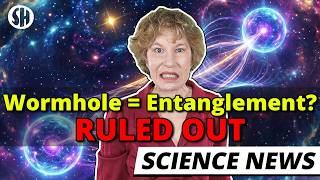

Wormholes in Physics: Debunked?
45sThe hook immediately challenges a popular physics idea, sparking curiosity and debate.
▶ Play Clip"Title is somewhat sensational but the video delivers a clear explanation of the ruling out, though it includes a sponsor segment."
The video discusses the recent ruling out of the ER=EPR conjecture, which proposed that entangled particles are physically connected by wormholes. The host explains the conjecture, its origins, and a new paper that tests it by examining the electric field of a hydrogen atom, finding no measurable difference between entangled and non-entangled states. The host concludes that while the idea may be useful as a mathematical metaphor, it lacks experimental support as a physical wormhole.
The idea that entangled particles are physically linked by wormholes (ER=EPR) has been ruled out by a new paper. The conjecture was proposed by Juan Maldacena and Leonard Susskind in 2013.
Entanglement is a correlation between observable properties, not a physical connection. Example: identical twins share eye color, but knowing one's eye color doesn't mean they are physically connected.
The authors ask if an electron entangled with something else has a wormhole, then part of its electric field should go into the wormhole. They test this with a hydrogen atom, where electron and proton spins are entangled.
By poking the hydrogen atom with an electromagnetic field, they break the entanglement. If wormholes existed, the charge distribution and energy levels would differ between entangled and non-entangled states. They found no difference, matching standard quantum maths.
The paper doesn't entirely rule out ER=EPR; it only constrains the parameter for how much electromagnetic field goes through the wormhole to be very small. The host gives the paper 3/10 on the [__] meter because the idea itself was already [__].
ER=EPR may be useful as a mathematical metaphor or grand vocabulary, but as a physical wormhole, it has no experimental visibility. The host appreciates that some people still treat foundations of physics as science.
The ER=EPR conjecture, while intriguing, lacks experimental support as a physical wormhole. The new paper's test on hydrogen atoms shows no measurable effect, suggesting that if wormholes exist, they carry negligible electromagnetic field. The idea remains a mathematical metaphor rather than a physical reality.
What does ER=EPR stand for?
Einstein-Rosen bridges (wormholes) = Einstein-Podolsky-Rosen (entanglement).
Who proposed the ER=EPR conjecture?
Juan Maldacena and Leonard Susskind in 2013.
00:30
What is entanglement?
A correlation between observable properties, not a physical link.
01:09
What did the new paper test?
Whether a hydrogen atom's electron-proton entanglement would cause part of the electric field to go through a wormhole, affecting energy levels.
02:19
What was the result of the test?
No measurable difference in energy levels between entangled and non-entangled states, matching standard quantum maths.
03:55
Does the paper completely rule out ER=EPR?
No, it only constrains the parameter for electromagnetic field through the wormhole to be very small.
04:07
ER=EPR Ruled Out
The video announces a significant development in theoretical physics, capturing attention.
Entanglement is Correlation
Clarifies a common misconception about entanglement, providing a clear analogy.
01:09Hydrogen Atom Test
Describes a concrete experimental test of a theoretical idea, showing how physics is done.
02:19No Difference Found
The null result is a key finding that challenges the physical interpretation of ER=EPR.
03:55ER=EPR as Metaphor
Summarizes the takeaway that the idea may be useful mathematically but not physically.
05:15[00:00] One of the most popular, if not the most popular, recent ideas on the foundations of physics was just ruled out. It's the idea that entangled particles are actually physically linked by wormholes known as ER equals EPR. Let's have a look. ER stands for Einstein Rosen bridges, which
[00:18] is the technical term for the simplest type of wormhole. EPR stands for Einstein, Podolski, and Rosen who wrote one of the first papers on quantum entanglement though at the time it wasn't called
[00:30] entanglement. The conjecture says that entangled particles are connected by these wormholes. This idea was proposed by Juan Maldacena and Leonard Suskind in 2013. And it's since become one of
[00:43] those phrases that theoretical physicists like because it's vague and sounds deep, but is hard to check. If you remember the infamous episode of a wormhole on a quantum computer, yeah, that was
[00:57] brought to you by ER equals EPR. The wormholes on the quantum computer were supposedly the entangled particles plus some higher dimensional blah blah. But let's not get distracted. The idea
[01:09] that entangled particles are physically linked by wormholes or anything is of course nonsense because entangled particles are not linked. Entanglement is a sort of correlation. It implies
[01:23] no physical link whatsoever. A correlation just means that some observable properties are related. Identical twins, for example, share the same eye color. If you know they're identical twins and you
[01:36] know the eye color of one of them, you know the eye color of the other. That's what it means for properties to be correlated. Knowing the one will tell you something about the other. It doesn't mean they're physically connected. Entanglement is like that. You can of course say, "Ah, look, we
[01:53] just take the mathematics for the entanglement and call that a wormhole." Okay, I admit this isn't wrong. It's just meaningless. I could also call my hair a non-perturbative field configuration,
[02:07] but it still wouldn't converge. If you want the ER equals EPR conjecture to be physically meaningful, then well, you actually need some kind of wormhole there. If entangled particles are really connected
[02:19] by wormholes, then those wormholes should do something more than looking profound on a seminar slide. The authors of the new paper now ask a simple question. Suppose an electron is entangled
[02:32] with something else. If that entanglement is a physical wormhole and the electron has an electric field, then some of the electric field must go into the wormhole. Can we not measure this? At first, the answer to this question seems to be no. Because whatever the wormhole, it's ridiculously
[02:50] tiny. Otherwise, we'd see particles disappear and reappear like popping in and out through portals. But the authors look at a case that we've measured very very precisely. A hydrogen atom. A hydrogen
[03:03] atom consists of just one proton in the atomic nucleus surrounded by one electron. They both have a spin and usually the electron and the proton spin are entangled. The authors now
[03:15] say that if the entanglement is a wormhole, then part of the electric field that spans between the electron and proton goes through the wormhole. that in and of itself is unobservable.
[03:27] However, if you poke a hydrogen atom with an electromagnetic field at the right frequency, you can break this entanglement and create an electron proton pair that is not entangled. The author's point is then that these two states are now different. The one has a wormhole, the
[03:43] other not. And this makes a relative difference for the charge distribution in the hydrogen, which then makes a measurable difference for the energy levels of the electron. And this difference
[03:55] well isn't there. The electron energy levels of the two states entangled and not entangled are perfectly described by the standard quantum maths without the wormholes. Of course, this doesn't
[04:07] entirely rule out the idea. Strictly speaking, it just means that if there are wormholes, then very little of the electromagnetic field goes through them. So they say there's some
[04:19] parameter that must be very small. This is why I have to give the paper three out of 10 on the [ __ ] meter. But that isn't because of the paper. It's because the idea itself was already [ __ ]
[04:31] So of course, you can't rule it out. Now look, the people who work on this will say, "But this is not what we mean by ER equals EPR. It's not a real wormhole. It's just a way to think about the maths." In which case, you know, maybe you should stop calling it wormholes.
[04:49] It's quite easy to predict that this paper will not make a difference and physicists will happily continue publishing about this because it really doesn't matter at this point whether it's got any
[05:01] relation to reality. Still, I wanted to tell you about this paper because it's good to see that at least some people still treat the foundations of physics as the science it once was. In summary,
[05:15] ER equals EPR may be useful as mathematics metaphor or grand writing vocabulary, but as a physical wormhole, it appears to have the experimental visibility of my patients. I do a lot
[05:31] of online research and I hate the idea that third parties are tracking what I read, what videos I watch, and what I search for. There's also always the risk I click on the wrong thing and catch some
[05:45] malware. This is why I'm using NodeVPN, who've been sponsoring this video. NodeVPN is an app that makes your internet connection ultra secure. You install it on your phone or laptop and use it
[05:57] to create a safe connection. But it's not just that. NodeVPN is constantly improving their service and they're taking online safety to a new level with their next-gen antivirus.
[06:09] It doesn't only scan for viruses and malware. It also warns you of scams and fishing attempts, all with 24/7 customer service. NodeVPN doesn't just protect your privacy.
[06:21] It also makes your life easier. You see, NodeVPN has thousands of servers all over the world, and you can choose one. This allows you to access websites in other countries by using a server located there. I find this especially convenient to get around all the blockages on US pages for
[06:38] visitors from the European Union. NordVPN is a high quality product that I'm happy to recommend. If you want to try it out yourself, use my link nordvpn.com/sabine or the coupon code Sabine
[06:53] for our special offer. Thanks for watching. See you tomorrow.


⚡ Saved you 0h 07m reading this? Transcribe any YouTube video for free — no signup needed.