[00:00]
String theory has finally made a testable prediction. I read this in The Economist this week. New theories and experiments should shine light on string theory. And proponents claim that
[00:14]
string theories made a testable prediction. And not just this, it's something to do with dark dimensions, which I swear is not a joke about the present state of academia. It's instead
[00:26]
an attempt to use string theory to explain dark matter and dark energy. And that would of course be very very interesting. So let's have a look. String theory was supposed to be the theory of
[00:38]
everything that explain why the particles of the standard model are what they are and how they interact with gravity. Unfortunately turned out that there's not just one string theory but an enormous number of them. An estimated 10^500 or so. This is called the string theory landscape.
[00:56]
And in this landscape, no one's yet found even one string theory that's compatible with the standard model of particle physics. Nevertheless, string theorists are convinced they're on
[01:08]
the right track. And in the past decade, they've tried to make their case in a new way. In 2018, some string theorists argue that in string theory, dark energy could not be constant, but it would
[01:21]
have to depend on time. And would you know it, in the past 2 years, we've indeed seen evidence that dark energy does depend on time. This is very intriguing indeed, isn't it? Naturally, the group
[01:34]
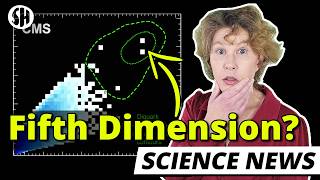
at Harvard around Cumrun Vafa which put forward the idea tried to get more out of this. For this, they looked at the additional dimensions of space that string theory requires. In total,
[01:46]
there are six additional dimensions. Usually, string theorists assume that they're way too small to be measurable. They're rolled up to extremely tiny radius and we just can't measure such a tiny
[01:58]
radius. This is why string theory is so difficult to test. But this group says look if one of those dimensions is small but not super small somewhere on the scale of a micrometer then that could also
[02:12]
explain dark matter. This is because if there is such an extra dimension then gravity knows of it. The particles of the standard model electrons and quarks and so on they sit on a slice with
[02:24]
three dimensions of space. This is our universe. But gravity goes into all dimensions. And since this is a theory of quantum gravity, gravity has quanta. These are the gravitons. And the
[02:36]
gravitons that go into the extra dimensions, they become massive. And that the string theorists say is what dark matter is made of. These massive gravitons in the extra dimensions. Concretely,
[02:48]
they say that if one of the extra dimensions has a radius in the range of some micrometers, then this fit to the observations of dark matter. This is why they called it a dark dimension. And
[03:00]
yes, that can be tested directly. This is because Newton's law depends on the number of dimensions. The 1/rˆ2 are actually only true in three dimensions of space. If you could measure Newton's
[03:12]
law in distances so small that they're below the radius of the extra dimension, then you could see deviations from Newton's law. This has been tested down to about 30 micrometers and no deviations
[03:25]
from Newton's law have been seen. The dark dimensions proposal puts the deviation at about 10 micrometers. That's why they say string theory is now testable. New is just recently that just in July an astrophysicist turned to cosmological data to see whether the dark dimension idea could
[03:43]
be tested with data from the plank satellite and some earthbased telescopes. The answer is no at present. But she writes that future surveys could quote confirm or rule out string theory models of
[03:57]
the dark sector. What are we to make of this? Well, if you read my book, "Lost in Math", that should sound very familiar. In the foundations of physics, ideas are always intriguingly testable
[04:12]
with an experiment that'll be done in the near future. Then the experiment is done and it doesn't find any evidence of whatever they predicted. Then they throw out the idea and try to fool
[04:24]
you with the next one and you'll read about it in the economist. It's a solid 10 out of 10 on the [ __ ] meter. If we had evidence for an extra dimension of space and well that would be evidence
[04:37]
for an extra dimension of space. You don't also need strings for this. And the idea isn't derived from string theory either. It's just conjectured into place. So why am I telling you about this?
[04:50]
It's to remind you that there are people who call themselves scientists at top universities who get paid for this nonsense and that this continues to go on and that it gets reported in the media. I
[05:04]
don't talk about it a lot because it's terribly boring, but it's institutionalized pseudocience and that's the real story that the economist should be writing about. If future experiments
[05:17]
find nothing at 10 micrometers, I confidently predict that string theory will remain testable at an even more exciting distance. I have two children in school and I have opinions about
[05:30]
their maths and science education. In my opinion, it could be better. Luckily, today's sponsor, Brilliant, helps my kids to get ready for the future, and they can help yours, too.
[05:42]
Brilliant is an online learning platform with a large number of courses on mathematics, science, and coding. They just recently introduced a new AI tutor that'll walk children through the problem
[05:54]
sets, not by giving away the answers, but by helping them when they're stuck, reminding them of what they already know, and explaining each step. I really think this is the future of education. My
[06:06]
children especially like it that Brilliant doesn't tie them to a specific topic, but that they're free to explore whatever piques their curiosity. And of course, I have a special offer. You can get
[06:18]
started with Brilliant Tutor for free. And if you use my link, brilliant.org/Sabine or scan the QR code, you can save 20% on an annual subscription. Thanks for watching. See you tomorrow.