
Why Sailing Straight Downwind is a Trap
40sChallenges common intuition with a clear demonstration, making viewers question what they thought they knew.
▶ Play Clip"Delivers exactly what the title promises — a clear, concise explanation of sailing physics without fluff."
This video explains the fundamental physics behind how sailboats can travel in directions other than straight downwind, using a simple toy boat demonstration and clear diagrams. It breaks down the forces of lift, the role of the boat's underwater shape, and the optimal sail angle for efficient travel.
A sail positioned perpendicular to the boat's travel direction, with the wind blowing directly from behind, pushes the boat forward. This is the simplest but least useful configuration.
Turning the boat to travel in a different direction while keeping the sail perpendicular is flawed; the more you turn, the less effective the wind becomes. At 90 degrees (perpendicular), the wind only pushes the boat sideways.
Angling the sail at about 45 degrees allows the boat to move in the desired direction even when traveling perpendicular to the wind.
The sail deflects air, changing its direction. This change in direction means a force is applied to the air, and by Newton's third law, an equal and opposite force (called lift) acts on the sail and boat. This is the same lift generated by airplane wings, but in the horizontal plane.
The boat's underwater shape is long and thin, creating high resistance to sideways motion but low resistance to forward/backward motion. This allows the lift force to be broken into components, with the sideways component canceled out and the forward component propelling the boat.
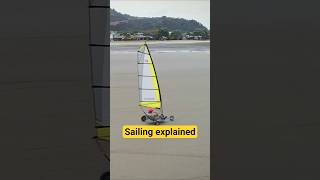
Finding the optimum sail angle is a key skill for sailors. The same principle applies to land yachting, where wheels provide resistance to sideways motion but allow forward movement.
The video effectively demystifies how sailboats can sail into the wind by explaining the physics of lift and the importance of the hull's shape. The key takeaway is that the optimal sail angle and the boat's design work together to convert wind force into forward motion, a principle that also applies to land sailing.
What is the optimal sail angle for traveling perpendicular to the wind?
About 45 degrees.
00:56
What force is generated by the sail when it deflects air?
Lift, the same force generated by an airplane wing, but in the horizontal plane.
01:36
Why doesn't the boat move sideways when the lift force has a sideways component?
Because the boat's underwater shape is long and thin, creating high resistance to sideways motion.
01:48
What principle explains the equal and opposite force on the sail?
Newton's third law: every action has an equal and opposite reaction.
01:20
What is the effect of the Coanda effect on the sail?
It deflects air on the far side of the sail as well, contributing to the change in air direction.
01:08
Lift in the Horizontal Plane
Clarifies that the same lift force used in aviation applies to sailing, making the physics more intuitive.
01:36Hull Shape and Resistance
Explains the critical role of the boat's underwater design in enabling forward motion against the wind.
01:48Optimal Sail Angle as a Skill
Highlights that finding the best sail angle is a practical skill, not just theoretical physics.
02:38[00:01] может работать парусный спорт. Я расположил этот парус так, чтобы он был перпендикулярен направлению движения лодки и обращен ко мне. В этой ситуации я — ветер . Таким образом, когда я дую, ветер толкает парус, и это толкает
[00:16] лодку вперед. Данная конфигурация паруса и лодки не представляет особой необходимости. Как часто бывает, что место, куда ты хочешь попасть, совпадает с ? А что, если бы вы захотели двигаться в этом направлении относительно ветра? На самом деле
[00:30] лодку в нужном направлении, сохраняя при этом положение паруса, но это, по сути, ошибочный подход. Чем сильнее вы поворачиваете лодку, тем хуже она работает. Рассмотрим крайний случай, когда необходимо
[00:43] двигаться перпендикулярно ветру. Ветер вообще не движет лодку вперед . Оно просто пытается его опрокинуть. Вместо этого в данном случае следует наклонить парус примерно на 45°. Вот и все , мы почти можем направить лодку
[00:56] . Вот упрощенная схема парусной лодки. Таким образом, парус отклоняет воздух вот так. На самом деле, это также отклоняет поток воздуха с противоположной стороны паруса из-за эффекта Коанда, о котором мы здесь подробно рассказывать не будем, но суть в том, что
[01:10] завершения взаимодействия с тогда, когда испытывает силу. Если это исходное направление, а это новое направление, то сила должна быть направлена в этом направлении. Итак, эта сила
[01:24] исходит от паруса. Парус направляет ветер в новое русло. Каждое действие вызывает равное и противоположное противодействие. Таким образом, на парус также действует сила, направленная в противоположную сторону. И, конечно же, это оказывает давление на всю лодку.
[01:38] той же самой, что создаёт крыло самолёта, но здесь подъемная сила возникает в горизонтальной плоскости. Это довольно запутанное слово, но смысл один и тот же . Так почему же лодка не движется в этом направлении? Это происходит из-за
[01:51] формы лодки под водой. Подводная часть лодки длинная и узкая. И посмотрите, когда я опускаю руку в воду, мне трудно двигать ею из сопротивление, и мне легче двигать рукой вперед и
[02:05] назад, потому что в этом направлении сопротивление меньше. То же самое относится и к лодкам. Сопротивление боковому движению не является абсолютным. И на самом деле, в случае с нашей игрушечной лодкой, наблюдается довольно сильное боковое движение, потому что форма
[02:18] лодки под водой не очень длинная и узкая. Но для настоящих парусных лодок это нулю. Таким образом, мы можем взять этот вектор силы и разложить его на компоненты в этом направлении сопротивление воды не оказывает никакого влияния , однако
[02:32] в этом направлении присутствует некоторая составляющая. Поэтому мы ожидаем, что лодка будет двигаться в этом направлении. Таким образом, на практике существует оптимальный угол наклона паруса. И, собственно, это часть мастерства хорошего моряка.
[02:44] Кстати, вы находитесь точно так же, как и на суше. Наземный яхтинг, или парусный спорт на песке, или сухопутное парусное плавание — это вид спорта, при котором используются колёса на суше. Колеса оказывают сопротивление при движении вбок, but reduce resistance in the backwards and forwards motion.
⚡ Saved you 0h 02m reading this? Transcribe any YouTube video for free — no signup needed.