
The #1 Longevity Secret (It's Not What You Think)
45sOpens with a bold claim and immediately reveals a shocking statistic (300% higher mortality risk for least fit) that grabs attention.
▶ Play Clip"Delivers solid research-backed exercise insights, but the personal results and community plug at the end feel like a soft sell."
This video presents research-backed insights into exercise as the most powerful longevity intervention, covering the relationship between fitness and mortality, the benefits of combining cardiovascular and resistance training, and specific exercise volume recommendations.
Physical fitness is the single biggest predictor of life expectancy and health span, with progressive benefits for mortality risk even at very high fitness levels.
The least fit individuals have roughly 300% higher mortality risk compared to the extremely fit.
Exercise physiologically improves all organ function, reduces risk of virtually all chronic diseases, and improves virtually all biomarkers.
Cardiovascular fitness is more strongly associated with lower mortality than muscle strength, but combining both is better than either alone.
Vigorous exercise benefits peak at 150 minutes per week, while moderate exercise benefits extend up to 900 minutes per week.
HIIT is more effective for raising HRV, aerobic exercise improves cardiometabolic risk factors more, and both are better for reducing visceral fat than resistance training.
Increase aerobic fitness and VO2 max, increase muscle strength and power, incorporate balance and mobility, aim for 150 minutes vigorous exercise weekly, do up to 900 minutes moderate exercise, and allow ample recovery.
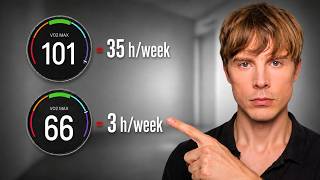
The speaker increased VO2 max from 53 to 66, reduced visceral fat from 359g to 54g, and reached top 1% health across 100 biomarkers.
Exercise is the most powerful longevity intervention, with clear benefits for mortality risk and aging. Following the outlined principles—combining cardio and resistance, meeting volume targets, and allowing recovery—can significantly improve health outcomes.
Fitness as top predictor
Establishes exercise as the most powerful longevity intervention with a clear, evidence-based claim.
300% mortality risk difference
Quantifies the dramatic impact of fitness on mortality, making the stakes concrete.
00:13Combine cardio and resistance
Provides actionable guidance that both exercise types are necessary for optimal longevity.
00:41Exercise volume thresholds
Gives specific weekly minute targets for vigorous and moderate exercise, useful for planning.
00:54Personal health transformation
Demonstrates real-world application and results, adding credibility to the advice.
01:54[00:00] Exercise is the most powerful longevity intervention out there. Here are some research-backed insights into exercising for a healthier and longer life. 1. Physical fitness is the single biggest predictor of life expectancy and health span.
[00:13] Higher fitness shows progressive benefits for mortality risk, with little to no added risk observed even at very high fitness levels. Extremely fit individuals have a lower mortality risk, even compared to people who already have high fitness. The least fit have a roughly 300% higher mortality risk than the extremely fit.
[00:29] 2. Exercise targets all the hallmarks of aging. Exercise physiologically improves all organ function, reduces the risk of virtually all chronic diseases, and improves virtually all biomarkers. 3. You should do both cardiovascular
[00:41] exercise and resistance training. Head-to-head cardiovascular fitness is more strongly associated with lower mortality than muscle strength, but both combined is better than one alone. Resistance training increases muscle mass and strength, whereas cardiovascular fitness
[00:54] increases your VO2 max. The combination of the two is superior to one or the other alone. Number four exercising more than the guidelines suggests is associated with even lower mortality The benefits of vigorous exercise over 60 of max heart rate peak at about 150 minutes per week But for moderate exercise 40 max heart rate
[01:12] the benefits extend up to 900 minutes per week. Next, aerobic exercise has a few advantages over resistance training. 1. High-intensity interval training is more effective in raising HRV than resistance training. 2. Aerobic exercise improves cardiometabolic risk factors more than resistance
[01:27] training. And number three, aerobic exercise and high-intensity interval training are more effective in reducing visceral fat than resistance training. Here are the main takeaways. Number one, increase aerobic fitness and VO2 max. Number two, increase muscle strength and muscle power. Number three,
[01:40] incorporate balance and mobility. Number four, aim for 150 minutes per week of vigorous exercise. Number five, do as much moderate exercise as you have time for, up to 900 minutes per week. And six, allow ample time for rest, relaxation, and recovery. By following some of these principles,
[01:54] I've managed to increase my VO2max from 53 to 66, reduce my visceral fat from 359 grams to 54 grams, and reach top 1% health across 100 biomarkers. But it's not just me. If you want to get similar
[02:06] results as other people like this, then join my top 1% health community, linked down below.
⚡ Saved you 0h 02m reading this? Transcribe any YouTube video for free — no signup needed.