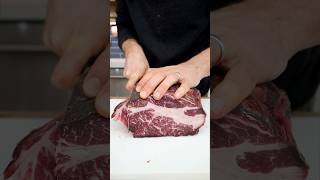

Turning Cheap Chuck into Steak?
46sThe premise of transforming a cheap cut into a premium steak is intriguing and challenges common beliefs.
▶ Play Clip"Delivers a clear, honest answer to the title's question with a real experiment, though the conclusion is somewhat predictable."
This video tests whether dry-aging a budget-friendly chuck steak is worth the effort. The creator dry-ages a chuck steak for 45 days, then compares it side-by-side with a fresh chuck steak from the same butcher, cooked identically, to evaluate differences in flavor, texture, and overall value.
The creator selects a chuck steak from the shoulder of the cow, noting it's much cheaper than ribeye or New York strip, making it a candidate for dry-aging to improve tenderness and flavor.
The steak is placed on a rack for airflow and put into a retrofitted dry-aging cooler, then left for 45 days.
After 45 days, the steak shows a dried-out pellicle (crust) which is sliced off, revealing beautifully marbled dry-aged meat that is then cut into individual steaks.
To compare, a fresh chuck steak is bought from the same butcher, and both steaks are seasoned with salt and pepper and cooked exactly the same way on the grill.
The fresh (control) steak is cooked to perfect medium rare and is described as 'still pretty underrated'.
The dry-aged steak is noticeably drier due to water loss during aging, cooks faster, and has a completely different flavor profile, with the taster exclaiming 'Wow, that has some way more flavor.'
The dry-aged steak is not necessarily more tender; it's slightly more well done, which doesn't help the comparison. The creator notes that from a previous experiment, dry-aging expensive cuts isn't worth it due to outer skin loss.
Given that chuck is half the price of ribeye or New York strip, the creator concludes that dry-aging chuck is worth it, with the taster agreeing: 'I would say that's worth dry-aging.'
Dry-aging a budget-friendly chuck steak is worth it, delivering a significant flavor boost without the high cost of aging premium cuts.
What cut of beef is used in the dry-aging experiment?
Chuck steak, from the shoulder of the cow.
00:01
How long is the steak dry-aged?
45 days.
00:27
What is the dried-out outer layer of a dry-aged steak called?
Pellicle (or crust).
00:39
Why is chuck steak considered a good candidate for dry-aging?
It's much cheaper than ribeye or New York strip (half the price), so the loss from trimming the pellicle is less costly.
01:45
What was the main difference in texture between the dry-aged and fresh chuck steak?
The dry-aged steak was drier due to water loss, and it cooked faster.
01:20
Flavor Enhancement
Demonstrates that dry-aging significantly intensifies flavor, a key benefit of the process.
01:20Cost-Effectiveness
Highlights that dry-aging is more worthwhile on cheaper cuts, a practical takeaway for home cooks.
01:45[00:01] cut of beef, and I want to see if I can turn it into a tender steak through the dry-aging process. So, I went to the butcher and picked up a nice piece of price of ribeye because it comes from the shoulder of the cow, making it
[00:14] cooking. But, it still can work well as intermuscular marbling. So, I'm simply going to place it on a rack for some airflow and put it in my retrofitted dry-aging cooler and set it and forget
[00:27] it. And about 45 days later, this is what I've got. Not a crazy long dry-aging process, but it still should dramatically alter the flavor and texture of the steak. I sliced off that dried-out pellicle or crust, which
[00:39] revealed some absolutely beautifully marbled dry-aged meat, which I then sliced up into individual steaks. And to really see what this dry-aging process does to the steak, I picked up a fresh chuck steak from the exact same butcher.
[00:52] and pepper and cooked them up exactly the same way on the grill for a proper AB test. All right, here we go. They look completely different. The dry-aged Like it's red. >> I think we should try the regular one
[01:05] first, the control. >> Perfect medium rare. It's still pretty underrated. >> So, maybe the moral of the story is just >> Well, let's let's see. >> The dry-aged is so much more dry from
[01:20] the aging. You lose a lot of that water content. It's got a completely different little bit because it cooks so much faster. >> Wow, that has some way more flavor. >> Wow, I wouldn't say it's necessarily
[01:32] more tender, would you? Slightly more well done, which does not help. The reason I wanted to try chuck is because from the last experiment, it wasn't worth dry-aging an expensive cut because you lose so much from the outer skin
[01:45] much cheaper than a ribeye or New York strip, half the price, and it makes >> I would say that's worth dry-aging. >> Yeah, wow. Okay, success. >> Yeah, wow. Okay, success. Wow.



⚡ Saved you 0h 01m reading this? Transcribe any YouTube video for free — no signup needed.