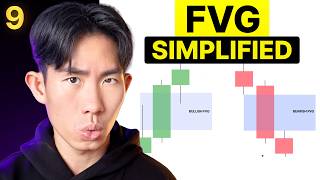

The Hidden Truth About Market Pullbacks
45sThis segment challenges a common trader misconception and introduces a powerful concept, sparking curiosity and engagement.
▶ Play Clip"Delivers a thorough explanation of fair value gaps with practical examples, though it could be more concise."
This video explains the concept of fair value gaps (imbalance) in trading, which are areas where price moved too quickly, leaving behind inefficiencies. The instructor demonstrates how to identify these gaps and use them to anticipate price retracements and continuations.
Imbalance, also known as inefficiency or fair value gap, occurs when price moves aggressively in one direction, leaving behind an area of unfinished business. Understanding this helps traders anticipate where price may retrace or continue.
A fair value gap is an inefficient area where one side was so aggressive that the market moved too quickly, not trading efficiently through that zone. It represents a gap left by smart money due to rapid price movement.
A fair value gap appears in a three-candlestick sequence: the first candle leaves one side of the range, the second expands aggressively, and the third leaves a gap between the wick of candle one and candle three.
To identify a fair value gap, find the first candlestick before a big juicy candlestick and the one after it. Draw a box between the low of the after-candle and the high of the before-candle. This gap shows where price moved quickly.
Fair value gaps form due to aggressive buying or selling pressure, causing price to expand quickly. This indicates market inefficiency, and price is expected to pull back to fill the gap before continuing.
After a huge imbalance, the market pulls back to fair value, moving from imbalance to balance. This revisit can act as a retracement where price mitigates the gap and then continues in the original direction.
Look for a big bullish or bearish candlestick indicating strong displacement. Check if there is a gap between the high of the previous candle and the low of the next candle. If no gap exists, there is no imbalance.
Trade fair value gaps with context: look for bullish gaps in discount ranges and bearish gaps in premium ranges, aligned with higher time frame trend and structure. Avoid trading gaps alone without confluence.
Using naked eyes, spot strong displacement and draw the fair value gap. Examples show price mitigating the gap before continuing. Patience is key—wait for price to pull back to the gap rather than chasing moves.
A fair value gap can fail if the higher time frame structure is against it. For example, a bullish gap in a bearish trend may not hold. Always consider multiple factors before trading.
Do not mark fair value gaps where there is no actual gap. Some traders see big candlesticks and assume a gap, but if the high of the previous candle and low of the next overlap, there is no imbalance.
Combine fair value gaps with premium/discount zones and supply/demand. For example, a bearish gap in premium range is more likely to be respected. Use multiple confluences for better trade ideas.
Price may react at the edge, midpoint, extreme, or even pierce past the gap. Do not assume a specific reaction; use the gap as a reference point, not a guarantee.
Fair value gaps can be used for entries (e.g., short at a bearish gap) or as targets (e.g., target the next opposing gap). They are areas where price gravitates towards.
In a live example, the instructor identifies a bearish fair value gap after strong displacement, waits for price to mitigate it, and plans a short with a stop loss above the gap and target at the next bullish gap.
Identifying a gap does not mean it will hold. It is a magnet drawing price, but whether it holds depends on market structure, liquidity, and other factors. Never assume a gap will hold.
A strong bullish move creates a gap, but price breaks through it because the context (e.g., premium pricing) is wrong. This shows the importance of confluence and market context.
An imbalance or fair value gap is an inefficient area created by aggressive price movement. It indicates smart money activity and helps predict retracements. Combine with other concepts for effective trading.
Fair value gaps are powerful tools for anticipating price movements, but they must be used with context and confluence. Mastering this concept is essential for advanced trading strategies like order blocks.
What is a fair value gap?
An inefficient area in the market created when price moves aggressively in one direction, leaving behind a gap.
01:03
What are the three candlesticks in a fair value gap sequence?
First candle leaves one side, second expands aggressively, third leaves a gap between the wick of candle one and candle three.
01:42
How do you draw a fair value gap?
Find the low of the candlestick after the big candle and the high of the candlestick before it, then draw a box.
02:28
Why do fair value gaps form?
Due to aggressive buying or selling pressure causing price to expand quickly, leaving inefficiency.
03:11
What is the market's behavior after a fair value gap?
Price tends to pull back to fill the gap before continuing in the original direction.
04:07
What is the rule for identifying a fair value gap?
Look for a big candlestick with strong displacement and check for a gap between the high of the previous candle and low of the next.
05:04
What happens if there is no gap between the candles?
There is no imbalance or fair value gap.
05:42
Why should you trade fair value gaps with context?
Because they may fail if the higher time frame structure is against them; confluence is needed.
06:35
What are the possible price reactions to a fair value gap?
Price may react at the edge, midpoint, extreme, or pierce past the gap.
12:40
How can fair value gaps be used for entries and targets?
They can be used for entries (e.g., short at bearish gap) or as targets (e.g., target the next opposing gap).
14:26
What is a common mistake traders make with fair value gaps?
Assuming a gap will hold without considering market structure and other factors.
23:12
Definition of Fair Value Gap
Provides a clear, foundational definition that is essential for understanding the concept.
01:03How to Draw a Fair Value Gap
Offers a step-by-step method for identifying gaps, which is practical and actionable.
02:28Market Seeking Fair Value
Explains the underlying principle of market behavior, crucial for anticipating price movements.
04:07Trading with Context
Emphasizes the importance of confluence, a key to successful trading.
06:35Fair Value Gaps Are Not Guaranteed
Warns against over-reliance on gaps, highlighting the need for comprehensive analysis.
22:30[00:02] direction and then suddenly coming back into the same area before continuing? Most traders think that that's just a random pullback, but a lot of the time the market is just coming back to fill an imbalance.
[00:18] And if you understand that, you start seeing the chart very differently. So today, I want to break down one of the most important concepts in price delivery and that is imbalance, or which is also known as inefficiency, which is
[00:31] also known as the fair value gap. Because when price move very aggressive in one direction, it's going to leave behind an inefficiency in price in the market. And understanding that can help you anticipate where price may retrace,
[00:47] you anticipate where price may retrace, react, or continue from. In the first lesson, we talked about how the market have to move from phases of imbalance to right? Because the market is actively seeking fair value. That's what this
[01:03] concept is about, right? Imbalance is basically an inefficient area in price where one side was so aggressive that the market moved too quickly and did not the market moved too quickly and did not trade efficiently through that zone.
[01:18] So it's basically an area where price moved so fast, so far that it left behind unfinished business. Right? Just like in this case right here, we have a bullish candlestick right here. Next thing you know, huge
[01:30] bullish candlestick signaling there's a lot of buying pressure, a lot of buying momentum, and then the momentum starts slowing down. All right? When this happens, this pretty much tell us that there's an imbalance right here, and
[01:42] this is the gap that smart money has left behind because they've pumped price up so fast, right? That it just didn't have any pause whatsoever. So a fair value gap, it's basically one of the most clearest visual forms of
[01:57] imbalance. It usually appears in like this three candlestick sequence just like this. Where the first candlestick leave one side of the range, the second candle expand aggressively either to the upside or to the downside, and then the
[02:12] third candle leave a gap between the wick of candlestick number one and the wick of candlestick number three forming your fair value gap. Okay, so once again, let me just slow it down a little bit. Basically, when you
[02:28] candlestick just like this, what you want to do is to find the first candlestick that was before that big juicy candlestick, and the candlestick that came after that big juicy candlestick, and you find the low of the
[02:44] candlestick that comes after that and the high of the candlestick that comes before that, and then draw a box just like this, and this is where you got your fair value gap. And this gap shows you that price has moved very quickly
[02:57] through that area itself. So a bullish fair value gap, just like this, is a strong move to the upside which leave inefficiency below. A bearish fair value gap is a strong move to the downside that leave
[03:11] inefficiency above. Okay, so once again, you must understand the logic behind the fair value gap. The reason why it form in the first place is because there was such an aggressive amount of buying
[03:26] or selling pressure. And as a result, that caused price to expand very, very quickly. So this pretty much tell us that at this point of time, there's so many sellers in the market that there was so little buyers
[03:39] in the market which caused price to just move very aggressively to the downside. Therefore, the market is counted as inefficient at this point of time. Okay, so when the market move too aggressive just like this, it does not
[03:54] always price everything fairly on the way up or down. So as a result, it's just going to leave behind a gap which is known as our imbalance or gap. Right? So there's a lot of different names for it.
[04:07] after this gap is formed, we are expecting the market to actually pull back to this gap. Now, why? Because remember when we talked about how the market move from phases of imbalance to
[04:20] balance to imbalance to balance because it's actively seeking fair value. So after a huge imbalance to the downside, we're expecting price to pull back to fair value, right? Going to the next phase, which is the balance phase before
[04:34] the next phase of imbalance again, and then balance and then imbalance and balance and balance and Because the market is often seeking efficiency, seeking fair value. Right? So this revisit in price can act as like
[04:49] a retracement where price is potentially mitigating the fair value gap and then continuing to the downside. So yeah, that's the fair value gap. It's not just a gap, it is a clue that the market may want to rebalance before
[05:04] market may want to rebalance before moving on. now just follow these rules right here, and you will be able to easily identify a fair value gap. Basically, you just want
[05:17] to see like a big juicy candlestick just like this, either a bullish or a bearish candlestick, which signal that is strong displacement. candlestick that comes before it and after it.
[05:29] If there is a gap that was formed at the high of the previous candle and the low gap just like this, then there is imbalance. However, if let's say
[05:42] just like this in the previous candlestick, the wick was like somewhere right around here. Right? And then the next candlestick, the wick was somewhere again, following the exact same principles, we identify a huge
[05:57] candlestick just like this, strong displacement. So somewhere over here, there might be an fair fair value gap or there might be an imbalance. Now, let's comes before and after it. Well, the candlestick that came before it, the
[06:09] high was right here. Well, the candlestick that came after it, the low was right here, right? So if you look at this, there is no fair value gap whatsoever. So even though there was a lot of buying pressure and a lot of
[06:22] buying momentum here, there is actually no imbalance. Right? This just show that, you know, smart money did actually came up there, pulled back, filled up continuing even further, right? So there is no imbalance, there is no
[06:35] is no imbalance, there is no inefficiency whatsoever. we have learned so far with this concept itself, which means that we want to see
[06:48] itself, which means that we want to see a bullish fair value gap at a discount range. And ideally, we want to trade it if the higher time frame trend direction, the swing structure, the internal structure is actually bullish.
[07:01] these fair value gap when price comes down to mitigate it. Same thing as the bearish fair value gap, but like in an opposite manner. So now, let's try to go under the charts and try to apply this concept itself,
[07:16] on fair value gap. So just using your naked eyes alone, you should be able to easily spot a fair value gap. Like I said, first step, just look for strong displacement. Okay? Let's go from left to right, right left
[07:29] side here. What do we have? We see big candlesticks just like this. Immediately, my eyes is drawn towards that big bearish candlestick, and this is where you can find the candle that came before
[07:41] it and the candle that came after it. And then this is where I can draw a box marking up the imbalance, marking up the gap just like this. And sure enough, later on price did went up there, mitigate the fair value gap,
[07:55] and then come down. Okay? And then another very obvious one that I've seen is probably this one right here. Very obvious strong displacement. The low of next candlestick, drag all the way up here, and once again, you can see price
[08:08] came all the way down here. Right? And then went up there, mitigate it before continuing down even further. So this is why you guys shouldn't be already made its move, right? So in this case, price has already came all the way
[08:22] down here. You don't want to be entering for a sell right here. Because if you're going to be at a huge disadvantage because you have to place your stop loss above this high, and your entry is just not precise anymore. So you're much more
[08:36] better off being patient, you know, because you understand the concept of imbalance and balance, just waiting for the market to pull back to when it does, then you look for shorts, and then just continue shorting it down
[08:50] from there. So let's try to identify a bullish fair value gap. Since that's the bearish fair value gap, okay, there's one right here, right? Huge imbalance to the upside. Okay, there's a gap from this high and
[09:02] this low of the next candlestick right here. And sure enough, price pulled back consolidated a little bit, and then starts going up. let me just give you one final example before I can show you some tips and
[09:16] market condition. Right? So you can see this is very obvious big bullish candlestick, strong displacement. And then this is the high of the previous previous candlestick, and you can see we got a little fair value gap right here.
[09:31] But in this case, the reason why the fair value gap failed is because if you look at the higher time frame structure, it is still bearish. So like I said, it's all about really just using as many weapons in the arsenal to just develop a
[09:44] proper trade bias, taking into consideration everything before you actually look for longs or look for shorts. another thing that you guys must understand is that
[09:57] you want to make sure that you don't just mark up fair value gap if there is no gap whatsoever. What I mean by that is that a lot of people that they see You can see big candlesticks, big candlesticks. Then they immediately come
[10:10] fair value gap as like this range right here or something. But that's not true, right? Because there is no gap whatsoever. If you zoom there is no gap whatsoever. If you zoom into this price point over here.
[10:22] you look at the high of the previous candlestick and look at the low of the next candlestick, which is right here, there is no gap whatsoever. And since fair value gap, which also means that there is no imbalance right here.
[10:38] left-hand side over here, where did price actually retrace to? Price potentially retrace back to this fair value gap that we have right here. Okay, retrace back to this bearish fair value gap and then continuing
[10:51] value gap and then continuing with the higher time frame downtrend. So, remember, you don't just want to look at fair value gaps alone. You want right now. Who is in control of price? Okay, so right now clearly today price
[11:04] control of price. Cool. That tell me that I need to look for bearish fair value gap. Okay? And then ideally, I want to wait for price to pull back to a imbalance to the downside.
[11:17] potentially look for shorts. Okay, or what you can do is also to combine your premium and discount with your fair value gap concepts. So, example in this case right here, price broke structure, came down. This is your swing high and
[11:32] this is your swing low. And then maybe I can just map that premium and discount up there. And this is where you might have identified one fair value gap right here, another fair value gap right here. And you can see both of these are fair
[11:45] value gaps. But why is it a fact that this one got disrespected where price just blast right through while this one actually got respected? It's because this one is more high up within the premium range. And there's also a huge a
[12:00] more bigger amount of imbalance right here where the market has to fill before here where the market has to fill before it continue going down even further. So, yeah. Always make sure that you trade fair value gaps with context. Once
[12:13] again, none of these market mechanics concepts they can work just by itself bearish fair value gap, I'm just going to enter for a sell. Bullish fair value gap, I'm just going to enter for a buy." If you trade that way, it's very, very
[12:26] dangerous, right? You want to use multiple confluences itself. Uh another thing you must understand is that sometimes price will tap into the edge of the fair value gap and then react from it and
[12:40] But sometimes it might go deeper into it. Okay, let me just give you a few examples. In this case, price came down, tap into the fair value gap and then go. All right? And then in this other
[12:53] scenario, it came all the way up to the midpoint, which is the 50% of the fair value gap and then go. Uh another example is this one, right? Maybe price came all the way down here, came all the way up to the extreme,
[13:06] right? Extreme of the fair value gap and then go. Uh another example like maybe this one right here, where price even pierce past the fair value gap and then go.
[13:20] So, do not expect the market to react the same way every time. there and don't assume that price is going to touch it and go. Okay, because the 50% of it. There's also times where it will touch the extreme of it and then
[13:35] go. There's also times where price might break past the fair value gap, sweep some liquidity, and then go. Okay, so never, ever assume. Just use this as like a reference point, but like don't stick to it. Okay, like don't don't
[13:49] don't don't just expect or anticipate price to touch it and go. So, once again, you want to make sure that you are using this fair value gap
[14:01] the other concepts, supply and demand zones, with you know, premium and discount. So, ideally, I want to look for bearish fair value gap that is within premium pricing. I want to short from there. And
[14:14] pricing. I want to short from there. And I want to look for longs at the gap that is within the discount ranges itself.
[14:26] gap is that you can use it as a way for you to actually enter on your trade, right? So, for example, the minute price mitigate this bearish fair value gap, it all the way down here. Another way you can use fair value gap
[14:39] is to use them as targets because that is where price is gravitating towards. So, for example, if let's say like I drew I want to enter for a sell at this fair value gap right here. And then I want to target maybe this
[14:53] next fair value gap that we have on the left-hand side over here. This is where you can potentially look for shorts the minute price mitigate this bearish fair value gap. And you can potentially target the next fair value
[15:07] gap, which is where price is gravitating towards next, which is this one right fair value gap. Yeah, so you can either use it to help you enter your trades or you can also use it to help you to set your take
[15:21] Because once again, you must understand that that is just a price point in which price is gravitating toward. It doesn't always have to fill up the fair value gap, but a lot of times it tends to do that before continuing
[15:36] tends to do that before continuing moving off. few more examples. Or maybe I can show you how I would use it live as well. Right? So, let's just look at this one right here.
[15:51] Okay, so in this case, let's say price has been coming down here very aggressively. Okay, very aggressively coming down. You look at prices came down, pull back, and then goes down even further creating like an
[16:05] internal break of structure to the downside just like this. downside just like this. Okay, so this becomes my swing high. Well, my swing low has not been formed yet since price has not made a pullback,
[16:19] minute price has been back there, I can move my swing low here. So, now once again, just using all the concepts that we have learned so far, this is where discount. Okay? And right now we are anticipating
[16:32] price to pull back to the premium range before continuing down even further. It doesn't have to, but if it does, good for us. It's just an additional have to. And then maybe I can draw my supply
[16:45] zone, right? Just by marking out this pivot candle right here at this extreme end, right? There we have six uh supply zone. Okay? And then now, introducing this new concept of imbalance of fair value gap,
[17:01] I'm asking myself, "Okay, where is the strong displacement in this entire move?" Because once I identify the strong displacement, which is really just a fancy word of a big bullish or bearish candlestick,
[17:14] then I can identify my fair value gap, right? So, in this case, once again, I'll say like just use your naked eyes and just compare it with the size of the candlesticks that is near it, right? So, that's how you kind of
[17:28] tell whether it is big or small. You just find like use your common sense and candlesticks in here. And then just try to com- compare it with like the way bigger than them, right? If it's like a big boy, then you know that
[17:43] there's probably a strong displacement. So, in this case, big candlestick right here. Okay? Then now I'm looking at a candlestick that comes before it and a So, for the candlestick that comes
[17:55] low. And then for the candlestick that came after it, this is where I mark up the high. So, now, is there a gap? Yes, there is, right? There is a gap which tells that there's an imbalance or inefficiency or
[18:07] to call it. So, this tells us that price is going to be gravitating towards that gap, fill up that gap before continuing down even further. Right? So, in this case, this becomes my
[18:21] fair value gap. Right there. Okay, so that is the most recent bearish fair value gap. candlesticks, right? Is there a fair value gap say around here? Nope, because
[18:38] this low is around the same level as this high right here. Is there a fair low of the previous candlestick, this is the high. So, nope, no gap. So, no gap, no gap, no gap. Only here have a gap. Okay, so this is like the only fair
[18:52] value gap inside this entire move to the downside itself. And just observe what price does next. Okay, price pretty much came up there, mitigates the fair value gap, and then continuing down even further. And I
[19:06] believe it's going to start reversing anytime right now. around here and then eventually reverse. Okay, so if you were to trade this fair
[19:20] look for shorts. The minute price mitigate this fair value gap, place a stop loss above the fair value gap and just target like 3R you know. We are going to talk more about where to place a stop loss and
[19:33] where to place a take profit later on, but for now, not going to focus on entries and exits. Just going to focus on sharing with you guys like this fair value gap concept and just helping you guys implement it. So, yeah. In this
[19:45] worked out. And where would he have been able to target? Well, you know, another way that you can use fair value gap is to use it as a price point to actually target, right? So, in this case, maybe let's come back here.
[19:59] right here. You enter for shorts, you know, value gap, and now you are you don't know where to actually target. Okay, so what you can potentially do is to find what's what's the next opposing
[20:13] fair value gap. So, if I'm entering for a sell at a bearish fair value gap, I want to target the next bullish fair value gap because that's where I'm expecting price to move towards next and then reverse to the upside.
[20:26] left-hand side, looking at the price action that just happened right here, and I'm asking myself, where is the most recent bullish fair value gap? Because that's potentially where I can set my take profit. So, I'm looking at the
[20:39] left-hand side right here. What about that price went up? Right, strong displacement to the upside, cool. Let's go step by step. Big candlestick candlestick and followed by another bigger candlestick itself. So, just by
[20:53] doing this alone, I can map this as a fair value gap because this high right here and then this low of the next candlestick was formed, like this. And then there could potentially be another fair value gap
[21:07] right here, right from this previous high um and to this new low right here. in this case. And if you go down to the 5-minute time And if you go down to the 5-minute time frame, you will see that price actually
[21:22] coming down to the second one, respecting the second one, maybe coming order block over here, which you're going to learn in the next lesson, and then starts moving to the upside. Right, so I'll say like what you can do is to
[21:37] use it either to enter on a retracement, right? Use it to to like allow yourself to gauge where price is retracing to, or you can also use it as a target area because that's where price is most
[21:51] likely going to move towards the area next in order to rebalance. take profit at this fair value gap, it's not the best like risk-to-reward know, if you're scalping, you could potentially enter like upon the
[22:05] loss above that high, and then just target like this low right here. But like I said, I don't want to get too deep into the nitty-gritty details when I really want you to like just familiarize yourself with this concept
[22:18] of fair value gap itself. Because like I said, it's a very simple concept, but if applied well, it's actually pretty powerful. I can't emphasize this enough, but just
[22:30] because you can identify that fair value gap, does not necessarily mean that it's going to hold. Remember, the whole gist of a fair value gap is that that's where price is going to move towards next.
[22:44] that's where price is going to move towards next and it's going to hold. No. It just says that it's a magnet that's drawing the price towards that area. another story. That depends on the market structure,
[22:59] depends on whether there was liquidity, depends on so many different other So, that's why you don't ever ever want to assume that a fair value gap is going to hold. This is the mistake that a lot of
[23:12] people make. They just trade fair value gaps alone, right? When price mitigate the fair value gap, they immediately enter for a trade without realizing that you know, it's not going to hold because the structure is against you, you are
[23:25] trading at the wrong location, you are trading a bullish fair value gap in a premium pricing, you know, like you don't take into account the context of the market. And as a result, you fail trading the fair value gap. So,
[23:40] just to give you an example of what I mean by that, look at this. Strong move to the upside, right? Strong move to the upside, very strong displacement right here, big bullish candlestick, a lot of buying pressure, a lot a lot of buying
[23:52] intent, a lot of buying momentum. So, just by looking at this alone, I can is the low, boom, my fair value gap is right there. And in this case, price has pretty much
[24:06] come down, right? It's retracing. At this point of time, your immediate instinct should be, okay, price is retracing. Now, where is price next? The fair value gap. That's it.
[24:20] Okay, that's what you use fair value gaps for. For you to know where price is most likely going to retrace to because that's the area where price needs to balance before it continue moving. So, in this case,
[24:32] right here. I'm not going to be entering for a buy right here. I'm only going to enter for a buy if price has come back down to my fair value gap, and that is where the balance can potentially occur.
[24:44] Right, so in this case, price comes down to the fair value gap. Now, I will consider looking for longs if I have multiple confluences. that tell me that it's a good idea to enter for longs, then boom, this is
[24:56] where I can enter for a longs. If not, then I would just be using this as a reference point for me to know where price is moving towards next, and that's it. I will not trade it. So, in this case, let's continue to see what
[25:10] price does. Price came down and break right through it. fair value gap alone, it's about a myriad other different factors
[25:24] for you to actually develop a great trade idea. really ensure that, you know, you are super
[25:36] duper familiar with like just applying this concept and just knowing that it's not as simple as, oh, buy at a fair value gap, a bullish fair value gap, or sell at a bearish fair value gap. You need to take into account of the
[25:48] liquidity, the market structure, the zones around it, right? A lot of different other factors, which we are going to continue talking about over the going to continue talking about over the next few lessons itself.
[26:00] So, to keep it simple, just to sum up everything, an imbalance or a fair value gap is an inefficient area in the market that is created when the price moved very aggressively in one direction.
[26:15] Basically, in simple English, it just tell us that at this point in time, smart money have entered for a large amount of buy orders, causing price to move up so aggressively that it just created this gap, just left
[26:30] Same thing for the bearish fair value gap, but instead of buy orders, they enter for a ton of sell orders, causing price to collapse so fast, so this. And remember when we talk about the
[26:43] talked that when smart money push price in a sudden direction, it tends to cause price to retrace back to that same direction so
[26:55] orders. It could be the same thing in this case gap just like this, smart money might want to cause price to come back down to this fair value gap, and then look for more buy orders,
[27:10] and then look for more buy orders, causing price to continue going up. value gap. It's very simple. It's basically huge move, and we are expecting price to retrace to fill up that huge move and then going up even
[27:26] that huge move and then going up even further. Just tying back to the cycle of imbalance, balance, imbalance, and then balance, and then imbalance again. That's just the build of price, right? That's just how price fundamentally
[27:41] But like everything else in trading, it's not just about identifying and trading the fair value gap. It's about learning how to use it in the right market conditions, learning how to combine it with other confluences
[27:56] how to combine it with other confluences to develop a proper trade idea. That's what a fair value gap is. And in the next lesson, or I don't know, like the next few lessons, I'm going to talk about an order block, which is a concept
[28:09] which requires you to really understand imbalance or fair value gap. If you don't understand whatever I just covered for like the past 30 minutes or so, please make sure you rewatch it, right? Rewatch it over and over again until you
[28:22] but you must also know how to implement it. If you know how to implement it, then you can move on to the next lesson. If you don't, then I'll say like keep on practicing, keep on like training your
[28:35] brain to like spot this fair value gap and spot these imbalances. And most importantly, please just watch these lessons in chronological order, and you move on to the order block lesson, you wouldn't know
[28:49] order block because like each lesson is itself. Right, so if you want to learn how to trade order block, you have to how to trade order block, you have to first learn how to identify imbalance.
[29:02] Because you can only find an order block when you have identified imbalance, literally built on top of each other like a pyramid. And if you, you know, just skip to the next level for going to the previous level, it's like going to
[29:15] fight the level 100 boss in a video game when you haven't even defeated the level Right? So, stop trying to rush the process, continue plugging through these courses and lessons in chronological order, continue getting better at
[29:31] applying them. Okay, so maybe I'll just give you one last example to end off this video itself, right? Just to show you um like how it really works once again because I just really want to
[29:44] emphasize the importance of this concept itself. So, price came down very aggressively, strong displacement in price. Okay, immediately spotted the this is where you can look at the candle came before it and the candle came after
[29:57] it. And when you do, find the low of the previous candle, find the high of the gap, and drag it out just like this. And boom, there is a fair value gap. And in this case, price came up, mitigate the fair value gap, continue going down, but
[30:10] was not enough fuel. So, as a result, it actually came back up and mitigate the order block, which is what we're going to cover next, and then continuing down Right. So, hopefully by now you have seen like how important it is to like
[30:26] just really have multiple weapons in the arsenal so that you can like maneuver and change to a different position when your enemy is fighting from in the other That's what trading's really about, right? It's just really about having as
[30:40] much confluence as as possible to make the most sense out of the market. So that you can have the probabilities on your side, right? So that you can have the odds on your side rather than having them stacked against you.
[30:54] teaching you guys a new concept in the next lesson. And as always, remember next lesson. And as always, remember you're just one trade away. Mwah.

⚡ Saved you 0h 31m reading this? Transcribe any YouTube video for free — no signup needed.