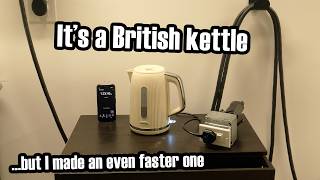

Building a cursed adapter to boil water with an EV charger
49sThe absurdity of using a car charger to power a kettle with a homemade, dangerous adapter sparks curiosity and shares.
▶ Play Clip"The title is accurate: the video demonstrates boiling water quickly using a car charger, though the setup is unconventional and not practical for everyday use."
The video explores the speed difference between US and British electric kettles, driven by voltage and power limits. The creator builds a custom adapter to power a British kettle from a car charging station, then pushes an American kettle to 6,000 watts for a 55-second boil. The experiment highlights electrical principles, safety concerns, and cultural quirks like the 'breakfast cup' measurement.
US kettles are limited to 1,500W due to 120V household power, taking ~4 minutes to boil a liter.
British kettles use 230V and 13A outlets, drawing 3,000W and boiling water in ~2 minutes.
The BBC coordinated with the National Grid during breaks because half a million kettles turning on created a massive power surge.
The adapter uses a J1772 connector wired to a Leviton BSRDP-W receptacle, with a resistor-diode circuit to simulate a car connection.
Due to split-phase power, both live pins are at 120V to ground, meaning the kettle may remain energized when off.
The British kettle boiled water in 1 minute 55 seconds, compared to ~4 minutes for US kettles.
Connecting an American kettle to 240V quadruples its power to 6,000W, boiling water in 55 seconds.
The 6kW kettle failed after two uses; the heating element's magnesium oxide fused into solid rock.
A British breakfast cup is 8 imperial fluid ounces (227 ml), while a standard British cup is 6 imperial fluid ounces.
What is the typical power limit for US household appliances like kettles?
1,500 watts
1:10
How much power does a standard British kettle draw?
3,000 watts
1:34
How long does a US kettle take to boil a liter of water?
About 4 minutes
1:17
How long does a British kettle take to boil a liter of water?
About 2 minutes
9:33
What happens to the power draw of an American kettle when connected to 240V?
It quadruples (from 1,500W to 6,000W) because current doubles and voltage doubles.
10:14
How fast did the 6kW American kettle boil water?
55 seconds
12:04
What is a 'breakfast cup' in British measurements?
A British breakfast cup is 8 imperial fluid ounces (227 ml), while a standard British cup is 6 imperial fluid ounces.
7:48
What is the Leviton BSRDP-W and why was it made?
The Leviton BSRDP-W is a single BS1363 receptacle designed for North American junction boxes, intended for retrofit in Gulf countries using British plugs.
3:16
What happened to the heating element of the 6kW kettle after failure?
The magnesium oxide inside the heating element fused into solid rock due to extreme heat.
17:29
How does the adapter trick the charging station into supplying power?
The control pilot pin is connected to ground through an 882-ohm resistor and a diode.
5:17
BBC and National Grid coordination
Illustrates the massive power demand from kettles in the UK, equivalent to a nuclear reactor.
1:53Tricking the charging station
Explains the resistor-diode circuit used to simulate a car connection, a key technical detail.
5:17Breakfast cup unit
Highlights the quirky British measurement system, adding humor and cultural insight.
7:48Ohm's law and power quadrupling
Demonstrates how voltage change affects power draw, a fundamental electrical principle.
10:14Heating element failure analysis
Reveals the internal damage from overheating, providing insight into material limits.
17:29[00:00] Hello.
[00:00] It is still November.
[00:02] The heat just kicked on, but I don't care.
[00:04] And today, I'm going to make
[00:09] And I'm going to do it using this British kettle
[00:14] using this very cursed adapter
[00:20] Now, before I hear any complaints
[00:24] this video is basically a repeat of that time
[00:30] allowing me to use my car charging station as a
[00:34] that delivers 240 volts AC (which in case you didn't know, is all
[00:42] But this time I put that connector onto an electrical
[00:49] is this horrible thing.
[00:51] But more on that later.
[00:53] You might wonder why I've done this.
[00:55] Well, you see, I have a few British friends who have all expressed frustration at how slow electric kettles are here in the US.
[01:03] Because of our 120 volt household power and the desire to maintain compatibility with smaller 15 amp circuits,
[01:10] most ordinary appliances are limited to 1,500W of power,
[01:15] and kettles are no exception.
[01:17] Put that much power into a liter of room temperature water, and it will take about 4 minutes for that water to boil.
[01:24] Now, personally, I think that's plenty fast
[01:28] but because the Brits have 13 amps of
[01:34] they can shove three whole
[01:40] And because they can, they do.
[01:43] And today, they're so used to this
[01:45] that the absurdity of a plastic countertop appliance sucking down more power than my home's central air conditioner
[01:51] just doesn't quite register.
[01:53] Fun fact, the BBC used to have to share when breaks in their programming would happen with the National Grid
[01:59] because half a million people getting up
[02:03] meant there was suddenly a large nuclear
[02:08] For making tea.
[02:10] And other hot beverages, probably.
[02:12] Ooh, maybe even porridge.
[02:14] Uh, anyway, after I made that video on
[02:19] a certain slow-mo guy named Gav suggested
[02:26] That sounded delightfully up my alley,
[02:28] so I promised I would make that happen.
[02:31] And here we go!
[02:32] First, I would need to get my hands on a kettle designed to work with the 240 volt electricity my car charging station puts out.
[02:40] So, I imported this British kettle,
[02:47] Next, I would need a way
[02:52] Now, I could have done the sensible thing,
[02:54] which would be to build an adapter
[02:59] and then cut the end off of this cord
[03:05] But a while ago, someone on the internet
[03:11] Yes, this is a real product you can buy for some reason.
[03:16] The Leviton BSRDP-W is a single BS1363 receptacle
[03:27] Why on Earth do they sell this?
[03:29] I have no idea!
[03:30] There's no way this would be
[03:34] [sudden muzak]
[03:36] Okay, so this instruction sheet made me dig a little deeper
[03:40] and it would seem that Saudi Arabia's current
[03:47] (that's the British one).
[03:48] But it seems that in the past they and/or perhaps other Gulf countries were following NEMA standards for junction boxes, etc.
[03:58] This device meets SASO standards
[04:01] and that little symbol above the 0007 is the
[04:07] and so I think it is intended
[04:13] So it's got a real use case... but certainly not here.
[04:19] Because we use split-phase power over here,
[04:26] It will function just fine - no electrical load knows the difference
[04:29] - but these two pins will both be live at 120 volts potential to ground, which means depending on how a device was wired,
[04:37] it may always be energized, even if switched off.
[04:41] Which might be shocking.
[04:43] Now, Leviton was smart enough to make sure this switch
[04:49] But still, this is all kinds of weird!
[04:53] And yet it exists.
[04:55] So, I threw together this adapter, which simply has
[05:04] wired directly to the cursed receptacle on the other side.
[05:09] Am I showing you what's inside of here?
[05:11] No!
[05:12] And to make the charging station think it's
[05:17] the control pilot pin is connected to the ground
[05:25] Now plugging this into my
[05:29] and energize this receptacle
[05:35] It will work, though.
[05:36] So let's do a little test.
[05:38] Here's an American kettle plugged into the wall
[05:44] This is almost exactly one liter, but not quite.
[05:47] The important thing is
[05:52] The water was 63.7° F or 17.6 C.
[05:56] And with the kettle pulling about 1,460 watts, it took 4 minutes and 5 seconds to hit my subjective definition of boiling.
[06:05] And for a slightly less subjective definition,
[06:12] But I had a second American kettle to test.
[06:15] This cheaper model has an exposed heating element.
[06:18] And since it becomes completely submerged when filled with water,
[06:22] there are absolutely no heat losses to the air below the kettle.
[06:28] That doesn't matter very much,
[06:33] This one was filled with water at 63.1° F or 17.3 C.
[06:39] And after a failed start because it
[06:46] and required 4 minutes and 15 seconds
[06:51] And it switched itself off at the 4 minute 35 seconds mark.
[06:55] So, both of these kettles require
[07:02] And now it's time to see
[07:06] This time the water was at 61.8° F or 16.6 C.
[07:12] And I want you to notice something here.
[07:14] This is just under 1 liter of water.
[07:17] And when I placed it in this kettle,
[07:24] That doesn't make any sense.
[07:25] So this is 4.5... what exactly?
[07:29] Oh, I found the answer.
[07:31] And having found it, I simply cannot resist pointing out
[07:34] that every kettle I have ever used
[07:40] Yet, this British kettle has markings for,
[07:46] breakfast cups.
[07:48] Not an ordinary British cup,
[07:52] but a British breakfast cup,
[07:59] That's right, our ounces, pints, and gallons
[08:03] or 227 milliliters.
[08:06] So, the next time any of you out there who speak metric get annoyed that I forgot to include a conversion for you,
[08:12] I want you to remember this little adventure
[08:19] Now, in fairness, I can't be too annoyed about
[08:26] because for us Yanks,
[08:31] a cup of coffee is only 6 ounces.
[08:35] If you've ever wondered why your coffee pot
[08:40] So, we've also got our fair share of strange customary units
[08:47] And I suppose it's a fun coincidence that we've got 8 oz standard cups and 6 oz coffee cups
[08:53] while the Brits have
[08:59] Actually, it's only through figuring out what this unit is on this kettle that I learned British cups are 6 ounces.
[09:07] What's going on there? You have 20 cups in an imperial gallon?
[09:12] At least our customary
[09:16] ...until you get down to the teaspoon -
[09:19] Anyway, enough about strange units.
[09:21] How long does it take this British kettle to boil that water?
[09:25] Well, we have twice as much power
[09:30] it should only take about 2 minutes.
[09:32] And whaddya know!
[09:33] It took 1 minute 55 seconds
[09:38] And it switched itself off at the 2 minute 10 second mark.
[09:42] That sure is quite a lot faster
[09:46] And I suppose if you're a big tea drinking culture, it would be nice to shave a couple of minutes off the boiling time.
[09:53] But I still think it's kind of bonkers that shoving 3 kilowatts into a cheap plastic kettle is just a normal thing over there.
[10:03] But then I thought...
[10:04] what if we shoved 6kW into a cheap plastic kettle?
[10:09] Because you see, if I were to
[10:14] Ohm's law would dictate that it will consume twice as much current than it will from a 120 volt supply.
[10:20] And by also having twice as much voltage,
[10:23] that means its power draw will
[10:31] And that's why I made this other adapter.
[10:34] This is a NEMA 6-20,
[10:36] one of the various 240 volt receptacles
[10:42] And with a matching plug and a little bit of choppy choppy,
[10:49] And my charging station can supply up to 7.5 kW.
[10:52] So, it should have no trouble at all
[10:58] Now, obviously, don't do this at home for lots of reasons.
[11:03] One, I will be overloading the NEMA 6-20 slightly.
[11:07] The kettle's gonna draw about 24 amps
[11:13] But even worse, the wires going to the kettle
[11:18] This is only 16 gauge wire, which should
[11:23] but we're doing 24.
[11:26] Now, honestly, the kettle
[11:31] So, I won't be overloading it for long at all, and I doubt any of the electrical connections are going to get very warm.
[11:37] But, I'll be shoving a stupid amount of power through a very small heating element inside a plastic kettle.
[11:43] So, you know, stuff might go wrong.
[11:46] Only one way to find out, though!
[11:49] I had a fire extinguisher at the ready
[11:51] and filled this kettle with my standard
[11:58] The power switch did not latch correctly, so the start
[12:04] this thing got the water boiling in just 55 seconds.
[12:08] Not such a slow kettle anymore, huh?
[12:11] You'll notice the water is boiling quite violently.
[12:14] I'm not sure it would be safe
[12:18] But boy is it quick!
[12:21] And sure enough, it was powered for such a brief period of time that the power cord had barely warmed up at all to the touch.
[12:29] Now, I decided to do this again
[12:33] This time, the water was 60.8 F, which is exactly 16 C.
[12:39] And well, if the colder water
[12:43] Because again, it was violently boiling by the 55 second mark,
[12:51] So, we learned a few things.
[12:53] One, this does indeed work to make a stupidly fast kettle.
[12:57] Two, it's probably not safe
[13:01] or else it'll probably throw boiling water out of itself.
[13:04] And three, it survived long enough to do the test twice.
[13:08] But then I noticed something.
[13:10] Long after it had switched off,
[13:12] this steady stream of bubbles was coming up from where the heating element is bonded to its little support bracket.
[13:19] These bubbles kept going for several minutes,
[13:25] I thought it might be possible
[13:31] See, everywhere else on the heating element
[13:35] which will do a great job taking heat energy away from it.
[13:39] But that little connection point there might have stayed dry enough for the heating element to melt a small hole in itself.
[13:47] And those bubbles might be the result of air
[13:54] And if that is a leak, it would be very dangerous to use again.
[13:58] I decided to let this sit overnight full of
[14:03] For now, I had another kettle to test.
[14:06] This one has its heating element bonded to the bottom of its stainless steel interior, which is a very common design.
[14:13] It can apparently handle 3 kW without an issue.
[14:17] But what about six?
[14:20] Well, again, only one way to find out!
[14:24] This kettle also only needed
[14:29] but the water inside was boiling
[14:33] You can quite clearly see the steam which activates the auto stop feature flying out near the power switch.
[14:40] Uh yeah, in case you didn't know,
[14:42] there's a bimetallic disc down here
[14:47] And it's this tube here at the top which will direct steam down to that disc once the water is actually boiling
[14:53] that makes the disc snap and shuts off the kettle.
[14:57] Steve Mould taught me that.
[14:59] I picked the kettle up after it shut off and felt the bottom of it.
[15:03] To my surprise, it wasn't really warm at all.
[15:06] The electrical contacts were quite hot,
[15:10] but it didn't seem like the plastics
[15:15] Water is really good at absorbing heat energy,
[15:18] but I figured the embedded heating element would direct at least some of its heat downward at the base.
[15:25] If it did, it was hardly noticeable.
[15:28] But that's where the good news ends.
[15:30] I tried to do this again and discovered it ain't working no more.
[15:35] The neon indicator in the switch was still lighting up,
[15:39] but no more boily boily.
[15:41] So, this was a very fast kettle...
[15:44] once.
[15:46] Which is honestly what I expected.
[15:48] I figured these things would have some sort of thermal fuse which will blow if it gets too hot.
[15:53] Like for instance, if you switched it on without any water in it.
[15:57] And since this one only has the water
[16:01] it stands to reason that
[16:07] But I wanted to know why exactly it failed.
[16:10] And with the other kettle's mysterious bubbling,
[16:16] First, if this kettle has a thermal fuse,
[16:21] I don't see any sort of separate component.
[16:23] And when I checked the heating element with an ohm meter,
[16:26] it shows either open circuit or quite a few megaohms.
[16:30] However, it blew, it blew.
[16:32] The water simply couldn't pull the heat away
[16:38] But nothing down here seems like it got very hot.
[16:41] All the plastic looks undamaged,
[16:47] That doesn't really matter as it's still broken,
[16:53] And now to see if this heating element
[16:57] I removed it from the kettle and then used a
[17:03] I found absolutely no signs of moisture.
[17:05] And I even heated it up with a
[17:10] So I was apparently chasing a phantom there.
[17:12] That was probably just a nucleation site of some sort.
[17:16] However, cutting into this revealed that
[17:21] and maintains an insulating gap between the electrically conductive nichrome wire in the center and the steel sides of the tube,
[17:29] appears to have fused together.
[17:32] The last one of these that I cut through had the magnesium oxide escaping like sand, but here it's now all quite solid.
[17:40] I couldn't bend this any more than you see here because the tube seems to be filled with solid rock now.
[17:47] And honestly, that makes sense.
[17:50] The actual heat was coming from that
[17:56] So, while the water could do a great job
[18:02] the inside of the tube was getting stupid hot.
[18:06] Just for comparison's sake,
[18:11] spreads those kilowatts between six heating element sections.
[18:15] This little coil here is about as long as just one of those,
[18:20] but it was producing nearly as much
[18:24] If we could have seen the insides of the tube while it was on,
[18:28] I'm sure it would have been glowing quite brightly, and I doubt this would have lasted more than a few more cycles.
[18:35] I was tempted to get another one of
[18:40] but that would have been effort
[18:46] So, what have we learned today?
[18:48] Well, British kettles are indeed quite fast,
[18:52] but hook an American kettle up to 240 volts and it's way faster.
[18:58] Once.
[18:59] We also learned what a breakfast cup is.
[19:02] And we learned that Leviton makes this thing for some reason.
[19:07] Now if you live in North America
[19:12] one way you could do that is to ask an electrician to install one of these NEMA 6-20 receptacles in your kitchen.
[19:20] That's a bit easier said than done
[19:25] and the need for two free slots in your breaker panel,
[19:28] but with the appropriate breakers,
[19:34] That will allow you to use
[19:39] and not one of our various terrifying monster plugs.
[19:43] The next part though becomes some
[19:47] I cannot find any 240 volt kettles for sale here,
[19:52] which means you'll have to do
[19:56] then chop off its plug and wire it to one of these.
[20:01] And the trouble there is again our split-phase power.
[20:05] Any kettle you might import will work just fine,
[20:09] but the neutral wires inside of it
[20:15] They will be live at 120 volts to ground.
[20:18] Whether that actually creates a safety hazard
[20:24] And to be honest, since not all plug standards in Europe are actually polarized, I feel like most designs out there would be fine.
[20:32] But you will be committed to using an imported,
[20:39] And insurance companies may not like that so much.
[20:42] So keep that in mind.
[20:44] If however you've got one of them fancy induction stoves,
[20:48] then any ordinary stovetop kettle
[20:54] can be just as fast as this British kettle.
[20:58] In fact, possibly faster depending on your stove.
[21:02] I am talking proper stoves, though.
[21:04] Those plug-in induction hot plates are limited to the same power as a plug-in kettle, so don't expect those to save you any time.
[21:12] If you've got a built-in cooktop or range with induction burners, though, a stovetop kettle should be wicked fast.
[21:20] And you get the benefit of a whistle!
[21:22] What's not to like?
[21:24] Actually, while I know it's not really saving me any time,
[21:27] I have switched to a stovetop kettle
[21:32] I have a conventional radiant stove,
[21:38] mainly because it has real knobs
[21:43] But when I'm bringing water to a boil,
[21:49] So, since I keep that thing
[21:54] rather than take up
[21:58] I just leave one of these things on there.
[22:01] But now, if I need to boil
[22:07] I'll just head out to the garage.
[22:10] ♫ anglo-saxophonically smooth jaxx ♫
[22:14] Why am I doing this?
[22:16] ...because of our 120 volt household voltage
[22:22] oops
[22:23] ...could have done the sensible thing which would be to build an adapter like this with a NEMA 6-20 receptacle
[22:29] and then cut the end off of this caaard
[22:32] coorrrd coorrd.
[22:35] Welp.
[22:36] We're having a hard time with this line today.
[22:39] First, if this kettle has a thermal fuse...
[22:43] I'm trying to pry it open.
[22:44] [laughs]
[22:46] Oh, I screwed it back together. I forgot I did that.
[22:54] Did I not - ugh
[22:56] That means I have to
[23:00] I will never let go of this "breakfast cup" thing.
[23:04] Just had to invent and standardize a whole unit based on "a cup for drinking tea or coffee while eating breakfast," huh?
[23:08] And you actually put that on your kettles!
[23:11] Never again are Brits allowed to suggest
[23:14] Now go eat a crumpet.
⚡ Saved you 0h 23m reading this? Transcribe any YouTube video for free — no signup needed.