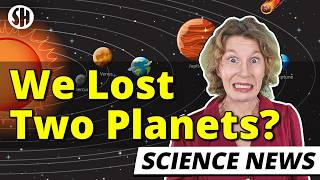

We Lost Two Planets!
37sThe shocking claim that the solar system lost two planets immediately grabs attention and challenges common knowledge.
▶ Play Clip"Title is accurate and intriguing, but the video includes a lengthy sponsor segment, reducing the score."
A recent study suggests that the early solar system may have had six giant planets instead of four, with two being ejected billions of years ago. The video explains the formation of the solar system, the evidence from Uranus's tilted axis and its moons, and the chaotic dynamics that likely led to the loss of these planets.
A recent study suggests the solar system originally had six giant planets, not four, and two were lost billions of years ago.
The solar system formed from a collapsing cloud of gas and dust, with the Sun igniting at the center and planets forming from a surrounding disc.
Close to the Sun, only rock could clump, forming small rocky planets like Earth. Further out, ice allowed for more material, leading to gas giants like Jupiter and Saturn.
Computer simulations of solar system formation require at least one or two extra giant planets to match observations, indicating the original system had more planets.
Uranus's extreme axial tilt suggests it was hit by a massive object, providing a clue to past planetary chaos.
Uranus's moons, especially Miranda, have unusual features that fit the scenario of a collision and subsequent re-formation.
The early solar system had six ice giants close together, leading to unstable orbits and chaos that ejected two planets.
One of the wandering planets hit Uranus, tilting its axis, while the two extra planets were eventually ejected from the solar system.
The ejected planets may still exist as rogue planets, wandering cold and dark between the stars.
The evidence is indirect, making the reconstruction of past events difficult, but the physics-based approach is more tractable than other historical sciences.
The solar system's history is more dynamic than textbooks suggest, with the loss of two giant planets explaining current observations. While the evidence is indirect, the study provides a coherent model for the solar system's evolution.
How many giant planets did the early solar system likely have?
Six
What is the main evidence for a collision with Uranus?
Uranus's extreme axial tilt
02:30
Why do simulations require extra planets?
To match observed solar system structure
02:17
What happened to the two extra planets?
They were ejected from the solar system
03:57
What is the name of Uranus's moon with unusual features?
Miranda
03:09
Lost Planets Discovery
Reveals a surprising new finding about the solar system's history.
Simulation Requirement
Highlights the need for extra planets in models, supporting the theory.
02:17Uranus's Tilt as Evidence
Provides a concrete clue for the chaotic past.
02:30Chaotic Early System
Explains the instability that led to planetary ejection.
03:21Scientific Uncertainty
Acknowledges the limitations of indirect evidence in astronomy.
04:22[00:00] We may have lost two planets. And no, I don't mean astrophysicists have another disagreement about what we're allowed to call a planet. I mean the result of a recent study which found that the
[00:12] solar system used to have six giant planets, not four, but we lost two of them billions of years ago. That's relatable. I mean, who hasn't lost a planet or two? But seriously, what the hell
[00:25] happened there? I have a brief summary. The solar system was not born as the neat diagram you find in school books with the planets all in place. It formed from a huge cloud of gas and dust. The
[00:37] cloud contracted under the pole of its own gravity and began to spin. The center became so dense and hot that nuclear fusion ignited it. That became our Sun. The leftover material formed a flat disc around the young Sun. Inside that disc, tiny grains began to stick together and slowly
[00:54] built larger and larger objects which became the planets and their moons. So far so clear. The devil is in the details. And it's the details that the authors of the new paper have now put
[01:06] together and compared with evidence. What we do know is that in the early solar system, it was so hot close to the Sun that only rock could clump and form planets. That's why the inner planets,
[01:20] Mercury, Venus, Earth, and Mars are small and rocky. Further out, it was cold enough for ice to also clump. That gave the young planets out there much more building material. Jupiter and Saturn
[01:32] grew quickly and became massive enough to pull in huge amounts of gas. Uranus and Neptune also grew large, but not large enough to collect as much gas before the disc disappeared. These four planets
[01:45] are called 'gas giants', and they're fascinating. If Jupiter were hollow, about 1,000 Earths could fit inside. Saturn has such a low density that it'll float in water if you could find a bathtub to fit
[02:00] it in. But here's the thing. If physicists try to reproduce the formation of our solar system on a computer, it doesn't work if there are only these planets. The way that they do this is to start with the initial distribution of matter and let it form a solar system. Then they keep only cases
[02:17] which result in something that looks similar to what we in fact observe. The thing is now that to match our observations, they need at least one but better two large extra planets otherwise,
[02:30] the solar system does not come out correctly. The idea is not entirely new. The biggest hint that something dramatic must have happened in the young solar system is Uranus because its axis is
[02:43] tilted a lot to the side and is not aligned with the overall axis of the solar system. This doesn't naturally come about during the formation of the solar system. It seems that something hit Uranus,
[02:55] hard. The new paper now looked at Uranus's moons and finds that these fit the picture as well. The moons also orbit around the tilted axis. And these moons, especially one by the name of Miranda,
[03:09] have more rise than one would expect. The authors now say this all fits together like this: The early solar system had not four, but probably six of these ice giants. They were
[03:21] much closer together than the ice giants are now. If these giant planets are close together, this makes their orbits very unstable. Solar systems are naturally chaotic and in a case like
[03:33] this, the chaos sets in very quickly. So, two of the giant planets didn't stay on regular orbits, but instead began to wander around and one of them hit Uranus and tilted its axis. In the aftermath,
[03:45] Uranus's moons got shaken out of their orbit and collided, which created multiple smaller moons, which then put on extra ice. The two extra planets eventually ended up on a path that took them out
[03:57] of the solar system entirely. This would have happened billions of years ago, so they'd be far away from us now. They may still exist somewhere, but by now they'd be wandering between the stars,
[04:09] cold and dark, alone, and probably not subscribed to my channel. I give this paper a 3 out of 10 on the bullshit meter. Not because of the paper, but because of the general difficulty
[04:22] of the subject. We're trying to patch together what happened in the distant past from what we see today. So all the evidence we can ever have is indirect. The problem is not so different from
[04:34] trying to understand the origin of life, but it's more dominated by physics. So I think it's more doable. I couldn't think of a closing joke, so I asked Chad GPT. And here's what he came up with.
[04:48] Six ice giants close together. This is not a solar system. This is a physics department after the coffee machine breaks. If you want to stay safe on the internet, I can really recommend NordVPN,
[05:01] which I've been using for many years. It's a high quality product that acts as a data filter between you and the bigger internet. It only lets in and out what you want. NordVPN is an app that
[05:14] you install on your phone or laptop. It provides a secure and private connection for your internet browsing through one of their thousands of servers all over the world. NordVPN also regularly updates
[05:26] its service. They now offer an all-around virus protection of the next generation, not just against malware, but also trackers and scammers and whatever the next curse will be that
[05:38] AI brings upon us. NordVPN also has a post-quantum encryption. And one of the great benefits of using NordVPN is that it's super handy to access websites in other countries that are blocked for visitors from elsewhere. All you need to do is use a server in the respective country
[05:54] and Nord has thousands of those. NordVPN is an easy and effective way to maintain your privacy online. And of course, I have a special offer. All you have to do is use my link nordvpn.com/sabine
[06:08] or use the coupon code SABINE. So go and check this out. Thanks for watching. See you tomorrow.



⚡ Saved you 0h 06m reading this? Transcribe any YouTube video for free — no signup needed.