
AI Summary
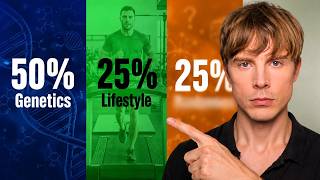
This video challenges the widely cited claim that longevity is 20% genetic and 80% lifestyle. Dr. Yuri Allen's research suggests that lifespan is actually about 50% genetic, 25% lifestyle/environment, and 25% stochastic noise (luck). The video explains the origins of the 80/20 rule, the role of genetics and lifestyle, and the implications for health optimization.
Chapters
Longevity is not 20% genetic and 80% lifestyle; it's closer to 50% genetic, 25% lifestyle/environment, and 25% stochastic noise (luck).
The 20% heritability estimate came from Danish twin studies (1870-1900) that didn't account for extrinsic mortality (deaths from infections, accidents, etc.).
When correcting for extrinsic mortality, lifespan heritability rises to about 50% for intrinsic mortality (deaths from natural causes).
Centenarian offspring have 62% lower all-cause mortality, 71% lower cancer mortality, and 85% lower coronary heart disease mortality. Having siblings who lived to 105 increases your chance of living to 105 by 35.6x.
Following seven core lifestyle pillars (physical activity, sleep, nutrition, stress regulation, social connections, avoiding harmful substances, consistency) can add 5-10 years to your life if your genetic potential is 80-90.
At 100-110, lifestyle adds only 1-2 years; at 60, going from unhealthy to healthy can add 10-20 years.
Genes like APOE4 (Alzheimer's risk), Lp(a) (heart disease), and LDLR affect longevity. Favorable genes include FOXO3 (stress resilience) and APOE2 (reduced Alzheimer's risk).
Controlling blood pressure, cholesterol, diabetes, and early screening can delay the 'trip wire' of disease, especially for those with poor genetics.
Your body is like a city: garbage (damage) accumulates as trucks (repair mechanisms) become less effective. Genetics determines your tolerance threshold (trip wire) for damage.
Randomness in development (e.g., blood vessel structure) and daily fluctuations (sleep, stress) contribute 25% to lifespan. Regular routines reduce this noise.
Sleep consistency (within ±30 minutes) is a bigger predictor of survival than total sleep duration. Most regular sleepers have 30-48% lower risk of death.
Lifespan is about 50% heritable, 25% environment/lifestyle, and 25% stochastic noise. In the 19th century, genetics mattered only 25% due to high extrinsic mortality.
Eliminating heart disease, cancer, and Alzheimer's won't stop aging; the final frontier is solving genetics to extend maximum lifespan.
The 80/20 rule is outdated; genetics plays a much larger role in longevity than previously thought. To maximize your lifespan, focus on the seven lifestyle pillars, understand your genetic risks, and maintain regular routines to reduce stochastic noise.
Mentioned in this Video
Study Flashcards (10)
What is the corrected heritability of lifespan according to Dr. Allen's research?
easy
Click to reveal answer
What is the corrected heritability of lifespan according to Dr. Allen's research?
About 50% genetic, 25% lifestyle/environment, and 25% stochastic noise.
11:17
Why did the original Danish twin studies underestimate heritability?
medium
Click to reveal answer
Why did the original Danish twin studies underestimate heritability?
They didn't account for extrinsic mortality (deaths from infections, accidents, etc.).
01:22
What is the 'trip wire' concept in aging?
medium
Click to reveal answer
What is the 'trip wire' concept in aging?
A threshold of accumulated damage that, when crossed, leads to disease or death. Genetics determines this threshold.
08:25
What are the seven core lifestyle pillars mentioned?
medium
Click to reveal answer
What are the seven core lifestyle pillars mentioned?
Regular physical activity, sleep quality, avoiding metabolic stress/obesity, stress regulation, social connections, avoiding harmful substances, and consistency.
04:54
How much can lifestyle add to lifespan if genetic potential is 80-90?
easy
Click to reveal answer
How much can lifestyle add to lifespan if genetic potential is 80-90?
An extra 5-10 years.
04:40
What is the impact of having siblings who lived to 105?
hard
Click to reveal answer
What is the impact of having siblings who lived to 105?
Increases your chance of living to 105 by 35.6x compared to the general population.
03:47
What is stochastic noise in the context of longevity?
medium
Click to reveal answer
What is stochastic noise in the context of longevity?
Randomness in development and daily physiological processes that contributes 25% to lifespan.
09:20
Why is sleep regularity more important than total sleep duration?
medium
Click to reveal answer
Why is sleep regularity more important than total sleep duration?
Sleep consistency (±30 minutes) is a bigger predictor of survival; most regular sleepers have 30-48% lower risk of death.
10:38
What is the 'city analogy' for aging?
easy
Click to reveal answer
What is the 'city analogy' for aging?
Your body is like a city: garbage (damage) accumulates as trucks (repair mechanisms) become less effective with age.
07:58
What is the maximum lifespan that has been observed?
easy
Click to reveal answer
What is the maximum lifespan that has been observed?
Around 120 years, with Jeanne Calment being the only person to live over 120.
02:54
💡 Key Takeaways
80/20 Rule Debunked
Challenges a widely accepted belief with new research, shifting the paradigm on longevity.
00:02Genetics' Strong Influence
Provides concrete numbers showing genetics' outsized impact on longevity, countering lifestyle-centric narratives.
03:21Sleep Regularity Over Duration
Offers a practical, actionable insight that sleep consistency is more important than total hours.
10:38Genetics as Final Frontier
Highlights that eliminating major diseases won't stop aging; solving genetics is the key to extending maximum lifespan.
12:13Full Transcript
[00:02] 20% genetic and 80% lifestyle. It doesn't matter what genes you have as course, there's an element of truth to that. If you're healthier, you will live longer. But every other human trait is closer to 50% genetic. Intelligence,
[00:16] personality, sleep chronotypes, they're all roughly 50% heritable. Why would longevity be any different then? Indeed, Dr. Yuri Allen is a physicist and systems biologist whose recent research suggests that longevity is much more
[00:29] recently published a study with his colleagues where they found that lifespan is roughly 50% genetic and roughly 50% non- genetic plus some unexplained varants things like your environment your lifestyle and what's
[00:42] called stochastic noise or luck. But I also wanted to make this specific video to clarify some of the details and to bring more attention to this. Also, if percentile to know what level of health you're at with various different types
[00:54] body composition, and blood work, what weaknesses, then take the health assessment in our top 1% health community link in the description. Let's start with why it was considered that
[01:06] longevity is only 20% genetic and 80% lifestyle. These claims originated from Danish studies done on twins born between 1870 and 1900. The estimated heritability of lifespan was about 26% in men and 23% in women. What's the
[01:22] recent analysis of these studies show that the Danish studies underestimated the lifespan heritability because they didn't consider extrinsic mortality enough. Extrinsic mortality refers to deaths from unnatural causes such as
[01:35] infections, poor hygiene, predation, starvation, plague, accidents, war, and violence. If you look at extrinsic and intrinsic mortality together, then the lifespan appears only modestly heritable. But when you look at only
[01:49] intrinsic mortality, there's a higher correlation. Once Dr. Alone corrected that, the Danish estimate rose from roughly the classic 23% towards about 50% for intrinsic lifespan. This suggests that genes play a much larger
[02:02] role in how long we live than older twin studies implied. When you look at older cohorts such as Swedish studies, Dr. alone's research also estimates that lifespan is around 50% heritable as opposed to 20 to 25%. In the 19th
[02:14] century, 25 to 30% of all deaths were due to tuberculosis. Before the middle of the 20th century, extrinsic mortality was extraordinarily high in human deaths. The reason was that antibiotics weren't invented and people could easily
[02:28] die to bacterial infections and there was no modern medical interventions. century, extrinsic mortality in significantly. Thanks to better living conditions and medicine, humans nowadays
[02:41] are living on average longer than ever before. And they have the opportunity to lifespan. Whereas in the past, it doesn't matter how good your genes were. If you died to plague, you're dead. This means that average life expectancy has
[02:54] been increasing roughly 6 hours per day over the last 150 years. However, maximum lifespan hasn't changed much. It stayed around 120 years. The 1995 bump is John Co who is the only person to have lived over 120. This means that the
[03:08] global gains in life expectancy have come from reducing extrinsic mortality with little to no progress in reducing intrinsic mortality. Let's talk about the power of genetics. Then according to Alon's research, longevity is about 50%
[03:21] heritable. A 2004 study on 295 centinarian offspring found they had a 62% lower risk of all cause mortality, a 71% lower risk of cancer specific mortality, and an 85% lower risk of coronary heart disease specific
[03:35] mortality. Being the sibling of a male non- Nigerian age 90 to 99 increases your likelihood of living to 90 by 1.73x, while having both a male and a female sibling who survived until the age of
[03:47] 105 increases your chance of living to 105 by 35.6x. six sex compared to the general population. That's an insane difference that's not explained by lifestyle or the environment. It means that people who have more favorable
[04:00] likelihood of living to the age of 100. That's the reason you hear all these anecdotal stories of your uncle living to 100 while smoking. It's not that There's mountains of evidence to suggest that smoking is very bad for your
[04:13] health. It's just that this grandpa either got lucky or he just has good exceptionally good longevity genetics, they're going to live an average lifespan. That average lifespan has been increasing over the last few hundred
[04:25] improved living conditions and better medicine. But it doesn't mean that something like that. So, how important is lifestyle then? According to Alon's estimates, lifestyle and the environment make up around 25% of longevity. If your
[04:40] genetic potential is to live to the age of 80 or 90, then following these seven core lifestyle pillars would add an extra 5 to 10 years to your life. Alone pillars to maximize your genetic potential are regular physical activity,
[04:54] sleep quality and consistency, avoiding metabolic stress and obesity with nutrition, stress regulation, social connections, avoiding harmful substances consistency and regularity in your behavior. Of course, there is a degree
[05:07] to which lifestyle matters. You can exercise semi-regularly like once or twice a week for 20 minutes. Or you can exercise every other day for 30 to 45 minutes. You can also be 15 to 20% body fat without metabolic disease. Or you
[05:19] can be 10 to 14% body fat as a male with perfect blood work. You can sleep 7 hours with 80% efficiency or you can sleep 7 to 8 hours with 95% efficiency. Both are lifestyle and both are adequate for normal health, but they are very
[05:32] different health conditions and arguably with quite different outcomes if you the healthier version will live longer in this scenario if the genetics was the same. The older you get, the less impact your lifestyle has on your longevity.
[05:46] I'm talking about the extremes of longevity. If you're 100 or 110 years old, living the most perfect lifestyle would maybe add an additional 1 to two years to your lifespan. But if you're 60 years old, going from a unhealthy
[05:59] reasonably add 10, 20 years to your lifespan. But first of all, no one's 110. There's not that many people in 100, not to mention 110. There's probably only a few dozen people. So,
[06:13] important your lifestyle is. And the worse your genetics, the more important about, you have less wiggle room. You can make fewer mistakes. The primary bottlenecks for people's longevity influenced by genetics include the APOE4
[06:27] gene which increases Alzheimer's risk, LP little A that is one of the most aogenic lipoproteins that increases heart disease risk, LDLR which affects There are hundreds of genes and thousands of them that can influence
[06:40] all of them. You also have favorable genes that promote longevity. Lower IGF-1 genes that reduce the risk of cancer. FOXO3 A genes that promote stress resilience and metabolism and APOE3 or APOE2 that reduce the risk of
[06:54] Alzheimer's disease and promote overall longevity. Having slightly worse genes doesn't mean that your fate is sealed. It just means that you have less margin attention to your lifestyle. Modern medicine can help to compensate for some
[07:07] reducing the chance that a vulnerability turns into early death. You can control your blood pressure better, treat your cholesterol, treat your diabetes, do early screening, and intervene earlier. By doing that, you delay the moment that
[07:20] someone crosses the disease trip wire. People with poor genetics benefit more from these interventions. But even if you eliminate all of the chronic and Alzheimer's, you would still run into the issue of age related decline in
[07:33] your body. As you age, your body gradually loses its ability to function. strength declines, kidney and liver functions drop, lung capacity shrinks, and your recovery from infections becomes weaker. Even without a specific
[07:46] disease, these declines reduce your ability to survive. Yuri alone explains aging with a simple analogy. Your body is like a city. There are structures that produce garbage, aka damage, and junk material. There are trucks that
[07:58] clean it up. When you're young, the trucks are able to clean things up. With age, garbage accumulates because the trucks become less effective and buildup is aging, especially scinesscent cells. The genetics doesn't control how
[08:12] doesn't control how many trucks you have to clean up the garbage. In Urian's framework, genetic mainly determines how much damage you can tolerate before something breaks. In other words, everyone has a built-in threshold, what
[08:25] he calls a trip wire. That's why two people can age in a broadly similar way, dementia or frailty much earlier than the other. People with good longevity They're more resilient. They can tolerate more accumulated damage, more
[08:40] inflammation, and more body dysfunction before crossing that trip wire. This is actually supported by the genes that we know affect longevity. APOE and LPA are good examples of genes that lower someone's threshold. FOX3 is a good
[08:54] example that raises it. The long-term solution may be gene editing. If scientists can identify the genes that influence aging, they may eventually be able to translate some of that knowledge into interventions and pills that would
[09:06] fix everyone's genetic weak points. And by doing that, we may add a few years to going to be enough to stop aging completely, but it will buy us more time biological aging. This will happen over the next 20 to 30 years. Lastly, a
[09:20] thought-provoking and underappreciated contributor to longevity according to Alon's research is stochastic noise or luck, which contributes 25% to someone's lifespan. Here's an example. During development, blood vessels grow through
[09:33] a partly random process. They branch out and extend towards areas that need oxygen, like your limbs. That process is guided by biology, but it is not essentially random the details of how the blood vessels are structured. So,
[09:46] better vascular layout, slightly stronger heart structure, and fewer tiny defects. Another person might have small imperfections that are not genetic, but they still lower their resilience over time. This process isn't determined by
[09:59] environment or lifestyle, not even that much genetics, but mostly through in the physiological processes of your body. Immune cells that help with cleaning up garbage fluctuate dayto-day. Sleep duration and sleep regularity
[10:12] change dayto-day and your stress levels and nutrient intake changes dayto-day. Circadian rhythms are slowly being recognized as a big contributor to aging is randomness in many things that influence your longevity, such as your
[10:25] your future life decisions, where you're born, who your parents are, as well as getting injured during sports or getting a concussion. Reducing that randomness and maintaining regular routines can help to reduce stoic noise. A specific
[10:38] example is sleep regularity. Sleep consistency, plus and minus 30 minutes, has been seen to be a bigger predictor of survival than total sleep duration. Most regular sleepers in the top 20% have a 30 to 48% lower risk of death
[10:51] compared to the least regular bottom 20%. Even after controlling for health, income, and lifestyle factors. Dr. Uri has seen this in his research that monks and nuns who follow very structured routines experience more predictable
[11:03] aging than their peers. All of the monks and nuns appear to die around the same similar structured routines. Overall, Dr. Alon's research is quite revealing and thoughtprovoking based on newer birth cohorts. Lifespan is about 50%
[11:17] heritable, 25% environment and lifestyle, and 25% stoastic noise or luck and randomness. When in the 19th century, genetics mattered only 25% other extrinsic factors. Then during the 21st century, genetics has started to
[11:31] matter a lot more than even in the 20th century because people are dying less and less to lifestyle diseases. People nowadays and in the future are way less likely to die to cancer and heart disease compared to even the 70s and
[11:43] are diagnosed with these diseases because the population has increased thanks to medicine and better living standards and we also have better conditions early. However, you're significantly less likely to die to
[11:58] medicine. If you completely eliminate heart disease, cancer, and Alzheimer's, important because that's the final frontier. The final frontier is your And that applies not to you as an individual, but to the human species as
[12:13] a whole. Right now, our genetics doesn't appear to allow us live to 500 years like some other animals. But we could figure it out by solving our genetics. who's trying to improve their health and live longer are these seven core
[12:26] principles that alone mentioned. Regular physical activity, sleep quality and obesity with nutrition, stress regulation, social connections, avoiding harmful substances like alcohol and smoking and consistency and regularity
[12:39] follow them casually. Follow them in a more optimal way. Try to not only be healthy but try to be optimally healthy. That's how you maximize your genetic genetic risks. Know if you have bad genes and understand your family history
[12:53] of diseases. If everyone gets heart disease in your family, then that's a Third, preventive healthcare is super important. Track your biomarkers at least semi-regularly. Address your biggest risk factors and intervene early
[13:06] if necessary. But for now, definitely check out the full podcast with Dr. Uri check out the full podcast with Dr. Uri alone.