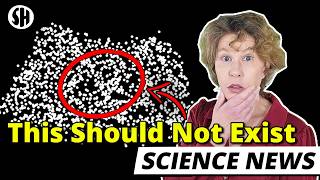

Biggest Thing in Space After Elon's Ego?
45sThe humorous comparison to Elon Musk's ego grabs attention, and the shocking size of the ring sparks curiosity.
▶ Play Clip"Delivers on the promise of a cosmic anomaly, but includes a lengthy sponsor segment and some speculative commentary."
Astrophysicists have discovered a colossal ring of galaxy clusters, dubbed the 'Giant Ring,' spanning 3 billion light-years, which challenges the standard model of cosmology. The structure, inferred from quasar absorption data, is statistically unlikely to exist under current theories, prompting debate about its validity and implications.
Scientists found a giant ring of matter, a suspicious arrangement of hundreds of galaxy clusters with a diameter of 3 billion light-years, which mathematically should not exist.
The Giant Ring is in the northern sky near the Big Dipper, in the constellation Boötes, about 7 billion light-years away and 3 billion light-years (30 trillion km) across. It is extremely faint and invisible to the naked eye.
Astrophysicists inferred the ring's presence by observing quasars behind it. Light from quasars passing through gas is partially absorbed, revealing the gas's presence. Most matter in the universe is gas, not stars or planets.
The current model of the universe (hot plasma with small fluctuations) predicts that structures of this size should not exist. The Great Ring is incompatible with the mathematics of structure formation.
The Great Ring is an outlier at about 4 sigma, with a chance of about 1 in 20,000 of occurring coincidentally. This does not account for other similar large structures found.
The Giant Ring is near the 'Giant Arc' and 'Big Ring' structures. Other large structures include the Clowes-Campusano-Quasar group (1991) and the 'Great Wall' (2003), all larger than expected.
The Big Ring alone is an outlier at 5.2 sigma, with a probability of less than 1 in 3 million by chance. Combining all structures makes their existence stunningly unlikely.
Many observations come from the same group (Roger Clowes at University of Lancashire), and their statistical methods have been criticized. The issue is similar to quantifying rare weather events: adding details reduces the sample size, leading to potential false positives.
The presenter gives the paper a 5 out of 10 on the bullshit meter, not because it's wrong but because of statistical wariness. They suspect other groups would find similar results, but independent confirmation is needed.
The real story is that most astrophysicists seem uninterested in investigating this problem. It could be a crack in cosmology, a statistical artefact, or something else entirely.
The Giant Ring is a fascinating anomaly that challenges our understanding of the universe's structure, but its statistical significance is debated. Independent verification is needed to determine if it's a genuine cosmological crisis or a statistical artifact.
What is the Giant Ring and how big is it?
A giant ring of galaxy clusters with a diameter of 3 billion light-years.
How was the Giant Ring detected?
By observing quasars behind it and measuring absorption of their light by intervening gas.
01:02
Why does the Giant Ring pose a problem for cosmology?
Because current models predict structures of that size should not exist given the universe's age.
01:37
What is the statistical significance of the Giant Ring?
It is an outlier at about 4 sigma, with a chance of 1 in 20,000 of occurring by chance.
02:07
What are two other large structures mentioned?
The Giant Arc and the Big Ring.
02:25
What is the Clowes-Campusano-Quasar group?
A group of 34 quasars extending over 2 billion light-years, found in 1991.
02:55
What is the 'Great Wall'?
A collection of galaxies about 1 billion light-years away extending over 1.5 billion light-years.
03:07
What is the statistical significance of the Big Ring?
It is an outlier at 5.2 sigma, with a probability of less than 1 in 3 million by chance.
03:24
What is the main criticism of the Giant Ring observations?
The statistical methods may be flawed due to the 'look-elsewhere effect' and lack of independent confirmation.
03:36
Discovery of Giant Ring
A structure that challenges the standard model of cosmology.
Statistical Outlier
The 4 sigma significance indicates a very low probability of chance occurrence.
02:07Statistical Criticism
Highlights the potential for false positives in rare structure searches.
03:36Lack of Interest
Most astrophysicists are not investigating this anomaly, which is surprising given its implications.
05:12[00:00] Scientists just found the biggest thing ever, right after Elon Musk’s ego: it’s a giant ring of matter out there in the cosmos, a suspicious arrangement of
[00:12] hundreds of galaxy clusters with a diameter of 3 billion lightyears. It’s not just amazing, it's also a big problem because the mathematics says that it shouldn’t exist.
[00:25] Just exactly what did they observe and what does it mean? I have a brief summary. The new Giant Ring lies in the northern sky, near the Big Dipper, in the direction of the
[00:38] constellation Boötes. They named the giant ring the giant ring which is good because let’s be honest no one has any idea what Boötes is or how to pronounce it. The giant ring is about
[00:50] 7 billion light years away from us and 3 billion light years – or 30 trillion kilometres across. You can’t see it in the night sky because it’s incredibly faint. In fact, it’s so
[01:02] faint that even the astrophysicists didn’t actually see it. Instead, they inferred its presence by looking at incredibly bright objects, called quasars, that are behind the ring. This data comes from the Sloan Digital Sky Survey. When the light
[01:19] from the quasars passes through gas on its way to us, some colours are partly absorbed. And from this absorption one can infer the presence of the gas. What’s so important about gas? Actually most of the matter in the universe is in the form of gas, not in stars or planets.
[01:37] The problem is though that our current model of the universe says such a structure should not exist. You see, physicists currently believe that the universe began with a very hot plasma that was mostly smooth with some small fluctuations in it. The universe expands and the
[01:55] plasma cools and begins to clump. It forms stars and galaxies and galaxy clusters and, well, big clouds of gas. How big those clumps can get depends on how much time
[02:07] has passed. And the Great Ring just shouldn’t be there. It’s not compatible with the maths. The authors of the new paper say it’s an outlier at about 4 sigma, meaning it’s very unlikely to occur just coincidentally, at a chance of about 1 in 20 thousand. And this is
[02:25] just the Great Ring alone, this doesn’t take into account that astrophysicists have found other such big structures. Indeed, the astronomers found the Giant Ring near two other mega structures called the “Giant Arc” and the “Big Ring” . Both
[02:41] of those have been found in the past years. But there have been other large structures which have been found earlier. Already in nineteen-ninety-one, they found a group of thirty-four Quasars, about the same distance as the big ring that
[02:55] extends over two Billion Light-years. It’s called the Clowes-Campusano-Quasar group. Since 2003 astrophysicists also know the „great wall“, that’s a collection of galaxies
[03:07] about a billion light years away from us that extends over 1 point 5 billion light years. That too, is larger than it should be. None of these structures should exist, and if you were to combine the statistical unlikeliness it’d be stunning. The Big Ring alone has been
[03:24] reported as an outlier at 5 point 2 sigma, meaning it has a probability of less than one in 3 million to have appeared by chance. And that doesn’t factor in all the other big structures.
[03:36] What does that mean now? One word of caution I must add is that many of those observations come from the same group around Roger Clowes at the University of Lancashire. They’ve been criticized for how they calculate the statistical significance of their observations.
[03:53] The problem is quite similar to the problem of quantifying how rare an extreme weather event is. You see, the more details you add about the event or structure whose likeliness you want to quantify, the fewer of those there are. I mean,
[04:08] why just search for rings? Why not search for the shape of a giraffe or I dunno, a middle finger? You could do all these things, and the more you try, the more likely you are to find something. Then you forget to mention all the different things you tried and insist
[04:24] it was extremely unlikely to find whatever you did find. That’s cheating with statistics 101. Now look, I am not saying it’s what they did. I am just saying this is a common pitfall in such analyses and I would be more comfortable if there were
[04:39] multiple independent studies on the matter. This is why I give this paper a 5 out of 10 on the bullshit meter. Not because it’s wrong but because I’m wary. That said, I suspect that if other groups were to look at this, they would arrive at a similar
[04:55] conclusion, because we have other evidence that matter in the universe isn’t distributed the way our current theories say. We discussed this a few times in the past. To me the real story here is that most astrophysicists seem to be remarkably uninterested in even looking at this problem.
[05:12] It may be a crack in cosmology, a statistical artefact, or the universe’s attempt to propose to Boötes, whoever that is.
[05:24] I do a lot of online research, and I hate the idea that third parties are tracking what I read, what videos I watch, and what I search for. If you care about your privacy, encrypting your
[05:37] internet traffic is non-negotiable. And this is why I use NordVPN. NordVPN is an app that makes your internet connection ultra secure. You install it on your phone or laptop and use it to create a
[05:50] safe connection. But it's not just that. NordVPN comes with a malware shield that warns you of fake shops, malicious ads, malware, and fishing attempts. For Android users, they now also
[06:02] display a scam detection warning during incoming calls. It doesn't just protect your privacy, it also makes your life easier. You see, NordVPN has thousands of servers all over the world, and you can choose one. This allows you to access websites in other countries by using
[06:18] a server located there. I find this especially convenient to get around all the blockages on US pages for visitors from the European Union. NordVPN is a high quality product that I'm happy to recommend. If you want to try it out yourself, use my link nordvpn.com/sabine or the
[06:37] coupon code SABINE for my special offer. Thanks for watching. See you tomorrow.



⚡ Saved you 0h 06m reading this? Transcribe any YouTube video for free — no signup needed.