
Your Thigh Size Predicts Heart Disease?
44sThe shocking claim that thigh circumference under 60 cm doubles cardiovascular risk sparks curiosity and health anxiety.
▶ Play Clip"The title promises 'weird body parts' but delivers standard health metrics — a mild oversell, though the content is genuinely informative."
The video discusses five body measurements that are scientifically linked to lifespan and disease risk. It covers hip circumference, head circumference, waist size, calf circumference, and grip strength, providing specific thresholds and explaining the underlying health connections.
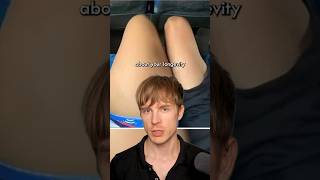
A 12-year Danish study found that hip circumference under 60 cm doubles the risk of cardiovascular disease and premature death. The protective effect stabilizes around 60 cm, likely reflecting leg muscle mass and metabolic health.
Head circumference, a proxy for brain volume, is linked to Alzheimer's risk. Larger brain volume provides more cognitive reserve, delaying symptom onset.
A study of 650,000 adults showed that every 5 cm above the optimal waist size reduces lifespan. The optimal waist circumference is under 90 cm for both men and women.
Calf circumference below 35 cm is an independent predictor of higher mortality. It serves as a proxy for skeletal muscle mass and is one of the simplest ways to measure it.
Grip strength is a powerful biomarker of health and longevity. Low grip strength correlates with type 2 diabetes, hypertension, cardiovascular disease, dementia, and mortality.
These studies are correlational — healthier people tend to have larger calves, hips, and forearms. The advice is to focus on regular exercise, adequate muscle mass, and lower body fat, not on optimizing specific measurements.
What hip circumference threshold doubles the risk of cardiovascular disease?
A hip circumference under 60 cm doubles the risk of cardiovascular disease and premature death.
00:01
What is the optimal waist circumference for both men and women?
A waist circumference under 90 cm is optimal for both men and women.
00:53
What calf circumference is considered a predictor of higher mortality?
A calf circumference below 35 cm is an independent predictor of higher mortality.
00:53
How much does each 5 cm above optimal waist size reduce lifespan?
Every 5 cm above the optimal waist size reduces lifespan.
00:26
List the health conditions correlated with low grip strength.
Low grip strength correlates with type 2 diabetes, hypertension, cardiovascular disease, dementia, and mortality.
01:08
Hip circumference under 60 cm doubles CVD risk
Provides a concrete, actionable threshold for a simple body measurement that predicts serious health outcomes.
00:01Every 5 cm above optimal waist reduces lifespan
Quantifies the impact of waist size on longevity, making the risk tangible and motivating.
00:26Grip strength as a powerful biomarker
Highlights a simple, non-invasive test that correlates with multiple chronic diseases and mortality.
01:08Correlation, not causation
Clarifies that these metrics are markers of overall health, not targets to optimize in isolation.
01:20[00:01] пять показателей, которые, как показано, влияют на продолжительность вашей жизни. Во-первых, окружность бедра. В ходе 12-летнего датского исследования было установлено, что обхват бедер менее 60 см в два раза повышает риск сердечно-сосудистых заболеваний
[00:13] и преждевременной смерти. Защитная функция стабилизировалась на уровне около 60 см. Таким образом, нужно просто избегать маленьких бедер. Более массивные бедра, вероятно, отражают большую мышечную массу ног и лучшее состояние обмена веществ . Второй показатель — окружность головы. У
[00:26] вероятность развития болезни Альцгеймера в три раза выше . ниже риск развития болезни Альцгеймера, так как они умирают раньше. У людей с большим объемом мозга больше когнитивный резерв и большая мозговая масса, а это
[00:39] до появления симптомов болезни Альцгеймера. Третий пункт – обхват талии. Исследование, проведенное среди 650 000 взрослых, показало, что каждые 5 см превышения оптимального размера талии сокращают продолжительность жизни. Оптимальный обхват талии как для мужчин, так и для женщин находится
[00:53] в нижней части диапазона, составляя менее 90 см. Четвертый показатель — окружность голени. Обхват голени менее 35 см является независимым фактором, предсказывающим более высокую смертность показатель массы скелетных мышц и один из самых простых способов измерения.
[01:08] Пятый пункт: сила хвата или размер предплечья. Сила хвата является мощным биомаркером здоровья и долголетия. Низкая сила хвата коррелирует с диабетом второго типа , гипертонией, сердечно-сосудистыми заболеваниями, деменцией и смертностью. Чем больше
[01:20] , эти исследования основаны на выявлении взаимосвязей. Это значит, что люди с , будут иметь более крупные икры, бедра, предплечья и т.д. Поэтому вам не обязательно стремиться к оптимизации или наращиванию
[01:35] икроножных мышц или увеличению размера бедер. Вам просто нужно заниматься спортом, иметь достаточную мышечную массу и немного меньше жира в организме. процентный показатель здоровья, оценить свой уровень здоровья по различным
[01:49] состав тела и анализы крови, а также выявить свои слабые места и основные assessment in our top 1% health community. Link in the description.
⚡ Saved you 0h 01m reading this? Transcribe any YouTube video for free — no signup needed.