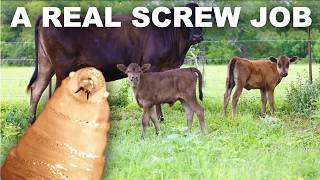

Sterile flies are saving your beef
46sStarts with a bizarre government program that sparks curiosity and challenges viewers to question their first reactions.
▶ Play Clip"标题戏剧化但准确,视频确实解释了螺旋虫如何影响牛肉供应,并提供了背景和原因。"
视频介绍了新世界螺旋蝇(screwworm)重新入侵美国的问题,这种害虫的幼虫以活体组织为食,严重威胁畜牧业和人类健康。过去美国通过释放不育雄蝇成功根除了螺旋虫,但近年来由于气候变化、移民和人为因素,螺旋虫再次出现,可能导致牛肉价格上涨。
美国政府在巴拿马繁殖不育雄蝇以控制螺旋虫,这对牛肉产业至关重要。
螺旋虫幼虫(Cochliomyia hominivorax)以活体组织为食,威胁牲畜、宠物和人类。
美国农业官员报告自1960年代以来首次确认螺旋虫感染到达美国本土。
虽然60年前通过不育雄蝇技术根除了螺旋虫,但2026年夏天再次出现,且可能成为问题。
雌性螺旋蝇只交配一次,使用特殊的储精器官储存精子,这为不育雄蝇技术提供了基础。
Edward Nippling和Raymond Bushland在1930年代提出:繁殖并释放大量不育雄蝇,使其与雌蝇交配但产下未受精卵,从而减少种群。
1950年代在佛罗里达试点,到1960年代末将螺旋虫赶出美国南部;1990年代赶出墨西哥;2000年代初到达巴拿马达连隘口。
螺旋虫在巴拿马逃脱控制,2024年在墨西哥爆发,原因可能是气候变化、人类迁移和牲畜走私。
特朗普政府下的DOGE(政府效率部门)削减了USAID资金,导致联合国粮食安全项目中螺旋虫监测和防控项目被关闭。
DOGE和特朗普政府解雇或迫走约2万名USDA员工(占15%),造成机构知识流失,影响螺旋虫防控。
USDA确认了5例美国本土传播的螺旋虫感染(德州3头牛、1只山羊,新墨西哥州1只狗),为自1966年以来首次。
螺旋虫可以用廉价抗寄生虫药治疗,但需早期发现;对人类食品安全威胁很小,但可能构成职业安全风险。
目前不育雄蝇产能不足,但正在与墨西哥合作新建设施,预计一年内可达到重新根除所需能力。
视频最终强调全球互联性:富国在穷国抗疫也是自利行为,并高度评价了公共研究机构(如Edward Nippling)的重要性,指出所谓的“深州”中也有造福社会的科学家。
新世界螺旋蝇的学名是什么?
Cochliomyia hominivorax
04:04
为什么雌性螺旋蝇只能交配一次?
雌蝇有一个特殊的储精器官,第一次交配后会被装满,后续交配的精子无处容纳。
07:14
不育雄蝇技术是如何控制螺旋虫种群的?
繁殖大量不育雄蝇并释放,使其与雌蝇交配但产下未受精卵,从而减少下一代数量。
07:48
美国上一次螺旋虫本土感染发生在哪一年?
1966年(第一次);最新确认是在2026年6月(自1966年以来首次)。
15:18
哪种寄生虫可以治疗螺旋虫感染?
廉价抗寄生虫药(具体名称未提及,但可早期治疗)。
15:33
DOGE撤销了哪项与螺旋虫相关的资金?
USAID对联合国粮食安全项目中螺旋虫监测和防控的资助。
12:46
螺旋虫疫情导致美国暂停了从哪里的活牛进口?
墨西哥。
11:49
Edward Nippling和Raymond Bushland在什么背景下提出了不育雄蝇技术?
Nippling在得克萨斯州的农场长大,目睹螺旋虫危害,后成为昆虫学家,与Bushland一起在USDA工作。
06:44
不育雄蝇创新技术
一个基于昆虫生殖弱点的高效、环保的害虫防控方法,曾成功根除螺旋虫。
07:48气候变化与螺旋虫北移
迅速变暖的气候使螺旋虫更易在美国存活,展示了气候变化对农业和公共卫生的直接威胁。
10:22DOGE削减监测项目
政治决策(政府效率部门)切断关键监测资金,可能直接导致防控能力下降。
12:46USDA大规模裁员
15%的机构知识人员流失,削弱了应对新疫情的能力,凸显制度知识的重要性。
14:07全球互联性与自利援助
富国在穷国抗疫不仅出于道义,更是自利行为,因为害虫可以通过自然方式跨境传播。
17:29[00:00] If I were to tell you that the US government breeds sterile male flies to mate with female flies in Central America, you might ask, why? Why is a perfectly reasonable response to that?
[00:16] That's ridiculous, that's a scam on the American taxpayer, that is not a reasonable response, but why absolutely is? Curiosity, curiosity, my friends, curiosity over reflexive anger and
[00:33] suspicion, curiosity over anger. If something doesn't make any sense to you, don't get mad, get curious, and then get mad, if warranted. Anyway, as many people are learning the hard way right now,
[00:50] the whole sterile fly breeding thing is actually really important for the US beef industry, especially. Why? Well, let me see if I can put this in the most dramatic way possible while
[01:03] still being essentially accurate. That was my job. Back when I wrote copy for traditional broadcast news organizations, most dramatic way possible while still being true. A worm that feasts on
[01:18] living flesh is coming for your livestock, for your pets, and maybe even for you. In recent weeks, US agriculture officials have reported the very first confirmed
[01:33] screw worm infestations to reach mainland United States since the 1960s. The way that we eradicated them back then was by breeding sterile male flies and releasing them,
[01:49] eventually mostly in Panama. That effort, as much as any other, is what allowed the southwestern cattle industry to thrive in the US, which reminds me to thank thrive market sponsor
[02:03] of this video. If you're looking to keep certain ingredients out of your diet or to eat a certain way, or if you just want super high quality groceries, consider a thrive membership. Five dollars a month gets you access to curated, vetted food and personal care products that you can trust.
[02:20] Cleaning products too, this is a nice no harsh chemical surface cleaner. Thrive works around a thousand plus restricted ingredients, so whatever you need for your diet, they've got. Set your shopping
[02:32] preferences, grain free, vegan, allergy friendly, high protein, whatever, and then just get to shopping. On top of their beautiful fresh meat and seafood selection, I quite appreciate the snacks, they have excellent snacks. I like these avocado oil potato chips, gluten free heavenly hunks.
[02:50] That's what they called me in my housemates in college. Their house brand organic olive oil is really nice. Save with everyday affordable prices. Your annual membership unlocks all your favorite products at up to 30% off retail value, and you can't sell it within 30 days. If you're on a restricted
[03:06] diet, $5 a month is worth it just for the shopping filters alone, and they do take snap benefits. Join Thrive Market and stock up for summer. Use my link thrivemarket.com slash adda magusia,
[03:20] get $20 off your first three orders, and a free gift. Thank you Thrive Market. Anyway, we drove screw worm fully out of the United States 60 years ago by breeding sterile flies. It worked,
[03:35] but now, as of this summer, the screw worms are back, and it's probably going to be a problem. Not a beef industry ending problem, but a problem that will probably raise prices.
[03:51] And if you're looking for blame, there is plenty to go around. Though the distribution may not be strictly speaking equal, I actually think that the subject of blame is still an open question here,
[04:03] and we will get back to that. The new world screw worm is technically not a worm. It is the larval stage of a fly. See hominivorex, which means that it is technically a maggot rather than a worm,
[04:19] and maggots eat flesh. Flies are attracted to the smell of dead or dying animals. The females lay their eggs, and when they hatch, the maggots fuel their rapid growth with readily
[04:34] available animal protein. This is not unusual. People across cultures have four millennia use maggots to clean wounds. They eat in a chronic tissue, the dead part of the wound that you need to get rid
[04:49] of. maggots do not eat living tissue. Unless you're talking about sea hominivorex. The larvae of the new world screw worm do eat living flesh, which is reason number 10,000 and one
[05:07] while you probably shouldn't administer surgical maggots to your own wounds, because you might have the kind that eat live tissue, not the dead tissue, and that would be very bad. The fact that
[05:19] sea hominivorex eats live tissue presents a problem not only to ranchers, but to forensic scientists who use the presence of maggots on a body to determine the rough time of death.
[05:33] That estimate will be wrong by several days if the maggots happen to be new world screw worms, because they can start eating long before rot has set in. So if you need to dump a body,
[05:46] dump it with some new world screw worms, and that might throw them off your trail for just a little bit. JK, anyway, the screw worm generally enters through a wound. That's how sheep and cattle and such usually
[05:59] become fly struck as they say. The animal gets a little scrape. The mama flies smell it and they lay their eggs. The larvae hatch and then they burrow deep into the animal in the manner of a screw,
[06:16] looking for healthy tissues to eat, and that damage leads to bacterial infection that eventually kills the animal. This used to cause significant losses for the livestock industry in the parts of
[06:28] the Americas that are very hot and humid, which is what the screw worm likes. Florida, for example, the Caribbean. South America, Central America, Mexico, and up into Texas, where in 1909, a guy named
[06:44] Edward Nippling was born. He grew up on his dad's ranch. He saw how awful the screw worm was. He trained as an entomologist, went to work for the U.S. Department of Agriculture, where he met
[06:57] Raymond Bushland and the two of them cooked up an idea. They noticed that the new world screw worm fly has a curious reproductive vulnerability. The female has a special sperm storing organ.
[07:14] The male fills it up and then she has all the sperm she will ever need to fertilize eggs for what remains of her weeks-long lifespan. If another male tries to mate with her after that, his contribution
[07:30] will have nowhere to go, so the females effectively can only mate once. What these two young scientists in the 1930s figured was, well, what if you flood the zone with sterile male flies?
[07:48] You breed the flies, you irradiate them to kill their sperm, then you release a ton of them into the target area. They hopefully outcompete the fertile males, they shoot their blanks, and then all of the
[08:03] eggs those females lay will never, ever hatch. That work was interrupted by World War II. Reason number 10,001, why war is bad? We could have eradicated screw worm decades earlier, but
[08:21] they got back to it in the 50s, they did a pilot program in Florida, and by the late 60s, they had pushed the screw worm entirely out of the southern United States. By the 90s, they had pushed it out of Mexico, and by the early 2000s, they had reached the Darian gap,
[08:39] that little narrow isthmus in Panama that just barely bridges North and South America. The US and the Panamanian government partnered on a sterile fly factory down there that still operates,
[08:53] and for a while, we were able to contain the screw worm pretty cheaply, because you don't need that many sterile flies to cover an incredibly narrow land area. We had cut them off effectively.
[09:08] But then they started creeping back up North. There was a little outbreak in the Florida Keys in 2016. It affected like half a dozen domestic dogs and such, but mainly it got the key deer,
[09:25] which are these adorable like many deer that roam wild on the Keys, which are islands off the southern tip of Florida if you didn't already know that. Nobody knows how the flies got to the Keys.
[09:37] They could have blown there on strong winds from Caribbean islands, maybe an infected pet or a livestock animal was introduced by someone, but the Keys are a small, contained area. The government
[09:50] introduced some sterile flies and that took care of the problem in a few months is going to be a lot harder down in Texas. The screw worm escaped containment in Panama and caused an outbreak in
[10:04] Mexico in 2024. Why? How? Nobody knows. But the relevant scientists who have been speaking on this topic publicly say that it is probably some combination of the rapidly warming climate,
[10:22] making the environment much more hospitable for screw worms up here, and perhaps human migration. People fleeing violence and drought in Central America looking for safety further north,
[10:37] a few bringing livestock with them. Humans can also be infected any any warm-blooded animal can. Between climate change and migration, there's something for every U.S. political faction to blame
[10:52] this on, and that's what really matters, right? I will point out that northward migration is in part driven by climate change, so same difference. Also, there's a third possibility that it's spread via
[11:08] cattle smuggling. There is a well-documented problem of ranchers grazing cattle illegally in the relatively unstable countries of Central America, where you can get away with grazing on government land,
[11:21] or nature preserve, that kind of thing, and then you smuggle the cattle into Mexico where there's a big market for it. When screw worm popped up into Mexico again, officially confirmed in late 2024,
[11:34] everybody knew it was only a matter of time until it got back to the U.S. It could spread up here via wild animals. The key deer outbreak that proved as much. There is also cattle smuggling that happens
[11:49] across the U.S. Mexico border. We immediately shut down live cattle imports from Mexico when all of this started back up, but that probably creates an even greater incentive for smuggling.
[12:01] Everybody knew that screw worm was coming back to the U.S., but this all came to a head right at the transition between the Biden and the second Trump administration. Upon retaking office, Trump tasked his
[12:15] funder, Elon Musk, with rooting out ostensibly wasteful government spending, the so-called department of government efficiency or doge. Here is what we know and what we don't know about doge
[12:30] and screw worms. Doge did shut down USAID, the foreign aid agency, and in doing so, they cancelled U.S. funding for United Nations Food Security programs. Among the programs defunded were
[12:46] bird flu and screw worm monitoring and containment efforts, and shortly after U.S. funding was cut, those programs were shut down. That is all according to an anonymous source cited by the agricultural
[13:02] trade publication AgriPulse. When people say that doge cut money to stop the screw worms, they are citing this singular report with an unnamed source. That is, in the opinion of this
[13:20] former journalism teacher, Thinsourcing. I'm not saying it's wrong. It definitely seems like something that would have happened. We know that doge was just cutting things that they didn't recognize
[13:35] or understand, and fly monitoring in Panama for sure sounds like something that they just would have cut, but we have to be careful here. We ought not round probable up to certain. Unlikely outcomes
[13:50] happen all the time. What we know for sure is that US response to screw worm is centered on the US Department of Agriculture, and doge and the Trump administration fired or otherwise pushed out about
[14:07] 20,000 USDA employees right as this screw worm situation was really starting to heat up. That is about 15% of the USDA workforce, and all of their institutional knowledge just gone almost overnight.
[14:24] How that effective the screw worm problem is something I doubt we will know for years, once some tell all books have been written. Regardless, the agricultural lobby obviously succeeded pretty
[14:39] quickly in ringing alarm bells with the Trump administration because starting in the spring of 2025, we started partnering with Mexico on building a bunch of new sterile fly production facilities, and we started building a big new one in Texas that won't be operational for another year.
[14:58] Bad news. Considering that just this month, June of 2026, the USDA confirmed five screw worm cases. The first mainland US domestically transmitted cases since 1966. Three heads of cattle and a goat in
[15:18] Texas and a dog in New Mexico, it begins. Just because an animal is infected doesn't mean it's a loss. You can easily treat screw worm with cheap anti-parasitic drugs if you catch it reasonably early,
[15:33] but that requires catching it reasonably early. Regarding humans, none of the experts are raising any alarm about this from like a food safety perspective.
[15:46] It could be an occupational safety issue. A person working on a ranch, the flies can lay their eggs on a scrape or a cut, but also any other body opening. That's fun.
[15:59] Look, this is a problem that we know how to fix and we've fixed it before. We'll probably fix it again. The experts say we do not have the sterile fly capacity to re-eradicate screw worm just yet,
[16:14] but we should have it soon, ish. In the meantime, ranchers will be spending lots of extra time and resources in monitoring their herds and treating any infections. This will cost money.
[16:29] Beef is already quite expensive right now. For a few reasons, but the biggest one just being drought. The US cattle population is at a 75 year low right now, chiefly due to drought.
[16:43] The industry analysts that I've seen commenting on this issue say that screw worm will probably just keep the prices high, roughly where they are, for quite a while longer, unless the problem gets really
[16:55] out of hand. That's not why I am talking about this. I think that we could all stand to eat a lot less beef for a lot of reasons, so I don't particularly mind a little upward price pressure.
[17:11] Easy for me to say. Sit in here with my YouTube money. Your consumer activity is your own business. The reason I just talked about screw worm for however many minutes that was is that this is a situation that reminds us yet again how interconnected our
[17:29] whole world is. A rich country spending money to fight disease in a poor country isn't just about doing a good deed. It is also self-interest. Sometimes all it takes is a stiff breeze to make
[17:45] somebody else's problem your problem. Which is another reason why I am grateful to have a large professional civil service working for me, and I am proud to pay for it with the sickening amount
[18:01] that I pay in Texas every year. A century ago the government took a ranch kid in Texas, the government trained him at public research universities, hired him to be a bug scientist,
[18:15] and that guy came up with a fix for screw worm. When people talk derisively about the deep state, they are talking about some real things that are really bad. I will grant you, but they are also
[18:28] talking about Edward Nippling. Edward Nippling was also the deep state, and it's a good thing he was because his research is what is going to save us from the flesh eating worms. Thank you for your service,




⚡ Saved you 0h 18m reading this? Transcribe any YouTube video for free — no signup needed.