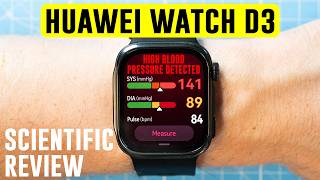

Huawei Watch D3 Inflates on Your Wrist to Measure Blood Pressure
45sThe unique inflating mechanism and personal stakes of high blood pressure create an immediate hook for health-conscious viewers.
▶ Play Clip"The title promises a review, and the video delivers exactly that — honest testing and a clear verdict."
The Huawei Watch D3 is a smartwatch that measures blood pressure by inflating a cuff around the wrist, offering a more traditional approach than other wearables. The reviewer tested it over several days and found it reasonably accurate for systolic pressure but with limitations for higher values. The video concludes that while the device has promise, it may not be suitable for everyone, especially those with high blood pressure.
The Huawei Watch D3 measures blood pressure by inflating a cuff on the wrist, unlike other devices that estimate from heart rate waveforms.
The device also offers nightly measurements, enabling a 24-hour blood pressure protocol.
About 80% of measurements were within 10 mmHg of reference devices, but the watch struggled to detect higher values above 140 mmHg.
The watch has a loose fit during exercise, which affects accuracy and comfort.
The reviewer concludes that the watch is not suitable for his situation but could be valuable for others with higher blood pressure fluctuations.
Inflating cuff method
Explains the unique mechanism that sets this device apart from other wearables.
00:15Accuracy within 10 mmHg
Provides a concrete metric for the device's reliability.
10:05Limitations for high blood pressure
Highlights a critical flaw for users with elevated blood pressure.
10:48Personal health needs matter
Emphasizes that the device's usefulness depends on individual health profiles.
12:40[00:00] Huawei just announced their Huawei Watch D3, which could be good news for me because I have relatively high blood pressure and especially a family history of high blood pressure. And this device actually inflates to measure your blood pressure on the wrist.
[00:15] So unlike some other devices which try to estimate your blood pressure from the waveform of your heart rate, this actually measures your heart rate in a more traditional way by actually inflating. Now the blood pressure monitors you might have at home like this one right here actually
[00:30] inflate around the upper arm and the Huawei Watch T3 now does it around the wrist. But there are also other consumer devices like this out there meant for the wrist. So this is a very viable option and probably a lot better data quality than what you get
[00:47] from these rough estimations based on your heart rate. So let's actually dive into some testing that I did. but first I want to make a few remarks about how I did that testing and what the limitations are
[00:59] you should see this as an initial review I tested it for a few days and I did the measurement as good as I could so the way you actually do it is you put it on your wrist and then you start the
[01:12] measurement so the way it works is while you're measuring you're not supposed to talk but you'll hold your arm or basically device at heart height and then it estimates your blood pressure by inflating. I can now feel it pumping up as the values actually increase right here and it gets
[01:30] to be quite uncomfortable or slightly uncomfortable and then it also measures at night if you want. So you can also get nightly blood pressure measurements and thereby you basically get a 24-hour protocol. But the way I set it up is that during the day it prompts me to take a measurement
[01:46] and then I actually have to start it whereas at night during your sleeping window it automatically starts and you don't have to do anything. Now as I said this is probably the best way of getting reliable blood pressure measurements and the way I tested it is that by each time I took a
[02:02] measurement with the watch I also took three measurements with either this blood pressure monitor from Omron or this blood pressure monitor from Boirer and I actually tried to use both so I took six measurements three with this device three with that device and then I take the median value
[02:18] of that and compare that to the measurement of the Huawei Watch. However, first I was curious, if I take a measurement with both devices, how good is the agreement there? Well, here I made a plot of some of those measurements.
[02:32] By the way, for those of you who are new to the channel, my name is Rob and I'm a postdoctoral scientist specializing in biological data analysis and as always that will be the focus of this video, an initial quick data analysis of the blood pressure measurement of the Huawei
[02:46] watch d3 which as you can see is already a lot smaller than the initial Huawei watch so let's actually put them side by side this on the left right here is the d3 whereas on the right here
[02:58] is the original version the d1 which is a lot bigger then came the d2 right here which is still a little bit bigger than the d3 and you can especially see that here in the cuff part of the
[03:10] watch. However, overall, the Huawei Watch D3 isn't a whole heap smaller than the D2. It's mostly in the strap part, less so in the actual watch part. But yes, it does look a bit better and it's also
[03:24] a bit more sleek. The screen is a bit bigger. Overall, it's definitely an improvement. But as I said, let's take a look at the data quality. But before doing that, I want to see how close are the measurements from these two consumer devices that you can buy to measure your blood pressure And of course we looking in a relatively narrow range So from a systolic blood pressure I had from let say 112 until 125
[03:51] with along the horizontal axis the median measurements according to the OMRON and then comparing that to an individual measurement of the other device or the Boira. So the same way we're going to look at the Huawei Watch D3.
[04:04] And there we can see a clear correlation, so the points do form a nice line right here in red that is parallel to the perfect correlation line right here. However, on average, the Boehrer measured slightly higher blood pressure values than my Omron,
[04:22] at least when it comes to the systolic blood pressure. And that is mostly also true for the diastolic blood pressure, so the lower value, but there's still generally a nice correlation with some deviation.
[04:35] So overall, we can definitely see some variation already, just looking at two different consumer devices, that already shows you that there is quite some uncertainty in these blood pressure measurements as taken with consumer blood pressure monitors.
[04:50] However, luckily, they mostly agree. We can also do it the other way around, but of course, that looks much the same. So here we have the Boira as the reference, and then we look at the omron measurements and as we saw before the boirer tends to measure higher
[05:04] values than the omron so if we take for instance this point right here we can see that the boirer measured roughly 123 whereas the omron here measured let's say 117 so about a six to seven
[05:21] millimeters of mercury difference but now comes what to me was the interesting question how do the blood pressure measurements of the Huawei Watch D3 compared to my Omron and of course we're also going to look at the Beurer. Well this looked a little bit less good. Let's first look at
[05:37] a better result which was the diastolic blood pressure. Now again there wasn't a big variation here this varied between 62 and let's say 75 and within that range there is a clear correlation
[05:51] but on average the Huawei Watch T3 measured a bit of a higher blood pressure there at least when it comes to diastolic blood pressure that's a smaller number if we look at systolic blood pressure the
[06:03] higher number there we don't see such a nice correlation and often when I had a relatively high blood pressure there let's say up to 137 or so the Huawei Watch would still measure relatively
[06:17] low values in the low 120s. So this is what I also noticed when I took the measurement myself. When my reference devices said I had a relatively raised blood pressure, my Huawei watch, at least
[06:29] for me, didn't pick up on this. We also don't see such a strong correlation. It's a little bit there, but basically the Huawei watch never detected a blood pressure above 125, whereas clearly my
[06:41] Omron did detect measurements above 125, even maybe one-third of them were above this. And we can do the same by taking the other reference device, so the Boirer right here.
[06:53] There we generally see the same pattern. So if we look here at the systolic blood pressure, we can see Huawei had a very narrow range, whereas according to the Boirer, I did have values above 130.
[07:06] now I use the omron a lot more than the boiler which is why there are fewer points right here and for the diastolic blood pressure again Huawei measured higher values on average that doesn look that great we can actually also visualize that right here So this is what is called a bland Altman plot It
[07:26] looks quite complicated but actually is not. So we have the zero line right here. So if the devices would perfectly agree Alt points should be along zero right here. But we can see that in the lower systolic values generally Huawei is in
[07:42] the right range but in the higher systolic values they have two low values whereas diastolic was almost always above zero so measured at two high value and if we look at the boira we generally
[07:58] see the same pattern in roughly the same range in the lower range for systolic too low in the higher range and always too high in the diastolic range one final thing i wanted to look at is how
[08:11] often were these measurements close enough, let's say. I wanted to see how often was the Huawei watch close at least to the Omron and the Boira. So if we focus on the green and blue line first,
[08:26] basically along the horizontal axis we have the difference with the reference, and then along the vertical axis the percentage of measurements that were better than this difference. So we can see
[08:38] if we look at the value of 5 here, roughly 50% of systolic measurements taken with the Huawei Watch D3 were within 5 millimeters of mercury of the reference. And if we then raise that to a maximum
[08:53] difference of 10, roughly 80% of measurements were within that range. Now, of course, we can do the same for the Omron versus the Boira and the Boira versus the Omron. And then when we take a maximum
[09:05] difference of 10 basically all values agree so again of course almost i would say the two consumer devices measuring on the same location were much closer to each other than the Huawei Watch D3 was
[09:18] to them but of course there was some value in these three here and again i'm measuring in a very narrow range but what about the diastolic measurements where again we have the Huawei watch D3 versus Omron in blue versus Boirer in green and then the two reference devices against
[09:37] each other in red and pink we can definitely see that the lines are a lot higher for the reference devices against each other so these agreed a lot more than the Huawei device agreed with the two
[09:49] references so we can see that if we take a difference of a maximum of 5 mm hg only about let's say 40% of measurements were within that range of 5mm of mercury, whereas if we go to
[10:05] 10 right here, all of them again basically agree between the two consumer wearables, whereas we have a similar 80% or so for Huawei. So about 80% of measurements with the Huawei
[10:19] Watch D3 had a difference of 10 or less compared to the two reference devices. So I would say that in a reach of 10 millimeters of mercury is relatively reliable but again we were also
[10:31] looking in a relatively narrow range let's say between 110 and 137 millimeters of mercury so it also wasn't that easy for the Huawei watch to detect big differences but this is a very initial
[10:48] review but what is my conclusion on the Huawei watch d3 well I think it could have some promise but I think for me given that I have a somewhat higher blood pressure and I tend to get sometimes values above 140 even I think that is still a range where for me at least on my body
[11:06] the DG3 doesn't seem to be able to detect it. And it does detect that elevation in systolic pressure especially. And for me, it also detects a too high diastolic blood pressure. And that is compared to both of the reference devices.
[11:20] So I am pretty confident that at least on my body, for now, I wouldn't use the Huawei Watch T3 because that uncertainty means that for me, I don't need to measure my blood pressure every hour of every day
[11:33] and that I can just use one of these sort of upper arm measurement devices that are inherently just more trustworthy. And I can just, let's say, every once in a while, measure this 10 times a day or 5 times a day
[11:46] and get a bit of an impression of how my blood pressure varies without needing any more information. That still helps me keep track of my trends over time or even getting just a warning from my Fitbit Air
[11:58] that I'm trending in the wrong direction I think is already valuable enough for somebody in my position. Now something like the Fitbit Air uses those shapes in your heart rate so it's inherently less reliable for exact values
[12:11] but it can detect drastic changes in your blood pressure values. I think for me, that is enough. But for somebody who has big fluctuations of their blood pressure over the day or over the week,
[12:24] something like this might be practical. And I think those bigger ranges, the while I watch these three, is more likely to detect. But somehow, at least on my body, it's just not doing good enough to have a use case on me in my situation.
[12:40] Now, it's somewhat clear, hopefully, that I'm not super old yet. I'm almost 40 or in two years I'll be 40 so I'm not that young either and with my family history it is important to keep track of my blood pressure I just don't think that wearing a watch like this
[12:55] every day will work for me also for instance for exercise the fit on the wrist just isn't ideal because when you close it there will always be some more space left because there's no tuning it at all so I just need a sports watch and every once in a while I need to know that my blood
[13:11] pressure is not increasing and given the unreliability in the relatively narrow ranges I'm looking at I just cannot recommend the YYG3 for somebody in my situation but again that might
[13:23] be different if you have a much higher blood pressure and also much higher fluctuations and there could be scenarios where something like this is valuable and I'd love to test it on somebody that has blood pressures like this because I think that's a much more valuable test.
[13:37] Again, this is my initial review, I hope it at least gave you some information. Also, if you have any experience with the WilderWatch D1 or D2 and if it helped you in any way, please let us know in the comments below because I would be really curious about
[13:50] the use cases that somebody would actually have for a device like this. Now, if you do end up getting the WilderWatch D3, maybe the D2, another device like maybe a Wolf strap or an Amazfit Helio strap, you want to support the channel, there are different
[14:05] affiliate links in the description below, none of which cost you any extra and many of which give you the best discount possible. Even if you buy anything at all on Amazon for that matter, even something as small as toilet paper or coffee beans, use my general
[14:18] amazon affiliate link to go to amazon and then each time you make an amazon purchase after clicking that link you support the channel without it costing you any extra. Now given that you watched this video on the Huawei Watch T3, I think you might like this
[14:32] video on another newly released Huawei product or this video on my favorite sleep improvement device the A3 pod.


⚡ Saved you 0h 14m reading this? Transcribe any YouTube video for free — no signup needed.