[00:00]
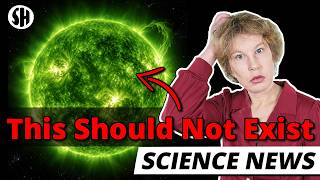
Astronomers have found a green star. It’s a white dwarf. Wait what? Stars can be green? I didn’t know this either. And not just this, they say some stars are pink, purple and turquoise. The universe is very inclusive. Let’s have a look.
[00:17]
Stars come in different colours. Some, like ours, are yellowish-white. Others are more reddish. Yet again others are white or bluish. This colour tells us how hot the surface of the star is. The longer the wavelengths, the cooler the stars. Red is on the long-wavelength end,
[00:34]
so red stars like red giants are comparably cool with a surface temperature at around 3000 to 4000 Kelvin. Our sun is yellow tending to white with a temperature of about 5 to 6000 Kelvin. The white to blueish ones are the hottest with a temperature that
[00:49]
can exceed 10000 Kelvin. Yes that’s right, blue is actually hotter than red. I’m sorry. Astronomers thought that green stars don’t exist because stars don’t just emit one colour. They emit all colours in different amounts, this is called a spectrum. The colder stars emit most
[01:05]
of their radiation in the red range, this is why they look reddish. But the hotter they get, the more evenly distributed the colours become. So the star mixes them all together, which looks white. Fun fact: Our sun actually does emit most of its light at wavelengths around green.
[01:22]
But it also emits plenty of red and blue, and together these colours look almost white to us. Oh and all these colourful images of galaxy nebula and supernova that you see: They actually don’t
[01:35]
look like this. These are usually observations in ranges of the electromagnetic spectrum that we cannot see by eye that have been shifted to make the images visually appealing. But back to the stars. Okay, these astronomers say. But wait, this entire argument that there
[01:51]
are no green stars assumes that we see all the light that is emitted from the surface of the star. And for a white dwarf, they say, that just might not be the case. A white dwarf is what remains when a star like our Sun reaches the end of its life. Then, the star
[02:08]
blows up dramatically and evaporates planets close by. Then it loses its outer layers while the core contracts and becomes very compact. It’s not a neutron star, it is just very dense atomic matter.
[02:20]
A typical white dwarf contains about the mass of our Sun in a sphere about the size of Earth. It no longer produces energy by nuclear fusion. It simply radiates away the heat it still has,
[02:32]
and over billions of years it slowly cools. But here’s the thing. These stars have a sort of atmosphere, which are clouds of gases that surround them and that are gravitationally trapped. These gases are chemical elements that the nuclear fusion of the star once produced or
[02:49]
sometimes what’s left over from the planets that once surrounded it. And the gas clouds aren’t necessarily thin. The astronomers calculate that because of the strong gravitational pull, the clouds’ density can be comparable to water on our planet. And at such high densities, the clouds
[03:07]
around the white dwarf can absorb a lot of light. It’s not just individual lines. If you look at single atoms you get characteristic absorption lines at very specific colours. But the atmosphere
[03:20]
of the white dwarf is so dense that the atoms collide all the time. And then they don’t just absorb individual lines, they cut out big parts of the colour spectrum. This is actually very similar to how earth’s atmosphere absorbs infrared light. The researchers then asked ok, but that’s the
[03:38]
spectrum. But if we were to actually look at it with human eyes what would it look like. In particular they say there’s a white dwarf about 280 light years away from us in the constellation
[03:50]
Draco. It's got a temperature of about four thousand degrees Celsius and an atmosphere that contains sodium, calcium, and lithium. The sodium absorbs much of the orange light, while calcium removes part of the violet. The light that remains has a distinctly greenish
[04:08]
appearance. It's a pale yellow-green, rather than the colour of a traffic light, but it's green. And the team found two more white dwarfs with paler greenish colours. They also
[04:20]
identified some rather more spectacular combinations. In certain white dwarfs, carbon from the interior rises into the atmosphere which makes the stars look pink or purple. Other white dwarfs have hydrogen and helium in their atmospheres which tilts them turquoise. And
[04:37]
one white dwarf, with a temperature of only about four thousand kelvin, would appear a vivid blue. That said, it is somewhat uncommon. Most white dwarfs are indeed white. It’s about 3 to
[04:51]
4 percent of them that have these odd colours. I find this a wonderful paper that I am sure will find its place in some science fiction movie scenes. It’ll be called 50 shades of white dwarf.
[05:04]
Are you someone who frequently adds mathematical equations to word documents, light presentations, educational videos, or technical diagrams? I thought you are. And I think you might want
[05:16]
to have a look at today's sponsor, Radical Pie. Radical Pie is an equation editor that produces instant professional results, rivaling and often exceeding the output quality of LaTeX. With
[05:28]
Radical Pie, adding beautiful mathematics to your documents is so easy. You can do it right through the user interface where you find a huge variety of mathematical and scientific symbols. And you
[05:40]
can use whatever fonts you want. You'll no longer waste your time trying to find the right LaTeX commands or locating an obscure package. You can adjust all the fine details like spacing, line
[05:52]
thickness, arrows, shapes, and even how much an integral leans forward. And Radical Pie also has tools that let you draw lines and shapes directly inside your equations. Visit radicalpie.com to
[06:07]
download a free trial. Use my promo code SABINE for 15% off your personal copy that works forever. Unlike most software these days, Radical Pie is sold under traditional licensing terms and does
[06:21]
not require you to pay a subscription to keep using it. Thanks for watching. See you tomorrow.