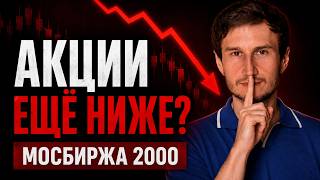

Moscow Exchange crashes to 2022 lows
42sViewers are drawn to panic-driven market crashes and predictions of further decline.
▶ Play Clip"Title matches the content — with index and stock targets delivered — but promo fluff and rambling dilute the density."
Artem Zvezd, a Russian trader since 2008, analyzes the ongoing decline of the Russian stock market. He explains the macro backdrop — including Ministry of Finance currency purchases, OPEC+ oil quota increases, inflation and the Central Bank's rate pause — and gives price forecasts for the Moscow Exchange index and individual stocks such as Tatneft, Novatek and Ozon.
The presenter, a trader since 2008, sets up the video by noting the tense backdrop and that the market is falling due to a worsening overall situation, not just one news item.
The MOEX index collapsed to 2,130 points, matching lows from late December 2022. Large buyers are in no hurry to enter, so the market may fall even lower.
From July 7 to August 6, the Ministry of Finance plans to buy currency rather than sell it, including gold worth 123.2 billion rubles (~5.4 billion per day). The Central Bank reduced its own foreign currency purchases by 4.82 billion rubles, easing pressure on the ruble.
OPEC+ agreed to raise oil production quotas for August by 188,000 barrels per day. Russia, as a member, gets more selling opportunity, but its oil is sold at a discount (Urals at $42 per barrel), which keeps hurting oil revenue.
The Central Bank earlier promised fast rate cuts, but Elvira Nabiullina reversed course, blaming the fuel crisis for higher inflation. This is bad for business and sets a negative tone for investors.
In June, total MOEX trading volume was 197.7 trillion rubles, but only 2.8 trillion came from stocks and mutual funds; 157.9 trillion was in the foreign exchange market. A thin stock market leads to high volatility.
On the Moscow Exchange, the precious metals market grew 2.8x year-on-year in June to 385.5 billion rubles, with gold turnover alone at 373.1 billion. Investors see gold as simple protection against ruble, bond and stock risks.
The Industrial Development Fund issues targeted loans at 3-5% for up to 7 years, while bank loans are around 20%. This is an admission that industrial enterprises cannot develop at market rates.
Regional real estate prices are falling by 0.1-0.2%, but the Domclick Moscow index shows prices in the capital rose 6% in May-June. The presenter calls this a bubble that is economically unjustified.
The index is near December 2022 lows and the next liquidity target is the 2,000 level. The presenter is in shorts and expects further downside, though timing is uncertain.
Tatneft hit the target of 455, but volumes are falling, indicating lack of demand at current levels, so the logic points to further movement lower.
Novatek reached its 1,000 ruble target, failed to consolidate above the psychological level, and the forecast is now updated to 768, where stronger demand may appear.
Ozon is in the 3,000 target area, with the next target at 2,500. The monthly chart suggests a global target of 1,200. The fuel crisis and weak consumer demand are pressuring the e-commerce sector.
The presenter expects the Moscow Exchange index to keep falling toward 2,000 and sees no reversal signals yet. Investors are rotating into gold, and stocks such as Tatneft, Novatek and Ozon still have lower targets, suggesting further downside.
What low did the Moscow Exchange index hit, matching late December 2022?
2,130 points.
01:44
How many barrels per day did OPEC+ add to August oil production quotas?
188,000 barrels per day.
03:52
What is the planned daily gold purchase by Russia's Ministry of Finance from July 7 to August 6?
About 5.4 billion rubles per day, totaling 123.2 billion rubles.
02:25
According to the speaker, what share of product cost is logistics chain expenses?
40-50%.
06:09
What was the total Moscow Exchange trading volume in June, and how much was in stocks and mutual funds?
Total 197.7 trillion rubles; stocks and mutual funds only 2.8 trillion.
06:37
How much did Moscow Exchange precious metals turnover grow year-on-year in June, and what was gold turnover?
2.8 times to 385.5 billion rubles; gold turnover 373.1 billion.
08:38
What interest rate do Industrial Development Fund targeted loans carry?
3-5% for up to 7 years.
10:19
How much did Moscow real estate prices rise in May-June per the Domclick index?
6%.
11:17
What is the speaker's next downside target for the Moscow Exchange index?
2,000 points.
12:26
What is the updated Novatek target after it failed to hold 1,000?
768 rubles.
18:31
What are Ozon's intermediate and global downside targets?
2,500 and 1,200.
22:36
MOEX hits December 2022 lows
Confirms the severity of the decline: the index has retraced to levels not seen in over two years.
01:44Thin market structure
Only 2.8 trillion of 197.7 trillion rubles of turnover is in stocks, explaining extreme volatility and sharp moves.
06:37Flight to gold
A 2.8x jump in precious metals turnover shows investors abandoning ruble assets for simple protection.
08:38State lending below inflation
3-5% targeted loans versus ~20% bank rates is an explicit admission that industry cannot grow at market rates.
10:19Targeting 2,000 via liquidity levels
Demonstrates a concrete technical method for setting downside targets on the Moscow Exchange index.
12:26[00:01] political and economic events, as well as some securities. Why is some securities. Why is the market falling, where will it fall and even lower? And what will happen next. In general, how things will begin, how they will end, how
[00:14] the heart will calm down. My name is Zvezn Artem Anatolyevich. I have been trading in the markets since Artem Anatolyevich. I have been trading in the markets since 2008. Qualified investor, Central Bank certificate. Here is my yield chart. Let's go. Before we get going, a quick
[00:27] [clears throat] We are Atlanteans, we are gods, we do not possess anyone, we transmit energies. And the Atlanteans told me to give you a promo code for a 15% discount on all products from
[00:43] our online school, Finzvezda. That means you can learn trading, investing, scalping, neural networks, anything at a huge 15% discount, but only until the end of this week. So, if you've been putting it off and don't have the money, but you're
[00:59] holding on, use the promo code AtL. When paying, enter this promo code, it will give you a crazy discount on all products. I say again, except for products. I say again, except for mentoring until the end of this week.
[01:13] Enter the promo code and earn. You do n't need to thank me. Say thank you to the Atlanteans, and they will thank you too. I can't do that, but anyway, it doesn't matter earn money. Well then, let's start racing. The backdrop we're currently facing is, to
[01:30] put it mildly, very tense, and the market is n't falling because of just one piece of news. It is falling because the overall situation is getting worse and worse in our vast homeland. The main story of the last few days is, of course, the
[01:44] Moscow Exchange index, which is collapsing again and hitting new lows again. We'll look at it a little later. Yesterday morning it fell to 2,130 points. These are the lows of late December 2022
[01:58] . This is the moment where such a global turnaround took place in its time. In general, we have reached the minimum. Well, I'll say it again, we'll look at it a little later. What does this mean? This means that large buyers are still in no hurry to come to
[02:12] our ACS, so the market may fall even lower. Investors prefer completely different assets, which we will also talk about a little later. I have highlighted some of these important news items. The first important news, of course, is the
[02:25] first important news, of course, is the plans of the Ministry of Finance. From July 7 to August 6, that is, for about a month, the Ministry of Finance plans to buy currency rather than sell it. Along with foreign currency, it will also purchase
[02:38] with foreign currency, it will also purchase gold worth 123.2 billion rubles. by approximately 5.4 billion rubles. per day. Taking into account that the Central Bank mirrors these positions, the Central Bank reduced its purchase of foreign currency by 4.82 billion rubles. What does this mean? In simple
[02:55] words. When the government buys foreign currency, it creates a small additional demand for that currency and thereby puts pressure on the ruble. That is, the ruble is starting to strengthen. If the volume of these purchases decreases, it means that the pressure on the
[03:09] ruble becomes slightly less. For the ruble, this is, well, a pretty good plus, but it is, of course, local, because it does not change the entire geopolitics that the Executioner created, unfortunately. Moreover, the ruble is under pressure from several
[03:24] different factors, which we will also discuss in this issue. They are not going anywhere, but this is one of the advantages that is currently allowing the ruble to strengthen a little. Let's put it this way: the decline that has begun
[03:37] to occur over the last couple of days is, of course, causing concern both at the Ministry of Finance and at the Bank of Russia, creating additional risks that no one wants to expand. In addition, a new risk factor has emerged here -
[03:52] OPEC PS. You know, my short video went viral, and my brother just told me a couple of minutes ago that the Ukrainians are saying, he called them by another word, and they’re posting you on Twitter and saying that you’re predicting the collapse of Russia. So that's what
[04:06] I said in this video. The seven countries that are part of OPEC Plus have agreed to increase their oil production quotas for August by 188,000 barrels per day. But it is important to keep in mind that people who thought that I was predicting the collapse of Russia
[04:20] apparently did not take into account the fact that Russia is a member of OPEC. If quotas are increased, then Russia, well, sort of gets an additional opportunity to sell its oil in larger volumes. But there are nuances everywhere. And here, among other things, there is a
[04:35] small nuance. The thing is that we sell oil at a discount; we sell it within a certain corridor. We also sell oil through various shadow fleets. All this has a painful impact on the price of oil itself. And now, if we look at the
[04:49] same EURs, we are already selling it at 42 dollars per barrel. This is much lower grade than brand. If the brand starts to leak, then, of course, it drags the legal entity below the
[05:01] And in this regard, the fall in oil prices, of course, has a negative impact on our country. Besides, here you also need to look at the inside. And the inside we have is the following. This is inflation and rates. And while
[05:15] our index is in decline, it is linked not only to geopolitics, but also to investors' anticipation of some kind of pause that the Central Bank will take to combat inflation. The Central Bank told us earlier that, guys, we will,
[05:29] accordingly, lower the rate at a very fast pace, and you won’t blink an eye as we give you 4-5%. I'm exaggerating, of course. And then, at the last meeting, Elvira Nabiullina came out and said, "Guys, I'm sorry, but you yourselves led
[05:43] the country to a fuel crisis. This is all driving up inflation. And you see, even Valberes is planning to raise your commission. So, you're screwed, not given a low rate." And in this regard, of course, this is very bad for business. And besides
[05:55] this, logistics costs are also rising , and the fuel crisis has already been mentioned a million times . I think we won't develop this topic. I if your product has a logistics
[06:09] chain, then almost 40-50% of it is expenses for this logistics chain. If your gasoline costs 30% more, then your product will cost at least 15% more. And given that people are already poor, losing their
[06:24] jobs, and demand is declining, a new increase in prices for goods and services will drive up inflation. Well, in general, you understand, it’s such a negative spiral. When I was at the institute, we had a saying: "I can feel it in my ass." And
[06:37] investors, obviously, what I’m telling you now, they feel it in their bones and understand perfectly well that everything is developing according to a negative scenario. Therefore, the Moscow Exchange showed the trading structure. In June, the total trading volume
[06:51] trading structure. In June, the total trading volume amounted to 197.7 trillion rubles. But of these 197.7 trillion, 157.9 are in the foreign exchange market. The futures market accounts for only 17.5
[07:05] trillion, and the stock and mutual fund market accounts for less, only 2.8 trillion rubles. You know, a year ago I interviewed Andrei Vorontsov, he changed his last name, it used to
[07:17] changing it. I even shook his hand, but still. And then he said a wonderful phrase: “It seems to me,” he said, “ that the Russian market is some kind of misunderstanding.” And so investors began to think, in much the same way, that the
[07:29] Russian stock market was some kind of misunderstanding, and that therefore the market was becoming very thin. What does this mean? A thin market has very high volatility. Today, I’m already planning to record it. I went out and looked at
[07:44] volatility in the stock market. It does n't bother him. But this doesn’t bother him, because he doesn’t buy shares. He doesn't even use the internet. If he wants to buy shares, I don’t know, through some assistants, he is
[07:57] reality, where there is no stock market, no shares, no lines for gas, he is not interested in this at all. Therefore, volatility does not interest him either. And in developed countries, a thin stock market is a real problem. Because
[08:11] if a big bag of money comes into the market , and this big bag of money, for example, flows into shorts, you immediately have a serious big drop. Just as vice versa, if this money is invested, for example, in a purchase, the market could suddenly
[08:24] make a big, serious pump, which is what we all, frankly, would like. Because for the last 2-3 years, Russian investors have been quietly collecting tears, because everything is falling, and along with it, even the
[08:38] ergonomics that we had are falling. If we talk about private investments and private investors, these private investors have now begun to move into the precious metals market. On the Moscow Exchange in June, this market grew
[08:52] Moscow Exchange in June, this market grew 2.8 times year-on-year to 385.5 billion rubles. And the turnover of gold alone reached 373.1 billion. What does this mean? This means that
[09:08] investors are looking for simple protection. They don’t believe in the ruble, bonds, or stocks. They simply buy gold and keep their money in this very thought I was the only genius and
[09:21] kept, well, almost 40% of my total portfolio in gold. That is, usually metallic gold, relatively speaking, yes. It turned out that I was not the only one who was so smart. And there turned out to be 2.8 times more of these smart ones compared to year-on-year,
[09:36] because investors understand that they will give in stocks, they will give in bonds, because business is falling and it is unclear which company will default next. I don't understand anything about shares either . In short, everyone is waiting for the denouement. What this
[09:50] Geosteg of ours did. Everyone is waiting to see how it all ends. It never it ends, we keep all our money in gold, which is what I generally wish for you. Incidentally, derivatives for the purchase of
[10:05] US government bonds and so-called dollar liquidity, that is, currency liquidity, have appeared on the Moscow Exchange. Since we're talking a bit about business and industry, the so-called Industrial Development Fund (IDF) reports that the Ministry of
[10:19] Trade expects the IDF to be capitalized in 2026. The fund issues these funds IDF to be capitalized in 2026. The fund issues these funds as targeted loans at 3-5% for a term of up to 7 years. So what does this mean? In banks, our loans are about 20%, and targeted
[10:35] loans from the state are about 3.5%. So, in fact, this is, you know, an admission that with current market rates, industrial enterprises simply cannot develop, and therefore they are forced to seek some kind of government contract, and they
[10:49] are forced to seek something so that the state will at least somehow help them. 3-5% in rubles is very little. This does n't even cover inflation, of course. But such a measure is obvious, and God grant that this measure will be widespread. And the money
[11:03] that is going away now is unclear. Well, more precisely, it’s clear where, but we are in Russia, and I’m not on the bottle yet. Here. And so that this money goes towards industrial development. Well, now let's look at the market together. The
[11:17] first thing we'll start with is real estate prices. And, you know, I read just a couple of days ago that prices in the regions began to fall very sharply, in the regions began to fall very sharply, by 0.1%, by 0.2%. Here I am opening the
[11:29] Moscow real estate index Domclick. So what is the essence of this index? It shows the price per square meter in the primary and secondary markets in Moscow based on actual transactions. We see that since May , let's count together,
[11:43] , let's count together, May and June, that is, two months, prices in Moscow have increased by 6%. Therefore, to be honest, it is not clear what 0.1% is. But on the other hand, I understand, because if we are talking about regions where people
[11:57] live on 70,000 rubles. maximum, and compare this with Moscow, where it is 200,000 rubles. get cleaners. [ __ ], I'm sorry. This is such a big gap, of course, against the backdrop of the crisis. It inflates in the capital and deflates in the regions.
[12:11] Therefore, it is obvious that prices will continue to rise. Is this economically justified? No, it is not justified. Is this a bubble? Of course, a bubble. Sooner or later it will burst, I hope not in our lifetime. Let's discover the Moscow Exchange index with you. Let me remind you that the
[12:26] last time we opened it, we expected a correction into the green zone. But this correction began to occur, that is, we clearly reached this zone and began to fall much lower. We are now at the level, as previously
[12:41] noted, of December 2022. Let's now designate this level as 2.68. This is the potential level we will reach to collect liquidity. Let's designate it here as a target level with liquidity. We will reach this level,
[12:56] that is, the 2,000 level. I think we will give it in the very near future, but it is, of course, difficult to specify timing. And at this level, of course, a question mark appears . Why does the question mark appear? Because there will be a lot of
[13:10] demand here. And if we have a serious breakdown here, if this demand is sufficient, then we may see some kind of sideways movement, a correction. In general, we'll have to see. That is to say, unfortunately, it is impossible to say in advance here
[13:23] . That we are going to this level. Let me remind you that we are still here in shorts. and Shartim is quite good. We earned a lot. May God bless each of you. Therefore, we move further to the range of approximately 2.72.000.
[13:38] If it is broken, we move and consolidate lower. Then we move to the next level of 1797. Tatneft shares, they reached our target just a couple of days ago. Our goal was 455.
[13:53] We reached our goal. We see that our volumes seem to have started to grow. Our volumes began to increase around July of 1926, but after that they began to decline. That is, investors thought that the bottom would be somewhere here
[14:06] , they bought, the market fell down, then they thought that the bottom would be somewhere here . That is, they bought at our target level , there was a rebound, but it was not enough. And now we see the same thing , but we see that there is
[14:18] no longer enough enthusiasm. Our volumes are starting to sag and fall sharply. This indicates a lack of demand at current levels, so it is logical to expect further so it is logical to expect further movement lower. The next range is 39379.
[14:33] Let's move on to the monthly chart. Let's see what we have on the monthly charts. On the monthly charts we have a classic box structure. Perhaps there is some other name for this classical structure. What is
[14:45] its essence? This essence means, in fact, such a great accumulation. It is believed that large participants in this big box are accumulating a position in order to move the price further in one direction. This is one of the theories. The
[14:59] second theory is not schizophrenic, it is more or less true. The fact is that investors don't have enough strength to buy above the range, in this case 740, and do n't have enough strength to sell below the range, in this case 500. And the market
[15:14] seems to get locked in between these two marks and starts to wobble. If the market breaks through one of the boundaries, in this case it breaks downwards, investors begin to dump their shares, because the position has been increasing all this time,
[15:27] and if the market goes up, for example, the participants who have been increasing their short positions will be forced to buy. And if it goes down, participants who have been increasing their long positions will be forced to sell, which is what we are seeing now.
[15:40] We also see how the current month opens at the marks of the previous month and opens at the tail of the previous month, that is, at the bottom. This speaks of dominant sales and dominant sellers. That
[15:54] is, when we open, we have this candle. Once again, many people write to me: "What kind of analysis is this about candles? Are you crazy or something?" Guys, there are two houses, five apartments, almost a whole fleet of cars there. I know my way around this topic, believe me.
[16:08] You can trust me. Don't trust anyone, maybe candles are essentially analyze quotes, you and I analyze prices. If our current prices open lower than previous ones, and we see the
[16:23] downward momentum increasing, this indicates negative sentiment among market participants. It's not because the candles drew something there. Candles are an indicator. We are trying to understand supply and demand. In this case, we have a lot of
[16:37] supply, which means we move further down. We had a mark where there was a lot of demand, that was 455, but there is no demand left here. That's it, he was simply eaten. So, we move further down to the 400 level. And let's watch
[16:52] Aksu Sege. It needs to be updated a little , because we have reached our goals and, in general, even broken through them. Let's open the monthly chart with you. Everything looks very beautiful here. That is, here they are directly saying that crypto is a
[17:06] scam. Yes. Let's move on to the daytime rest. We had a target forecast, which was the creation of a small sideways movement followed by a downward movement. There was no sideways movement from this point on . That is, this means that we have a lot of sales here and they are
[17:19] selling like crazy. This indicates the emergence of a very powerful seller in the market. If a security falls below the market, it is faster than the market, in general, yes, the market. This means that the market is selling off a lot, and
[17:34] this paper, more precisely, is being sold off a lot. Even Vermall wrote about this in his time . And here we clearly have a subsequent further downward movement. Let's Accordingly, we now have an increase in volume. It would be nice if this increase
[17:49] in volume would result in some small growth, something like that, followed by a downward movement, since we are in a bearish trend. If we talk about the goals that we can, in principle,
[18:03] expect to achieve, our next goal is approximately 0.35 and the next goal is 0.23. We took these targets from the Fibonacci grid. This is not a super-precise instrument, but we should at least have something to focus on, because these are, after all,
[18:18] we are dealing with technology and not fundamentals, then at least we can use the FBO as a general guide and roughly imagine, as my mother used to say, the Kingdom of Heaven, where the market will end up. Let's
[18:31] where the market will end up. Let's calculate the cubic capacity, which is approximately 0.34 023. And we can, in principle, get here. We will also update information on Novatek with you . Let us remember that we have achieved our goals. Our goal was 1,000 rubles.
[18:44] 1.23.000. We have reached our goal. Our next target, accordingly, is 768. Just like with other securities, we see a drop in volume. Moreover, we see that our market was previously
[18:58] heavily sold off on these very same volumes. Here were, ah, the shorts of a major player. This phrase has become very popular, you know, about the shorts of a big player, a big shot, an insider, and so on. To put it simply, they were
[19:12] simply selling very large blocks of securities here. We see an increase we see that we have reached a psychological level where a security moves from a three-digit value to a two-digit value,
[19:26] or, for example, from a four-digit value, as in our case, to a three-digit value, that is, from a thousand to below a thousand, right? This is a psychological level. We see that here, at this psychological level, there was an attempt to
[19:39] somehow enter into a purchase. And this whole attempt to enter into a purchase, it turned out to be which, accordingly, does not even cover the middle and does not consolidate above a thousand. The 1.000 level was accepted here. This means that we are
[19:53] moving further down. Therefore, here we will slightly update our forecast to 768. But here the level is already quite strong, and we will need to monitor this. Let's sign this as strong demand. There is
[20:08] a possibility, do you know what kind of movement? There is a possibility that we will break down, capture some liquidity and then, accordingly, move downwards. But because I am not sure about it. For now, it's most likely just a move to
[20:24] 767. Here, the movement is within the range of a decline of 16%. Well, on the short side, I think we can look for something here in futures. Ozone also needs to be updated. We also reached
[20:38] our goal. Let me remind you that our target was from the 4.200 range to the 3.660 range. A Well, as it usually happens. In fact, this review was not done. That
[20:50] 's why we are now in such a target area. This is the such a target area. This is the 3,000 target area for the security. 3.100 3.000. We see that we are experiencing a drop in volume. There
[21:03] is not enough demand here. This means that we are moving further down within the framework of the bearish trend in which we are currently located. Our next target is 2,500. And here, just like
[21:15] in the previous security, I will write that there is very high demand. Let's not get ahead of ourselves, but let's see what happens next. Unfortunately, there is no hint of any kind of stop or reversal of this decline. We had this
[21:27] candle of some kind on July 7th. So, just today I’m recording the eighth. That is, she was there yesterday. There was quite a lot of volume here, but that's all.
[21:39] Nerona wrote to me here that they're discussing Ozon and how the rate will affect consumption and marketplaces. The bullish thesis is that e-commerce continues to grow , while the bearish thesis is that money, logistics, commissions are expensive,
[21:54] consumer demand is weak, and the unit economy is at risk of deterioration. This is if we are talking about the global Ozone, which is, unfortunately, the main victim of the fuel crisis. Besides this, the main victim of the events
[22:08] that took place was the Executioner. And, naturally, Ozon's revenue will fall, just as its net income will fall. In general, both Ozon and Valbris are not going through the best of times right now. Well, including Yandex. It is clear that both the
[22:22] fuel crisis and the current events will end sooner or later. It's only a question of timing. For now we are moving further towards 2,500. maybe there is an opportunity to take on some serious longs here.
[22:36] Let's open the monthly chart with you. Well, according to the monthly charts, we will, of course, continue to fall. That is, according to our monthly charts, if you look at it, it’s 2,500 - this is even an intermediate target, because our global target is 1,200. Let's not
[22:49] how it all ends. Let me remind you that our school currently has a local discount available using this promo code. When paying, enter this promo code АЛН, and your price will be recalculated by 15%.
[23:05] You can take any product you want at our school, from investment training to scalping training, and you can also take training in Nero. In general, any choice except personal work. 15% on everything. Go ahead, explore, and
[23:19] everything. Go ahead, explore, and earn money. See you in the glass.



⚡ Saved you 0h 23m reading this? Transcribe any YouTube video for free — no signup needed.