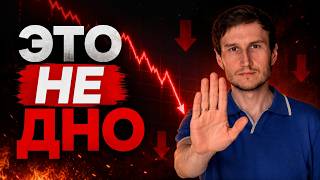

I Challenged My Haters and the Central Bank Blocked Me
60sThe creator openly admits his haters reported him to the Central Bank, making this a rare mix of personal feud and state intervention.
▶ Play Clip"The title accurately promises a bearish market analysis and delivers exactly that, despite some promotional filler and political tangents."
This video presents a bearish outlook for the Russian stock market, arguing that the bottom has not yet been reached. The author, trader Artem Zvezd, reviews the Central Bank's upcoming rate decision, the suspension of OFZ bond auctions, a widening budget deficit, and the fuel crisis, then walks through technical charts for the Moscow Exchange index and selected stocks.
Artem Zvezd, trading since 2008, introduces the video as a review of recent market events, focusing on whether the Moscow Exchange will rebound and to what extent.
Most analysts expect the central bank to keep the key rate unchanged; a smaller group sees a possible 0.25% cut, which the author calls barely meaningful.
The suspension of federal loan bond placements is a key event. The government bond index shows participants refusing current yields, believing they don't compensate for high holding risks.
The planned deficit of 3.8 trillion rubles reached 5.7 trillion in the first six months. Money is spent on defense rather than income-generating projects, raising inflation risks.
After refinery attacks, Russia faced its worst gasoline crisis and sought additional supplies from India. Higher logistics costs will be passed on to consumers, feeding inflation.
The EU failed to agree on the 21st sanctions package, keeping the oil price cap at $44.10 per barrel until July 23. Sanctions against Putin are described as symbolic.
Target zone of 1,800–2,000 was reached after a volatility spike. The index has declined for 19 consecutive trading weeks; recent two green candles are not enough to confirm a reversal.
After breaking 40 rubles, the next targets are 34 rubles and then 20 rubles. A reversal would require a move above 60; current bounces are suitable for shorts with a stop above 60.
The rebound toward 92–96 is happening on declining volumes, so the bottom hasn't been found. Buyers will likely lose money unless they intend to hold for 5–10 years.
A neutral candle at the top suggests short-term speculators, not strong buyers. Level 131 was taken, and the next target is 90.
If the central bank doesn't cut rates on the 24th, Aeroflot could drop to the 100-ruble range, forming a 'third gift bottom'. It's too early to call a reversal.
Speculators should stay aside; long-term investors without leverage can buy at current prices, but the market remains uncertain and dynamic.
In short, the author advises against aggressive stock purchases now, unless you are taking a long-term, no-leverage position with a 5–10 year horizon. Speculators should wait for clearer reversal signals, watching the Central Bank rate decision on the 24th and key support levels like 1,800–2,000 on the Moscow Exchange index.
What does Artem Zvezd expect from the Central Bank's key rate meeting on the 24th?
Most analysts expect the rate to be kept unchanged; a minority see a small 0.25% cut.
01:37
What did the Ministry of Finance do with federal loan bonds (OFZ) and why is it important?
It suspended OFZ placements indefinitely because market participants refuse to buy at current yields, which do not cover risks.
02:04
What was Russia's planned annual budget deficit versus the actual figure after six months?
The planned deficit was 3.8 trillion rubles, but it already reached 5.7 trillion in the first six months.
04:24
According to the video, how did quasi-money printing happen in 2022?
The Ministry of Finance issued bonds and asked banks to buy them using the bonds as collateral; banks later wrote off these bonds, effectively creating quasi-money.
07:01
How many consecutive weeks did the Moscow Exchange index decline, according to the author?
19 trading weeks, with one exception on May 11, 2026.
12:05
What happened to the Moscow Exchange index after the 2008 decline of 74%?
It returned in rubles to its maximum and by October 2021 grew by 788%.
11:24
Widening budget deficit
A concrete number (5.7 trillion vs 3.8 trillion planned) signals serious fiscal stress and inflationary pressure.
04:0919-week decline
A long, steady decline without a bottom is a strong bearish technical argument.
10:03Crises are followed by huge recoveries
Historical context shows 788% growth from the 2008 lows, but only over a long horizon.
11:24Rising price, falling volume
A classic technical warning that a rebound lacks conviction and is likely to fail.
16:22Long-term vs speculative approach
The author separates long-term no-leverage investing from short-term speculation, which should be avoided in a falling market.
25:14[00:02] Today we will discuss the events that have affected the last few days. What will happen next with some securities? Let's see if there will be a rebound on the Moscow Exchange. If so, to what extent? My name is Zvezn Artem
[00:15] Anatolyevich. I have been trading in the markets for 17 or 18 years, since 2008. So here's my return chart. Qual investor, CB certificate. Let's go. Before we start driving, a short announcement. And in one of the videos I asked my haters
[00:29] to write denunciations, and they did it brilliantly. The Central Bank screwed us over . The Central Bank was not happy with the fact that our website contains references to cryptocurrency exchanges operating in Russia without licenses. Oh, and since
[00:42] these cryptocurrency exchanges haven't obtained any kind of license, we, as a financial star school, are supposedly responsible for this. We are in the process of unblocking, but this will all take about one and a half to two months. Our resources are accessible via
[00:56] VPN. Using a VPN is not prohibited in Russia . Using these QR codes you can find my Telegram channel and also Telegram in Max. So please subscribe to these messengers to stay updated. And I will
[01:10] let you know when we are unblocked to allow access from Russia. Our school, like other schools, was targeted by the Central Bank due to the so- called brokers' case. You can google what this thing is. Well, in
[01:24] general, the haters did their best. Thank you very much . Well, we continue to look at the main fundamental and technical events. Let's start with the main one. This means that the market is now waiting for the next
[01:37] meeting. There will be a meeting on the key rate on the twenty-fourth. Most analysts are inclined to believe that the Central Bank will most likely keep the current rate, that is, will not ease. And the other part
[01:50] speaks of some softening, but by a small percentage, by 0.25. That is to say, it’s like a poultice for a dead man. For this reason, we do not see much demand. The most important central event that has escaped our notice, so to speak,
[02:04] Finance has suspended the placement of federal loan bonds for an indefinite period. This news just passed by in passing. Nobody paid any attention to her. Meanwhile, it is very important. That's the best way to do it,
[02:17] fellow professionals, right? Now, if we open the government bond index now, notice that we are right here. This is a weekly timeframe, meaning one candle is a week, since this is a
[02:30] government bond index, it is impossible to conduct technical analysis here. Something like this: buyers, sellers. What is much more important here is volatility, whether it is increasing or decreasing. In
[02:43] both cases, either an increase in volatility or a decrease is bad. And this is what we see now. These are the events we have. In April 2020, we had a 1% close, meaning the yield fell by 1%. In May, there was also a closure of approximately
[02:57] 1.5-2% and then things started moving. And notice what kind of drain followed. What is this connected with? This is due to the fact that market participants refuse to buy and do not agree to the yield that the Ministry of Finance is currently providing
[03:12] . And participants believe that they do not cover the risks that holding these very securities may entail. The risks here are, to put it mildly, very high. Okay, the fuel crisis has already been talked about a million times.
[03:26] One thing or another keeps exploding. And most importantly, it is unclear what will happen to the Central Bank rate. That is, as they promised us, they promised us all, that we would have a gradual easing of the Central Bank’s central interest rate throughout the entire year. And
[03:40] now we see that inflation has risen again and pro-inflationary the central bank will have to raise the rate again, and as a result, this will lead to new yields on bonds,
[03:54] which, naturally, is priced in by the market. In general, the participants say: " Friendship is friendship, but money is money." And they refuse to buy at current prices. corresponding drop in demand and an increase in the profitability that
[04:09] the Ministry of Finance can provide. Why is this very important? Because at the current moment, the hole in the budget that is happening due to the actions of Vadim Vadimovich is growing, that is, it is not decreasing and is becoming bigger and bigger
[04:24] decreasing and is becoming bigger and bigger , bigger and bigger. She already, I could be wrong, but it seems like the planned deficit, I’m reading now from official sources, the planned deficit of 3.8 trillion in the first six months has
[04:37] already reached 5.7 trillion. That is, the annual deficit that was planned has already deficit that was planned has already grown by 2 trillion rubles. It is clear that the year is not over yet. We still have at least these same 5 months ahead of us until the end of the
[04:52] year. And it will only get worse. We have a harsh winter ahead of us, naturally. Well, you understand, this will also lead to , ah, a new round of inflation. Overall, it's so-so . Here, propagandists usually like to say that there is nothing
[05:06] like to say that there is nothing wrong with this. That is, in a deficit, yes, in the debt that exists. Just look at the US national debt. There, for example, it’s the same thing , yes, you don’t need to confuse hard and soft. The US national debt does
[05:19] exist, but these are slightly different concepts. The US national debt, first of all, is owed to external creditors. This is one. And secondly, their economy is alive, and it allows them to pay off their permanent debts, and the economy is constantly growing. In
[05:33] this case, the debt structure is different. Let's compare this with ordinary life. It's one thing when you take out, for example, a loan from a microfinance organization and go to the nearest store because you have nothing to eat, and buy groceries.
[05:46] It's a different matter when you take out a loan from the same microfinance organization drive a taxi and earn money, where there's a higher you borrowed. Well, of course, in the second case, when this money brings
[06:01] you income. In our case, this money, unfortunately, does not generate income. They we have, and naturally, towards the defense budget. And if it's a defense budget, all this money goes toward military operations. Unfortunately, military action has
[06:17] not yet brought any profit, so we have what we have. At the same time, we need to calm the panic a little and say that it’s not a question of no one wanting to buy and saying: “Why the hell do we need this sovereign debt?” Of course not. We
[06:30] are talking specifically about reducing demand. That is, participants are ready to buy, but not at the yield currently offered by the Ministry of Finance, but at a slightly higher rate. There is no talk yet of any budget crisis, system collapse, or other stories
[06:45] that foreign agents will now tell you we want, I'll give you a little life hack: before everything starts to collapse, we'll see inflation rise. That is, our government
[07:01] will start printing money directly. Either directly or through indirect causes, as was the case in 2022. The Ministry of Finance issued certain bonds and asked banks to buy these bonds using these very bonds as collateral. Well, naturally, the banks
[07:14] bought out these bonds and then, in order not to compensate them or anything like that, they simply wrote off these bonds. A kind of quasi-money printing occurred, yes. The same thing could happen, but this is, of course,
[07:27] increase inflation, but it’s probably too early to talk about that. The next interesting news. Reuters reported that Russia faced its worst gasoline crisis due to the refinery attacks and even sought additional
[07:42] gasoline supplies from India. So, today the media wrote that many oil refineries have entered the stock market and started selling. There is no talk yet of fully compensating for those supplies that were
[07:57] disrupted as a result of the arrivals. And it is unclear how these arrivals will be stopped in the future. But for now we have what we have. Again, it's too early to talk about a collapse , but it's clear that the government
[08:11] is preparing for what is likely to happen and is now looking for opportunities to buy diesel fuel and, accordingly, increase purchases of gasoline. The harvest has already begun and it will only continue. You know, many people
[08:26] say: “In Russia there will be a year because there will be no gasoline.” We are in a market economy, so you will have gasoline. The question is simply about the size, and therefore the cost of this very gasoline. Exactly the same
[08:40] applies to diesel fuel, but people will not buy it for 80 rubles. or how much it costs there, and for 120 rubles. And here we go back to the very beginning, that is, to waiting for the Central Bank, because a manufacturer who has spent
[08:52] 20, 30% more on the logistics chain will naturally factor this into the chain will naturally factor this into the cost of the product and, naturally, this will affect the end consumer. Another important factor that has emerged in
[09:05] recent days is that Europe has been unable to agree on the twenty-first package of sanctions against Russia. At the same time, it
[09:19] was decided to leave the price cap on Russian oil at 4410 per barrel until July 23. That is, the discussion is still ongoing, but it is clear that the European Union will accept this sanctions package. In my opinion, by the way, they also talked about the fact that there are personal
[09:33] sanctions against Vladimir Putin himself. Yes. And I think that I don’t know, does Vladimir Putin have any foreign real estate there or what, they won’t let him open a brokerage account in Cyprus or what? Well, that is to say, it is very
[09:48] funny. This is very funny. That is, the most empty sanctions, it seems to me, are the sanctions against Vladimir Putin. What can they change? I just don't understand. OK. This is already a political question. I do n't understand politics. You watch
[10:03] Kiselev, Solovyov, you understand this. And I'm such a loser, I don't understand this. So we move on to the technical side of the issue. Let's look at the Moscow Exchange index at the beginning . Let me remind you that our target forecast
[10:17] . Let me remind you that our target forecast was a movement lower to the 2.000 level with a subsequent breakout and return, because this is where liquidity was located . And then I said that we would have to look at this,
[10:29] because there is a question mark here. We see that we have a sharp acceleration. And this sharp acceleration in volatility suggests that the market may now find a bottom somewhere. This bottom is not there yet. We see
[10:44] some kind of rebound and closing in the middle of the previous week. This gives us a good incentive to expect this bottom somewhere around here in the near future. But we won't get ahead of ourselves . OK. If we look at history, and this is a
[10:59] weekly time frame, after each acceleration we, accordingly, had a good recovery. Our market has also fallen sharply. We had a very good recovery after that. Here, in exactly the same way, the market went down,
[11:11] accelerated, and then, accordingly, recovered. Earlier in history the same thing . That is, our market is going down, accelerating, turning around, accelerating, turning around. In 2008, the market fell 74%
[11:24] 74% from its highs. And then, if we look at the Moscow Exchange index, it gives us a return in rubles up to its maximum. return in rubles up to its maximum. In October 2021, it grew by 788%.
[11:40] And then the drain started. Notice how overheated the market was. And here you begin to think that maybe all crises really are totally manageable and that this kind of slifs really began to happen precisely because of the
[11:53] dizziness from the successes that we had. However, now we see that for we had. However, now we see that for 1 2 3 4 5 6 7 8 9 weeks
[12:05] in a row our Moscow Exchange index has been going down. 10, 11, 12, 13, 14, 15, 16, 17, down. 10, 11, 12, 13, 14, 15, 16, 17, 18. 19 trading weeks. The market has been steadily
[12:18] 18. 19 trading weeks. The market has been steadily declining, with the exception of May 11, 2026. Let's move on to the daily timeframe to see what's happening. We see how the market rose quite well on June 20th, and on June 21st the market even
[12:34] opened with a positive gap, and now, at the time of writing, it continues to trade at an upward level. The last time we saw a similar situation was around October of 25, when the market was also growing quite well,
[12:49] but after that there was also a dump. The drain occurred because market participants were unable to find new demand. Can these two candles be called the emergence of such serious demand that it can stop this
[13:02] serious global trend? Of course not. Of course not. The current state of affairs does not turn around now. That is, the technical side of the issue here suggests more that we will either be in a sideways trend with a subsequent downward movement,
[13:18] or we will try to look somewhere in these target areas, we will try to find some buyer who does not yet exist. If this buyer upstairs. In general, the situation is uncertain right now, and, unfortunately, in times of
[13:33] increased volatility, when we have a surge in volatility, this is always the case. Therefore, we will now outline two forecasts. I'm already removing this arrow, because we've reached our goals. Gentlemen, there is only one scenario here -
[13:45] moment between 1.800 and 2.000. The market needs to settle down and calm down a little. And I put a question mark here , because a lot will depend on what will happen
[14:00] specifically in this side area, in this calm. The market may go further down. It will all depend on the current geopolitical situation. So at this point we're not talking about going all in on everything
[14:14] unless it's a long-term, no-leverage investment. Long-term investments without leverage, for God's sake, buy them. The price is very good. With a 5-10 year horizon, you will earn money in the short term. There is nothing for a speculator to do here yet. Let's take a look at
[14:29] the shares of the Gamas company. Let us remember that we are wearing shorts in them. Right now our market is very simple, but we have reached our target level. 40
[14:41] rubles for one security. We broke through it, the level was accepted by the system. We are now seeing entries from large participants who will lose money on this security. Let me remind you, around the summer of '25,
[14:53] here we indicated that someone had dropped off the paper. Let's sign this place so we don't forget again that the paper was dropped here. And then, accordingly, we started to drain. There was an attempt by market participants
[15:05] to make a purchase in February of 26. Participants considered the range to be 70 days. Then I said they would lose money. They lost money. We move on. And every time, buyers try again and again to touch the bottom. That was when it was
[15:20] 60 rubles. for one paper. It seemed like there was some volume, a small rebound, and then the flow went lower. Then it was 50 rubles. for one paper. Right now it's 40 rubles. for one paper. But the volumes here are, of course, significant, much more than what
[15:35] happened before, but insignificant, so that Let's narrow the chart like this to reverse this big bearish trend. Our next target is 34 rubles. for one security. If it is broken, we move further to the twenty. There are
[15:52] not enough buyers yet to move further up. There is no sign of a reversal here. A reversal can be predicted when the 60 level is broken. Therefore, the current growth can only be perceived as a way to short with a
[16:08] stop above 60. Next we move to thirty and, accordingly, with a possible correction to 21. I also wanted to look at Gazprom. You know, a lot of people wrote after the comments that Gazprom immediately went down after your release
[16:23] . Let me remind you of something. Here we had, firstly, a short-term downward slump, and after that we now expect a rebound to the 96 range, yes, that is, to this very trend line, the acceleration trend line
[16:36] . Don't forget about timings, friends. The timings are very difficult to guess. I would say that it’s even, well, practically impossible. You wait and cancel other people's impossible things, so that after some review comes out, for example,
[16:52] immediately after this the bank market will rush somewhere. And God forbid he goes in the opposite direction. What the [ __ ] are you talking about? At least someone would share their profits at least once , but if the market goes in the opposite direction, the whining immediately begins
[17:05] . I don't like such things. However , I will remind you of the forecast for Gazprom. We are in a bearish trend here. Our market is moving down. Now we can expect some kind of rebound, we expected a little bit upwards and assumed
[17:19] that if the market goes up, we have here up to a range of about 94-92. But at the same time, we see how volumes are falling during growth. This means that the bottom has not yet been found. This is not the bottom. The market is deceiving you. And everyone who buys now in
[17:36] The market is deceiving you. And everyone who buys now in the hope of making money will lose money. Unless your purchase involves purchasing this paper for 5, 10 years. If you're willing to invest for 10 years, by all means, the price is very good right now. That
[17:51] is, over a period of 10 years, I think you will be able to earn something. And if, of course, Russia remains in the form in which we have it now. Let's take a look at the Rusagro group. So, fundamentally here is a defensive
[18:04] agricultural history. During a period of high inflation and logistics, this paper may grow, that is, fundamentally. This is what the GPT chat writes about. On what basis he took this, how he determined it, is completely unclear. That is, there is no sign of a reversal here.
[18:19] Let's outline the key areas here and start, perhaps, even with a weekly time chart. So, we see that we have broken through the low, it turns out that in March 2020 we broke through it, but were unable to
[18:33] consolidate below the lows. We see how our volumes are gradually falling, and we will move on to the daily chart. This means that on the daily chart we see an increase in volume. We see a rebound from this
[18:46] bottom. We also see how here we had a bearish trend, and we had an acceleration of this very bearish trend. That is, here we have acceleration followed by a turn. And then our market accelerated in July of 26
[18:59] . There was a serious fall, and now a rebound is happening. We also now a rebound is happening. We also consolidated below 92. Well, friends, I'm not responsibility as to advise you to buy right now,
[19:13] even considering the long-term distance. That is, of course, with my own money, here’s what I would do with my own money, I would wait now from the jump and see how the market would react here, if it would mark some kind of stop in this range
[19:29] . That is, if we had a pattern like this, for example, a reversal or a reversal pattern like this, it would indicate that we have a knee, and we can then move towards the 92 range. To be
[19:43] honest, I'm not particularly confident in this analysis. Here. And that's why I would trade like that with my own money, but I'm honestly not ready to take responsibility for other people's money . So I'll write a question here. If
[19:57] a buyer appears here, and we can understand his presence by the models I have outlined, then we move further up. Here I also looked at the wheat futures. This is on an international exchange, that is, not internal, ours. Prices
[20:12] are rising quite well here. Of course, they are not growing as much as in 2022, when these sad geopolitical events took place. We had a pretty good rebound after that grow again. It is connected with the so-called Eleninho effect and,
[20:27] consequently, with the drought that is occurring in Europe. Many rivers and lakes there are already shallow and have dried up, and it is expected that things will only get worse. And next year, accordingly, farmers predict
[20:41] that there will also be hot weather with elements of drought. So, if we're talking about fundamental news, of course, everything here points to buying. the issue, then it’s clear that we have a trend movement here. Here we can
[20:56] designate a vector like this. Now we have a sharp acceleration, and a sharp acceleration in volumes. It is not enough at the current moment to break through the high and make a higher high right now. But it is enough to go further up.
[21:10] That is, we see how purchases appear, and each time the volume of buyers is satisfied. That is, there are no special sellers in the structure of this movement. This means that here we have a full-fledged formation of a bullish trend, a
[21:24] bullish tendency. And those people who say that in the future there will be very expensive products, very expensive bread, they are right. There really is a reversal here. There are indeed preconditions for a subsequent bullish
[21:39] trend here. We're already in this bullish trend, but let's consider a small pullback with a subsequent move above level 70. And the next level is 7742.
[21:54] I think we'll get there soon. Let's also look at VKontakte. There was a small rebound on VKontakte, but we see that money has started to come in during this rebound . A certain number of buyers entered here, and the subsequent
[22:10] movement is taking place at the upper boundary. The fact that we have a neutral candle right here at the very top means that buyers do not have any trivial strength. That is, short-term speculators came in here.
[22:24] Ordinary hamsters, ordinary people who wanted to make a little money, people who, well, maybe day traders, yes, they will 100% lose money. That is, if they don’t fix their longs right now, they
[22:38] will lose money, because there is nothing to indicate that there will be a subsequent reversal upwards. Rather, everything here points to a subsequent downward movement. Level 131 will be taken, it has already been taken. And the next level is 90. We can easily
[22:54] reach it. Airplane. Let me remind you that we had a potential bottom at 700. And then we marked a second bottom as a gift. It was around level 220. You can look at previous reviews and pay attention to this. We have reached
[23:10] this bottom. We see a good market reaction to the 200 level. We see that buyers have started to enter here. It is expected, of course, but now Elvira Nabiullina will lower the rate on the twenty-fourth. This will be a good
[23:24] incentive for the aircraft company. And, of course, market participants are buying in anticipation of this very key rate. Market participants, however, apparently do not look at the chart and do not pay attention to the fact that we are in a severe
[23:38] bearish trend and that we can fall even lower here. If the market starts to reverse in the near future, then our next range is 100 rubles. for one paper. I think that several factors must come together here. That is, there is a
[23:53] lot of uncertainty here right now because of the Central Bank’s interest rate. If the rate is not lowered on the twenty-fourth , and it will most likely not be lowered because there are inflationary factors that we talked about, then we
[24:06] could, accordingly, have a third bottom as a gift. It will be in the range of 100 rubles. for one paper. Let's designate here as a third bottom as a gift. The market will reach the 100 ruble range. for one paper. It is too early to talk about a reversal
[24:21] here. We see how we have a lot of volume appearing right here at the tops. And let's move on to a very short-term situation. Let's move to 3 o'clock. Yes, we see how we have this bullish trend, a
[24:34] bullish tendency that seemed to be here , and something could have manifested here, we see how our market begins to shrink and a lot of volume appears that is incomparable with what we are seeing now. Accordingly, we can
[24:48] say that here at the top, we have a lot of sales going on here. That is, the participants who apparently got stuck somewhere here, maybe right here, are starting to exit the market, not expecting anything
[25:01] good. Therefore, we will obviously now go into a slight sideways movement. That is, we will have a structure like this: the appearance of a sideways movement followed by a downward drain . This is the kind of forecast that can be made here. That is, a sideways movement followed by a
[25:14] downward movement. Friends, what we say on this channel is very see. The forecasts that I give have a very good passability. You
[25:26] see, we try not to tell you, you know, things we are not sure of, as infocygans do. Come on in, guys, let's make millions now, because I understand that every word I say will be followed by your actions. And in
[25:39] some places I don't want to take responsibility for the signals I might give. That is, signals that I myself am not sure about. The market is a dynamic thing, it is constantly changing. And between the time I do the analysis and you
[25:53] see it, even a day passes in about an hour. In this regard, we must always keep this in mind. And for this reason, we stand out from most other people who do not take any responsibility. So
[26:07] please subscribe to our Telegram channel and also to Telegram Max to stay in touch with us. It is clear that there are more materials there and more analyses and analysis. But of course,
[26:22] of course, you can make the decision yourself. Subscribe, watch, observe me, think that I am some kind of bad guy. Unsubscribe. It doesn't cost you anything , but it's very important to us at this time . Happy earning.
[26:36] . Happy earning. See you in new videos.


⚡ Saved you 0h 26m reading this? Transcribe any YouTube video for free — no signup needed.