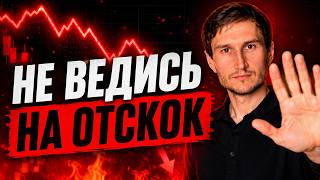

Why the Central Bank Won't Lower Rates
59sExplains the controversial reason behind the central bank's rate decision, tapping into public frustration with Nabiullina and real inflation drivers.
▶ Play Clip"Title is accurate: the video explains why buying stocks is risky, but political rants and subscribe plugs dilute the analysis."
The video argues that the Russian stock market remains dangerous to buy into because global and domestic factors have shifted against it. The speaker explains why the Central Bank keeps rates high, how geopolitical risks fuel inflation and a weak ruble, and why Asian market turbulence adds further pressure. It concludes with technical analysis of Gazprom, the ruble, oil, VKontakte, and Moscow Exchange shares.
The ruble weakened even as oil rose, signalling a shift in market demand and a deteriorating situation on the Moscow Exchange.
Inflation is rising again on both weekly and annual measures; geopolitical shocks, a fuel crisis and Ozon warehouse fires feed price pressure, so the rate will not be cut significantly at the next meeting.
In unpredictable conditions, entrepreneurs avoid expansion and park money in deposits, debt instruments, foreign currency, or move it abroad.
If the Central Bank cut the rate to 10%, the ruble could fall to 100-150 per dollar; a deeper cut could push it to 200-300.
Russian military personnel currently earn more than European and American soldiers; cutting pay before elections could provoke a military coup, so the state keeps the rate high.
Roskomnadzor blockages force businesses into downtime; entrepreneurs compensate by raising prices, and ordinary people pay the cost.
With tanker losses and insurance costs, oil margins shrink from 20% to 10%; exporters sell less foreign currency, offering no support to the ruble.
South Korean and Asian markets are falling because heavily leveraged AI companies are cracking; the drop is 6% then 9%, totalling 15%.
After the failed China gas deal, Gazprom has fallen below its 2008 lows and continues to decline.
The dollar-ruble futures price is near 80; a sustained move above the 81-85 range would signal continued upward movement.
VKontakte was removed from Apple, Google and Huawei stores; big-money shorts were visible from March, and the stock hit the Fibonacci target of 1.68, a historical low.
Moscow Exchange shares paid dividends but the gap did not close in a bearish trend, suggesting another move down to 130.
The speaker recommends staying out of Russian equities and moving to conservative instruments until geopolitical risks subside and peace talks make progress.
According to the speaker, what would happen to the ruble if the Central Bank cut the rate to 10%?
It would depreciate to approximately 100-150 rubles per dollar.
05:36
Why does the speaker say the Central Bank cannot significantly lower the rate?
Because inflation is rising due to geopolitical events, fuel crisis and warehouse fires; lowering the rate would accelerate inflation and weaken the ruble.
01:52
What happens to business investment in a 'turbulence' environment?
Businesses refuse to invest and instead put money in deposits, the debt market, or convert to foreign currency and send it abroad.
03:59
What could happen if soldiers' wages were sharply reduced before elections?
It could lead to a military coup.
07:12
What total percentage decline did Asian markets experience according to the speaker?
A 6% drop followed by a 9% drop, totalling 15%.
14:13
How does the speaker value dollar-ruble futures?
Divide the futures price by 1,000; e.g., 73,000 / 1,000 = 73 rubles.
18:51
What did the speaker say about Gazprom's price relative to 2008?
Gazprom has fallen below its 2008 levels.
15:23
What is the speaker's technical target for VKontakte stock?
Maximum rebound to 140, then decline to 110 and below, possibly 87.
24:09
Central Bank rate rationale
Provides the core macro argument for why the Central Bank cannot cut rates despite political pressure.
01:37Ruble depreciation scenario
Quantifies the direct exchange-rate impact of a rate cut, making the trade-off concrete.
05:36AI bubble cracks
Links the Asian sell-off to overleveraged AI companies, explaining a global risk factor for oil demand.
13:43Futures pricing conversion
Gives a practical trading tip for reading dollar-ruble futures quotes.
18:51Dividend gap as bearish signal
Shows how an unclosed dividend gap during a downtrend can point to further downside.
24:37[00:02] drawdown on the Moscow Exchange. Don't buy the market right now because the Global factors have changed, which we will discuss in this video, because
[00:14] this week we saw the ruble fall despite rising oil prices. This indicates a change in demand in the market and also the situation in this very market. Also in this video I will explain why the Central Bank is not cutting the rate. We'll
[00:28] look at the Moscow Exchange index, the Moscow Exchange, the ruble exchange rate, and also some securities that have piqued my interest. And along the way, we will also touch upon the Korean market, which has been falling for several days in a row. My name is
[00:42] Zvezdin Artem Anatolyevich. I have been trading in the markets since 2008. Here is my yield chart. Let's go. Before we get going , please subscribe to my Telegram channel. It is available via this QR code and also via the link in the description. In the
[00:57] era of Roskomnadzor blocking. This is very important, because even we have encountered blocks from Roskomnadzor. In Telegram, we can more or less conduct our activities normally and help you understand the
[01:10] markets. And most importantly, talk honestly and openly about what is happening . Please subscribe to the Telegram channel. Let's start with the Central Bank. Why doesn't the Central Bank lower the rate? If you
[01:23] look at any media propagandists now , they all say as one : "Elvira Nabiullina, the bastard , doesn't lower the rate, that's why we have economic destruction." Well, that means Elvira Nabiullina is to blame for everything.
[01:37] I will now explain to you why the rate is not being reduced and why it will not be reduced significantly at the next meeting on the twenty-fourth . Even if they lower it, they will lower it only a little. Last week we saw inflation on the rise. Weekly
[01:52] inflation has started to rise again. Annual inflation also increased. Some experts say that inflation is growing year after year. Inflation is not rising just like that , because there are geopolitical events taking place. This is why
[02:06] we have a fuel crisis. That’s why we have, for example, two Ozon warehouses burning right now. All this leads to an acceleration of inflation. Here is the Ozon warehouse that burned down . God bless him there, with Valberis, they will get insurance payments. But the companies
[02:22] that stored goods there faced huge losses. Many, if not all, bought this product, naturally, on credit, what will happen next? Naturally, these companies will not be able to repay these loans, or they will be able to, but
[02:36] after some time. That is, we are talking about the extension of these very loans. Not only are the loans themselves expensive, but the company is also, naturally, facing losses, and I'm not even mentioning the fact that taxes have doubled
[02:50] or tripled over the past few years. The events taking place have an inflationary factor. What does this mean? I will translate for you from economic into Russian. Here you are, a company, an ordinary one, for example, a company that
[03:04] produces underwear. Your production line takes about a month or two. Or, for example, you sell mice, right? At the time you take out a loan and start production, you must be confident that in two
[03:18] years, when your production line is up and running, you will sell your mouse. Moreover, you will sell at the same price that you set, and not at the price that the make a profit, you don’t want to trade, naturally, at a loss and you don’t
[03:33] want to receive these same losses. The most important thing is to be sure that your business is not attacked by a drone. that your key employees won't receive a draft notice or leave the country, and that your
[03:46] wages will remain the same. That is, there are many factors that you, as an entrepreneur, must take into account in conditions of so-called turbulence. In conditions where it is unclear what is happening, businesses
[03:59] refuse to invest their money in business expansion, in increasing the size of this very business. What does business do? He invests his money in deposits, in the debt market, withdraws it into foreign currency, withdraws it abroad, in general, he
[04:14] uses the tools that are available to simply wait available to simply wait out the situation. And that's okay. It 's normal for a market economy, which is what we still find ourselves in. But
[04:26] this, however, will not last long, I think. And then some infidel comes out and says: "Elvira Nabiullina is to blame for everything," or a propagandist comes out and says: "Elvira Nabiullina should lower the rate by 10%."
[04:40] Well, let's assume that Elvira Nabiullina will lower the rate there by 7, 10, or some other number of percent. What will happen next? percent. What will happen next? The economy is dried up, there is no demand from people. The
[04:52] enormous risks that exist now are only increasing. 4 years ago, 5 years ago, no one would have even imagined that the Ozon warehouses would burn because a UAV hit them . It would never have even
[05:06] occurred to anyone. There are such risks now too. As a result, money will leave the system, that is, it will leave deposits, savings accounts, and the debt market, and will simply be pumped into foreign currency or sent abroad. And so we move on. What happens
[05:21] next? Naturally, all this will increase inflation. Along with inflation, this will also affect the exchange rate of the ruble itself. And now this is the situation. Here we have a situation where the Central Bank, for example, lowered the rate there by 4.25%,
[05:36] there to 10%, as the market wants, for example. At this rate, the ruble exchange rate will be approximately 100-150 rubles. for one American dollar. That is, it will depreciate by approximately 50 or two times.
[05:50] If the rate is lowered further, the ruble will fall where, excuse the phrase, it could be. This is 200-300 rubles. for one American dollar. To hell with him, let him fall, for example, someone who is a
[06:03] because, well, what business will say that this is good? A foreign country whose capital is in foreign currency assets. Low wages will attract foreign investment, even despite the fact that we have certain types of
[06:16] sanctions. But we will go even further and look at a more global picture, yes, from the small level of entrepreneurship we will look at global things. I urge everyone to always look at the global picture and move away from any
[06:30] local worldview. We are currently experiencing military operations. These military operations involve people. These people receive wages from the state. That is, the state pays them money. pay money in
[06:44] pays them money. pay money in rubles. Taking into account the current ruble exchange rate, they receive good purchasing power for the money they receive. Today, soldiers on the line of contact are
[06:58] paid very well, even by international standards. Today, Russian military personnel receive more than military personnel in Europe. Well, taking into account all the payments, compensation, and so on, more than a military man in America. Never in history has anything like this happened
[07:12] . I think there won't be anyone who has a weapon in their hands, who receives a certain amount of monetary compensation, so-called, who has combat experience. And here, right before the elections, he finds out that instead of the 2-3,000
[07:28] dollars that he receives in 1 month, he suddenly began to receive 1,000 dollars or less than 1,000 dollars. What kind of person would like this? Well, what kind of soldier with a weapon in his hands would like this? Naturally, this
[07:43] will ultimately lead to a military coup. The state does not want there to be a military coup. And nobody wants that. I hope none of you want this. So please stop blaming Olvira, Nabiullina
[07:57] and the Central Bank. The central bank only assesses risks, and risks are created by politicians. We need to ask politicians and what they do. The Central Bank is simply a hostage to the same situations and risks in which
[08:10] we, among others, find ourselves. I'm not even mentioning the current policy of constant bans, prohibitions, blocking, and so on. when, excuse me, you are an entrepreneur, let's even take my example. So, I'm an entrepreneur,
[08:24] I have an online business, and on Friday evening I receive a message from Roskomnadzor, or rather, not from hosting: "We received a request from Roskomnadzor to block your site on Friday evening." I ask: "What is the reason?" That is,
[08:39] why do my sites, from which I earn money, pay taxes, and I pay such shitty taxes, I pay VAT and so on. Why did they decide to block my websites? To which the hosting company tells me: “We have no grounds and no
[08:53] to block it, go and check with Roskomnadzor. And at the same time, you must correct anything that violates the law on your site within 24 hours. But you can find out what exactly is violating within five days. That is, look, you
[09:08] days. That is, look, you find out what exactly your site violates, you will be told within five days. Naturally, my business as such is going into downtime. I don't pay
[09:21] taxes. So this is my example, guys. I'm just a no-name, my turnover isn't that high . But if it's some serious company, like Skillbox or some other company based on the internet, and
[09:34] Roskomnadzor comes and says: "You know, you wrote here, for example, you have an icon for some organization banned in Russia , you , you didn't include a footnote, we'll block you for a month."
[09:46] Naturally, whoever likes this, this increases the risks. What do I do after my websites are unblocked? I'll just increase the price and that's it. in order to compensate for these downtimes. Who will pay for this? Ordinary people. Am I to blame
[09:59] as an entrepreneur? Perhaps, but the real reason is Roskomnadzor, which made such demands. And the real reason is the government that does this. Well, something like that. For this reason, our ruble is falling against the
[10:12] this reason, our ruble is falling against the backdrop of rising oil prices. I'm not even talking about the so-called shadow fleet tankers, which are now either blowing up or not blowing up. In general, Russia is losing them. Today
[10:26] I read on the Internet, the GPT chat told me that we have approximately 2,500 tankers in the shadow fleet. I can’t say right now how much exactly was destroyed there, but it’s a lot. And all of this, again, must be
[10:39] compensated somehow. And again, many people are convinced that there is the Russian Federation and, accordingly, this very Russian Federation has tankers of the shadow fleet. Nothing of the kind. There are private companies such as Softcmflot,
[10:53] such as Rosneft, such as. They have tankers. These tankers are subject to certain bombings. And so you are a company, for example, Rosneft or Sovcomflot, and your tanks were blown up, for example . You have lost the means of
[11:06] production, that is, you have lost a certain profit. This means that you do not provide this profit to the state. Well, let's move on. Since the tankers are insured, the insurance company also begins to
[11:20] lose certain profits. It even involves certain costs. Well, basically, that's what they were paid for. As a result, that barrel of oil that you were transporting and that you were planning to sell there, for example, for 60, 50 dollars per
[11:34] barrel, and your margin there, for example, was 20% on that very barrel, your margin was 20% on that very barrel, your margin will fall from 20% to 10%. Because price. You must include in the cost the costs that
[11:49] arise due to military action. For this reason, even if oil prices rise, the budget may still not receive a certain amount of profit, and as a result, the ruble falls, because exporters, who were forced to sell
[12:04] a certain amount of foreign currency earnings at the time, do not receive this earnings and do not sell it, and, as a result, do not support the ruble exchange rate. Also, let me explain again. We are now faced with the fact that the state is forced to purchase gasoline, and there are
[12:20] already rumors that diesel fuel will also be purchased from abroad. And it turns out that we buy fuel at market prices, and we sell our oil, from which, in fact, this very fuel will be made, at below-
[12:34] market prices. And this is where the big difference comes in. Someone has to compensate for this difference . Naturally, the state, which has been running a budget deficit for several years now, is finding it increasingly difficult
[12:48] to compensate for all of this, more and more difficult. And, naturally, for the stock market, this is clearly a signal to exit this very stock market, sell this very stock market, close all your positions, and
[13:01] move into conservative instruments. In addition to the problems listed, another one is added. It comes from the Asian market. That's where, as they say, you know, but when you're in a room with an explosive mixture, it's unclear
[13:14] where the spark will come from. It seems like there's a spark here again, but So what happened in South Korea? The market began to fall very sharply. Moreover, this decline began to spread to all Asian markets as such. That is,
[13:28] investors are beginning to assess global demand for metal and oil more and more negatively. other raw materials due to the fact that all of this will not be needed due to the decline that we are experiencing now. The reason is that it seems that the
[13:43] The reason is that it seems that the markets, there were some serious, generally speaking, PVDRs, that is, serious companies amount of money in artificial intelligence. And it seems that these very
[13:59] companies are now starting to crack, they are starting to crumble very badly. The reason is that these companies were heavily leveraged . And investors have inflated this bubble so much that the current decline, and we had a
[14:13] decline, it turns out, of 6% a few days ago, and before that of few days ago, and before that of 9%, a total of 15%. It doesn't seem like a disaster yet. If we look at the Russian market, it has fallen by 60% over the
[14:26] last year and a half to two years. However, we are in the process, and this could have a painful impact on subsequent events, in particular on the demand for oil that we have. And so we have this geopolitical situation in
[14:41] Asia. We are beginning to experience a crisis, and as a result, demand for energy resources is falling. On the other hand, we have problems with logistics and sanctions. As a result, we cannot sell our resources to either the Asian or the European
[14:55] market. And besides this, the deal between Gazprom and China fell through. It's like everyone's telling us: "We don't give a damn about these Americans, we're going to [ __ ] China now ." China said: "Well, guys, so to speak, you have this
[15:10] very bowl of rice that you're talking about. We can buy this bowl of rice , but several times cheaper, and even then, you know, just squinting, basically. In general, China, apparently, is screwing us. And screwing us,
[15:23] apparently, quite seriously with the gas projects that exist. And in this regard, Gazprom has already fallen below the 2008 levels. We, of course, will now take a closer look at it. Wherever you look, everything is bad. That is, it is
[15:37] not even clear how we will get out of this. That is, everything is bad. It is not clear from which side to even approach it. It is not clear, that is, where this thread of drowning man. It is not clear. The only thing that can save us is peace talks.
[15:54] Here, I think that you understand politics better. You are subscribed to Solovba, to others Propagandists. You understand politics, and I'm like I don't understand it. So, of course, you can write to me in the comments.
[16:07] Well, let's move on to the technical side of the question. Let's talk about Gazprom, let's look at Gazprom right away, and then we'll look at the ruble exchange rate. So, we've seen a drop below 2008 levels. We're in
[16:20] the process of falling, and we see our volumes falling. I opened FinamTYD here to see what historical lows there are. But here's the historical low, we've broken through it, so we'll move on to TradingQue.
[16:34] So, we were planning a long-term sideways movement above 100135, breakout. At the moment, this short-term breakout, which we expected to happen, has begun to happen , but
[16:49] geopolitics is getting in the way, and this short-term breakout may be turning into a long-term one. If we look at On the daily timeframe, we see that our volumes are somewhat worse, similar to those volumes that subsequently
[17:02] trigger a reversal. But at the same time, we see that we are in the process of falling. Currently, it's July 18th, Saturday, a trading weekend. I still can't get used to the fact that our exchange is open on weekends
[17:17] . I can't get used to it. We're opening inside a bearish candlestick. This indicates that we have a serious negative bearish trend. So far, there's no stopping candlestick or calming candlestick. That means
[17:32] we're in the process of falling. If we switch to the weekly timeframe, it's the same on the weekly timeframe: we haven't calmed down at all, we're in the process of moving. This means we could fall even lower.
[17:44] And if for some reason we have a short-term rebound, we can expect it from this trend line. That is, the range is approximately 96, that is, less. 100, 9496. Well, depending on what
[17:59] levels we catch this instrument at, with a probable subsequent downward movement. At the moment, we have the following situation. The long-term sideways movement that we
[18:11] had here, let's change this forecast and remove it altogether, so that it doesn't get in our way here. At the moment, we are trending downwards, with the only question: where is the stop now? Where will the bottom be now? So,
[18:26] if we are talking about buying an instrument for the long term, that is, specifically in an investment scenario, then from an investment perspective, the price is actually very interesting. If we
[18:38] buy for the long term, it's very interesting. But if we take the short-term situation, in the short term, we could see a decline here further . So far, nothing indicates that we have any kind of stop. Let's look next at the dollar-ruble futures. Well, that is, we'll
[18:51] look at the ruble exchange rate. Let's look at it on the futures. So, if you don't trade futures, simply divide the value by 1,000. For example, 73,000 at 1,000. That would be 73 rubles. So, what do we have here? We have an upward movement and a
[19:05] drop in volumes. This drop in volumes against the backdrop of the market rising upwards indicates that we are now in a pullback structure. Well, seeing this pullback? Yes, that is, in relation to what? After all, pullbacks only occur in
[19:19] trend structures. And where is this trend structure? We open the chart further. We see that there is a downward trend structure here, but it has exhausted itself. Therefore, we understand that we are in a bullish trend structure. That is, we have an
[19:32] example of an emerging trend. There is a nuance here. This means that at the moment, we have come close to this trend line. We do not see an increase in volume here. We see that after the increase in volume, an upward surge has begun to appear again. We
[19:46] laid out the main key forecast here - a movement beyond the 100-kilometer mark. Our key levels here were 79. And 80. We see how we're approaching 80. We're seeing volume emerging, but the movement is still
[20:00] interpret it in one way. There's more demand than supply in the market right now. This suggests that we're seeing a full-fledged reversal toward demand, meaning further upward movement. The only thing is, we need to look at the reaction in the range of
[20:14] this trend line, specifically in the 818500 range. Here, we'll see what the reaction will be. And if there's a breakout, we'll move further toward the water. If the reaction here is negative, if a seller appears
[20:29] at this point, then we'll see a subsequent movement near the upper boundary, followed by an upward surge. So, for now, we're talking and expecting only upward movement. But I repeat, this isn't a long-term situation; it's
[20:45] purely momentary. In the long term, everything will be determined by geopolitics. Let's look at Brand grade oil now . As a reminder, we have Eurs grade oil. We're looking at Neft grade oil now. Brand. EURS and the brand
[20:59] differ in value, and also in some movements. We see a decline in volumes now, meaning oil prices are starting to slowly fall. We have an upper limit, meaning we had a very large accumulation
[21:12] formed between March 26 and June 26. We exited it . Naturally, we exited due to geopolitics. We are starting to approach here again, and we see how we are approaching on falling volumes.
[21:25] This indicates that there is currently no serious demand in the market there is currently no serious demand in the market forcing us to go higher. But this demand now in the Ormur Strait area. What
[21:40] can we expect here? At the moment, we are in the process, so we expect an upward movement with the potential for a sideways movement and a possible downward movement. This is the first scenario. The second scenario is a movement into this accumulation. Here, a
[21:54] point of some kind of balance is found, followed by an upward movement. Let me remind you that we are still currently in the area of rejection of upper prices. This area was marked here. That is, we are in the structure of such a
[22:09] large bearish decline, but this bearish decline has not yet formed, and we are looking for this nearest demand level , at which the market will now begin to tilt in the opposite direction again and begin to reverse. Let's look at the
[22:24] VKontakte stock. Let me remind you, the VKontakte stock was this week, and in general, the VKontakte app was removed from all available foreign stores, like the available foreign stores, like the Apple Store, Google Play Market, and
[22:38] Huawei also has its own Play Market. Something there, too, is generally unavailable now. If you look at the top left screen, it says the international company PowerO VK, that is, the question of
[22:52] whether this company is international is now in question. Let me remind you, in March of 26, we said that at the top, here, there are clearly shorts of large amounts of money. That is, someone was selling a security here. We then We did
[23:05] n't yet understand what it would be connected with. Then we found some local demand, and the market went sideways. Then the main demand, the market found it here. And when they started blocking the application, it became clear
[23:17] where the insight came from, who was really selling. That is, it became clear that there really were big money shorts here . And the reason why this big money was exiting this security became clear. We then set a target of
[23:30] 1.68 on the Fibonacci retracement. We reached it. This is a historical low. We see how the market has calmed down a little at the moment . It is essentially in the wick of the previous candles. It's not about the candles, of course. The point is that
[23:43] retail traders are obviously entering the market now. We are seeing an increase in volume, with people buying at 123, at 131. be dismissed. That is, they will lose money, that's for sure , because
[23:56] the structure here still indicates that the bottom has not been reached. Found. We see an increase in volume, but we don't see any confirmation for this reason. It's definitely shorts here. The maximum rebound is to 140, followed by a further decline to
[24:09] 110 and below. We now have a wave here. Let's attach to wave here. Let's attach to this wave. We could see a move to 87 if we fall further. And let's look at Moscow Exchange shares next.
[24:23] We reached 139, meaning we've taken our profits. And for now, we're still falling. Moscow Exchange paid dividends here. We see how a dividend gap opened and didn't close. We had a dividend gap
[24:37] during a bearish trend. This indicates a fairly significant decline. Therefore, we expect a further move down to 130. We put a question mark here . Well, once again, I urge you to subscribe to my Telegram channel.
[24:50] See you in the next episodes. Good luck. Earn money.


⚡ Saved you 0h 24m reading this? Transcribe any YouTube video for free — no signup needed.